Hoyt vs Mathews Compound Bows: How to Choose by Fit and Use
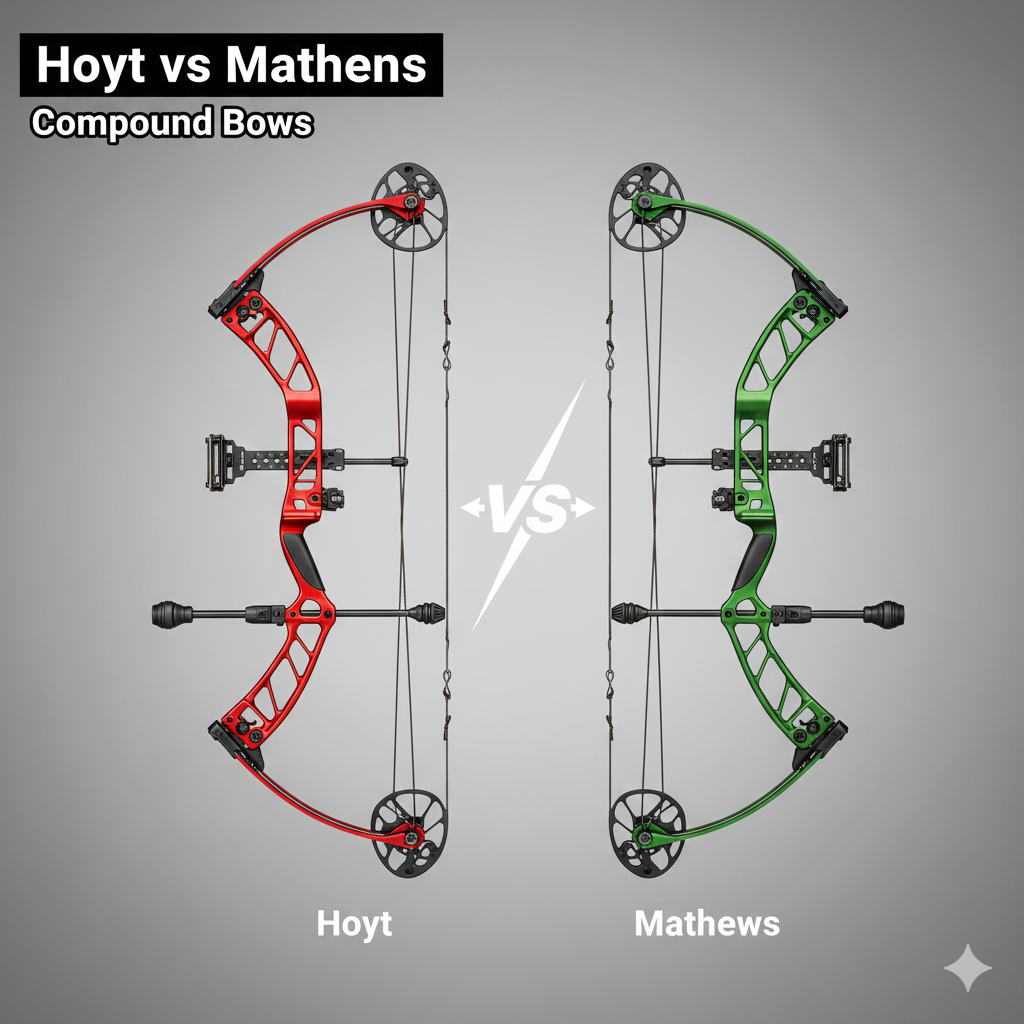
Hoyt and Mathews are two of the most respected names in compound archery, and neither one is a universal winner. Both build accurate, well-engineered bows for hunting and target shooting, so the better brand for you depends on how a bow fits your hand, how it feels at full draw, your shooting goals, and your budget. The most reliable way to choose is to shoot both at a pro shop and let your own draw cycle and grip preference decide, not a spec sheet or a brand reputation.
Quick answer
Pick the bow that feels best in your hands and shoots most consistently for you, regardless of the name on the riser. Hoyt and Mathews both have loyal followings, strong build quality, and full lineups that span entry-friendly to flagship models. The right choice comes down to fit, draw cycle, intended use, and what your budget allows after you add arrows, a rest, a sight, and a release.
There is no single best brand
Two skilled archers can shoot the same target equally well with a Hoyt or a Mathews. Brand loyalty in archery is real, but it usually reflects personal fit and habit more than a measurable accuracy gap. Treat both brands as strong starting points and let your own shooting confirm the choice.
What each brand is known for
Both brands have long reputations in competitive and hunting archery, and both invest heavily in riser design, cam systems, and dampening. The general reputations below are broad tendencies, not promises about any specific current model. Check the maker’s official model pages and independent archery instruction resources for current specifications before you decide.
Hoyt
Hoyt has a long history in both target and hunting archery and is often associated with solid riser construction and a strong presence on competition lines. Many archers describe Hoyt bows as feeling stable and dependable at full draw. You can review the current lineup and specifications on the Hoyt website.
Mathews
Mathews is widely known among hunters and is often associated with smooth-shooting single-cam heritage, quiet operation, and tunable cam systems on its newer models. Many hunters value the brand’s focus on noise reduction and a settled shot. The current lineup and specifications are listed on the Mathews website.
Why reputations only go so far
Both companies update their bows often, so a strength people associate with one brand can show up in the other’s next release. Reputation is a fine way to build a shortlist, but it should never replace shooting the actual bow you plan to buy.
Cam systems in plain English
Most of the “feel” difference people attribute to a brand actually comes from the cam system, so it helps to know the vocabulary before you walk into a shop:
- Single cam (solocam): one power cam and one idler wheel. Historically associated with Mathews, it is quiet and simple but can be fussier to tune for arrow-to-arrow consistency at longer distances.
- Hybrid and binary cams: two cams linked by control or slave cables so they roll over together. Both brands have used two-cam designs in recent generations, and they generally hold nock travel well and time up predictably.
- Modular draw length: the draw length is set by swapping or rotating a module rather than changing the whole cam. This is the norm on current flagships from both makers, and it is a big reason a used bow can often be resized to fit you.
- Draw-weight modules: some designs change peak weight by swapping a module instead of backing limb bolts out, which keeps the bow at full limb preload and preserves the draw feel.
In practice, a shooter who says “Mathews feels smoother” or “Hoyt feels more solid on the wall” is usually describing a specific cam generation, not the brand as a whole. Ask the shop which cam a given model uses and how much of the draw cycle can be adjusted before you decide the feel is a brand trait.
Hoyt vs Mathews at a glance
Use this as a shortlist builder, not a verdict. Every row is something you can verify on the model you are actually considering.
| Consideration | What to look at on a Hoyt | What to look at on a Mathews | Why it matters to you |
|---|---|---|---|
| Typical reputation | Rigid riser feel, strong target-line presence | Quiet shot, dampening focus, hunter following | Sets expectations only; verify by shooting |
| Draw cycle | Ranges from smooth to more aggressive by cam | Often described as settled and even | Determines how repeatable your shot is |
| Grip | Distinct riser grip shape; aftermarket options exist | Distinct grip philosophy; aftermarket options exist | Grip torque is a top cause of left/right misses |
| Draw-length adjustment | Usually modular; range varies by model | Usually modular; range varies by model | Matters for growing archers and resale |
| Noise and vibration | Riser and limb dampening packages | Heavy emphasis on dampening hardware | Critical for treestand and ground-blind hunting |
| Axle-to-axle options | Short hunting rigs through long target bows | Short hunting rigs through long target bows | Shorter is handier; longer is steadier |
| Price tiers | Flagship plus more affordable lines | Flagship plus more affordable lines | Budget should cover accessories too |
| Dealer network | Widely stocked; confirm locally | Widely stocked; confirm locally | Local service beats a spec advantage |
A common mistake is treating a table like this as the decision itself. Two bows can look nearly identical on paper and feel completely different the moment you come to full draw, which is exactly why the shop visit stays non-negotiable.
Fit, grip, and draw feel
Fit is the single most important factor when choosing between two quality brands. A bow that matches your draw length, draw weight, and grip preference will be easier to shoot well than a higher-spec bow that fits poorly. This is where personal differences between Hoyt and Mathews matter far more than marketing.
Draw length and draw weight
Your draw length should be measured by a knowledgeable shop, and your draw weight should be a load you can pull smoothly and hold under control, not the maximum you can yank back once. A bow set to fit you will feel more comfortable and shoot more consistently across both brands.
How draw length is actually measured
The quick wingspan estimate — arm span in inches divided by 2.5 — gets you within about an inch, which is close enough to start a conversation and nowhere near close enough to buy on. A proper measurement is taken at full draw with a draw-check arrow while you hold your normal anchor and release, because your anchor point, head position, and release aid all shift the number.
Signs your draw length is wrong are easy to feel once you know them: a bow that is too long pushes your bow shoulder up and forces you to lean back, and your string hand ends up floating past your face with no solid anchor. Too short and you feel cramped, your bow arm bends, and your groups open up under pressure. Half an inch matters more than most people expect. Re-check it any time you change release aids, since a hinge or thumb button often adds effective length compared with a wrist strap.
Grip shape and hand torque
Grip shape varies between brands and between models, and a grip that suits your hand reduces torque and helps your shots group. Some archers strongly prefer one brand’s grip the moment they pick it up. That instinct is worth paying attention to during a shop visit.
Left-hand, youth, and smaller-frame fit
Not every model in either lineup ships in a left-hand version, and the ones that do can be back-ordered longer, so left-handed archers should confirm availability before falling in love with a particular bow. Determine eye dominance first — a right-handed shooter with a strongly left-dominant eye is often better served shooting a left-hand bow than fighting the mismatch forever.
Smaller-framed adults, youth archers, and many women shoot better on models with short minimum draw lengths and a low bottom end on the weight range. Both brands offer bows that adjust down further than their flagship hunting rigs, and there is no accuracy penalty for a 45-pound setup with the right arrow. Start lighter than you think you need: form built at a manageable weight transfers up, while form built while straining almost never does.
The draw cycle
The draw cycle is how the bow feels from the start of the pull through the back wall. Some archers prefer a smoother, more forgiving cycle, while others want a more aggressive, speed-oriented feel. Neither is better in the abstract. The right cycle is the one you can repeat the same way, shot after shot.
Tuning and adjustability
Tuning is what turns a good bow into a bow that shoots well for you. Both Hoyt and Mathews offer adjustable systems on many current models, and a quality pro shop can set draw length, tune the rest, and time the cams. The brand matters less than the setup and the support behind it.
Shop and support availability
Consider which brand your local pro shop stocks and services. A dealer who knows the brand well can tune the bow, order parts, and help with adjustments over time. Strong local support can be more useful than a small spec advantage on paper.
Adjustment range as you grow
If you are still building strength or expect your draw length to change, ask about each model’s adjustment range. A bow that adjusts across a range can grow with you, while a fixed-spec setup may need module or limb changes. Confirm the specifics for the exact model with the shop or the maker’s manual.
Strings, cables, and service intervals
Strings and cables are wear items on any brand. Peep rotation, serving separation, fuzzing strands, and a peep that no longer lines up are all signs the string has crept or is on its way out. Most serious shooters replace strings every year or two depending on volume, and a high-volume target archer will go through them faster than a hunter who shoots a few dozen arrows a month.
Between replacements, keep it simple:
- Wax the string and cables lightly every few weeks of shooting, avoiding the servings.
- Check cam lean and timing marks before the season and after any hard knock or fall.
- Inspect limbs for cracks or splinters in good light, especially near the limb pockets.
- Never dry fire, and never let anyone “just pull it back” without an arrow nocked.
- Have the bow pressed by a shop rather than improvising, unless you own a proper press and know the model’s limb type.
Corrosion is less of a concern on a bow than on a firearm, but the same habits carry over: the discipline behind keeping steel free of surface rust on your rifle is the same discipline that makes you check hardware on your bow before opening day rather than after a failure.
How to read a compound bow spec sheet
Spec sheets are useful once you know what the numbers do and do not tell you.
- Axle-to-axle (ATA): the distance between the cam axles. Short bows (roughly 28–31 inches) are handier in a blind or tight stand; longer bows (33 inches and up) generally hold steadier and are more forgiving of form errors. Target rigs often run longer still.
- Brace height: the distance from the string to the deepest part of the grip. Lower brace heights usually mean more speed and less forgiveness; higher brace heights are gentler on imperfect form. Most hunting bows land in the 6-to-7-inch neighborhood.
- Let-off: the percentage of peak weight the cams remove at full draw. High let-off is easier to hold; some archers prefer slightly less let-off for a more defined back wall and better shot control.
- Mass weight: the bare-bow weight. It matters most if you carry the bow for miles, but a heavier bow often holds steadier — this is a genuine trade-off, not a flaw.
- Rated speed: measured under standardized lab conditions with a long draw length and a light arrow. Your real-world speed will be lower. As rough rules of thumb, expect to lose roughly 10 fps per inch below the rated draw length and about 1 fps for every 3 grains of extra arrow weight, plus a few fps for peep, nocking loop, and other string gear.
The practical upshot: two bows within 10 fps of each other will not change your hunt, but a bow that holds still while you aim absolutely will. Chase forgiveness and fit first, speed last.
Hunting vs target use
Your intended use shapes which features matter most. A hunting setup and a target setup pull a buyer toward different priorities even within the same brand, so define your main use before you compare models.
Hunting priorities
For hunting, many archers value a quieter shot, a manageable mass weight for carrying, a forgiving draw cycle, and a bow length that handles well from a stand or blind. Both brands offer hunting-focused models that aim at these traits, so compare the actual bows rather than assuming one brand owns this category.
Target priorities
For target archery, archers often favor a longer axle-to-axle length, a stable hold, and a setup that rewards a consistent form. Both brands compete on target lines, so again the better choice is the one that holds steady and repeats well for you.
Matching the bow to the animal and the terrain
The animal matters less than most buyers assume; the terrain and shot presentation matter more. A whitetail hunter sitting a 20-foot ladder stand over a food plot can shoot a short, light, quiet bow at moderate weight and be perfectly equipped. An elk hunter covering steep country all day will feel every ounce of mass weight, and a mountain hunter working long approaches on foot has different priorities again — the same calculus that goes into choosing a pack for hauling meat and gear off a mountain applies to choosing how heavy a bow you want strapped to it.
Check your state’s minimum draw weight and broadhead rules before you settle on a setup. Requirements commonly land somewhere in the 35-to-45-pound range for deer-sized game, with some states adding arrow weight or broadhead width rules, and they do change. Your state wildlife agency is the authority; federal land and refuge hunts may add their own conditions, which the U.S. Fish and Wildlife Service publishes for the units it manages.
3D, bowfishing, and mixed use
If you plan to shoot 3D in the off-season, a bow that is a touch longer than a pure treestand rig will pay you back on unknown-distance targets, and both brands sell models that split that difference well. Bowfishing is the one use where you should not take your flagship — a dedicated cheap rig set to low weight with a reel mount saves your good bow from water, mud, and the eventual fish that runs the arrow under a log.
Budget and value
Both brands span a range of price points, and the bow is only part of the total cost. Plan for arrows, a rest, a sight, a release aid, a quiver, and a tuning session, because those accessories turn a bare bow into a shootable setup. A complete, well-tuned mid-tier setup often outperforms a flagship bow with mismatched gear.
Flagship vs value models
Flagship models carry the newest features and usually the highest prices, while each brand’s value-oriented lines can still shoot very well for most archers. If you are newer to archery, a well-set mid-priced bow with quality accessories is often the smarter use of a budget than the top model with leftover funds for gear.
Resale and longevity
Both brands tend to hold value reasonably well on the used market, which can ease the cost of upgrading later. A quality bow that fits you and gets serviced can last many seasons, so think about long-term use rather than only the sticker price.
What a realistic complete setup costs
Budget by system, not by sticker price. A workable allocation looks roughly like this:
- Bare bow: the largest single line item, and the one people over-weight.
- Sight: worth real money. A bright, rigid, well-marked sight is the accessory you look through on every shot.
- Rest: a quality drop-away or a well-tuned blade; cheap rests cause more tuning headaches than any other component.
- Arrows: a matched, properly spined dozen with consistent components. Under-spent arrows will cap your accuracy no matter what riser you bought.
- Release aid: buy for the shot execution you want, not the price tag — a good release is the closest archery equivalent to clean trigger work, and the same pressure-and-follow-through discipline that decides rifle accuracy decides where your arrow lands.
- Stabilizer, quiver, case, and a paid tuning session.
Plan the accessories at roughly the cost of the bow itself for a serious setup. If that math forces a choice, drop a tier on the riser and keep the sight, rest, and arrows intact. It is the version of the setup you will shoot better.
When to buy: model-year timing
New flagship models are typically announced in the late-year cycle, with dealers stocking them through winter and into spring. That creates two predictable buying windows: the weeks after a new lineup lands, when last year’s flagship is discounted while remaining an excellent bow, and the post-season stretch when shops clear inventory. If you are assembling a whole kit at once, the late-season discount stretch is usually where accessory dollars go furthest. Buying a one-year-old flagship at a discount is one of the best value moves in archery — the bow did not get worse when the catalog page changed.
Why you should shoot both first
Shooting both brands at a pro shop is the step that settles the decision. If you are newer to compound bows, it also helps to review our recurve vs compound bow guide before comparing premium brands. Specs and reviews can build a shortlist, but only your own hands tell you which grip, draw cycle, and balance feel right. Ask the shop to set each bow close to your draw length and weight so the comparison is fair.
What to pay attention to
How smooth the draw feels from start to back wall.
How the grip sits in your hand without forcing it.
How steady the bow holds while you aim.
How the shot feels and sounds at release.
How balanced the bow feels when you hold it out.
A 30-minute in-shop test protocol
Walking in and pulling a few bows at random tells you very little. Run the same sequence on every bow and the differences become obvious:
- Have your draw length verified first, before you touch a single bow, so every rig is set the same.
- Ask for both bows at the same weight — comparing a 60-pound Hoyt to a 70-pound Mathews tells you nothing about either.
- Draw each bow three times without shooting, eyes closed on the third rep, and pay attention to where the hump falls and how defined the wall feels.
- Hold at full draw for 20 seconds. Any bow feels fine for two seconds; fatigue reveals the balance and grip problems.
- Shoot five arrows at a close bag with your own release if you have one, ignoring where they land and focusing on how the shot feels and sounds.
- Shoot five more at 20 yards and only then look at the group.
- Swap back to the first bow for two final arrows. The second impression is more honest than the first, because novelty has worn off.
- Write down one sentence per bow before you leave. Memory blurs after two hours; notes do not.
If you are traveling to a bigger shop to do this, it is worth folding into a broader pre-season readiness plan so one trip covers the bow, the tune, and anything else on your list.
Bring your own benchmarks
If you already own a bow, note what you like and dislike about it before the visit. Comparing each new bow against your current setup makes the differences easier to feel and helps you avoid buying on brand name alone.
Setup and safety basics
Whichever brand you choose, a safe setup starts with a proper fit and a careful tune. Have a qualified shop set draw length and weight, inspect the string and cables, and confirm the rest and nocking point before you shoot at distance. For general archery safety and instruction resources, organizations like USA Archery and World Archery are good starting points.
Follow the manufacturer manual
Maintenance intervals, recommended draw-weight ranges, and approved accessories vary by model, so follow the manual for your specific bow. If you hunt, equipment rules such as minimum draw weight can vary by state and season, so confirm the current requirements with your state wildlife agency before you head out.
Range and field safety habits that carry over
Compound bows are quiet compared with firearms, but the range around them often is not — if you practice at a mixed facility or sight in a rifle the same weekend, treat hearing and eye protection at the range as standard kit rather than an afterthought. In the field, the biggest archery-specific risk has nothing to do with the bow at all: it is the climb. A rated harness with a lifeline, used from the ground up, is the single cheapest life-saving purchase a bowhunter makes, and choosing a properly rated fall-arrest system deserves as much research as choosing between two risers.
Two more habits worth building early: always raise and lower the bow on a haul line with an arrow off the string, and never nock an arrow until you are clipped in and settled. The Archery Trade Association also maintains dealer and industry resources at the Archery Trade Association if you want to confirm that a shop is an established member of the trade before you hand over a bow for service.
Common mistakes when choosing between Hoyt and Mathews
- Buying too much draw weight. The most common error by a wide margin. If you cannot draw the bow straight back while seated without pointing it at the sky, it is too heavy — and it will be heavier still on a cold November morning in a coat.
- Deciding from a spec sheet. Speed ratings and paper specs sell bows; fit shoots them.
- Shooting two bows set to different weights or draw lengths. The comparison is meaningless, and you will credit or blame the brand for the setup.
- Spending the whole budget on the riser. A flagship with a bargain sight and unmatched arrows is worse than a mid-tier bow with good components.
- Ignoring the local dealer. A brand nobody near you services means every tune becomes a road trip.
- Letting a friend’s loyalty decide. Their hand is not your hand. Their anchor is not your anchor.
- Skipping the follow-up tune. New strings settle in the first few hundred shots; a second visit after break-in is normal, not a defect.
Scouting and season prep beyond the bow
Choosing between two excellent bows is a satisfying problem, but it rarely decides whether you fill a tag. Time on target and knowing where the animals are decides that. Running remote scouting units on travel corridors through late summer tells you more about stand placement than any cam system ever will, and a broader look at your full season kit list will surface the gaps — rangefinder, boots, wind checker — that actually cost people shots.
If your ambitions run bigger than a home woodlot, understand that bow hunts in demanding country are a different discipline again; the physical preparation behind something like high-country hunts abroad matters more than the last 5 fps on a spec sheet. And if you find that the draw-and-hold cycle simply does not suit your shoulder or your hunting style, it is worth honestly weighing how a horizontal rig compares before you spend flagship money on a bow you will not practice with.
Frequently asked questions
Is Hoyt better than Mathews?
Neither is better for every archer. Both build accurate, high-quality compound bows. The better brand for you is the one that fits your hand, draws smoothly for you, and suits your hunting or target goals after you shoot both.
Which brand is better for hunting?
Both offer strong hunting models. Hunters often weigh noise, weight, and a forgiving draw cycle. Compare the actual bows you are considering rather than assuming one brand wins the category.
Do I really need to shoot both before buying?
It is the best way to choose. Fit, grip, and draw feel are personal, and a short session at a pro shop usually reveals a clear preference that specs alone cannot.
Is a flagship bow worth it for a beginner?
Not always. A well-tuned mid-priced bow with quality accessories often serves a new archer better than a flagship with leftover budget. Spend on fit, tuning, and good arrows first.
Is one brand noticeably faster than the other?
Not in any way that changes outcomes. Flagship hunting bows from both makers land within a handful of feet per second of each other at the same rated conditions, and your draw length and arrow weight will move the number far more than the badge does. Choose the bow you can hold steady, then build speed with a properly spined arrow rather than a lower brace height you cannot shoot well.
Can I buy a used Hoyt or Mathews safely?
Yes, with conditions. Confirm the model’s draw-length range includes your measurement, budget for a new string and cable set unless the seller can document a recent replacement, and have a shop inspect the limbs, cams, and axles before you shoot it. A used one- or two-generation-old flagship from either brand is often the best value in archery. Walk away from any bow with limb cracks, bent axles, or a history of a dry fire.
Do both brands have good warranties?
Both offer strong limited warranties to the original owner on the bow’s core components, and both handle claims through their dealer networks. Coverage terms, transferability to a second owner, and what counts as user damage differ, so read the current warranty text on the maker’s own site and register the bow at purchase rather than relying on what a forum post said.
Do I need a bow press to own one of these?
Not to shoot one. You need a press to change strings, adjust cams on some designs, or install a peep properly, and both brands have models with specific press requirements. Unless you shoot high volume and intend to learn the process properly, let your dealer handle press work — an improperly pressed bow can be damaged in seconds.
What draw weight should I start with?
Start with a weight you can draw smoothly while seated, without hitching or sky-drawing, and hold for 20 seconds at full draw. For many adult men that is 50–60 pounds to begin with, and for many adult women and youth archers 35–45 pounds. Strength builds quickly once form is established; bad habits built under strain do not go away as easily.
How often should I re-tune the bow?
Check paper or bare-shaft tune at the start of each season, after any string or cable change, after switching arrow or broadhead setups, and any time your groups open without an obvious form cause. New strings should be re-checked after the first few hundred shots as they settle.
Final takeaway
Hoyt and Mathews are both excellent, and the right answer is personal. Build a shortlist from each brand’s current lineup, then go shoot them set near your draw length and weight at a pro shop. Choose the bow that fits your hand, draws smoothly, holds steady, and matches your use and budget. A quality bow that fits you, tuned by a shop you trust, will serve you far better than a brand badge.
Conclusion
The Hoyt versus Mathews debate has no winner because it was never a contest between two products — it is a fitting exercise between one archer and two very capable tools. Both companies build bows that will outshoot the person holding them for years. What actually separates a setup you love from one you tolerate is a verified draw length, a manageable draw weight, a grip your hand settles into without effort, a cam cycle you can repeat under pressure, and a local shop that can tune and service the thing when it needs it. Spend your decision-making energy there, and split your budget so the sight, rest, and arrows are as good as the riser.
Your next step: book a fitting session at a pro shop that stocks both brands, ask for each bow set to your measured draw length and the same draw weight, and run the eight-step test protocol above before you spend a dollar. Thirty minutes of honest side-by-side shooting will tell you more than a month of reading spec sheets — and you will walk out knowing which bow is yours.