10 Best Spotting Scopes for Birding
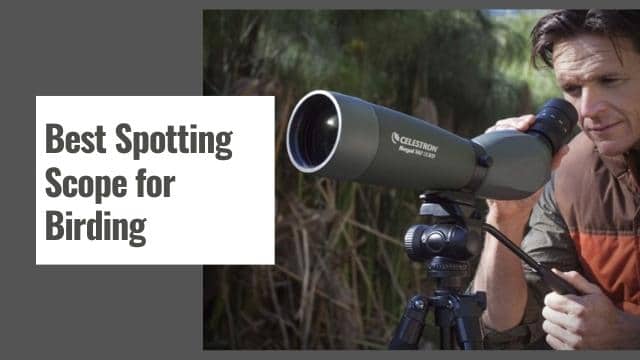
The best spotting scope for birding is the one that gives you a bright, wide, steady view at the distance you actually watch birds, without becoming too heavy to carry or too shaky to enjoy. For most birders, a 60 mm to 100 mm scope with a stable tripod, comfortable eyepiece, and smooth focus matters more than chasing the highest magnification number on the box.
We looked specifically at how each scope handles the things birders care about most: field of view for tracking a moving bird, close focus distance for songbirds near a trail, and how much weight you are willing to carry versus how much light-gathering power you need for distant shorebirds and waterfowl. This guide covers nine real, current models across that range, from lightweight compact scopes to large-objective long-range picks, plus a buying guide that explains the tradeoffs so you can match a scope to your own birding style.
Table of contents
- Quick Picks Table
- How We Chose These Scopes
- Vortex Diamondback HD 20-60×85 Angled
- Celestron Ultima 20-60×80 Angled
- SVBONY SV406P 20-60×80 Angled ED
- Athlon Optics Argos HD 20-60×85, 45 Degree
- Gosky Flagship DiamondEdge 20-60×80
- Vortex Crossfire HD 16-48×65 Angled
- Vortex Viper HD 11-33×50 Angled
- Celestron Regal M2 100ED
- SVBONY SV28 100mm 25-75x
- Field of View and Close Focus for Birding
- Magnification Tradeoffs
- Tripod and Portability
- Frequently Asked Questions
Quick Picks Table
Use this table to jump straight to the scope that matches your birding style, then read the full section below for the specs and tradeoffs behind each pick.
| # | Scope | Best for | Check Price |
|---|---|---|---|
| 1 | Vortex Diamondback HD 20-60×85 Angled | Birders who want the clearest all-around glass without moving into flagship pricing. | Check Price |
| 2 | Celestron Ultima 20-60×80 Angled | Birders who want a dependable step-up scope without paying for features they will not use. | Check Price |
| 3 | SVBONY SV406P 20-60×80 Angled ED | Birders who want ED glass color correction without paying premium-brand prices. | Check Price |
| 4 | Athlon Optics Argos HD 20-60×85, 45 Degree | Birders who split time between birding and long-range shooting sports and want one scope for both. | Check Price |
| 5 | Gosky Flagship DiamondEdge 20-60×80 | New birders who want everything included in one purchase: scope, tripod, phone adapter, and case. | Check Price |
| 6 | Vortex Crossfire HD 16-48×65 Angled | Birders who hike long distances and want HD glass in a smaller, lighter 65 mm package. | Check Price |
| 7 | Vortex Viper HD 11-33×50 Angled | Birders who want premium XR Plus glass in the smallest, lightest package on this list. | Check Price |
| 8 | Celestron Regal M2 100ED | Birders who mainly watch shorebirds, waterfowl, and raptors at long distance from a fixed spot. | Check Price |
| 9 | SVBONY SV28 100mm 25-75x | Budget-minded birders who want a large 100 mm objective without stepping up to ED-glass pricing. | Check Price |
How We Chose These Scopes
Every scope on this list is a real, currently listed product with in-stock availability and a meaningful number of verified owner reviews. We compared listed specs (objective size, zoom range, field of view, close focus distance, eye relief, and weight) across manufacturer listings, then weighed those specs against what actually matters for birding rather than for target shooting or hunting, where many of these same scopes are also sold.
We prioritized wide field of view and close focus distance over raw top-end magnification, since a bird rarely holds still at 60x. We also made sure the list included at least one scope in each of the main use cases birders ask about: an all-around pick, a budget pick, an ED-glass pick, a lightweight hiking pick, and a large-objective pick for distant shorebirds and waterfowl.
1. Vortex Diamondback HD 20-60×85 Angled
Best for: Birders who want the clearest all-around glass without moving into flagship pricing.
Key specs (from Vortex product listing): 20-60x zoom, 85 mm objective, angled eyepiece, HD optical system with fully multi-coated lenses, helical focus, argon-purged waterproof and fogproof body, Arca-Swiss compatible foot.
Pros
- HD glass gives noticeably better color fidelity and edge sharpness than entry-level scopes
- Helical focus wheel is fast to use and stays smooth in cold weather
- Backed by Vortex’s unlimited, unconditional, transferable warranty
Cons
- 85 mm objective adds real weight, so a sturdy tripod is not optional
- Some chromatic fringing shows up at the top of the zoom range
Skip this if: you hike long distances often and want the lightest possible setup, or you need the absolute widest field of view for scanning open water.
2. Celestron Ultima 20-60×80 Angled
Best for: Birders who want a dependable step-up scope without paying for features they will not use.
Key specs (from Celestron product listing): 20-60x zoom, 80 mm objective, 45-degree angled eyepiece, BaK4 prism, field of view 2.0 to 1.0 degrees (105 to 53 feet at 1000 yards), close focus distance about 26 feet, 18 mm eye relief, fully multi-coated optics, waterproof and nitrogen-purged.
Pros
- Wide field of view for the price makes it easier to find and track moving birds
- Close focus distance around 26 feet works well for songbirds near a trail
- Ships with a T-adapter for digiscoping and a soft carrying case
Cons
- Zoom eyepiece loses some sharpness above roughly 40x
- No adjustable eye relief, which glasses wearers may notice
Skip this if: you regularly need to identify distant shorebirds at full zoom, since detail softens noticeably past the midpoint of the range.
3. SVBONY SV406P 20-60×80 Angled ED
Best for: Birders who want ED glass color correction without paying premium-brand prices.
Key specs (from SVBONY product listing): 20-60x zoom, 80 mm ED (extra-low dispersion) objective, angled eyepiece, dual focus wheels for coarse and fine adjustment, IPX7 waterproof rating, field of view roughly 108 to 60 feet at 1000 yards, close focus around 18 feet, eye relief 20 to 18 mm.
Pros
- ED glass cuts chromatic aberration well beyond what non-ED scopes in this range can do
- Dual focus wheels make fine detail work on feather patterns much easier
- Detachable 1.25-inch eyepiece works with third-party astronomy eyepieces too
Cons
- Stock tends to run thin since it sells through quickly, so check availability before planning a trip around it
- No printed instructions to speak of, so budget a few minutes to figure out eyepiece assembly
Skip this if: you want a scope bundled with a tripod and phone adapter out of the box, since this one is sold as the optical tube only.
4. Athlon Optics Argos HD 20-60×85, 45 Degree
Best for: Birders who split time between birding and long-range shooting sports and want one scope for both.
Key specs (from Athlon Optics product listing): 20-60x zoom, 85 mm objective, 45-degree angled eyepiece, HD glass with fully multi-coated lenses, argon-purged waterproof and fogproof housing, rotating tripod ring, item weight about 4.3 pounds.
Pros
- HD glass delivers bright, true color in low light around dawn and dusk
- Rotating tripod ring lets multiple viewers find a comfortable angle without moving the tripod
- Sealed and gas-purged construction holds up well in wet, humid birding conditions
Cons
- At 4.3 pounds it is one of the heavier options here for all-day carrying
- Fewer birding-specific reviews exist compared with the more established Vortex and Celestron lines
Skip this if: weight is your top priority, since the 85 mm objective and full-metal body add up quickly on long walks.
5. Gosky Flagship DiamondEdge 20-60×80
Best for: New birders who want everything included in one purchase: scope, tripod, phone adapter, and case.
Key specs (from Gosky product listing): 20-60x zoom, 80 mm objective, BAK4 prism, manual focus, item weight about 2.4 pounds for the optical tube, waterproof housing, includes tripod, phone adapter, and carrying bag.
Pros
- Complete kit means no separate tripod or adapter purchase before your first outing
- Lighter optical tube than most 80 mm scopes in this guide, which helps on the trail
- Strong review volume from birders and casual wildlife watchers
Cons
- Included tripod is noticeably less stable than a dedicated birding tripod
- Optical clarity trails the Vortex, Celestron, and SVBONY ED options at full zoom
Skip this if: you already own a solid tripod and phone adapter, since you would be paying for accessories you will not use.
6. Vortex Crossfire HD 16-48×65 Angled
Best for: Birders who hike long distances and want HD glass in a smaller, lighter 65 mm package.
Key specs (from Vortex product listing): 16-48x zoom, 65 mm objective, angled eyepiece, HD optical system, helical focus, Arca-Swiss compatible foot, argon-purged waterproof and fogproof body.
Pros
- 65 mm objective keeps overall weight and bulk down compared with 80 mm and 85 mm scopes
- Lower top-end magnification (48x) stays brighter and steadier in the field than an 80x claim on a cheap scope
- Same HD glass and coatings used in Vortex’s larger Crossfire models
Cons
- Smaller objective gathers less light at dusk than the 80 mm and 85 mm options in this list
- Not the pick for birders who mainly watch distant open water or shorebirds
Skip this if: your birding is mostly waterfowl or shorebirds across open water, where a larger objective earns its weight.
7. Vortex Viper HD 11-33×50 Angled
Best for: Birders who want premium XR Plus glass in the smallest, lightest package on this list.
Key specs (from Vortex product listing): 11-33x zoom, 50 mm objective, angled eyepiece, XR Plus lens coatings, dual focus knobs, field of view about 182 feet, item weight about 1.7 pounds, Arca-Swiss compatible.
Pros
- By far the lightest scope in this guide, easy to carry all day on a shoulder strap
- Wide field of view at 182 feet makes it fast to find birds in flight or in brush
- Dual focus knobs give precise control despite the compact body
Cons
- 50 mm objective and lower top magnification limit how far you can push identification at long range
- Costs more than several larger-objective scopes in this guide for less raw reach
Skip this if: you need to reach out past a few hundred yards for distant raptors or shorebirds, where more magnification and a bigger objective matter more than weight.
8. Celestron Regal M2 100ED
Best for: Birders who mainly watch shorebirds, waterfowl, and raptors at long distance from a fixed spot.
Key specs (from Celestron product listing): 22-67x zoom, 100 mm ED objective, angled eyepiece, dielectric-coated BaK4 prism, fully multi-coated XLT optics, rotating tripod mount, item weight about 5 pounds.
Pros
- 100 mm ED objective gathers noticeably more light than any other scope in this guide
- ED glass keeps color true and fringing low even at the top of the zoom range
- Rotating tripod mount makes it easy to share views at group outings
Cons
- At around 5 pounds this is not a scope you want on a long hike
- Needs a genuinely sturdy tripod, a lightweight travel tripod will not control the shake
Skip this if: you carry your gear on foot for miles, since the weight and bulk are built for fixed or short-walk locations.
9. SVBONY SV28 100mm 25-75x
Best for: Budget-minded birders who want a large 100 mm objective without stepping up to ED-glass pricing.
Key specs (from SVBONY product listing): 25-75x zoom, 100 mm objective, BAK4 porro prism, FMC lens coating, manual focus, item weight about 2560 grams (roughly 5.6 pounds), includes soft carry case and phone adapter.
Pros
- Large 100 mm objective brings in more light than most scopes at this price
- Includes a phone adapter and case, so digiscoping is ready to go out of the box
- Consistently a top seller in its category with a large, active review base
Cons
- No ED glass, so expect more chromatic fringing at high zoom than the SV406P or Regal M2 100ED
- Weight and size make this a tripod-and-car-trip scope rather than a hiking companion
Skip this if: color accuracy at full zoom matters more to you than objective size, in which case the SVBONY SV406P ED is the better match.
Buying Guide for Birding Spotting Scopes
Field of View and Close Focus for Birding
Field of view matters more for birding than for almost any other use of a spotting scope. A bird that flushes off a branch or dips behind reeds gives you a second or two to find it again, and a wider field of view at a given magnification makes that much easier. Scopes with a narrower field of view can still be excellent, but expect a slower learning curve when tracking movement.
Close focus distance is the other number birders often overlook. If you spend time on trails watching songbirds at 20 to 40 feet, a scope with a close focus distance in that range will feel far more useful day to day than one optimized purely for long-range clarity.
Magnification Tradeoffs
Spotting scopes often advertise zoom ranges such as 20-60x or 25-75x. Lower power is brighter, wider, and easier to aim. Higher power shows more detail only when the glass, light, air quality, and tripod are all good enough to support it.
Heat shimmer, wind, and tripod vibration can make very high magnification less useful in the field than the number on the box suggests. For birding, a clear, steady view at moderate magnification is usually more useful than a dim, shaky view at maximum zoom.
Objective Size and Brightness
The objective lens is the large front lens. Bigger objectives gather more light and help with distant detail, especially at dawn and dusk, but they add weight and require a stronger tripod. A 60 mm to 65 mm class scope is easier to carry on long walks. An 80 mm to 100 mm class scope can be better for shorebirds, waterfowl, raptors, and low-light viewing from a fixed or short-walk location.
Angled vs Straight Eyepiece
An angled eyepiece is popular for birding because it is easier to share with people of different heights and more comfortable for viewing birds above eye level. A straight eyepiece can be faster for aiming at birds on the horizon or from a vehicle window mount, and some hunters and target shooters prefer it, but most birders find angled designs more comfortable for long viewing sessions.
Tripod and Portability
A spotting scope needs a stable tripod. If the tripod is too light, too tall, or too wobbly, the image will shake and focusing will feel frustrating no matter how good the glass is. Match the tripod to the scope’s weight, and choose a smooth pan head for tracking moving birds.
Portability is a real tradeoff, not just a marketing line. A large scope only helps you if you actually bring it along. If you hike long distances to reach your birding spots, a lighter 50 mm to 65 mm scope on a compact tripod may serve you better than a heavier 80 mm to 100 mm setup that stays in the car.
Digiscoping and Phone Adapters
Digiscoping means taking photos or video through the spotting scope, often with a phone adapter. If this matters to you, check whether the eyepiece shape works with common adapters and whether the scope stays balanced once a phone is attached. Expect a learning curve: phone alignment, focus, vibration, and light all matter, and a scope that is pleasant to view through in person should still be the priority.
Common Mistakes to Avoid
Buying more magnification than you can actually use is the most common mistake. High zoom numbers are tempting, but field conditions like heat shimmer and wind often limit useful magnification well below the advertised maximum. Ignoring tripod quality is a close second: a weak tripod makes even excellent glass frustrating to use. Choosing too much weight for your actual birding habits, and forgetting to check eye relief if you wear glasses, round out the mistakes we see most often.
Frequently Asked Questions
Q: What magnification is best for a birding spotting scope?
A: A 20-60x zoom range is common and useful for most birders. Many birders spend most of their time in the lower and middle part of the range because the image is brighter and steadier there than at full zoom.
Q: Is an angled or straight spotting scope better for birding?
A: Angled scopes are generally better for birding groups, long viewing sessions, and birds above eye level. Straight scopes can be quicker to aim at birds near the horizon or from a vehicle window mount.
Q: What objective lens size should I choose for birding?
A: A 60 mm to 65 mm class scope is easier to carry on long walks, while an 80 mm to 100 mm class scope gathers more light and can show more detail from a fixed viewing spot. Choose based on how far you typically hike with the scope and how often you view in low light.
Q: Does ED glass make a real difference for birding?
A: Yes. Extra-low dispersion (ED) glass reduces chromatic aberration, the color fringing that shows up around high-contrast edges at higher magnification. It matters most when you are trying to judge subtle feather color or pattern differences between similar species.
Q: Can I use only a spotting scope for birding, without binoculars?
A: You can, but it is not ideal. Binoculars are better for scanning and finding movement quickly. A spotting scope is best used after binoculars have located the bird, for studying feather detail, bill shape, and other close identification clues.
Q: Do I need a tripod for a spotting scope?
A: Yes. Spotting scopes need stable support to be usable. A shaky tripod makes focusing and identification harder, especially at higher magnification, and can make even a high-end scope feel disappointing.
Q: How close can a spotting scope focus?
A: Close focus distance varies by model, from roughly 18 feet on some ED designs to 26 feet or more on other scopes. If you often watch songbirds near a trail rather than distant birds across open water, check this figure before buying.
Q: Is a heavier, larger-objective scope always better for birding?
A: No. A larger objective gathers more light and can help with distant or low-light viewing, but it adds weight that matters if you hike to your birding spots. Match the scope’s size to how far you actually carry it, not just to its light-gathering specs.
Final Recommendation
Choose a birding spotting scope as a full viewing system: objective size, field of view, close focus distance, eyepiece style, tripod, and carry weight all work together. For most birders, the Vortex Diamondback HD 20-60×85 or the Celestron Ultima 20-60×80 will cover the widest range of situations without becoming too heavy to enjoy. If you hike long distances, lean toward the Vortex Crossfire HD 16-48×65 or the Vortex Viper HD 11-33×50. If your birding is mostly shorebirds and waterfowl across open water, the Celestron Regal M2 100ED or the SVBONY SV406P ED will reward the extra weight with real detail at distance.