Best Crossbow Bolts for Deer Hunting: Source-Checked Picks and Buying Guide

The best crossbow bolts for deer hunting are the bolts or arrows your crossbow manual approves first, then the ones that give you the right length, total finished arrow weight, nock style, broadhead compatibility, and consistent flight. For most hunters, the safest pick is not the fastest or most popular bolt; it is the one the crossbow maker approves for that exact model.
Fit check before you buy: Confirm the bolt length, total finished arrow weight, nock style, broadhead setup, and any minimum arrow-weight warning in your crossbow owner manual. A bolt that looks right online can still be wrong for your crossbow.
Use the crossbow manual as the final authority.
Do not choose by length alone.
Recheck product listings before ordering because pack counts, nocks, and variants can change.
Table of contents
On This Page
How We Chose
Quick Picks
Best Crossbow Bolts for Deer Hunting
Crossbow Bolts for Deer: Buying Guide
Crossbow Bolt Compatibility Checklist
Frequently Asked Questions
Final Recommendation
How We Chose
This is a research-based buying guide, not a hands-on field test. We compare source-visible product information, manufacturer specs, merchant-page signals, and compatibility-first buying factors. We do not claim to have personally tested these bolts.
Our selection logic is compatibility-first: we favor products with clear manufacturer information, distinct buyer roles, common hunting lengths, honest fit warnings, and reachable buying information. A bolt earns a place by being easy to match to a real crossbow setup, not by brand alone.
Before buying any option here, compare it against your crossbow manual and your local hunting rules. Treat every pick as a candidate to confirm for your exact crossbow, length, nock style, and finished arrow weight. For broader hunting setup context, see our crossbow deer hunting guide and crossbow deer hunting tips.
One more thing worth saying plainly: arrow listings are among the most volatile product pages in archery. A single SKU can change length, vane size, nock type, or pack count without changing its title, and discontinued variants often stay live for months. Everything in this guide reflects manufacturer product information and listing details as they stood when we last verified them for the 2026 season, but the correct habit is to re-open the listing yourself, read the variant selector line by line, and confirm the length and nock before you click buy. A common mistake is trusting a bookmarked link from a previous season — the same URL can quietly resolve to a different variant.
Quick Picks
Pick Best For Key Fit Check Product Link
Gold Tip Ballistic Bolts Most mainstream hunting crossbows that fit a mid-weight bolt setup Confirm the 22 inch variant, nock style, and finished weight against your manual. View on Amazon
Black Eagle Executioner Crossbow Fletched Arrows Hunters who want a premium carbon arrow with tighter tolerance options Confirm length, straightness option, nock style, and minimum arrow weight. View at Black Eagle
Gold Tip Nitro Bolts Fast or powerful crossbows that call for a heavier bolt range Use only if your manual supports the heavier finished weight range; this variant is 20 inch, not 22 inch. View on Amazon
Easton XX75 Magnum Crossbow Hunters who prefer a traditional aluminum bolt option Confirm the 20 inch moon-nock setup and inspect aluminum shafts carefully. View on Amazon
Barnett Headhunter 20-inch Carbon Arrows Budget-minded Barnett-compatible setups and practice/back-up arrows Confirm 20 inch length, nock style, and finished arrow weight. View on Amazon
Excalibur Diablo 18-inch Carbon Arrows Compatible Excalibur crossbows that specifically call for Diablo arrows Confirm Excalibur model compatibility and the 18 inch length. View on Amazon
Wicked Ridge by TenPoint Match 400 Lighted Arrows Compatible TenPoint/Wicked Ridge/Horton users who want lighted nocks Confirm Alpha-Blaze/Alpha-Nock compatibility for your exact bow. View on Amazon
Carbon Express PileDriver Universal Nocks (22-inch) Hunters comparing a heavier Carbon Express hunting-bolt option Confirm total finished weight and the 22-inch length with your broadhead and manual. View on Amazon
Spec Comparison at a Glance
The quick-pick table above sorts by buyer role. This one sorts by the numbers you will actually be comparing against the arrow-spec page of your manual. Where a figure is not published on the manufacturer or listing pages we checked, we say so rather than guess.
| Bolt / arrow | Shaft material | Length(s) referenced | Nock supplied | Published straightness | Published weight tolerance | Role in this shortlist |
|---|---|---|---|---|---|---|
| Gold Tip Ballistic | Carbon | 22 in | Per listing variant | ±.005 in | ±2 grains | Mid-weight all-around |
| Black Eagle Executioner | Carbon | 20 in, 22 in | Half-moon (removable); flat on 20 in | .001 or .003 option | ±1 grain | Premium accuracy upgrade |
| Gold Tip Nitro | Carbon | 20 in | Moon | ±.005 in | ±2 grains | Heavy bolt for high-energy bows |
| Easton XX75 Magnum | 7075-T9 aluminum | 20 in, 22 in | Flatback or half-moon | Not published on the pages we checked | Not published on the pages we checked | Traditional heavy aluminum |
| Barnett Headhunter | Carbon | 20 in | Verify on listing | Verify on listing | Verify on listing | Budget practice and backup |
| Excalibur Diablo | Carbon | 18 in | Verify by Excalibur model | Verify on listing | Verify on listing | Excalibur system arrow |
| Wicked Ridge Match 400 | Carbon | 20 in (400 gr total) | Alpha-Nock HP with Alpha-Blaze lighted nock | Inspected to .004 in | Not published on the pages we checked | Lighted TenPoint-family arrow |
| Carbon Express PileDriver | Carbon | 22 in | Universal Nock System (moon plus C-Nock) | Laser Match Set sorting | Laser Match Set sorting | Heavy penetration-focused option |
Read the table with two filters in mind. First, straightness and weight tolerance only matter once length and nock are already correct — a .001 arrow in the wrong length is still the wrong arrow. Second, tolerance numbers deliver diminishing returns: the jump from an unsorted budget shaft to a ±2 grain, ±.005 in shaft is usually visible on a target at 40 yards, while the jump from ±.005 in to .001 in is often smaller than the group your broadhead, rest contact, and shooting form are already producing.
Next step: open your manual to the arrow-specification page, write down the approved length, nock style, and minimum finished grain weight on your phone, then compare that single line against the listing before you order — five minutes of reading saves a wasted six-pack and a ruined opening morning.
Best Crossbow Bolts for Deer Hunting
Best Mid-Weight All-Around Pick: Gold Tip Ballistic Bolts

The mid-weight Ballistic sits between Gold Tip's lighter Swift and heavier Nitro lines.
Best for: hunters with a mainstream crossbow who want a balanced mid-weight bolt, after confirming fit in the crossbow manual.
Key specs:
Positioning: built to a weight between Gold Tip’s Swift and Nitro lines, per Gold Tip official product information.
Straightness tolerance: plus or minus .005 inch.
Weight tolerance: plus or minus 2 grains.
Factory fletched with 4 inch vanes.
Variant referenced: 22 inch, 6-pack.
The Ballistic bolt is the cleanest general deer-hunting starting point in this shortlist because Gold Tip positions it as a mid-weight bolt built between its lighter Swift and heavier Nitro lines. That middle-of-the-road spine and weight is exactly what most mainstream hunting crossbows are designed around, but the nock and insert setup that is right for you is still the one your crossbow maker approves.
Gold Tip’s published straightness and weight tolerances give you a consistency baseline to compare against other bolts. Your finished arrow weight depends on the point or broadhead you add, so confirm the total against your crossbow manual before hunting. Keep length, nock style, and minimum arrow weight as manual-first checks.
What buyers tend to like
- Mid-weight balance suits a wide range of common hunting crossbows.
- Published straightness (+/-.005″) and weight (+/-2 gr.) tolerances.
- Backed by current official Gold Tip product information.
What to weigh
- Stock on this exact 22-inch 6-pack variant is limited, so confirm availability before ordering.
- Not aimed at the highest-draw-weight crossbows that call for the heavier Nitro line.
Skip this if: your crossbow manual requires a heavier bolt, such as Gold Tip’s Nitro line for a high-draw-weight crossbow, a different length, or a nock style this bolt does not include.
Note: the original Gold Tip Ballistic Pro Bolts listing (3.5-inch vanes) this section covered was discontinued. This section now points to the current Gold Tip Ballistic Bolts 22-inch listing (4-inch vanes), a verified, same-line replacement that is in stock but limited, per Amazon’s current listing.
One practical note on the vane change: moving from 3.5-inch to 4-inch vanes adds a small amount of drag and a few grains at the rear of the shaft. In practice that usually shows up as slightly faster broadhead stabilization and a marginally lower point of impact past 40 yards, not as a problem — but it is still a reason to re-confirm zero rather than assume the new pack drops into your old sight tape.
Best Premium Accuracy Upgrade: Black Eagle Executioner Crossbow Fletched Arrows
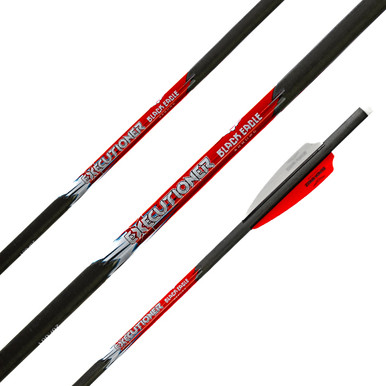
Brass inserts and shield-cut vanes come installed, which shifts more weight forward out of the box.
Best for: hunters who want a higher-tolerance arrow with durable components and are ready to match length, nock, and minimum weight to their crossbow manual.
Key specs:
Lengths: 20 inch and 22 inch.
Straightness options: .001 and .003.
Weight tolerance: plus or minus 1 grain.
Shaft: .300 inner diameter, .346 outer diameter, 9.0 GPI.
Included components: half-moon nocks installed and removable, flat nocks on 20 inch, Executioner brass inserts installed, and 3 inch Fusion X-II shield-cut vanes.
Bare-arrow weight: 20 inch and 22 inch arrows weigh 326 grains without a field point or broadhead.
Variant referenced: 20 inch, .003 straightness, 6-pack.
The Executioner is the premium accuracy candidate here because Black Eagle publishes tighter straightness options and a plus or minus 1 grain weight tolerance, which is the kind of consistency many hunters want for confident broadhead flight. The installed brass inserts and shield-cut vanes are useful out of the box, though you should still confirm the nock and insert setup matches your crossbow.
Black Eagle states these arrows work with most major manufacturer crossbows, but the same page tells buyers to check the crossbow manual for arrow weight minimums to avoid voiding the warranty. Follow that instruction. The listed 326 grain bare weight is a starting point only, because your finished weight changes once a point or broadhead is added.
What buyers tend to like
- Tight straightness options and a plus or minus 1 grain weight tolerance.
- Useful included components: brass inserts and shield-cut vanes.
- Two lengths and clear shaft specs from official product information.
What to weigh
- Premium positioning means a higher cost than basic practice arrows.
- Option-level stock can vary, so the exact length, straightness, and pack needs a final check.
Skip this if: your crossbow manual sets a minimum arrow weight or nock style this arrow does not meet, or you only need budget practice arrows.
View Current Price at Black Eagle
Worth doing the arithmetic before you order: a 326-grain bare arrow plus a 100-grain broadhead lands in the low 400s finished, which sits comfortably inside the approved window for most mainstream hunting crossbows. If your manual specifies a higher minimum — some high-output and reverse-draw bows do — a 125-grain head or a heavier insert is the simplest way to close the gap without changing shafts. Do the math on paper first; a grain scale then confirms it, and a $20 scale is the cheapest accuracy tool a crossbow hunter can own.
Best Heavy Bolt for Powerful Crossbows: Gold Tip Nitro Bolts

Stiffer spine and more mass — a fit-driven pick, not an automatic upgrade.
Best for: hunters running a fast or high-draw-weight crossbow that calls for a heavier bolt, confirmed against the crossbow manual.
Key specs:
Positioning: heavier-weight carbon bolt built with a stiffer spine for high-energy crossbows, per Gold Tip official product information.
Straightness tolerance: plus or minus .005 inch.
Weight tolerance: plus or minus 2 grains.
Factory fletched with 4 inch vanes.
Variant referenced: 20 inch, moon nock, 6-pack.
The Nitro is the heavy option in this shortlist. Gold Tip builds it with a stiffer spine specifically for fast and powerful crossbows, which is exactly the case where a heavier, stiffer bolt can help the system run within its intended weight range. It is not meant to be forced onto lower-draw crossbows, so this is a fit-driven pick rather than a default upgrade.
This listing ships with moon nocks in a 20 inch length, one inch shorter than the original 22 inch variant this section covered, so re-check your manual’s approved length as well as its draw-weight guidance. If you switch to this bolt, re-zero before hunting and confirm your broadhead and total finished weight against your manual.
What buyers tend to like
- Purpose-built heavier, stiffer-spine bolt for fast or high-draw-weight crossbows.
- Published straightness (+/-.005″) and weight (+/-2 gr.) tolerances.
- Backed by current official Gold Tip product information.
What to weigh
- Wrong choice for lower-draw crossbows that need a mid-weight bolt.
- Stock on this exact 20-inch 6-pack variant is limited, so confirm availability before ordering.
Skip this if: your crossbow manual calls for a mid-weight bolt, or your draw weight is at or below the range where a lighter bolt is recommended.
Note: the original Gold Tip Nitro Pro Bolts listing (22-inch, 4-inch vanes) this section covered was discontinued. This section now points to the current Gold Tip Nitro Bolts listing, a verified, same-line replacement, though it is a 20-inch moon-nock variant rather than 22 inches, and stock is limited.
If you are moving up to this bolt from a mid-weight shaft, expect a visible trajectory change, not a subtle one. Heavier arrows leave slower, and the drop between your 30- and 40-yard aiming references grows. That is not a flaw — it is the trade you accepted for momentum — but it does mean your existing sight settings, dial marks, or reticle holds are no longer valid until you re-verify each distance. Budget an afternoon and a fresh target face for the change.
Best Aluminum Backup Option: Easton XX75 Magnum Crossbow
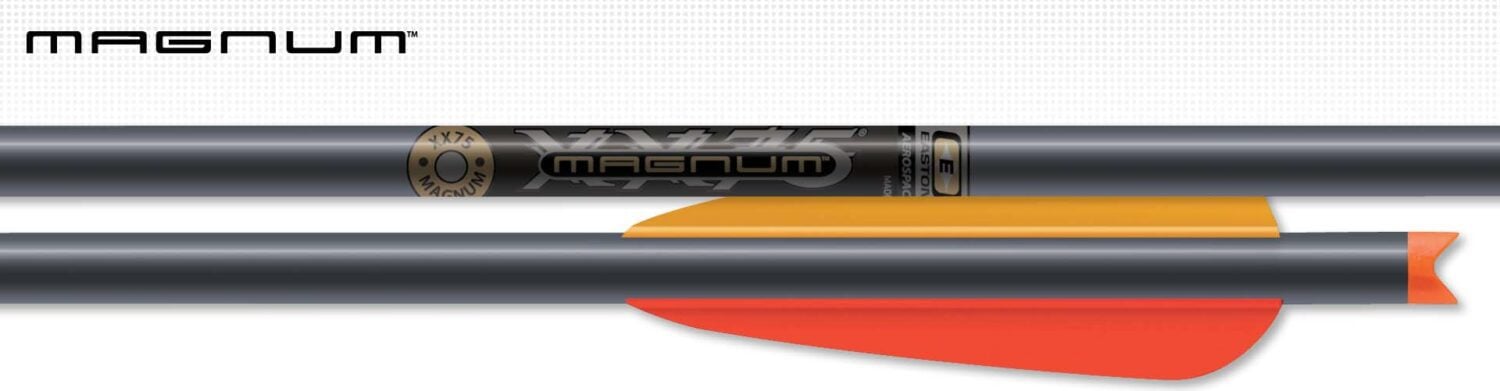
Hard-anodized 2219 aluminum shafts — heavier, easy to pull from foam, and easier to dent than carbon.
Best for: hunters who prefer traditional aluminum construction and a heavier finished feel, with a crossbow manual that supports the length, nock, and weight.
Key specs:
Material: 7075-T9 aluminum alloy, hard-anodized finish.
Bolt size: 2219; .306 inner diameter, .344 outer diameter; 13.8 GPI.
Approximate weights: 20 inch around 435 grains, 22 inch around 462 grains.
Included insert: 2219 insert at 26 grains.
Nocks: flatback or halfmoon.
Variant referenced: 20 inch, moon nock, 2219, 4 inch vanes, 6-pack.
The XX75 Magnum is the aluminum backup in this shortlist for buyers who like a heavier, traditional bolt and an easy target pull. Easton publishes concrete weight and dimension figures, which makes it easier to compare against your crossbow’s approved setup. It suits hunters who specifically want aluminum rather than carbon.
Aluminum bolts can dent or bend differently than carbon, so inspection before each shot matters. As with every option here, the length, nock style, and finished weight must match your crossbow manual. Easton’s own guidance is to inspect the shaft, nock, and components before each shot, replace damaged nocks, and never shoot a damaged arrow. That inspection guidance is published on Easton's own archery site alongside the shaft specifications, and it applies to carbon and aluminum alike.
What buyers tend to like
- Traditional 7075-T9 aluminum construction with published weights.
- Heavier finished feel and easy target pull.
- Backed by current official Easton product information.
What to weigh
- Aluminum behaves differently from carbon and can bend on hard impacts.
- Heavier weight is a poor match for crossbows that require a lighter bolt.
Skip this if: your crossbow manual requires a carbon bolt or a lighter finished arrow weight, or you want the lightest fast-shooting setup.
One honest caution that is easy to miss: a bent aluminum shaft is far more forgiving to detect than a cracked carbon one, but it is also much easier to create. A single glancing hit on a tree root, a rock behind the target, or another bolt in a tight group can put a slight bow in the shaft that you will feel by rolling it across a flat surface. Aluminum that is bent does not need to be thrown away for safety reasons the way splintered carbon does, but it will no longer group with the rest of the set — demote it to a stump-shooting arrow rather than trusting it on a deer.
Best Budget Barnett-Compatible Pick: Barnett Headhunter 20-inch Carbon Arrows
.jpg)
A sensible high-volume practice arrow for compatible Barnett-style setups.
Best for: Barnett-compatible hunters who want an affordable 20-inch carbon arrow for practice, backup arrows, and hunting setups after confirming manual fit.
Key specs to verify:
Length: 20 inch listing variant.
Nock style and crossbow compatibility for your Barnett or other approved setup.
Pack count and included components before ordering.
Total finished arrow weight once your point or broadhead is installed.
The Barnett Headhunter belongs back in this roundup because it fills a real buyer role: a common, budget-friendly carbon arrow for compatible Barnett-style setups. It should not be treated as a universal replacement bolt, but it is useful for hunters who want enough arrows for practice and backup without paying premium-arrow prices for every shaft.
Use this only if your crossbow manual approves the length, nock style, and finished arrow weight. If you are changing from another arrow, recheck point of impact before hunting.
What buyers tend to like
- Budget-friendly role for practice and backup arrows.
- Common 20-inch length for many hunting crossbow setups.
- Clear fit for compatible Barnett-style buyers.
What to weigh
- Not universal; nock style and weight still matter.
- Budget arrows may not be the best fit for premium or system-specific bows.
Skip this if: your crossbow manual requires a different length, heavier finished weight, system-specific arrow, or a nock style this listing does not match.
The smartest way to use a value arrow like this is as a volume-practice shaft that closely matches your hunting arrow in length and finished weight — not as a cheaper substitute with a different weight. If your practice arrows weigh 30 or 40 grains less than your hunting arrows, you are training on a trajectory you will never shoot at a deer. Weigh one of each on a grain scale, then shim the practice arrows with heavier field points until the two sets land in the same place at 30 yards.
Best Excalibur System Arrow: Excalibur Diablo 18-inch Carbon Arrows
.jpg)
Shorter 18-inch shafts belong to specific Excalibur systems — not a general-purpose length.
Best for: Excalibur owners whose manuals approve this Diablo-style 18-inch arrow setup.
Key specs to verify:
Length: 18 inch listing variant.
Exact Excalibur model compatibility.
Nock setup and total finished arrow weight.
Pack count and current listing variant.
The Diablo is a good example of why this article needs compatibility-first recommendations. It is useful for the right Excalibur crossbow, but it should not be bought as a generic substitute for a 20-inch or 22-inch arrow. For Excalibur owners, that specificity is a strength because it narrows the decision to the system the bow was designed around.
Before buying, match the arrow to your exact Excalibur manual and confirm whether the listing variant is the current one you need. If you are moving from practice points to broadheads, confirm flight and zero before hunting.
What buyers tend to like
- Clear role for compatible Excalibur systems.
- Useful when your manual specifically calls for this shorter arrow style.
- Better fit clarity than a generic all-crossbow recommendation.
What to weigh
- Shorter 18-inch length is wrong for many other crossbows.
- Compatibility must be checked by exact Excalibur model.
Skip this if: you do not own a compatible Excalibur crossbow or your manual calls for a different arrow length, nock, or finished weight.
Excalibur's recurve-limb platform is a reminder that arrow requirements follow the machine, not the market. Because these bows drive the arrow with a straight string path over a shorter power stroke than many compound designs, the maker's arrow and nock specification carries extra weight — and if you are still deciding between platforms, our overview of rail-mounted recurve limb designs explains why maintenance and arrow selection differ from cam-driven bows.
Best Lighted TenPoint-Compatible Pick: Wicked Ridge by TenPoint Match 400 Lighted Arrows

The Alpha-Blaze nock lights on the shot and switches off when pulled straight out of the shaft.
Best for: compatible TenPoint-family users who want a lighted-arrow option for easier arrow visibility and recovery.
Key specs:
Alpha-Blaze lighted nock activates on the shot for flight visibility, and deactivates by pulling it straight out; the LED runs about eight hours per activation.
20 inch carbon shaft, 400 grains, fletched slightly offset with Q2i Fusion X-II 3.0 vanes.
Inspected for straightness to within .004 inch; 60-grain aluminum insert for a claimed 13% FOC improvement.
Alpha-Nock HP: deep groove and large smooth-radius base with an HP aluminum bushing for added strength.
Variant referenced: 20 inch, 400 grain, pack of 3.
Lighted arrows can help you see arrow flight and find the arrow after the shot, but they add one more compatibility detail. TenPoint’s current Alpha-Blaze lighted-nock generation, the successor to the older Omni-Brite system this section originally covered, is built into the Wicked Ridge Match 400, a TenPoint-family arrow, so this pick should stay system-specific: confirm the nock and arrow setup matches your exact TenPoint, Wicked Ridge, or Horton model before buying.
Because lighted arrows can change component details versus standard arrows, confirm the final weight and point of impact before hunting. Do not use a lighted nock as a reason to ignore length, nock, or minimum weight requirements.
What buyers tend to like
- Current-generation Alpha-Blaze lighted nock for visibility and recovery.
- Straightness inspected to .004″ with a 60-grain insert for improved FOC.
- From TenPoint’s own Wicked Ridge family, the direct successor line to Omni-Brite.
What to weigh
- Compatibility is still system-specific; confirm your exact model.
- Lighted nocks add another part to check, charge by use, and maintain.
Skip this if: your crossbow does not support the Alpha-Blaze/Alpha-Nock arrow setup, or you prefer a simpler non-lighted arrow.
Note: TenPoint’s original Omni-Brite 2 Pro Elite lighted arrow listing this section covered was discontinued. This section now points to the Wicked Ridge by TenPoint Match 400, a verified in-stock lighted arrow from TenPoint’s current Alpha-Blaze nock generation, the direct successor to Omni-Brite.
Two field habits make lighted nocks worth the extra cost. First, pull the nock straight out to switch the LED off the moment you recover the arrow — leaving it lit drains the cell and makes it useless the next evening. Second, carry one spare lit nock and one standard nock of the same weight; if a nock fails on a hunt, swapping to a same-weight standard nock keeps your point of impact honest, while dropping in a lighter nock quietly changes the arrow you sighted in with. If you shoot a modern reverse-draw platform, the arrow, nock, and rail interaction is even more tightly specified — our write-up on one popular reverse-draw platform shows how closely those systems are engineered around their own arrow.
Best Heavier Carbon Express Option: Carbon Express PileDriver Crossbolts
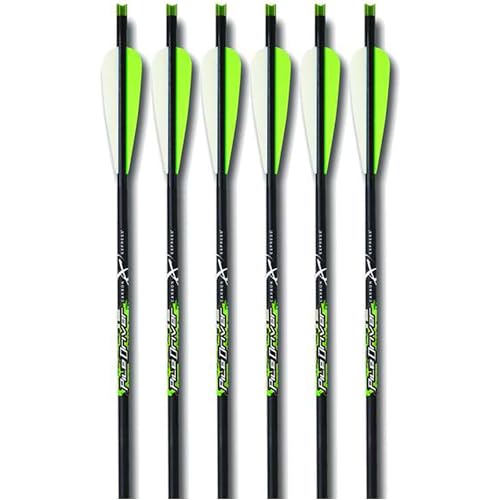
The Universal Nock System ships with moon nocks installed plus C-Nocks for capture-nock crossbows.
Best for: hunters comparing a heavier Carbon Express hunting-bolt option after confirming their crossbow supports the finished arrow weight.
Key specs:
Engineered for high kinetic energy and penetration, per Carbon Express official product information.
Laser Match Set: packs are sorted and matched by spine and weight for consistency.
Universal Nock System: inserted moon nocks plus C-Nocks, compatible with older crossbows that use a capture nock.
4 inch Fusion vanes.
Variant referenced: 22 inch, 6-pack.
The PileDriver fits the roundup as the heavier Carbon Express-style option, and this current listing is the same PileDriver line, now in a 22-inch length with a Universal Nock System rather than the 20-inch moon-nock variant this section originally covered. A heavier bolt can be appealing for broadhead setups, but it also changes speed, trajectory, and point of impact. The right way to choose it is to start with the manual, then confirm your final broadhead setup.
If you switch to this from a lighter or shorter arrow, treat it as a new setup: re-zero, confirm broadhead flight, and inspect each shaft before hunting. Do not buy it just because heavier sounds better; buy it only if the finished setup, including the new length, fits your bow.
What buyers tend to like
- Same PileDriver line built for high kinetic energy and penetration.
- Universal Nock System widens crossbow compatibility versus a single moon-nock setup.
- Laser Match Set sorting for spine/weight consistency.
What to weigh
- This variant is 22 inch, not the original 20 inch; re-check length against your manual.
- Stock on this exact variant is limited, so confirm availability before ordering.
Skip this if: your crossbow manual requires a lighter arrow, a specific 20-inch length, or a nock style this listing does not match.
Note: the original 20-inch Carbon Express PileDriver Crossbolt listing this section covered was discontinued. This section now points to the current Carbon Express PileDriver Universal Nocks listing, a verified, same-line replacement, though it is a 22-inch variant rather than 20 inches, and stock is limited.
The Universal Nock System is genuinely useful on older crossbows, but it is also where people get careless. Having both moon nocks and C-Nocks in the box does not mean either one is correct for your bow — it means you must choose the one your manual specifies and keep the other in the parts bin. Installing a moon nock in a capture-nock bow, or orienting a moon nock so the string sits outside the groove, is one of the fastest ways to dry-fire a crossbow with an arrow on the rail.
Crossbow Bolts for Deer: Buying Guide
Start with your crossbow manual
Your crossbow manual is the final authority for which bolts are safe to shoot. It sets the approved length, minimum total arrow weight, nock style, and broadhead guidance for your exact model. A bolt that looks right online can still be wrong for your crossbow, so start here before comparing brands. For terminology, a crossbow bolt is the short projectile used by a crossbow, but product listings may also call it a crossbow arrow.
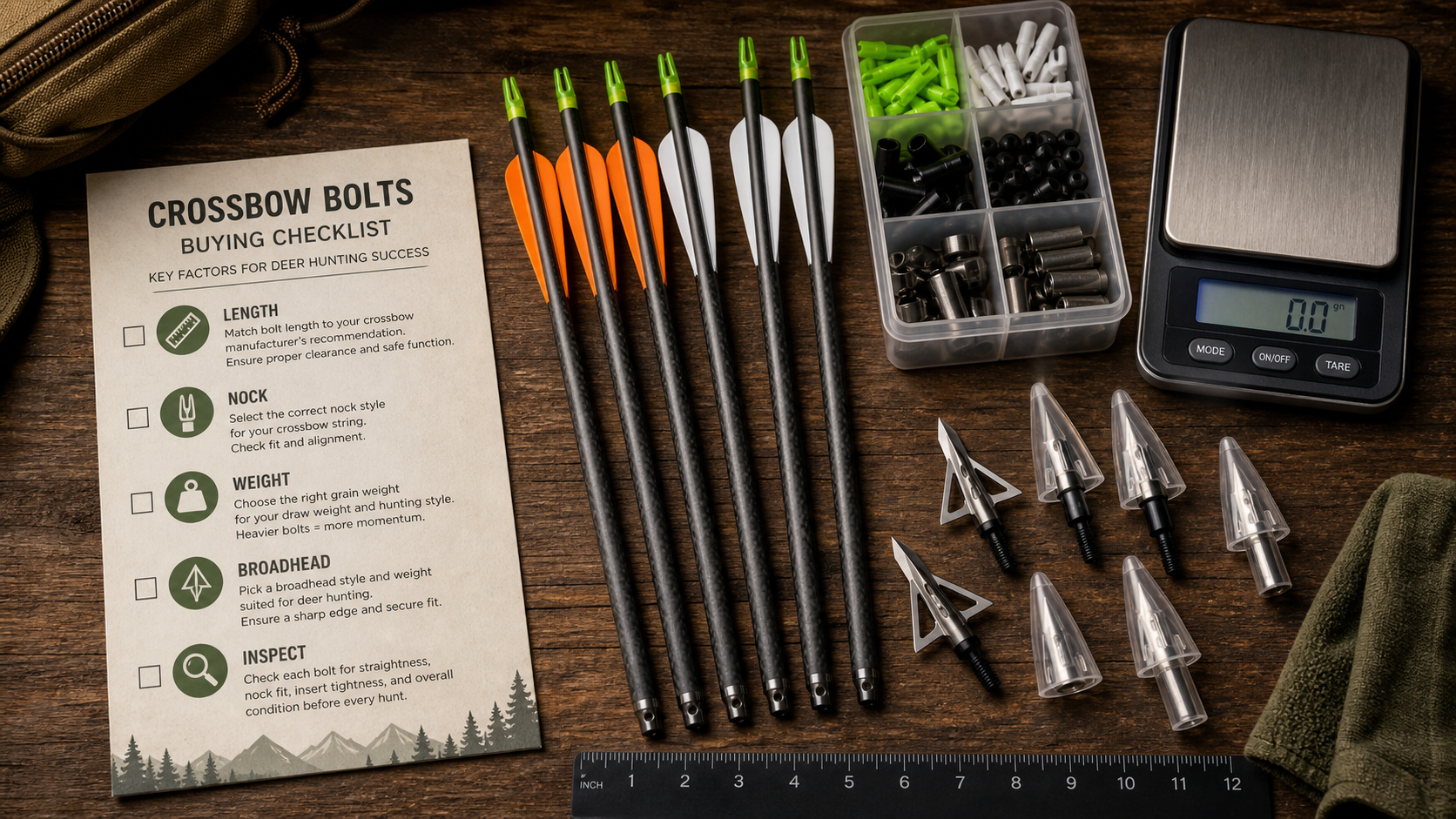
Everything on this bench affects finished arrow weight — measure and weigh before you commit to a pack.
If you have lost the paper manual, nearly every major crossbow maker publishes current and archived manuals as free PDFs under a support or owner's-resources page on its own site. Search by the model name stamped on the barrel or riser, not just the brand, because arrow specs frequently changed between generations of the same model family. If the model is old enough that no manual exists, contact the manufacturer's customer service with the serial number rather than guessing — that is a five-minute email that protects both your bow and its warranty.
Check your hunting rules before the season
Crossbow seasons, age rules, disability permits, equipment rules, and broadhead rules can vary by state. Confirm them with a hunter education or wildlife-agency source before you hunt. IHEA-USA is a useful starting point for hunter education, and your state wildlife agency is the final place to confirm local rules.
A detail that catches traveling hunters: the land you are standing on can impose stricter rules than the state does. National wildlife refuges, for example, publish their own hunt plans and equipment restrictions through the U.S. Fish and Wildlife Service, and many military installations, state parks, and water-authority lands do the same. Check the state regulation first, then check the specific property's own hunting rules — broadhead type, minimum cutting diameter, and lighted-nock allowances are the three that most often differ.
Length
Pick the length your crossbow manual approves. Many hunting crossbows use about 20-inch arrows, but some systems require 18-inch or 22-inch arrows. Do not assume a close length is safe, because length affects fit, clearance, balance, and how the arrow behaves when fired.
Be precise about how length is measured, too. Crossbow arrow length is normally quoted as the overall shaft length excluding the point and, in most cases, excluding the protruding portion of the nock — which is why a "20-inch" arrow can measure slightly differently on a tape than you expect. If you are cutting shafts yourself or ordering from a custom builder, confirm whether the quoted length is shaft-only or nock-groove-to-shaft-end before you commit the order, and never cut a shaft shorter than your manual's minimum to "make it fit."
Total finished arrow weight
Total finished weight includes the shaft, insert, nock, vanes, and the broadhead or field point. A bolt that is too light can be unsafe for some crossbows, and a heavier bolt can change trajectory and point of impact. Use your manual’s minimum arrow-weight guidance first, then confirm the complete setup.
It is worth understanding why the minimum exists. A crossbow's limbs store a fixed amount of energy; the arrow's job is to absorb it. Too little arrow mass means more of that energy stays in the limbs, rail, and string at the end of the power stroke — the same condition as a dry fire, just less extreme. That is why manufacturers treat under-minimum arrows as a warranty-voiding condition rather than a preference. In the other direction there is no safety ceiling, only a performance trade: more mass, more momentum, less speed, more drop.
Nock style
Match the nock style to the crossbow maker’s guidance. Flat nocks, moon nocks, capture nocks, Omni-style nocks, and lighted nocks are not interchangeable in every crossbow. The wrong nock can create poor string contact or unsafe performance.
A quick reference for the four you will actually encounter:
- Flat (flatback) nocks — a plain flat base with no groove; the string pushes on the whole face. Common on older and some recurve-limb crossbows.
- Half-moon nocks — a groove cut across the base that must be rotated so the string seats inside the groove and the groove is perpendicular to the string. Indexing them wrong is the single most common cause of a rail-level dry fire.
- Capture / C-nocks — a deeper cradle that surrounds the string, reducing the chance of misalignment.
- Omni-style and multi-groove nocks — several grooves cut around the base so the nock is effectively self-indexing in any rotation.
In practice, if your manual calls for half-moon nocks, build the habit of checking groove orientation as the last thing you do before every shot, the way a rifle shooter checks the safety. It takes a second and it is the cheapest insurance in the sport.
Broadhead compatibility
For deer hunting, broadhead choice matters as much as the bolt. Confirm the broadhead weight, total arrow weight, flight consistency, and local broadhead rules. If your broadheads shift the point of impact, re-zero before hunting. For a broader setup discussion, compare fixed and mechanical options in our broadhead comparison guide.
Three compatibility details get skipped more often than they should. First, insert thread: crossbow inserts are almost universally 8-32, but some system-specific arrows use proprietary or half-out designs, so confirm the head actually threads fully and squarely. Second, ferrule diameter versus shaft diameter — a broadhead noticeably wider than the shaft creates a step that can catch in the rail or arrow retainer on certain bows. Third, vane clearance: large fixed blades combined with tall vanes can contact the rail or retention spring on some models. Cycle an unsharpened broadhead-tipped arrow through the loading and de-cocking motion (uncocked, obviously) and look for contact marks before you shoot it.
Shaft condition and inspection
Inspect every bolt before and after shooting. Look for cracks, bends, loose inserts, damaged nocks, and torn vanes, and retire any shaft that fails the check. Manufacturer guidance from brands such as Easton is to inspect the shaft, nock, and components before each shot and to never shoot a damaged arrow.
The two-step field test takes about ten seconds per arrow. Flex the shaft slightly by holding both ends and bending it away from your face, rotating a quarter turn and repeating — listen for any crackle and feel for a soft spot. Then run a loose cotton ball or cotton swab along the full length; a splinter or hairline crack in carbon will snag the fibers when your eyes miss it. Anything that snags, crackles, or shows a lifted insert gets its vanes cut off on the spot so it can never end up back in the quiver by accident.
Practice before hunting
Practice with the exact bolt and broadhead setup you plan to hunt with. Confirm your zero at realistic distances and check that broadheads fly with the same point of impact as your practice points. USA Archery’s safety resources are useful background for safe shooting habits, while your crossbow manual and range rules guide the exact setup. If you also shoot target archery, our 3D archery setup guide can help with practice-focused gear thinking.
Practice sessions should also mimic hunting conditions rather than just bench conditions. Shoot from a seated position, from an elevated platform if you hunt from a stand, wearing the same coat you will hunt in, and take a cold first shot with no warm-up — that is the shot that counts. Hunters who only shoot from a bench with a bare arm are training a different skill than the one the season demands, and it shows the first time a bulky sleeve touches the string path.
What Actually Makes a Bolt Group Well
Once length, nock, and minimum weight are settled, three variables explain most of the accuracy difference between two otherwise similar arrows.
Spine (stiffness)
Spine is the shaft's resistance to bending. Crossbow arrows are shorter and generally stiffer than vertical-bow arrows, and because crossbow limbs release straight down the rail rather than around a riser, spine is less about clearance and more about consistency: every arrow in your set flexing the same amount produces repeatable flight. This is why manufacturers sell matched sets and why buying six arrows from one pack beats assembling six singles from a bargain bin. Do not attempt to hand-select a "stiffer" crossbow shaft the way you might for a compound — follow the maker's line recommendation for your bow's output instead.
FOC (front of center)
FOC describes how far forward the arrow's balance point sits, expressed as a percentage. Higher FOC — achieved with brass inserts, heavier broadheads, or half-out components — tends to stabilize a broadhead sooner and can help penetration, at the cost of a steeper trajectory at longer ranges. Several arrows in this roundup use heavy aluminum or brass inserts specifically to raise FOC. To measure it yourself, balance the finished arrow on a knife edge, mark the balance point, and compare its distance from the center of the shaft against overall length. Moderate FOC is fine for whitetail; chasing extreme numbers usually costs more in drop than it returns in penetration on a deer-sized animal.
Straightness, weight sorting, and honest expectations
Tighter straightness and weight tolerances genuinely reduce the size of your groups — but only after your form, rest, and optic are consistent enough to reveal the difference. In practice, most hunters see a larger accuracy improvement from a squared shaft end, a spin-tested broadhead, and a solid rest than from upgrading a .005-inch shaft to a .001-inch shaft. Buy the tolerance you can actually use, then spend the remainder on more practice arrows.
Carbon vs Aluminum: Which Shaft Material Suits You
| Factor | Carbon | Aluminum |
|---|---|---|
| Typical weight | Lighter for a given length; heavier options available | Generally heavier, especially in larger sizes like 2219 |
| Damage mode | Splinters and cracks; must be retired immediately | Dents and bends; unsafe less often, but loses accuracy |
| Inspection method | Flex and cotton-ball test for hairline cracks | Roll on a flat surface to spot bends |
| Durability on hard impacts | Excellent until it fails, then fails completely | Deforms rather than shatters |
| Target removal | Can bind in dense foam | Slick anodized finish usually pulls easily |
| Cost per arrow | Wide range, from budget to premium | Usually mid-range and stable |
| Best fit | Most modern hunting crossbows and manual specs | Traditional preference, heavier setups, easy pulling |
The practical takeaway: choose carbon unless you have a specific reason to want aluminum, because most modern crossbow manuals, arrow lines, and accessory ecosystems are built around carbon shafts. Choose aluminum when you want a heavier finished arrow with published, easily verified weights, or when you shoot a lot of high-density target foam and are tired of wrestling arrows out of it. Whichever you choose, do not mix materials within one hunting set — different shafts group differently, and a quiver with three carbon and two aluminum arrows is a quiver with two zeros.
Speed, Energy, and What Actually Kills a Deer
Crossbow speed ratings are published with a specific arrow weight; change the arrow and the rating no longer applies. If you want your own numbers rather than a marketing figure, a chronograph and two formulas do the job:
- Kinetic energy (ft-lb) = (arrow weight in grains × velocity in fps²) ÷ 450,240
- Momentum (slug-ft/s) = (arrow weight in grains × velocity in fps) ÷ 225,218
Momentum is arguably the more useful of the two for hunters, because it rewards mass rather than squaring velocity, and mass is what carries a broadhead through hide, muscle, and the occasional rib.
Here is the honest framing, though: mainstream hunting crossbows in current production produce far more energy than a broadhead needs to pass through a whitetail broadside. Failed recoveries are overwhelmingly caused by a marginal hit, a broadhead that flew differently from the field points, a dull edge, a shot taken past the hunter's practiced range, or a deer that jumped the string — not by a shortage of raw energy. Spend your effort on arrow-to-broadhead consistency and shot discipline before you spend it chasing 20 extra fps.
Building or Rebuilding a Bolt: Step-by-Step
Factory-fletched arrows cover most hunters, but knowing how to rebuild one saves a hunt when a nock breaks or an insert pulls loose.
- Square the shaft ends. An arrow squaring tool removes the tiny amount of material that keeps a point or insert from sitting perfectly perpendicular. This is the single highest-value, lowest-cost accuracy step in arrow building.
- Clean the shaft interior. Wipe the inside of the shaft and the insert with denatured alcohol so glue bonds to carbon, not to manufacturing residue.
- Choose the right adhesive. Hot melt allows you to reheat and remove an insert later; two-part epoxy is stronger and better for heavy broadhead use. Do not use cyanoacrylate on a hunting insert — it is brittle under impact.
- Set the insert straight and wipe the squeeze-out. Rotate the insert as you seat it to spread the adhesive, then wipe the outside immediately before it cures.
- Install the nock to the maker's index. For half-moon nocks, orient the groove exactly as your manual specifies relative to the vanes and the rail; if the nock is a press-fit, check that it seats fully without cracking the shaft end.
- Spin-test the finished arrow. Roll it on an arrow spinner or across two blocks with a broadhead installed. Any visible wobble at the tip means the insert, point, or shaft end is off — fix it before it costs you a deer.
- Weigh and label. Number each shaft with a paint pen. Numbered arrows let you spot the one that consistently flies left, which is information you cannot get from an unmarked set.
Sighting In and Broadhead Tuning in the Right Order
Changing arrows means starting this sequence over from the top.
- Confirm the crossbow is mechanically sound: tight rail bolts, undamaged string and serving, and a rail lubricated per the maker's schedule.
- Sight in at 20 yards with field points matching your broadhead weight exactly, shooting one arrow per aiming point so you do not destroy shafts by stacking them.
- Verify at your longest realistic hunting distance and record where each arrow lands. Do not extrapolate a 40-yard hold from a 20-yard group.
- Switch to broadheads on the same numbered shafts and shoot at 20 yards. Ideally, broadheads and field points land together.
- If broadheads group apart from field points, the arrow is not leaving the rail cleanly. Check nock fit and indexing, spin-test each head, confirm vane clearance, and inspect the string serving before you adjust the optic.
- Only after broadheads group consistently should you move the optic — and then move it to the broadhead group, because that is what you are hunting with.
- Re-verify after any component change and once mid-season, especially after a hard fall, a truck ride on a rough road, or a big temperature swing.
A crossbow optic with calibrated marks is only as honest as the arrow it was matched to, which is why a change in arrow weight almost always requires re-verification of each distance mark — our roundup of purpose-built crossbow optics explains how those speed dials and multi-line reticles are calibrated. The same principle applies to fixed-pin archery sights, where the choice between one and several aiming references is really a question of how many distances you can honestly verify: our comparison of single- versus multi-reference aiming setups covers that trade-off.
Bolt Care, Storage, and Field Handling
- Store arrows loose and dry, points down or in a foam-lined case, not rattling in a truck bed or wedged under gear. Crushed vanes and dented shafts happen in transit far more often than at the target.
- Avoid extreme heat. A closed vehicle in late summer can soften hot-melt insert adhesive enough to loosen points. If a point suddenly unscrews by hand, the adhesive has let go — rebuild it.
- Use a hooded quiver so broadhead blades are covered while you climb, walk, and load. Every year hunters cut themselves reaching into an unhooded quiver in the dark.
- Repair vanes properly. A partially torn vane will not fly the same. Strip it, clean the shaft with alcohol, and re-glue with a fletching jig rather than dabbing glue on a folded vane.
- Replace nocks on a schedule, not on failure. Nocks are cheap; a cracked nock at the shot is the most common cause of a dry-fire event on an otherwise healthy crossbow.
- Dry arrows after a wet hunt. Wipe the shaft, check that the vane bases have not lifted, and confirm the insert is still tight before the arrow goes back in the quiver.
Common Mistakes to Avoid
- Buying by length alone and ignoring nock style — the fastest route to a damaged bow.
- Assuming a "20-inch bolt" from any brand drops into any 20-inch-spec crossbow.
- Practicing with light field-point arrows and hunting with heavy broadhead arrows, without ever confirming both land in the same place.
- Ignoring the manual's minimum finished arrow weight because "it's only 15 grains under."
- Mixing pack generations: two arrows from an old pack and four from a new one, with different vanes or inserts.
- Adjusting the optic to fix a broadhead flight problem instead of fixing the arrow.
- Reusing a shaft that took a hard rock or steel-frame impact because it "looks fine."
- Sighting in in shirtsleeve weather and never re-checking in a heavy coat from a treestand.
Matching Bolts to Your Crossbow Platform
Recurve-limb crossbows, compound crossbows, and reverse-draw designs all put slightly different demands on the arrow. Recurve platforms are mechanically simpler and often forgiving on nock style, but their arrow-length specs are frequently unique to the model. Compound and reverse-draw bows generate more speed from a longer power stroke and usually publish higher minimum arrow weights, which pushes buyers toward heavier shafts and heavier inserts. If you are still choosing gear rather than arrows, the same fundamental trade between stored energy and mechanical simplicity shows up in vertical archery too, which our look at cams versus simple limbs unpacks in plain terms.
For hunters who own more than one crossbow, keep separate, clearly labeled arrow sets for each bow — even when the lengths match. Different bows produce different points of impact with the same arrow, and a shared quiver quietly guarantees at least one of them is shooting an unverified zero.
Range, Shot Placement, and Knowing Your Limit
The best arrow in the world does not extend your ethical range; your practice does. Set a maximum distance based on the group you can hold from a hunting position on a cold first shot, then subtract for wind, angle, and the animal's alertness. Broadside and slightly quartering-away are the shots that reliably reach both lungs; steep downward angles from a tall stand shorten the vital window considerably.
Terrain changes the calculus as much as equipment does. Dense timber compresses shot distances and rewards a compact setup, while open agricultural edges tempt hunters into shots well beyond a crossbow's practical window — our notes on adapting to varied country cover how the ground itself dictates setup. Know your quarry, too: body size and vital placement are not identical across deer species, a point our comparison of two very different deer species makes clear for anyone hunting outside their home range. And before the season starts, walking through a full gear list for a multi-day trip is a good way to catch the small items — spare nocks, a broadhead wrench, a field-point set — that get forgotten until you need them.
Crossbow Bolt Compatibility Checklist
Confirm each item below against your crossbow owner manual before you buy or hunt:
Manual-approved bolt length for your exact model.
Minimum total finished arrow weight, including any minimum arrow-weight warning.
Nock style the crossbow maker approves.
Shaft or bolt type the manual allows.
Broadhead or field-point weight that matches your setup.
Insert and broadhead fit for the shaft.
Vane or fletching clearance through your crossbow.
Local hunting rules for crossbow and broadhead use.
How Many Bolts Should You Buy?
A workable season plan for most deer hunters looks like this:
- Six practice arrows built to hunting length and finished weight, with field points that match your broadhead weight. These absorb the wear.
- Three to six hunting arrows from the same pack or the same matched set, spin-tested with broadheads and numbered.
- Two spare nocks per arrow and one spare set of vanes or a small fletching kit.
- One broadhead wrench and one spare broadhead per hunting arrow, since blades get dull and ferrules get bent.
Budget realistically: a premium six-pack costs more than a budget dozen, so many hunters split the difference — value shafts for high-volume practice, matched premium shafts for the quiver. What is not worth economizing on is quantity. Running two hunting arrows for a whole season means one damaged shaft puts you at fifty percent, and hunters in that position start rationalizing shots with arrows they should have retired.
Frequently Asked Questions
What is the best crossbow bolt length for deer hunting?
The best length is the one your crossbow manual approves. Many hunting setups use 20-inch bolts, while some crossbows require 18-inch or 22-inch arrows. Never choose by length alone; confirm nock style and total finished weight too.
Are heavier crossbow bolts better for deer?
Not automatically. Heavier bolts can carry more momentum, but they fly slower and can shift your point of impact. The better question is whether the finished arrow weight fits your crossbow’s approved range and your broadhead setup.
Can I use any broadhead with these bolts?
No. Broadhead weight, thread fit, flight behavior, cutting diameter, and local hunting rules all matter. Match the broadhead to the bolt and crossbow, then confirm accuracy before hunting.
Can crossbow bolts be reused?
Yes, but only if they pass inspection. Do not reuse a bolt with a cracked shaft, loose insert, damaged nock, torn vane, or any sign of impact damage. When in doubt, retire it.
How should I inspect crossbow bolts before hunting?
Check each shaft for cracks or bends, flex it gently to feel for damage, and confirm the insert, nock, and vanes are secure. Manufacturer guidance is to inspect before each shot and never shoot a damaged arrow. Retire any bolt that fails the check.
Do crossbow hunting rules vary by state?
Yes. Crossbow seasons, equipment rules, broadhead rules, and permit requirements differ by state and can change. The broader legal status of crossbows varies by jurisdiction, so confirm current hunting rules with your state wildlife agency before each season.
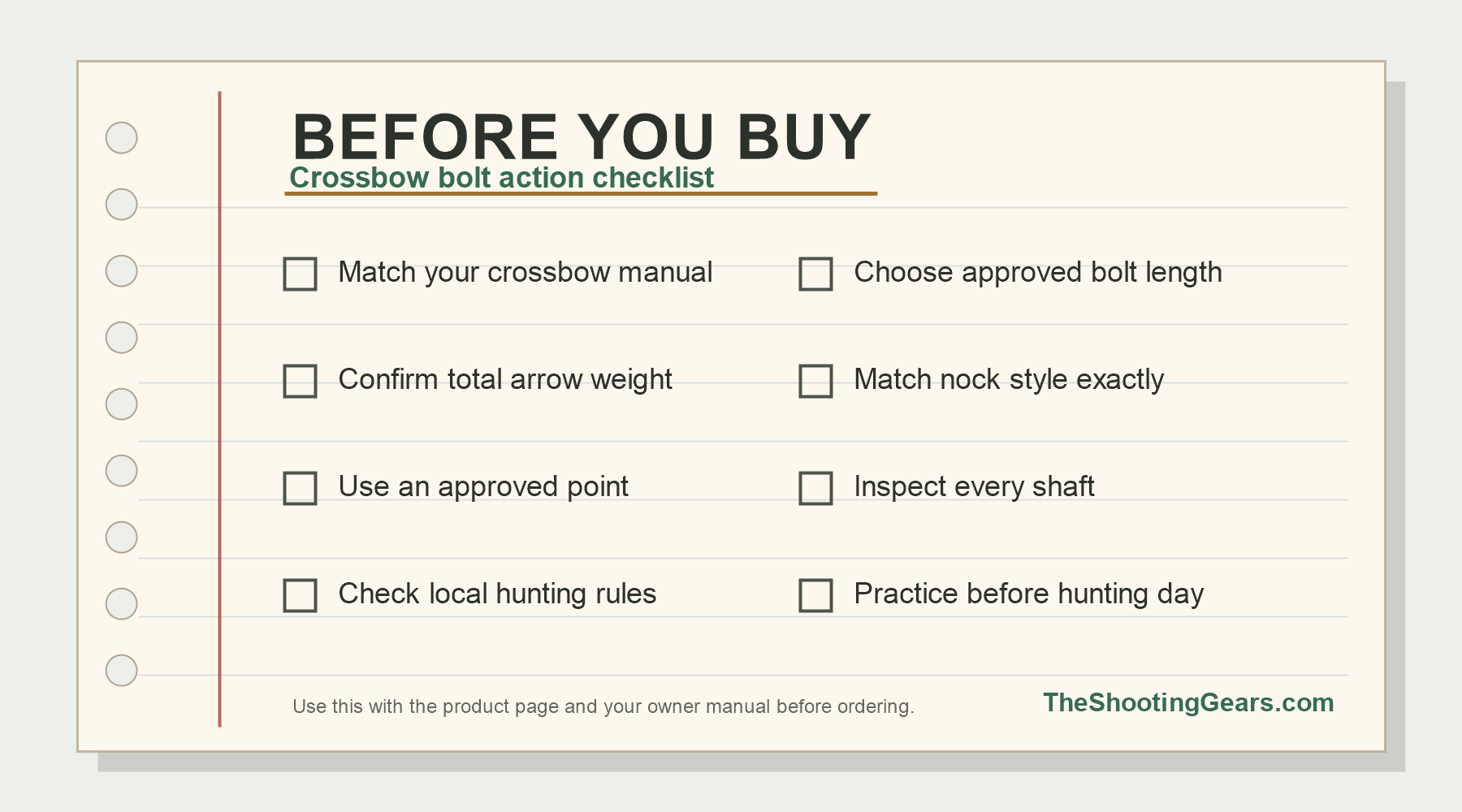
Print this and tick each box against your manual before you order — it is the whole guide in one page.
What is the difference between a crossbow bolt and a crossbow arrow?
Functionally, nothing in modern usage. "Bolt" is the traditional term for the short projectile shot from a crossbow, while most manufacturers now label the same product as a "crossbow arrow" because today's fletched, insert-equipped shafts are built like arrows. Product listings use the terms interchangeably, so search for both when hunting for a specific length or nock.
Can I shoot my compound bow's arrows out of a crossbow?
No, unless the manufacturer explicitly approves it. Vertical-bow arrows are longer, usually lighter, and their nocks are designed to snap onto a string rather than sit in a rail groove. A nock that grips the string can hold the arrow after release or fail to launch cleanly, and an under-weight arrow can behave like a dry fire.
How long do crossbow bolts last?
There is no set shot count. Carbon shafts last until they take an impact that starts a crack, which can be shot one or shot five hundred. Judge by inspection, not age: flex and cotton-test after every session, and retire any shaft that fails. Nocks and vanes are consumables and should be replaced far more often than shafts.
Do I really need to square my arrow shafts?
If you build or repair your own arrows, yes — it is the cheapest meaningful accuracy upgrade available. A shaft end that is even slightly out of square tilts the insert, which tilts the broadhead, which produces the tip wobble you can see on an arrow spinner. Factory-fletched premium arrows are usually squared already, but budget arrows frequently are not.
Why do my broadheads hit somewhere different than my field points?
Because a broadhead has planing surfaces and a field point does not, it magnifies any imperfection in arrow flight. Before touching your optic, check nock fit and half-moon indexing, spin-test each broadhead for wobble, confirm the vanes clear the rail and retainer, inspect the string serving for wear, and make sure the broadhead weight matches the field points you sighted in with.
Are lighted nocks legal, and do they affect accuracy?
They are legal in the majority of states but restricted or prohibited in a few, and rules can differ on specific public properties, so confirm with your state agency each season. Practically, a lighted nock adds a small amount of weight at the rear of the arrow, which slightly reduces FOC and can move point of impact — so sight in with the same lighted nocks you plan to hunt with, not with standard nocks.
What FOC should I aim for on a deer arrow?
Moderate FOC is plenty for whitetail-sized game, and most factory crossbow arrows with standard or brass inserts already land in a workable range. Raising FOC with a heavy insert or a 125-grain head can help broadheads stabilize sooner; pushing it much further mainly adds drop without meaningfully improving results on a deer. Verify any change on the target rather than assuming.
Should my practice arrows match my hunting arrows exactly?
Ideally, yes — same length, same shaft, same nock, and the same finished weight, using field points that match your broadhead weight. If budget forces a cheaper practice shaft, at minimum match the total grain weight so the trajectory you are training on is the trajectory you will shoot at a deer.
How many bolts should I carry while hunting?
Three to four in the quiver is a sensible working number: one loaded, one for a fast follow-up, and one or two spares in case a shaft is damaged during recovery. Carry a spare nock and a broadhead wrench with them.
Final Recommendation
The best crossbow bolt for deer hunting is the one that fits your crossbow manual first, then your hunting setup. If you want a balanced starting point, begin with a mid-weight option like the Gold Tip Ballistic .300 and verify the selected length, nock, and finished weight. If your crossbow calls for a heavier setup, compare the Gold Tip Nitro .272 or Carbon Express PileDriver. If you want a premium carbon arrow, compare the Black Eagle Executioner. If you prefer aluminum construction, the Easton XX75 Magnum is the backup option to check. For system-specific bows, the Barnett, Excalibur, and TenPoint-compatible picks should only be used when your exact manual approves that arrow setup.
Do not buy by brand, speed, or product count alone. Match the bolt to your manual, confirm the exact variant before ordering, inspect every shaft before shooting, and check your current hunting rules before the season.
More Crossbow Gear Guides
- Top broadheads for crossbows
Conclusion
Everything in this guide reduces to one principle: the arrow serves the crossbow, not the other way around. Length, nock style, and minimum finished arrow weight are non-negotiable safety specifications set by the manufacturer; straightness tolerance, FOC, shaft material, and lighted nocks are preferences you get to choose only after those three boxes are ticked. Get the order wrong and no amount of premium tolerance will save the setup — get it right and even a mid-priced matched set will put a broadhead where you aim it, season after season.
Your next step is concrete and takes about ten minutes: open your crossbow manual to the arrow-specification page, write down the approved length, the approved nock style, and the minimum finished grain weight, then hold that note next to the listing for whichever pick above matches your bow's power range — the mid-weight Gold Tip Ballistic for most mainstream crossbows, the Nitro or PileDriver for high-output bows, the Black Eagle Executioner if you want the tightest published tolerances, or the system-specific Barnett, Excalibur, and TenPoint-family options if your manual names them. Confirm the variant, order enough shafts to practice properly, and spend an afternoon verifying broadhead flight before opening day. That single session is worth more to your season than any upgrade on this page.