Broadhead Comparison: Fixed vs. Mechanical for Big Game
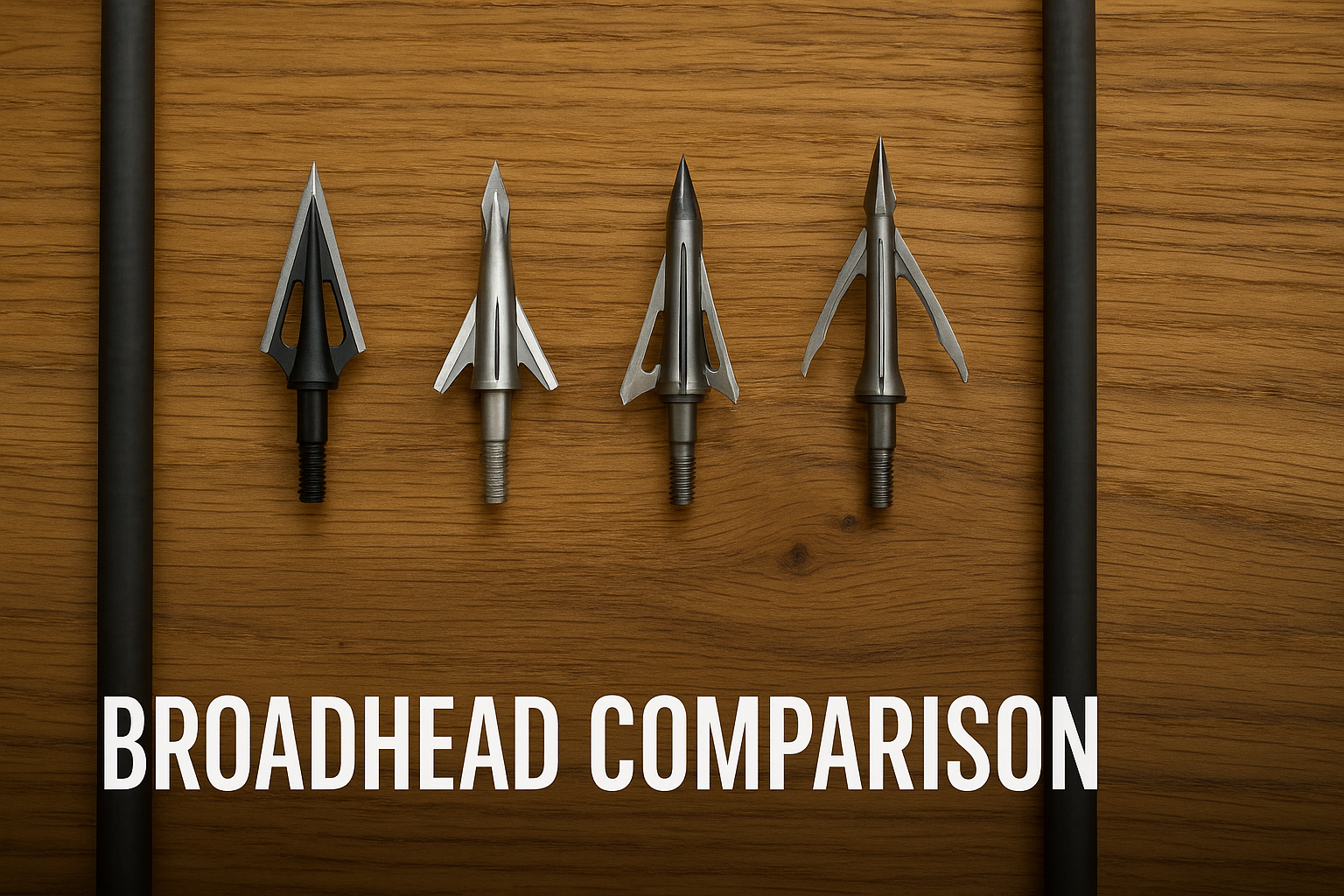
Fixed broadheads use blades that stay rigid in flight, prizing reliability and deep penetration, while mechanical broadheads deploy blades on impact for a larger cutting diameter and easier tuning. For big game, the right choice depends on your draw weight and arrow energy, the size of the animal, how well your bow is tuned, and the broadhead rules in your hunting area. Neither type guarantees a clean recovery. Your shot placement and your tuning matter more than the marketing on the package.
This comparison walks through reliability, cutting diameter, tuning demands, how each type fits different animals, and the regulations and ethics that should anchor the decision. For a wider point-type overview, see our types of arrowheads guide. Always confirm broadhead legality with your state wildlife agency before you hunt.
How fixed and mechanical broadheads work
A broadhead is the cutting tip you screw onto a hunting arrow. The two main designs differ in how their blades are arranged in flight.
Fixed blade broadheads
Fixed blade broadheads have rigid blades that are part of, or locked into, the head and do not move. Because nothing has to open on impact, there are fewer parts to fail. The blades are exposed in flight, which means they can catch air and affect arrow flight if the bow is not well tuned.
Within the fixed category there are meaningful sub-styles worth knowing before you buy. One-piece forged or machined heads have no blade slots or screws at all and are the toughest option on heavy bone, but they must be resharpened rather than reloaded. Replaceable-blade fixed heads use a ferrule with slotted blades you swap out, which is far more convenient mid-season. Blade count matters too: two-blade cut-on-contact heads start cutting the instant they touch hide and generally penetrate deepest, three-blade heads balance penetration with a more even wound channel, and four-blade or bleeder-blade designs trade a little penetration for more cutting surface. Vented blades (the ones with cutouts) reduce surface area and steady flight slightly, which is why they show up on so many modern fixed heads.
Mechanical broadheads
Mechanical, or expandable, broadheads keep their blades folded against the body in flight and deploy them when the head strikes the animal. The folded profile flies much like a field point, which makes them more forgiving in flight. The deploying mechanism is one more thing that must function correctly, and opening the blades uses some of the arrow’s energy.
Expandables differ mainly in how the blades swing. Front-deploying heads pivot the blades forward and outward from a tip-mounted pivot point; they usually cut a full-diameter entry hole but consume more energy opening against tissue. Rear-deploying (over-the-top) heads sweep the blades back along the ferrule, which tends to be more energy-efficient but can produce a smaller entry wound. Retention is the other variable: O-rings, shock collars, clips, or a mechanical detent hold the blades closed. In practice, a common failure mode is not the head “not opening” but the blades opening early — usually from a nicked O-ring, a missing collar, or a head that rattled loose in a quiver. Carry spare collars and inspect them every time you pull an arrow.
Hybrid and single bevel designs
Two variants sit outside the neat fixed-versus-mechanical split. Hybrid heads pair a small fixed blade set with deployable bleeder blades, aiming to keep a mechanical backup cut while retaining a rigid primary edge — useful if you want extra width but hunt heavy-boned animals. Single bevel heads are fixed two-blade designs sharpened on only one side of each blade, which makes the arrow rotate as it drives through tissue and can help split bone rather than skid off it. Single bevels demand a well-matched arrow spine and a bow tuned tightly enough that the head’s rotation is not fighting arrow yaw, so treat them as an advanced option rather than a default.
Reliability and penetration
Fixed blade broadheads are generally considered the more mechanically reliable option because they have no moving parts to fail. They also tend to penetrate deeper for a given amount of arrow energy, since none of that energy is spent opening blades and the narrower fixed profiles can drive through tissue and bone efficiently.
Mechanical broadheads sacrifice some penetration to power blade deployment. With modern designs and adequate arrow energy this is often a manageable tradeoff on thin skinned game, but as animals get larger and bones get heavier, the penetration margin matters more. Hunters using lower draw weights or lighter arrows often lean toward fixed heads for that reason. You can review broadhead and bowhunting fundamentals through Bowhunter-Ed.
It helps to think in momentum rather than kinetic energy. Kinetic energy scales with the square of speed, which flatters fast, light arrows, but penetration through hide, muscle, and bone tracks more closely with momentum — mass carried forward. That is why a heavier arrow at a modest speed frequently outpenetrates a very light arrow moving much faster, and why raising total arrow weight is usually the cheapest fix for a marginal setup. Arrow manufacturers such as Easton Archery publish spine and grains-per-inch charts that make it straightforward to build heavier without wrecking your spine match. The other half of the equation is friction: a compact ferrule, tight blade fit, and a genuinely sharp edge all reduce drag through tissue. A dull broadhead pushes tissue instead of slicing it and can cost you more penetration than the fixed-versus-mechanical choice ever will.
Cutting diameter and wound channel
Cutting diameter is where mechanical heads usually lead. Because the blades swing out beyond the arrow shaft, expandables commonly open to a wider cutting diameter than most fixed heads, which can create a larger wound channel and a better blood trail when everything works as designed.
Fixed heads generally have a smaller cutting diameter set by their physical blade width, though wide fixed and hybrid designs exist. The practical point is a tradeoff: mechanicals can offer more cutting width, while fixed heads trade some width for reliability and penetration. More cutting width only helps if the head still penetrates into the vitals, which is why energy and shot placement decide the outcome more than diameter alone.
Two holes usually beat one wide hole
Experienced trackers will tell you that an exit wound is worth more than an extra half inch of cutting diameter. Blood escaping only from an entry hole high on the ribcage often pools inside the chest cavity, and from an elevated treestand angle the entry hole can be sealed by hide and hair within a few strides. A pass-through leaves a low exit hole that drains, producing the kind of trail you can follow at dusk. That single fact reframes the whole comparison: choose the widest head your setup can still drive completely through the animal, not the widest head on the shelf. If you are hunting from height, plan for a steeper angle and accept that a slightly narrower, harder-hitting head may serve you better than a maximum-diameter expandable.
Tuning and accuracy demands
Tuning is often the deciding factor for many hunters. Because mechanical heads fly with their blades folded, they tend to behave like the field points you practice with, so they are more forgiving of small tuning imperfections and hold a tight group at longer distances more easily.
Fixed heads demand a well tuned bow. The exposed blades act like small wings and will exaggerate any imperfection in arrow flight, so fixed heads usually require careful paper tuning or broadhead tuning to fly true. Many hunters who shoot fixed heads consider that tuning a benefit, because a bow tuned to shoot fixed heads accurately is tuned well overall. Whichever type you choose, practice with the exact broadheads you will hunt with, not just field points.
Broadhead tuning, step by step
If your fixed heads are hitting away from your field points, work through the process in order rather than guessing at rest adjustments:
Check the hardware first. Confirm the head spins true on the shaft with a spin tester or by rolling the arrow tip on a hard surface. A bent insert, an off-square shaft end, or a head that is not seated flush will never tune out.
Verify centershot and nocking point. Start from the manufacturer’s recommended rest position and a level or slightly nock-high nocking point, then paper tune at about six feet for a clean bullet hole.
Bare shaft tune if you can. An unfletched shaft grouping with fletched shafts at 15 to 20 yards tells you the arrow is leaving the bow straight, which is exactly what fixed heads punish you for missing.
Broadhead tune at distance. Shoot field points and broadheads at 20 to 30 yards, then move the rest a very small amount toward the broadhead group — left if broadheads hit left, and so on — until the two groups converge.
Confirm fletching clearance. Dust the fletchings with foot powder or lipstick and check for contact marks on the rest and riser. Contact will masquerade as a tuning problem forever.
Re-check after any change. New strings, a different rest, a change in arrow weight, or even a hot-to-cold weather swing can shift point of impact enough to matter at hunting distances.
A common mistake is chasing tune with sight adjustments. Moving the sight makes broadheads and field points hit together at one distance while the arrow is still flying badly, and the error reappears the moment you shoot farther. Tune with the rest, then sight in.
Arrow build: weight, spine, and FOC
The broadhead is the last three inches of a system, and the rest of the arrow decides whether that head can do its job. Spine — the shaft’s stiffness — must match your draw weight, draw length, and total point weight; adding a heavy insert or a 125 grain head effectively weakens a shaft’s dynamic spine, which is a frequent cause of “my fixed heads plane and my field points don’t.”
Total arrow weight. Heavier arrows carry momentum and quiet the bow. Many big game bowhunters land somewhere in the 425 to 500 grain range for elk-class animals and a bit lighter for whitetails, but the honest answer is to build to the heaviest arrow that still gives you a trajectory you can shoot confidently inside your maximum range.
FOC (front of center). Weight biased forward stabilizes the arrow and helps it recover quickly from the bow, which is exactly what a bladed head needs. Moderate to high FOC generally improves fixed head flight; extreme FOC can cost trajectory, so change one variable at a time and shoot it.
Point weight. 100 grain heads dominate the market, but 125 and 150 grain heads are useful tools for raising FOC and total weight without changing shafts. Check that your intended head is offered in the weight you tune around before you commit.
Components. Squared shaft ends, quality inserts or outserts, and collars on the front end all reduce the chance of a bent insert on impact — which is the most common reason a head stops spinning true after one shot into a target.
Build the arrow first, confirm it flies cleanly, then choose the broadhead the arrow can drive. Doing it in the opposite order is how hunters end up blaming a head for a spine problem. If you are still assembling a system from scratch, our rundown of foundational kit covers the supporting equipment worth budgeting for alongside arrows and heads.
Matching the broadhead to the animal
The size and toughness of the animal should steer the choice along with your setup’s energy.
Whitetail and similar thin skinned deer: Both types work well when the bow is tuned and arrow energy is adequate. Many hunters value the larger cutting diameter of mechanicals here.
Elk and larger, heavier boned big game: Penetration is at a premium, so many experienced hunters favor a strong fixed blade head, especially with higher draw weights and heavier arrows.
Lower draw weight or youth setups: A reliable fixed head, or a mechanical specifically rated for lower energy, helps preserve penetration.
Match the broadhead to your real arrow setup. Total arrow weight, draw weight, and arrow speed determine how much energy is available, and that energy budget should guide whether you can afford the deployment cost of a mechanical head on the animal you are hunting.
Notes on other big game species
Black bear. Long hair and heavy fat plug wounds and soak up blood, so exit holes are critical. Many bear hunters run a durable fixed head or a narrow, high-reliability mechanical and wait for a genuine broadside shot with the near leg forward.
Wild hogs. Mature boars develop a gristle shield over the shoulder that punishes marginal penetration. Heavier arrows and a stout fixed head are the conservative answer; tuck the shot tight behind the shoulder rather than on it.
Moose and other heavy-boned game. Sheer tissue depth means momentum wins. A single bevel or heavy two-blade fixed head on a heavy arrow is the traditional choice for a reason.
Pronghorn and open-country deer. Shots can be longer and windier, so flight consistency carries extra weight. This is where a well-made mechanical earns its keep, provided your energy is adequate.
Backcountry and mountain hunts. When the animal may fall miles from the truck, reliability beats novelty. Hunters heading out on a demanding mountain hunt abroad rarely gamble on a head they have not shot all summer, and a well-fitted load-hauling pack for big animals belongs in the plan long before the shot happens.
Preseason scouting shapes the decision more than most hunters admit. If remote cameras on your food plots show that shots will be under 30 yards from a stand, you have room for a wider head; if the pattern says 50-yard field edges, flight consistency and a proven maximum range matter more than cutting width.
Crossbows and fast bows: what changes
High-speed crossbows and very fast compounds change the equation in two ways. First, impact velocity is higher, which stresses ferrules, blade slots, and retention systems — several manufacturers void warranties or simply state that a head is not rated above a given fps. Always check the speed rating printed on the packaging before you screw a head onto a 450 fps crossbow bolt. Second, short, stiff bolts with heavy front ends behave differently in flight than arrows, and some fixed heads that plane badly from a compound stabilize nicely on a bolt.
Crossbow shooters also face a practical difference at the shot: no let-off drift, but far more weight to hold steady, which is why a rest or shooting stick is common in blinds. If you are still deciding between platforms, the trade-offs in choosing between the two archery platforms affect broadhead selection as much as they affect how you carry and cock the weapon. Whichever you shoot, buy heads specifically labeled as crossbow-rated when you are near the top of the speed range.
Regulations and legality
Broadhead legality varies by location and is not something to assume. Some states and provinces set a minimum cutting diameter or width, some restrict or specifically allow mechanical broadheads, some require a minimum number of cutting edges, and some set minimum draw weight or arrow requirements for big game. These rules also change between seasons and species.
Before you buy or hunt, confirm the current broadhead rules with your state or provincial wildlife agency. Federal wildlife resources and hunter education sites can point you to the right authority, including the U.S. Fish and Wildlife Service and Bowhunter-Ed, but the legally binding rules are the ones your wildlife agency publishes for your hunt. This article is general information, not legal advice.
How to check the rules for the 2026 seasons
Regulations are now published almost entirely online, and most agencies update their digest before each license year rather than on a fixed calendar date. Practical habits that keep you legal:
Pull the current-year digest for the specific state, species, and season you are hunting — archery-only, general, and special-permit seasons can carry different equipment rules.
Search the digest for the words “broadhead,” “cutting,” “expandable,” and “draw weight” rather than skimming; the requirements are often buried in a legal equipment table.
Re-check when you cross a state line or hunt public land under a federal agency, since refuge and military-installation rules can be stricter than statewide law.
Save a PDF or screenshot of the relevant page to your phone before the season, because cell service in the field is unreliable and a warden’s question is not the moment to go looking.
Confirm eligibility rules too, not just equipment. Licensing questions such as restrictions tied to a criminal record are handled at the state level and change more often than most hunters realize.
Certified hunter education courses through Hunter-Ed are the fastest way to get grounded in the general framework, but treat them as background, not as the current legal text for your unit.
Ethical shot selection
The most ethical broadhead is the one you can place accurately into the vital area on a calm, broadside or quartering away animal, within a range you have proven you can shoot. No broadhead design compensates for a marginal shot or a distance beyond your practiced ability.
Practice with your hunting broadheads until your groups are consistent, set a personal maximum range and stay inside it, and pass on shots that are too far, obstructed, or poorly angled. A sharp, reliable head matched to your setup, combined with disciplined shot selection, is what leads to clean, ethical results. Treat recovery as part of the responsibility, not an afterthought.
Angles that work, and angles to pass
Broadside and quartering-away shots let the arrow travel through both lungs with nothing but ribs in the way; those are the shots worth waiting for. Quartering-toward angles put the near shoulder and its heavy bone directly in the arrow’s path and are the classic setting for a mechanical head to open early and stall. Straight-on and straight-away shots offer almost no margin. From an elevated stand, remember that a steep downward angle raises the exit hole and shortens the path through both lungs — aiming slightly lower on the animal than your instinct suggests often produces a better exit.
Safety belongs in this conversation too. Most bowhunting injuries have nothing to do with the arrow; they involve climbing. Wearing a full-body harness and staying connected from the ground up is non-negotiable, and if your current setup is worn or ill-fitting, upgrading to a properly rated fall-arrest system costs less than one day of missed hunting.
Side-by-side comparison at a glance
| Factor | Fixed blade | Mechanical (expandable) | Hybrid |
|---|---|---|---|
| Moving parts | None | Blades, collars/O-rings, pivots | Deployable bleeder blades only |
| Typical cutting diameter | Roughly 1 to 1.25 in (wide models exist) | Roughly 1.5 to 2+ in | Between the two |
| Penetration | Best for a given arrow energy | Reduced by deployment cost | Good, slightly less than fixed |
| Flight forgiveness | Requires a well tuned bow | Flies close to field points | Closer to fixed |
| Tuning effort | High | Low to moderate | Moderate |
| Best fit | Elk, moose, hogs, bear, low-energy setups | Whitetail, pronghorn, higher-energy tuned bows | Hunters wanting width with a fixed backup |
| Reusability | One-piece heads resharpen indefinitely | Replace blades and collars after most shots | Replace blades; ferrule often reusable |
| Failure modes | Blade loosening, planing if untuned | Early deployment, blade breakage, energy loss | Bleeder blade damage |
| Cost per pack | Wide range; one-piece heads cost more up front, less over time | Moderate to high, plus replacement blades | Moderate to high |
| Crossbow suitability | Widely usable; check speed ratings | Common, but must be crossbow-rated | Check ratings |
Read the table as a starting point, not a verdict. Two heads of the same category can perform very differently, and the version you can shoot into a consistent group at your maximum range is the one that belongs in your quiver.
Sharpness, maintenance, and field care
Sharpness is the variable hunters control most easily and neglect most often. A shaving-sharp edge slices tissue and lets blood vessels open cleanly; a dull edge tears and pushes. Build these habits into your season:
Test edges honestly. A head should shave arm hair or catch on a stretched rubber band with almost no pressure. If you have to press, it is dull.
Resharpen one-piece and single bevel heads with a fine stone or ceramic rod, maintaining the factory bevel angle. Single bevels are sharpened on one side only — sharpening both sides destroys their rotational advantage.
Replace blades rather than resharpening thin replaceable blades. They are inexpensive relative to a season’s worth of preparation, and a fresh blade is more consistent than a touched-up one.
Never hunt with a practice head. Broadheads shot into a target dull instantly and can develop micro-bends in the ferrule. Buy an extra pack, mark them clearly, and keep hunting heads sealed until the week before season.
Fight rust. Carbon steel blades will spot overnight in a damp pack. A light film of oil on the blades wiped off before the hunt is the simplest prevention, and the same rust-fighting lubricant used on firearms works fine on broadhead steel. If a head has already pitted, treat it the way you would pitting on a gun’s metal surfaces — remove it fully or retire the part.
Use a quiver hood that fully covers the blades and check tightness periodically. Heads back out of inserts more often than hunters expect, and a loose head throws point of impact off badly.
Common mistakes and how to avoid them
Buying the head first and tuning around it. Tune the bow and arrow, then select a head your system can drive. This order saves the most frustration.
Sighting in with field points only. Points of impact diverge with distance. Verify with the actual heads at your maximum range.
Ignoring speed ratings on mechanicals. A head rated to 300 fps on a 400 fps crossbow can open in flight or shed a blade on impact.
Assuming a bigger cut solves poor placement. It does not. Width without penetration produces a shallow wound and a hard track.
Reusing a head that has hit bone. Inspect the ferrule for straightness and the blades for chips. If in doubt, replace it.
Skipping the spin test after travel. Arrows rattling in a truck bed or checked luggage bend inserts. Spin every arrow before the first sit of a trip.
Not shooting from hunting positions. Groups from a level range say little about a shot taken seated, twisted, and wearing bulky layers. Practice the way you will hunt, ideally including a few reps at your actual stand height.
After the shot: reading the hit and recovering the animal
The broadhead’s job ends at impact; yours begins. Mark exactly where the animal stood and where it was last seen, then stay put and replay what you saw — arrow angle, the sound of the hit, and the animal’s reaction. Bright, bubbly blood suggests lungs; dark blood with gut contents means a long wait; bright red with a hard, mule-kick reaction often indicates a heart hit and a short trail.
As a general rule, give a well-placed double-lung hit 30 to 60 minutes, a liver hit several hours, and a paunch hit as long as conditions and legal shooting hours allow. Retrieve the arrow if you can do so without pushing the animal, since the shaft tells you a great deal. Mark blood with flagging tape as you go so you can see the direction of travel, work slowly, and keep one person on the last confirmed sign while another searches ahead. Bring a headlamp with fresh batteries and a backup light in every pack — few things ruin a recovery faster than a dead light at midnight. Thinking about recovery gear the same way you think about a broadhead purchase is part of getting organized well before departure, not a decision to improvise after the shot.
How to choose: a quick framework
Confirm what is legal for your species and season with your wildlife agency.
Know your real arrow energy from draw weight, arrow weight, and speed.
For larger or heavy boned game, or lower energy setups, favor reliable fixed heads for penetration.
For thin skinned deer with a tuned bow and adequate energy, either type can work; mechanicals add cutting width.
If your bow is hard to tune for fixed heads, a quality mechanical may fly more consistently.
Always practice with the exact broadheads you will hunt with.
Choose your maximum range based on proven accuracy, not the head’s marketing.
If you want a single default: for a tuned bow at 60 pounds or more shooting a 425+ grain arrow at whitetails, either category will serve you, and the tiebreaker is which head you shoot best. Below that threshold, or on any animal bigger than a deer, bias toward a rugged fixed head every time. Buy two packs of your chosen model — one to practice with, one to hunt — and settle the question in your own backyard rather than in a debate online.
Ready to lock in your setup? Compare current broadhead, arrow, and quiver bundles in our seasonal savings roundup for hunters and buy the spare practice pack now, while the discounts are live and there is still time to tune before opening day.
Frequently asked questions
Are fixed or mechanical broadheads better for elk?
Many experienced hunters favor a strong fixed blade head for elk because penetration through heavier bone and muscle is at a premium. A mechanical can work with enough arrow energy and good placement, but penetration margin is the main concern on larger big game.
Do mechanical broadheads fly more accurately?
Mechanicals fly with their blades folded, so they behave more like the field points you practice with and are more forgiving of small tuning issues. Fixed heads can fly just as accurately, but they require a well tuned bow to do it.
Are mechanical broadheads legal everywhere?
No. Broadhead rules vary by state and province and can restrict mechanicals, set minimum cutting diameters, or require a minimum number of blades. Always confirm the current rules with your wildlife agency before hunting.
Do I really need to practice with broadheads?
Yes. Broadheads can fly differently than field points, especially fixed blade designs. Practicing with the exact heads you will hunt with confirms your point of impact and your true effective range.
Should I shoot 100, 125, or 150 grain broadheads?
Shoot the weight your arrow is tuned around. 100 grain heads have the widest model selection, while 125 and 150 grain heads raise total arrow weight and FOC, which helps penetration and fixed head stability at the cost of a slightly more curved trajectory. Changing point weight changes dynamic spine, so re-tune and re-sight after any switch.
How many broadheads do I need for a season?
Plan on at least two packs: one dedicated practice pack you will dull and possibly bend, and one hunting pack kept sharp. Add replacement blades and spare O-rings or collars if you shoot a mechanical, plus one or two extra heads in case an arrow is lost or a ferrule bends on bone.
Can I reuse a broadhead after harvesting an animal?
Sometimes, but inspect it carefully. Spin-test the arrow, look for a bent ferrule, chipped edges, blades that no longer sit flush, and stretched or nicked retention collars. Replaceable blades should simply be swapped. A one-piece head that is straight and resharpened is fine to reuse; anything you have doubts about should be retired.
What draw weight do I need for big game with a mechanical head?
Rather than a single number, look at the whole system: many mechanical manufacturers specify a minimum draw weight or arrow speed for reliable deployment, and those figures are printed on the packaging. If your setup is at or below that stated minimum, or if you hunt animals larger than deer, a fixed head removes the deployment question entirely.
Do broadheads make bows louder or affect arrow speed?
Broadhead choice barely affects speed at equal grain weight, but it does affect drag downrange — large fixed blades shed a little velocity and are more wind-sensitive than folded mechanicals at longer distances. Noise comes from the bow and arrow weight, not the head; heavier arrows generally make a bow quieter and reduce string jump.
Can I use the same broadhead for turkey or small game?
You can, but purpose-built heads exist for a reason. Wide-cutting mechanicals and specialty turkey heads are designed to anchor birds rather than pass through, and small game blunts or judo points prevent arrows from burying in the ground. For big game, stick to a head legally and mechanically suited to the species you are hunting.
Does the broadhead choice change for a crossbow?
The principles are identical, but check the manufacturer’s speed rating. High-velocity crossbows can damage heads that were never designed for that impact energy, and many brands offer crossbow-specific versions with reinforced ferrules and stronger blade retention. Bolt spine and front-of-center behavior also differ from arrows, so tune with the exact bolts and heads you will hunt with.
Final takeaway
Fixed broadheads lead on reliability and penetration, while mechanical broadheads lead on cutting diameter and forgiving flight. The better choice for big game comes from your own setup: your arrow energy, the animal you are after, how easily your bow tunes, and what your wildlife agency allows. Confirm the regulations, build enough energy for the game, practice with your actual hunting heads, and choose shots you have proven you can make. The head matters, but disciplined shot placement and honest range limits matter more.
Related reading: youth archery gear guide and bow sight setup guide.
Conclusion
There is no universally “best” broadhead, only the best match between a head, an arrow, a bow, and an animal. Fixed heads reward a well-tuned system with penetration and mechanical simplicity, which is why they remain the default on elk, moose, bear, and hogs. Mechanicals reward hunters who want field-point flight and maximum cutting width on thin-skinned deer with adequate energy behind the arrow. Everything else — momentum, sharpness, shot angle, and honest range limits — matters more than which category you pick.
Your next step is simple and takes one afternoon: pull the current regulations for the state and species you plan to hunt, weigh your finished arrow, then shoot three of your actual hunting-model heads alongside three field points at your maximum range. If the groups overlap, you have your answer. If they do not, work the tuning steps above before you buy anything new — the fix is almost always in the tune, not in the next head on the shelf.