Best Crossbow Scopes: 4 Verified Picks for Hunting and Range Setup

If you want the best crossbow scope, start with crossbow-specific support, not a random rifle optic. A good crossbow scope should match your bow speed, bolt weight, zero distance, rail setup, and the way you confirm holdover marks before hunting.
This rebuild removes older rifle-scope mismatches and keeps the page focused on four verified crossbow-scope options from Vortex, Hawke, UTG, and TRUGLO. Before buying, recheck the current Amazon listing, your crossbow manual, your bolt setup, and your local hunting rules.
Table of Contents
Quick Picks
Crossbow Scope Comparison Table
Best Crossbow Scope Reviews
Vortex Crossfire II 2-7×32 Crossbow Kit
Hawke XB1 1.5-5×32 SR Crossbow Scope
UTG 4X32 1-Inch Crossbow Scope
TRUGLO 4x32mm Compact Crossbow Scope
How to Choose a Crossbow Scope
Crossbow Scope Setup and Safety Checks
FAQ
Final Verdict
Quick Picks
Pick Product Best for Amazon
Best overall Vortex Crossfire II 2-7×32 Crossbow Kit Hunters who want a current kit with variable magnification and a crossbow-specific reticle. Check Amazon
Best speed-calibrated variable Hawke XB1 1.5-5×32 SR Crossbows in the 250-425 fps range where speed calibration matters. Check Amazon
Best budget fixed power UTG 4X32 1-Inch Crossbow Scope Simple fixed 4x setup, especially around the manufacturer's 300 fps calibration context. Check Amazon
Best basic BDC scope TRUGLO 4x32mm Compact Crossbow Scope Affordable compact BDC/rangefinder-style setup with included rings. Check Amazon
Crossbow Scope Comparison Table
Product Magnification Tube Key fit note Skip if
Vortex Crossfire II 2-7×32 Crossbow Kit 2-7x 30mm XBR-2 reticle is designed for a 40-yard zero and crossbow holdovers. You need the lowest-cost fixed-power scope.
Hawke XB1 1.5-5×32 SR 1.5-5x 1 inch Speed-calibrated for 250-425 fps crossbow setups. Your crossbow speed falls outside the supported range.
UTG 4X32 1-Inch Crossbow Scope Fixed 4x 1 inch Manufacturer reticle context is built around 300 fps crossbows. You want variable magnification or a speed ring.
TRUGLO 4x32mm Compact Crossbow Scope Fixed 4x 1 inch Compact BDC/rangefinder-style option with 4-inch eye relief. You want a premium variable optic.
How This List Was Verified for the 2026 Season
All four picks were re-checked against the manufacturers' own current product data — model names, reticle designations, tube diameters, eye relief, and stated calibration ranges — rather than against older third-party spec sheets that tend to drift over time. Where a previous Amazon listing had gone inactive, the ASIN was replaced with the live listing for the same product, not a "close enough" substitute.
What we deliberately did not do is publish invented ballistic tables or claim a specific yardage for each reticle mark. No honest roundup can do that, because the same scope on a 320 fps bow and a 410 fps bow produces two completely different sets of numbers. Every product entry below tells you what the maker supports and what you still have to confirm yourself on a target. Prices and stock change constantly, so treat the buy links as a current-price check, not a fixed quote.
Crossbow Scopes vs Rifle Scopes: Why the Difference Actually Matters
It is tempting to bolt a spare rifle optic onto a crossbow — the rails often look similar and the scope is already sitting in a drawer. In practice there are four real differences that decide whether it works.
- Trajectory shape. A bolt leaves the rail at roughly 300–450 fps, while a common centrefire bullet leaves the muzzle several times faster. That means a crossbow bolt drops steeply and quickly, so useful aiming references have to be stacked much closer together and start dropping hard past 40 yards.
- Reticle spacing. A rifle BDC is designed around a 100-yard or 200-yard zero. A crossbow reticle is designed around a 20-, 30-, or 40-yard zero with marks that cover a total window most rifle shooters would call "point blank."
- Recoil signature. Crossbows do not recoil like a rifle, but they do produce a sharp forward-and-back vibration spike at the shot. Some rifle scopes handle it fine; some shift zero or lose a reticle cell. Manufacturer approval for crossbow use is the only reliable way to know which one you have.
- Parallax setting. Rifle optics are usually parallax-fixed at 100 or 150 yards. Crossbow scopes are commonly set far closer — the Vortex above is listed at 75 yards — which matters when you are shooting at 25 yards from an awkward head position.
If you also run a centrefire rifle, the selection logic is different enough that it is worth reading up on picking glass for a centrefire separately rather than assuming one buying checklist covers both. The same goes for the bow itself: simpler limb layouts tend to sit at more moderate speeds than aggressive compound rigs, and that changes which reticle system fits you. When in doubt, check the optic maker's own crossbow category — brands like Vortex Optics list crossbow-approved models separately from their rifle line for exactly this reason.
Best Crossbow Scope Reviews
Vortex Crossfire II 2-7×32 Crossbow Kit

The Crossfire II crossbow kit ships as a package: scope, rings, flip caps and a neoprene cover.
The Vortex Crossfire II 2-7×32 Crossbow Kit is the best overall pick here because it is a current crossbow-specific kit with a dedicated reticle system and solid manufacturer support. Vortex lists the Crossfire II Crossbow Kit with an XBR-2 MOA reticle, 2-7x magnification, 32mm objective, 30mm tube, 2.7 inches of eye relief, and a 75-yard parallax setting.
The main advantage is the reticle design. Vortex describes the XBR-2 reticle as built for crossbows with a 40-yard zero and holdovers from 20 to 100 yards. That gives hunters a structured setup path, but it still does not mean the marks will match every crossbow automatically. Your bow speed, bolt weight, point weight, and real zeroing results still decide what the marks mean in the field.
This is also the most premium-feeling choice in this shorter lineup. The variable 2-7x magnification gives more flexibility than a fixed 4x scope, and the kit format can help if you want rings included. The 30mm tube is also important: check rail fit, ring height, cheek weld, and clearance before assuming it will mount perfectly on your crossbow.
Best for: hunters who want a current crossbow-specific scope kit with variable magnification and a reticle system designed for real holdover work.
Source note: Vortex's official product page supports the model, reticle, magnification, tube size, and key optical specs.
Pros
Current crossbow-specific kit from a major optics brand.
2-7x magnification is more flexible than fixed 4x.
XBR-2 reticle is designed for crossbow holdovers.
Good fit for hunters who want a structured zeroing system.
Cons
Costs more than basic fixed-power options.
30mm tube/ring setup must match your rail and cheek weld.
Holdover marks still need live confirmation with your own bolts.
Skip if: you only need a low-cost fixed 4x scope or your crossbow setup does not match the way the reticle is intended to be zeroed.
Note: The originally linked listing for this kit went inactive. The current listing here is the same Vortex Crossfire II 2-7×32 Crossbow Scope Kit (scope, rings, flip caps, neoprene cover), verified via Vortex's own product data as of this update.
One practical setup note: the XBR-2 is built around a 40-yard zero, not the 20-yard zero many crossbow hunters default to out of habit. If you zero at 20 and then try to use the lower marks, nothing will line up and the scope gets blamed unfairly. Follow the reticle's intended zero first, then read the rest of the stadia against your own chronographed speed.
Hawke XB1 1.5-5×32 SR Crossbow Scope
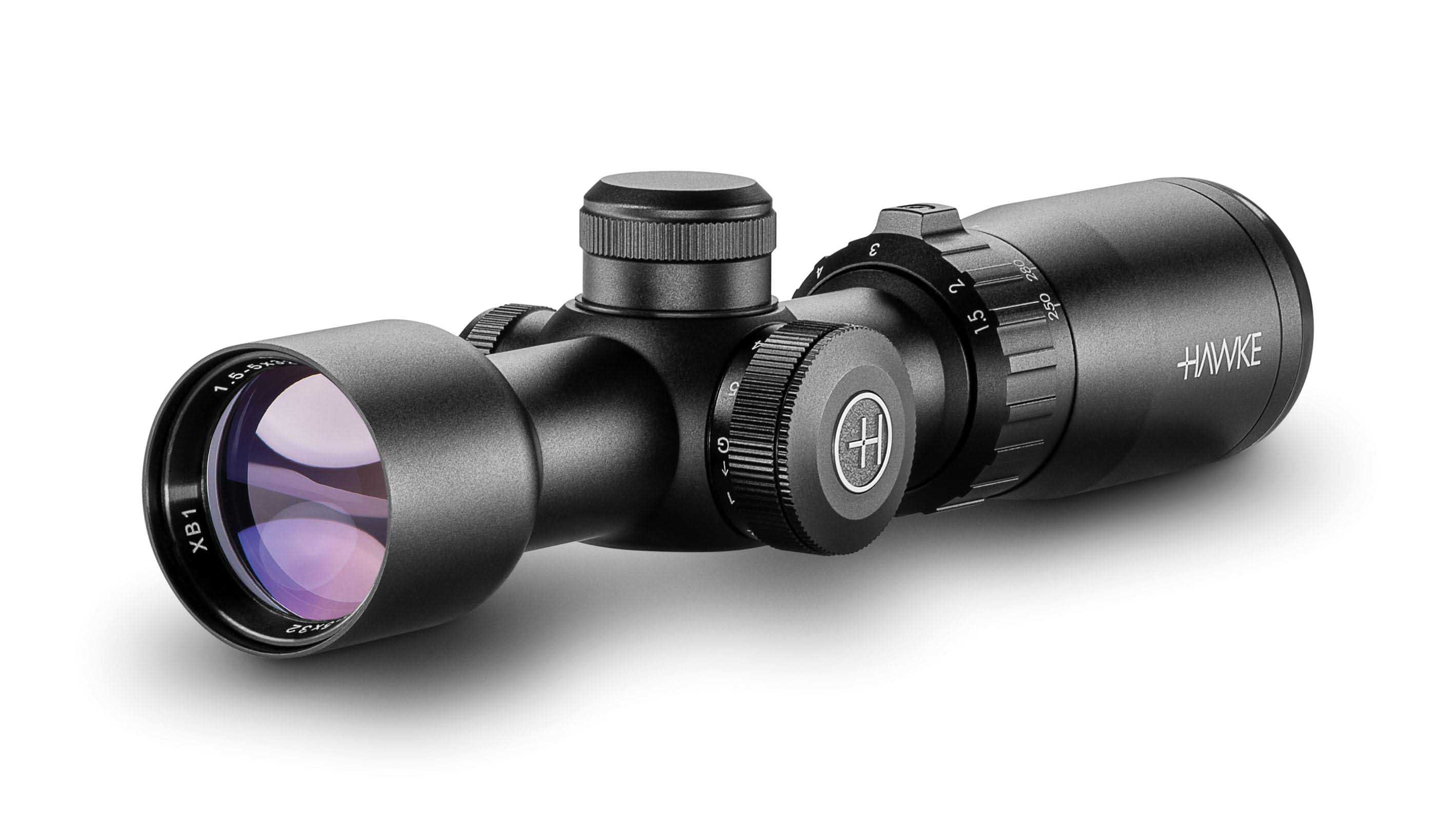
Note the low-profile capped turrets — they stay put in a case or a tight blind.
The Hawke XB1 1.5-5×32 SR is the best speed-calibrated variable scope in this group. Hawke identifies this model as a crossbow scope, and the source packet supports the 250-425 fps calibration range, 1-inch tube, illuminated XB1 SR reticle, waterproof/fogproof construction language, and capped low-profile turret design.
The reason to choose this scope is speed matching. If you know your crossbow speed and it falls inside Hawke's supported range, the scope gives you a more tailored setup than a basic fixed 4x optic. That can be useful for hunters who want a practical range of magnification without stepping into a heavier or more expensive scope.
The important caution is that speed calibration is not a shortcut around range work. Set the scope according to the manual, then confirm impact at the distances you actually plan to use. Broadhead weight, bolt weight, nock style, and bow tune can all shift real impact compared with a simple chart.
Best for: crossbow users in the 250-425 fps range who want a speed-calibrated variable scope.
Source note: Hawke's official product page supports the XB1 1.5-5×32 SR model and crossbow-specific positioning.
Pros
Dedicated crossbow scope, not a rifle-scope stand-in.
Speed calibration range gives it a clear fit scenario.
1.5-5x magnification works for close and moderate crossbow distances.
Good middle-ground option between basic and premium picks.
Cons
Not ideal if your crossbow speed is outside the supported range.
Requires careful setup and range confirmation.
Still needs the exact Amazon listing checked before buying because listings can change.
Skip if: your crossbow speed is unknown, outside 250-425 fps, or you prefer a simple fixed-power scope.
Why the bottom end of the magnification range matters: at 1.5x you keep a wide field of view and a very forgiving eye box, which is what you actually want on a 15-yard shot from a ground blind when a deer appears in your peripheral vision. A lot of hunters leave a variable scope cranked to maximum power all season and then struggle to find the animal in the tube. Set it low, dial up only when you have time.
UTG 4X32 1-Inch Crossbow Scope

Quick-detach rings are included, which saves buying a separate mount for a budget build.
The UTG 4X32 1-Inch Crossbow Scope is the practical budget fixed-power pick. The SourceFix packet tied this product to the Leapers/UTG official page for model SCP-M4CR5WQ, which lists the UTG True Hunter 4X32 1-inch Crossbow Scope with RGB illumination and a PRO 5-Step reticle.
UTG's reticle context is built around 10, 20, 30, 40, and 50 yard references and a 300 fps crossbow calibration. That makes the scope easy to understand, but it also means it is not a universal ballistic calculator. A faster or slower crossbow, different bolt weight, or different point setup can change where each mark lands.
This is a good fit for buyers who want a straightforward optic with included QD rings and do not need variable magnification. Fixed 4x is simple, but simplicity has tradeoffs: you do not get a speed ring, and you should not expect the same precision/flexibility as a higher-end variable scope.
Best for: budget-minded crossbow users who want a simple fixed 4x scope and are willing to confirm the reticle marks at the range.
Source note: Leapers/UTG official support confirms the crossbow scope model, reticle intent, illumination, and included mount details.
Pros
Dedicated crossbow-scope listing and official product support.
Simple fixed 4x magnification.
Reticle references are easy to understand.
Includes QD ring mounts in the official source packet.
Cons
Fixed power only.
300 fps reticle context may not match every crossbow.
Less flexible than Vortex or Hawke variable options.
Skip if: you want a variable scope, a speed-adjusted reticle system, or a higher-end optic for longer-range confirmation work.
A realistic expectation on the 300 fps reticle: modern crossbows in the 380–450 fps class will shoot flatter than this reticle assumes, so the lower marks will tend to hit high. That is not a defect — it just means the "50 yard" line may actually be your 60-yard line. Write your real yardages on a strip of tape on the stock and stop thinking of the marks by their printed numbers.
TRUGLO 4x32mm Compact Crossbow Scope
The compact body and 4-inch eye relief suit shorter, blind-friendly crossbow builds.
The TRUGLO 4x32mm Compact Crossbow Scope is the best basic BDC option here. TRUGLO's official product page supports the 4x32mm compact crossbow scope positioning, illuminated range finder/BDC reticle, fully coated lenses, 4-inch eye relief, Weaver-style rings, and nitrogen-filled weather-resistant construction language.
This scope makes sense if you want an affordable compact optic with drop references and included rings. It is not the most advanced scope in the group, but it fits the reader who wants something crossbow-specific and simple instead of a rifle optic incorrectly repurposed for crossbow use.
The big buyer note is BDC verification. TRUGLO's own guidance warns that reticle marks are not automatically fixed to exact yardages for every crossbow. Treat the marks as references to verify, not as promises. Sight in carefully and test your actual bolt and point setup before hunting.
Best for: buyers who want a compact 4x crossbow scope with basic BDC/rangefinder-style aiming references.
Source note: TRUGLO's official page supports the crossbow scope positioning, reticle style, eye relief, rings, and optical/weather-resistance features.
Pros
Affordable compact option.
Crossbow-specific product support.
4-inch eye relief can be useful for many setups.
Includes Weaver-style rings in the official source packet.
Cons
Fixed 4x only.
BDC marks require real-world confirmation.
Not as flexible as Vortex or Hawke variable scopes.
Skip if: you want variable magnification, a premium reticle system, or a speed-calibrated scope.
Where the generous eye relief pays off: 4 inches gives you room to shoulder the bow awkwardly — sitting, twisted, or leaning around a blind window — and still find a full sight picture. That is worth more to most hunters than an extra half-power of magnification, particularly on shorter crossbows where the scope ends up close to your face.
Quick Decision Guide: Which of the Four Fits You?
| If this describes you… | Pick | The trade-off you accept |
|---|---|---|
| Fast modern bow, you want room to grow, and you'll do proper range work | Vortex Crossfire II 2-7×32 Kit | Highest price; 30mm rings must clear your rail and cheek weld |
| You know your exact fps and it falls between 250 and 425 | Hawke XB1 1.5-5×32 SR | Speed ring still needs live confirmation; mid-tier price |
| Entry-level or older bow near 300 fps, tight budget, mounts included | UTG 4X32 | Fixed power only; reticle numbers won't match a fast bow |
| Short crossbow, ground blind, want the cheapest crossbow-specific optic | TRUGLO 4×32 Compact | Basic glass; BDC marks are references, not yardages |
| You're replacing a scope that failed mid-season | Vortex or Hawke | Paying more once beats re-zeroing twice |
Ready to commit? Open the current Amazon listing for the pick that matches your row above, confirm the tube diameter against your rail, and get it mounted with enough daylight left to burn a dozen bolts confirming zero before opening morning.
How to Choose a Crossbow Scope
The safest way to choose a crossbow scope is to match the optic to the actual crossbow setup you use. Start with bow speed, bolt weight, point weight, zero distance, rail type, eye relief, and the distances where you can confirm hits on target. Do not choose by magnification alone.
Match the Scope to Your Crossbow Speed
Some crossbow scopes use a speed-calibrated ring or reticle. The Hawke XB1, for example, is sourced here with a 250-425 fps calibration range. UTG's reticle context is built around roughly 300 fps. If your bow is far outside the scope's intended range, the holdover marks may not line up cleanly.
The number printed on the box is rarely the number you shoot. Advertised speeds are typically measured with a light test bolt at a standard weight, and every grain you add slows the bow down. In practice, a heavier hunting bolt, a heavier point, a lighted nock, string wax build-up, and an aging string can all pull real velocity below the sticker figure. The only way to know is to shoot through a chronograph with your actual hunting bolt — many clubs and pro shops will let you do this in five minutes. If a chronograph genuinely is not available, start from the manufacturer's rating, assume you are somewhat slower with a hunting-weight bolt, and let the target confirm the rest.
Understand BDC and Holdover Marks
BDC marks are helpful only after you verify them. Your bolt weight, broadhead or field point, string condition, speed, and zero distance all affect impact. Use the marks as a starting point, then confirm every distance you plan to use.
A verification routine that works: zero the top mark at the distance the manual specifies, then move back in 10-yard steps and shoot a three-bolt group at each one. Record where the group actually lands relative to the nearest mark. You will usually find the marks correspond to slightly different distances than printed — that is normal and completely workable, as long as you write the true distances down. Then repeat the whole sequence with broadheads, because fixed-blade heads in particular can plane away from field-point impact if the bow is not perfectly tuned. Aim small when you do this: a 1-inch dot teaches you more than a paper plate.
Fixed Power vs Variable Power
Fixed 4x scopes are simpler and often cheaper. Variable scopes such as the Vortex and Hawke give more flexibility, especially when you want a wider field of view at close range and more detail at moderate range. The tradeoff is cost, setup complexity, and sometimes weight.
There is a subtler issue with variable scopes worth knowing: on some designs the reticle subtensions are only correct at one specific magnification setting, usually the top end. If you zoom out to widen your view and then hold on a lower mark, the holdover value changes. Check the manual for whether the reticle is in the first or second focal plane and which power the marks are calibrated at, then get in the habit of parking the ring at that setting. A small dab of paint or a tape witness mark on the power ring makes it obvious at a glance in low light.
Rings, Tube Size, and Rail Fit
Check tube size, included rings, rail type, ring height, and cheek weld. A scope can be optically good and still fit poorly if the mount height or eye relief is wrong. The Vortex is a 30mm tube scope, while Hawke, UTG, and TRUGLO are 1-inch tube options in this rebuilt list.
A few fit details that catch people out:
- Picatinny vs Weaver. Both look similar, but Picatinny slots are wider and evenly spaced. Weaver-only rings may not seat on every crossbow rail, while Picatinny rings usually drop onto Weaver rails without issue.
- Ring height vs objective bell. With a 32mm objective you can normally run low or medium rings, which keeps your line of sight close to the rail and reduces the up-close aiming offset.
- Sight-over-bore offset. Your scope sits roughly 1.5–2.5 inches above the bolt. At 10 yards that offset is real and will put bolts low if you forget it — another reason to test close distances, not just 30 and 40 yards.
- Torque. Use an inch-pound driver and the maker's numbers. Overtightened rings can pinch a tube and shift point of impact; undertightened rings walk under vibration.
- Fore-aft position. Set eye relief with the bow shouldered in your normal hunting position — seated in a blind chair, not standing in a garage.
Low-Light Use and Illumination
Illumination can help reticle visibility, but it does not make unsafe light legal or improve target identification by itself. Confirm local hunting rules and identify the animal, target area, and background clearly before taking a shot.
On brightness settings, a common mistake is running the illumination far too hot at dusk. A reticle blazing at maximum will bloom and swallow the vitals on a dark-coated animal; the lowest usable setting almost always gives a crisper aiming point. Green often reads cleaner than red against a brown-and-grey woods background, though this is individual — test both on a real target at last light rather than in a bright shop. Carry a spare battery in your pack, keep the illumination switched off between sits so you do not drain it, and know where the aiming point sits without illumination in case the battery dies. If you find that even a low-set dot smears or flares for you, that can be an eyesight issue rather than an optics fault — the same phenomenon that causes smeared dots for some shooters with reflex sights.
Crossbow Scope Setup and Safety Checks
Before mounting or zeroing any crossbow scope, read your crossbow manual and the scope manual. Broad safety principles from the NSSF firearm safety rules and hunter education resources such as IHEA-USA are still relevant: know your target, what is beyond it, and the safe direction of the equipment at all times.
Confirm that the scope is supported for crossbow use.
Mount it with the correct rings and torque guidance.
Use manufacturer-approved bolts, nocks, and point weights.
Zero at the distance required by the scope manual.
Verify every reticle mark with your actual crossbow and bolts.
Check current state wildlife agency rules before hunting.
Do not use a rifle scope on a crossbow unless the manufacturer supports that use.
For broader setup help, see our guides to choosing a crossbow, crossbow bolts for deer hunting, and scope zeroing basics.
Step-by-Step: Mounting and Zeroing a Crossbow Scope
- Degrease and dry-fit. Wipe the rail and ring surfaces clean. Set the rings on the rail without the scope and check that they clear the rail's end stop and any cocking device.
- Level the bow, then level the scope. Put the crossbow in a rest so the rail is level, then rotate the scope until the vertical stadia is truly plumb. A canted reticle causes left/right error that grows with distance and is maddening to diagnose later.
- Set eye relief in your shooting position. Shoulder the bow the way you will actually shoot — seated, if you hunt from a chair or stand — and slide the scope until the sight picture is full with no black ring.
- Torque in a cross pattern. Snug the ring caps a little at a time, alternating screws, to the manufacturer's inch-pound spec. Leave an even gap on both sides of each cap.
- Bore-reference at short range. Shoot one bolt at 10 yards into a large target face to confirm you are on paper at all. Do not start at 40 with an untested mount.
- Zero at the manual's specified distance. For most crossbow reticles that is 20 yards; for the XBR-2 it is 40. Follow the scope, not habit.
- Adjust deliberately. Note the click value on the turret, calculate the correction, make the full move at once, then shoot a fresh three-bolt group. Chasing single bolts with tiny corrections wastes an afternoon.
- Walk the yardages back. Confirm 20, 30, 40, and 50 yards, recording true impact against each mark.
- Repeat with broadheads. Then re-check after any string change, transport in a hard case, or a hard fall.
A stable rest makes this whole process shorter and more honest, because it removes you as a variable. A sandbag setup works; so does a shooting stick or tripod — a steady front support is one of the more useful things a crossbow hunter can own, and it doubles as a field rest later. If you are building out a home practice area, the basics of gear worth having at the range apply just as much to bolts as to bullets, especially the backstop.
Common Setup Mistakes We See Repeatedly
- Zeroing with field points and hunting with broadheads without re-checking. This is the single most common cause of a "the scope is off" complaint.
- Mounting the scope too far forward. It looks right on the bench and gives you a black crescent when you shoulder up under pressure.
- Trusting the printed yardage numbers on a reticle. They are model assumptions, not your bow.
- Never re-checking after travel. Rough truck rides, ATV racks, and a dropped case all move zero. Fire two confirmation bolts at camp before the season opens.
- Leaving illumination on all night. Dead battery at first light is a self-inflicted wound.
- Ignoring the close-range offset. A 12-yard shot from an elevated stand is not the same hold as a 12-yard shot from the ground.
- Forgetting the downward angle. From height, horizontal distance is shorter than line-of-sight distance, so bolts hit high. This ties directly into how you plan your elevated setup — practise a few shots at the actual angle you will be shooting.
Caring for Your Crossbow Scope Between Seasons
Nitrogen-purged, o-ring-sealed scopes handle rain and humidity well, but they still need basic care. Blow or brush grit off the lenses before you ever touch them with a cloth — dragging dust across coatings is what causes fine scratches. Use a lens pen or a proper microfibre with a drop of lens fluid, never a shirt tail. Keep flip caps closed during transport, store the bow horizontally rather than resting on the turrets, and pull the illumination battery for long-term storage so it cannot leak.
Once a season, check ring screws for torque, look for any hairline movement marks between ring and tube, and re-confirm zero. If a scope will not hold zero after two careful check cycles with correctly torqued rings, contact the manufacturer rather than fighting it — the major optics brands in this list all run warranty programmes, and a scope that shifts under load is a safety issue, not a quirk.
Field Considerations Beyond the Optic
A scope only earns its keep in the situations you actually hunt. If most of your sits are in dense timber with 15–25 yard shooting lanes, a low fixed power and a big eye box beat magnification every time. If you hunt agricultural edges or open ridges where a 45-yard shot is realistic, the flexibility of a 2-7x and a verified 50-yard mark starts to matter. Shot distances and light conditions shift dramatically by country and cover type, so pick for the ground you actually walk, not the ground in the catalogue photo.
Regulations matter just as much as glass. Crossbow legality, permitted seasons, minimum draw weights, and rules around illuminated optics or lighted nocks vary by state and sometimes by unit — always confirm with your state wildlife agency before the season, and use federal resources such as the U.S. Fish and Wildlife Service when you are hunting a refuge or crossing state lines. What was legal in your state five years ago may have changed; check the current-year digest rather than relying on memory.
Frequently Asked Questions
FAQ
Can I use a rifle scope on a crossbow?
Only if the manufacturer supports that use. Crossbows create different recoil and trajectory demands than rifles, and a rifle scope may not have the right reticle, calibration, eye relief, or durability assumptions.
What magnification is best for a crossbow scope?
For many hunters, fixed 4x or a low variable range such as 1.5-5x or 2-7x is more practical than high magnification. Crossbow hunting distances are usually moderate, and field of view matters.
Are BDC marks accurate for every crossbow?
No. BDC marks depend on speed, bolt weight, point weight, zero distance, and the scope design. Confirm each mark with your own setup before hunting.
What does speed calibration mean on a crossbow scope?
Speed calibration lets the scope's reticle system better match a crossbow's arrow speed range. It still requires range confirmation because real impact can change with bolt and point setup.
Should I pick the cheapest crossbow scope?
Not automatically. A cheap scope is only a good value if it fits your crossbow, holds zero, has a useful reticle, and can be confirmed safely at the distances you plan to shoot.
How far can you ethically shoot a crossbow at deer?
There is no single legal answer, and distance is less important than repeatability. A practical standard: your maximum hunting range is the furthest distance at which you can put three consecutive broadhead-tipped bolts into a vital-sized circle, from your actual hunting position, in the light you hunt in. For many hunters that is 40 yards or less, even with a scope marked to 100. Wind, animal movement, and the bolt's slow flight time all argue for closing the distance. It also helps to know the animal — body size differs enough that a hold that works on a whitetail is not identical on other deer species.
Do I need to re-zero after changing bolts or broadheads?
Yes. A 25-grain change in total bolt weight is enough to move impact noticeably at 40 yards, and switching from mechanical to fixed-blade heads can shift point of impact even at unchanged weight. Re-confirm at your zero distance and at your longest practised distance, minimum.
What is the best zero distance for a crossbow scope?
Whatever the scope manual specifies, because the reticle spacing is calculated from it. Twenty yards is the most common convention; some crossbow-specific reticles, including the Vortex XBR-2 in this list, are designed around 40 yards. Deviating from the specified zero makes every other mark meaningless.
Does a lighted nock affect my zero?
It can. Lighted nocks add a few grains at the rear of the bolt, which slightly reduces speed and can alter arrow flight and front-of-centre balance. Zero with the exact nock you intend to hunt with rather than swapping them in the night before opening day.
Are illuminated reticles legal everywhere?
Not universally. Some jurisdictions restrict certain electronic aiming devices, and rules around illuminated optics, lighted nocks, and any form of projected light differ by state. Read the current regulations digest for the state and unit you are hunting.
How much should I spend on a crossbow scope?
Match the optic to the bow. Spending more on the scope than on a budget crossbow rarely pays off; spending too little on a fast, expensive bow wastes its accuracy potential. A rough guide many hunters follow is somewhere between a quarter and a third of the bow's cost, with the ceiling raised if you hunt heavily in low light.
Will my scope hold zero after a cold, wet season?
A quality sealed scope should, provided the rings are correctly torqued and the bow itself has not been abused. Late-season conditions are hard on gear — moisture, temperature swings, and hurried handling all take a toll — so build a zero-check into your routine before any cold-weather sits rather than assuming last October's zero is still valid.
Final Verdict
The Vortex Crossfire II 2-7×32 Crossbow Kit is the strongest overall pick because it gives you a current crossbow-specific kit, variable magnification, and a purpose-built reticle system. The Hawke XB1 is the better choice if speed calibration in the 250-425 fps range is your priority. The UTG and TRUGLO scopes are simpler budget-friendly choices for hunters who want fixed 4x optics and are willing to verify every holdover mark at the range.
Whichever scope you choose, do not skip setup. Match the scope to your crossbow speed, use approved bolts, confirm zero, verify the reticle marks, and check current hunting rules before taking it into the field.
If the bow itself is the weak link rather than the glass, it is worth reading our breakdown of a popular reverse-draw hunting rig before you spend on optics — a good scope cannot fix an ill-fitting crossbow, but the right pairing will hold zero and put bolts where you look for years.