Best Scope Magnification for 300 Yards: Practical Power Ranges
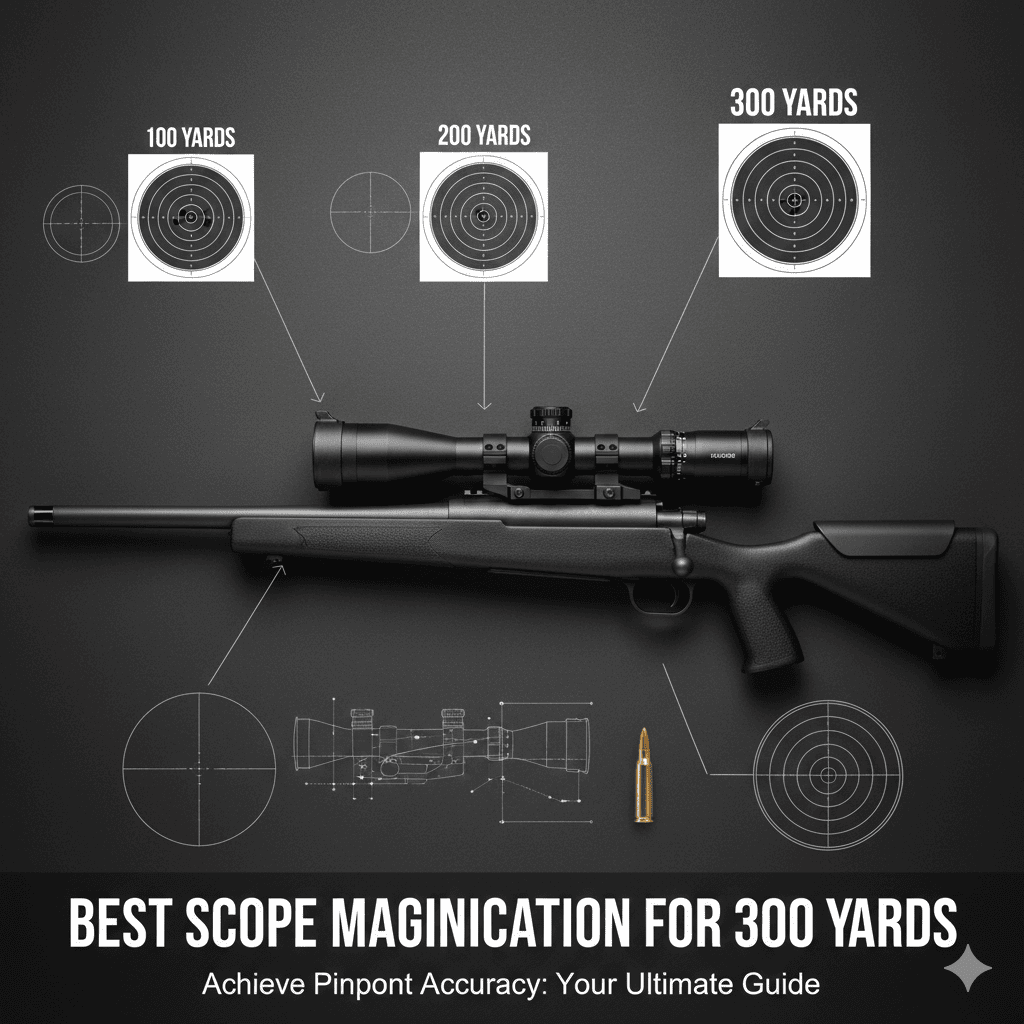
The best scope magnification for 300 yards is usually somewhere around 9x to 12x for careful aiming, with lower power still useful for hunting, field positions, and fast target finding. More magnification is not automatically better if the image shakes, gets dim, or narrows your field of view too much.
For most shooters, a 3-9x, 4-12x, or 4-16x rifle scope can cover 300-yard use well. The right choice depends on target size, shooting position, lighting, recoil, reticle visibility, and how quickly you need to find the target.
Table of Contents
Quick Answer
If you want one simple answer, a 3-9x scope can work at 300 yards, while 4-12x gives a little more room for careful aiming. A 4-16x can be useful for smaller targets or range work, but it is often more magnification than many hunters need for a quick field shot.
At 300 yards, choose enough magnification to see the target clearly, not so much that the scope becomes slow, shaky, or dark. Good glass, a stable position, and a clear reticle often matter more than the highest number printed on the scope.
Common Magnification Ranges for 300 Yards
| Scope range | Best fit | Tradeoff |
|---|---|---|
| 2-7x | Shorter-range hunting, light rifles, wider view | Less detail on small targets at 300 yards |
| 3-9x | General hunting and basic range use | May feel limited for small bullseyes |
| 4-12x | Balanced 300-yard hunting and range work | Can be slower at close range if left too high |
| 4-16x | Smaller targets and more deliberate range shooting | More shake, narrower field of view, more adjustment attention |
| 5-25x and higher | Precision target work from stable positions | Often excessive for ordinary hunting at 300 yards |
A telescopic sight helps by magnifying the target and giving you a reticle reference, but it does not make the rifle steadier. The more you magnify the image, the more you also notice movement, heartbeat, wind wobble, and position errors.
For Hunting at 300 Yards
For hunting, field of view and speed matter. You may need to find the animal quickly, confirm the target, track movement, and keep awareness of what is beyond it. A scope left at 14x or 16x can make that harder if the animal appears closer than expected or moves through cover.
Many hunters are well served by 3-9x or 4-12x. At 300 yards, 9x is enough magnification for many deer-sized targets when the shooter has a stable position. More power can help with detail, but it should not replace ethical distance limits, target identification, backstop awareness, or practice from real field positions.
For Range and Target Shooting
For paper targets, steel, and load testing, more magnification can be useful. A 4-16x scope gives extra detail for aiming at small bullseyes and reading groups. If you shoot from a bench or prone position with bags or a bipod, the added magnification is easier to manage.
For tiny groups or precision practice, higher-power scopes can make sense. Just remember that mirage, poor glass, dim light, or a shaky rest can erase the benefit. Magnification is only one part of the sighting system.
Target Size Changes the Answer
A large target at 300 yards does not need the same magnification as a small aiming dot. A deer-sized vital zone, a steel plate, and a one-inch paper square are very different visual problems. That is why two shooters can give different answers and both be right.
If your target is large and your position is unstable, a moderate magnification setting may help more than maximum power. If your target is small and your position is stable, extra magnification can make the aiming point easier to refine. Match magnification to the target, not just the distance.
When Too Much Magnification Hurts
Magnification makes objects appear larger, but it also makes scope movement more obvious. Too much power can narrow your field of view, slow target acquisition, reduce brightness, and make it harder to recover after recoil.
If you find yourself hunting for the target inside the scope, losing the animal after recoil, or fighting a shaky image, turn the magnification down. A clear, steady 8x view is often more useful than a jumpy 16x view.
Reticle, Parallax, and Turrets
At 300 yards, reticle clarity matters. A heavy reticle can cover too much of a small target, while an ultra-fine reticle can disappear in low light. Choose a reticle you can see quickly and use consistently. If your scope has hold marks, make sure you understand whether they are MIL or MOA and whether they match the turrets.
Parallax can also matter more as distance and magnification increase. The parallax concept is about apparent shift caused by viewing angle. In scope terms, parallax adjustment helps reduce aiming error when your eye is not perfectly centered behind the optic. If your scope has adjustable parallax, learn how to set it instead of ignoring the knob.
Safe Practice and Zero Confirmation
Before relying on any scope at 300 yards, confirm your zero, practice from field positions, and understand your bullet drop. Do not assume the rifle is ready because the scope has enough magnification. Confirm your setup on paper or steel at known distances.
For hunting, set a personal maximum distance based on your real field accuracy, not what the scope can technically see. If wind, light, position, or target movement makes the shot uncertain, shorten the distance or pass.
Buying Checklist
- Choose 3-9x or 4-12x for most 300-yard hunting setups.
- Choose 4-16x if you also shoot smaller targets from stable positions.
- Prioritize glass clarity and reticle visibility over maximum power.
- Check whether the scope has parallax adjustment.
- Match reticle and turret units if you plan to dial or hold corrections.
- Practice at 300 yards before treating the setup as field-ready.
FAQ
Is 9x enough for 300 yards?
Yes, 9x can be enough for many 300-yard hunting and range uses, especially on larger targets. Smaller paper targets may be easier with 12x or 16x from a stable position.
Is 16x too much for 300 yards?
Not for range work or small targets, but it can be more than many hunters need. If 16x makes the image shaky, narrow, or slow, turn it down.
What scope range is best for deer hunting at 300 yards?
A 3-9x or 4-12x scope is practical for many deer hunting situations out to 300 yards when paired with a stable shooting position and confirmed zero.
Do I need parallax adjustment at 300 yards?
You do not always need it, but it can help on higher magnification scopes or smaller targets. If your scope includes parallax adjustment, learn how to use it during practice.