How to Use a Scope for Long Range Shooting

To use a scope for long range shooting, start with a safe range, a properly mounted scope, a confirmed zero, known distance, reliable ammunition, and a basic understanding of elevation, windage, parallax, and reticle holds. Long range accuracy is not just magnification. It is a repeatable system.
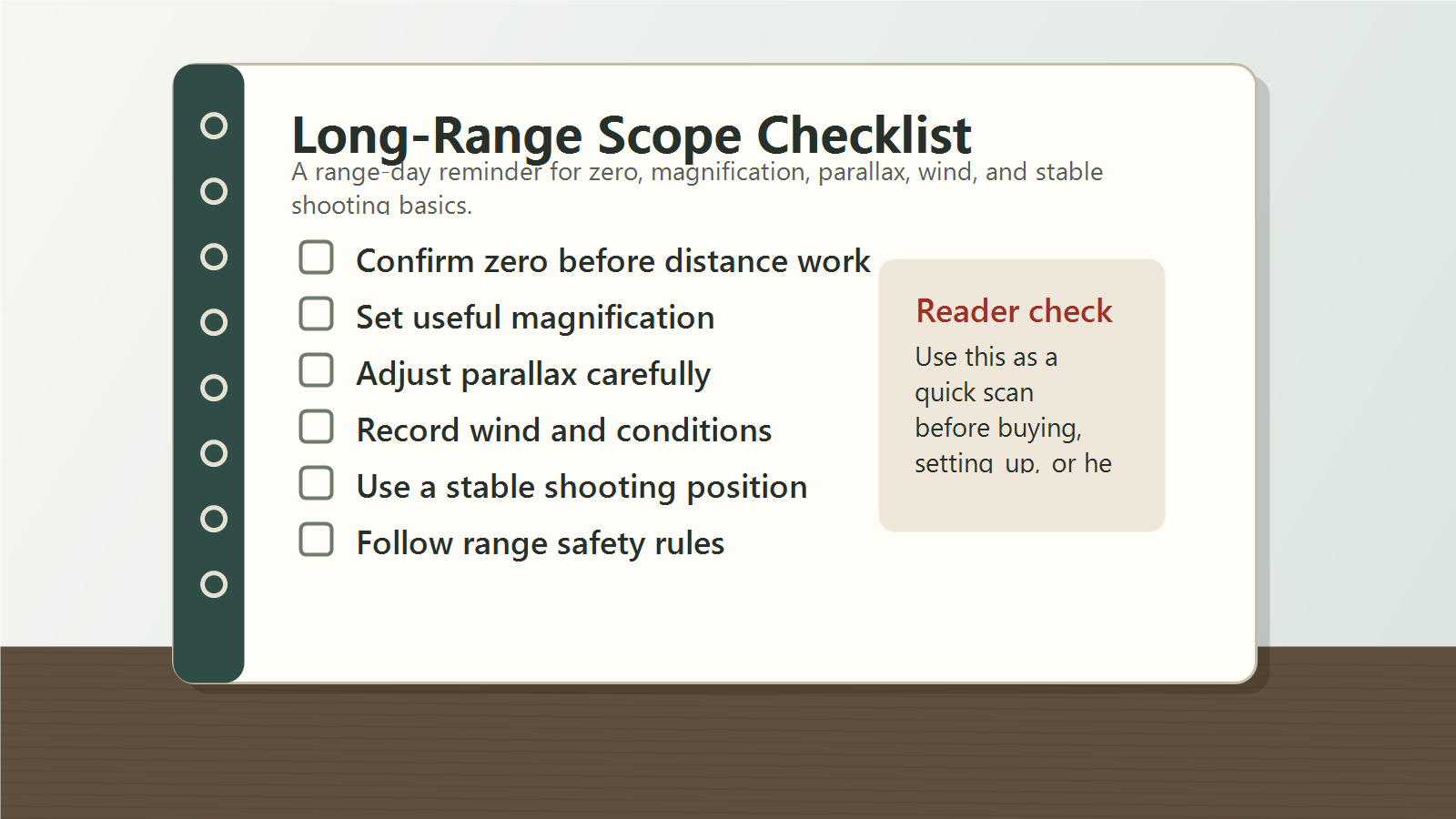
Table of contents
A scope can help you aim more precisely, but it does not solve poor fundamentals, unsafe distance choices, bad data, or an unstable position. The smart approach is to build from a close confirmed zero, learn how your turrets and reticle work, then stretch distance only after your rifle, ammunition, and skills are consistent.
Table of contents
Quick Answer: How To Use A Scope At Long Range
Use a long range scope by confirming your zero, measuring the target distance, setting parallax, choosing either turret dialing or reticle holdover, correcting for wind, and firing from a stable position. After each shot, compare impact to point of aim and make measured corrections instead of guessing.
The Basic Long Range Scope Workflow
- Confirm the rifle is safe and the range/backstop is appropriate.
- Verify your zero with the exact ammunition you will use.
- Measure or confirm target distance.
- Set magnification and parallax for a clear, stable sight picture.
- Dial elevation or use the reticle hold that matches your data.
- Estimate wind and apply a windage correction.
- Fire from a stable position and observe impact.
Safety First For Long Range Shooting
Long range shooting demands more safety planning than short-range bench work because missed shots can travel far. Only shoot where the range, backstop, target area, and local rules are appropriate for the distance. If you cannot confirm what is beyond the target, do not shoot.
Use A Known Safe Range
An established range with distance markers, berms, and clear firing rules is the best place to learn. Private land can be safe only when the backstop and downrange area are unquestionably suitable. The NSSF firearm safety rules are a good baseline before any live-fire session.
Know Your Target And Beyond
At longer distances, a miss may be harder to see and harder to account for. Use visible targets, known safe impact areas, and a shooting partner or spotter when possible. Do not let a powerful scope make an unsafe shot feel acceptable.
Scope Features That Matter At Long Range
Long range work is easier with the right scope features, but you do not need every feature on the market. The key is having clear glass, repeatable adjustments, a useful reticle, and enough magnification for the target size and distance.
Magnification
More magnification can help you see small targets, but too much magnification narrows field of view and can exaggerate wobble and mirage. Many shooters use less magnification than beginners expect because a steadier image is often more useful than a larger shaky one.
Repeatable Turrets
Turrets adjust elevation and windage. For long range, the adjustment should track predictably and return to zero. A scope that does not dial consistently makes data unreliable. If you plan to dial, turret quality matters as much as magnification.
Useful Reticle
A simple duplex reticle can work for a basic zero, but a MIL, MOA, or BDC-style reticle gives more aiming references. The right choice depends on whether you dial corrections, hold corrections, or use a mix. For more detail, see our guide on how to choose the right reticle.
Parallax Adjustment
Parallax adjustment helps reduce aiming error when your eye is not perfectly centered behind the scope. At longer distances, small errors matter more, so side-focus or adjustable-objective scopes can be valuable.
Mounting And Leveling The Scope
A good scope can perform poorly if it is mounted badly. Long range shooting magnifies small setup errors, especially scope cant, loose rings, and inconsistent eye relief.
Set Eye Relief First
Eye relief is the distance between your eye and the scope where you see a full image. Set it from a natural shooting position. If you have to crawl the stock or pull your head back every shot, the scope position is wrong. Our guide to eye relief explains why this matters for comfort and safety.
Level The Reticle
A canted reticle can create horizontal error when dialing elevation. Level the rifle and reticle carefully, then tighten rings evenly according to the mount maker’s torque guidance. If you are unsure, have the scope mounted by a qualified gunsmith.
Check Mount Security
Loose bases or rings can make a rifle appear inconsistent even when the shooter is doing everything right. If groups shift unpredictably, check hardware before blaming the scope or ammunition.
Zeroing The Scope Before Long Range Work
Zeroing means aligning the scope so the bullet impact matches your aiming point at a chosen distance. Long range practice should begin only after you have a reliable zero.
Start Close, Then Confirm Farther Out
Many shooters start close to get on paper, then confirm at 100 yards or another chosen zero distance. After that, confirm at longer distances gradually. Do not jump to 600 yards if the rifle is not reliably zeroed at 100.
Use The Same Ammunition
Changing bullet weight, velocity, or load can change point of impact. Confirm zero with the ammunition you will actually use. For a focused zeroing process, see our guide on how to zero a scope for .308.
Record Your Zero
Write down zero distance, ammunition, temperature if relevant, and scope settings. Good notes make future checks faster and help you spot problems when conditions or equipment change.
Understanding Turrets, MOA, And MIL
Long range scopes usually adjust in MOA or MIL. Both are angular measurement systems. Neither is automatically better. The important thing is using one system consistently and matching the reticle and turrets when possible.
What Turret Clicks Mean
A common MOA scope may adjust 1/4 MOA per click. A common MIL scope may adjust 0.1 MIL per click. The value tells you how much the point of impact should move at a given distance. The farther the target, the larger the physical movement represented by the same angular correction.
Match Reticle And Turrets
If your reticle uses MIL marks and your turret adjusts in MIL, corrections are easier. If your reticle uses MOA and your turret adjusts in MOA, the same is true. Mixed systems can work, but they add mental conversion. The telescopic sight overview explains common scope components and adjustment concepts.
Return To Zero
After dialing for distance, return the turret to your confirmed zero setting. Losing track of turret position is a common beginner mistake. Some scopes have zero stops or locking turrets to help prevent that.
Using Reticle Holds
Reticle holds let you aim using marks below or beside the center instead of dialing the turret for every shot. Holds can be fast, but they require practice and verified data.
Holdover For Elevation
Holdover means aiming with a lower reticle mark to account for bullet drop. It works only when you know which mark matches the distance, ammunition, magnification setting, and scope design.
Wind Holds
Wind holds use left or right reticle references to compensate for drift. Wind is often the hardest part of long range shooting because it can change between you and the target. Practice reading wind at modest distances before pushing farther.
First Focal Plane Vs Second Focal Plane
In many first focal plane scopes, reticle marks stay accurate at every magnification. In many second focal plane scopes, hold marks are calibrated for one magnification. Know which type you have before trusting holdover marks.
Parallax And Focus
Parallax happens when the reticle appears to move against the target as your eye shifts behind the scope. At longer ranges, parallax error can move your point of impact even when the reticle looked close.
Set The Diopter First
The diopter focuses the reticle for your eye. Set it so the reticle appears sharp immediately when you look through the scope. Do this before relying on side focus or parallax adjustment.
Adjust Parallax For The Target Distance
Use the parallax knob or adjustable objective to make the target clear and reduce reticle movement as your eye shifts slightly. For a deeper explanation, see our guide to rifle scope parallax adjustments.
Wind, Ballistics, And Real Data
Long range shooting depends on gravity, wind, velocity, bullet shape, and environment. A ballistic app or chart can help, but it should be confirmed on paper or steel under safe range conditions.
Do Not Guess Distance
Distance errors create elevation errors. Use known-distance targets, a quality rangefinder, or range markers. A good scope cannot correct for a distance you guessed wrong.
Build A Data Card
Record verified elevation and wind holds for your rifle and load. Start with a safe, modest distance and expand gradually. Your personal data is more useful than generic numbers because it reflects your equipment and conditions.
Understand Bullet Drop
Gravity affects every shot, and the bullet’s path changes with range. The general external ballistics concept helps explain why elevation corrections matter more as distance increases.
A Smart Practice Process
Long range skill should be built gradually. The point is not to shoot far once. The point is to make repeatable, safe, measured hits under known conditions.
Start With Groups, Not Hero Shots
Shoot groups at a manageable distance before stretching out. If the rifle will not group well at 100 or 200 yards, longer distances will only make the problem harder to diagnose.
Change One Variable At A Time
Do not change scope settings, ammunition, shooting position, and rest setup all at once. When something improves or gets worse, you need to know why.
Use A Spotter When Possible
A spotter can watch impacts, call corrections, and help maintain safety. Good communication matters: use consistent terms for elevation, wind, and target calls.
FAQ
What magnification do I need for long range shooting?
It depends on target size, distance, conditions, and your shooting style. More magnification can help with small targets, but too much can make mirage and wobble harder to manage. Use enough magnification to aim precisely while keeping the image stable.
Should I dial turrets or use holdover?
Both methods can work. Dialing can be precise when you have time and reliable turrets. Holdover can be faster when the reticle and data are well understood. Many shooters learn both.
Do I need a rangefinder for long range shooting?
A rangefinder or known-distance range is strongly recommended. Distance errors become more important as range increases, and guessing distance can make good scope corrections useless.
Why is parallax important at long range?
Parallax can shift the apparent aiming point when your eye position changes. At longer distances, that small error can matter. Adjust parallax and keep a consistent cheek weld.
Can a cheap scope work for long range shooting?
It may work for learning basics, but long range dialing depends on repeatable adjustments, clear glass, and reliable mechanics. If the scope cannot hold zero or track consistently, accurate long range work becomes frustrating.
Final Thoughts
Using a scope for long range shooting is about building a repeatable system: safe range, stable position, confirmed zero, reliable data, clean turret or reticle corrections, and honest practice. Start close, record what works, and increase distance only when the fundamentals are already solid.