How to Choose the Right Bow for Beginners

Choose the right bow by matching the bow type, draw weight, draw length, handedness, axle length, intended use, and safety setup to the archer. A beginner should start with a bow they can control smoothly, not the heaviest or fastest option. If you are unsure, get measured by a coach, archery shop, or supervised range before buying.
This guide is for selection and safety planning, not a product roundup. There are no affiliate recommendations here because the right bow depends on the archer’s size, strength, goals, local rules, and ability to practice safely. If you are still comparing styles, read our traditional vs compound bow comparison; if you are brand new, start with the beginner bow shooting checklist.
Table of Contents
Quick Answer: What Bow Should a Beginner Choose?
A beginner should choose a bow that fits their draw length, uses a manageable draw weight, matches their goal, and can be practiced safely. Recurve bows are simple for learning fundamentals, compound bows are adjustable and common for hunting or target setups, and longbows are traditional but less forgiving for many new archers.
Best first step
Try a few bows before buying. A short supervised session can reveal whether the archer needs lower draw weight, different draw length, a different grip, or a simpler setup.
What matters most
Fit and control matter more than speed. A bow that is easy to draw, hold, aim, and let down safely will help the archer learn faster and avoid strain.
Start With Purpose
The right bow depends on how it will be used. A bow for backyard-style target practice at a legal range is not always the same as a bow for indoor target leagues, 3D archery, bowhunting, youth lessons, or traditional archery.
Target practice
For target practice, comfort and repeatable form are the priority. Many beginners do well with a light recurve, an entry compound, or a club bow that can be adjusted as skills improve.
Hunting
For hunting, legal draw weight, arrow setup, broadhead rules, safety, and ethical range matter. Do not buy a hunting bow only because it is fast. It still needs to fit and be controllable under field conditions.
Youth learning
Youth bows should be easy to draw, sized correctly, and supervised. Adjustable bows can help growing archers, but the adult still needs to check fit and safety often.
Compare Bow Types
Each bow type has tradeoffs. Do not choose by appearance alone. Choose by fit, learning curve, maintenance, local rules, and how often the archer will practice.
Recurve bows
Recurve bows are common for lessons and target shooting because they are simple and teach form clearly. They do not have let-off like compound bows, so draw weight should be modest for beginners.
Compound bows
Compound bows use cams and let-off, which can make holding easier at full draw. They also require correct draw length, tuning, safe press work when needed, and compatible accessories. A shop setup is helpful.
Longbows
Longbows are simple and traditional, but they can be harder for beginners to shoot consistently. They are best for archers who want traditional practice and are willing to build skill slowly.
Measure Draw Length
Draw length affects comfort, anchor, accuracy, and safety. A bow with the wrong draw length can make the archer overextend, collapse, or fight the bow instead of learning clean form.
Get measured
The best option is to get measured at a shop, club, or range. Online formulas can estimate, but real fitting catches posture, anchor, release style, and bow-specific details.
If you do not have a trusted shop nearby, USA Archery’s find a coach and find a club tools can help you locate supervised instruction. A coach or club can often help a new archer try equipment before spending money.
Compound adjustments
Many compounds adjust within a range, but not all adjust the same way. Check the maker’s chart and avoid forcing cams, modules, or draw stops without the right tools.
Recurve fit
Recurve draw weight usually increases as the bow is drawn farther. A longer draw can make the bow feel heavier than the printed weight, so fit still matters.
Choose Draw Weight
Draw weight should match the archer’s strength and purpose. Too much weight causes shaking, poor posture, shoulder strain, and unsafe let-downs. A lighter bow that the archer controls well is usually the better starting point.
Control test
The archer should be able to draw smoothly, hold briefly, aim without shaking badly, and let down safely. If the archer has to sky-draw, lean back, or grimace, the bow is too heavy.
Build up slowly
Strength can improve with practice, but draw weight should increase slowly. Better form at a lower weight builds a safer foundation than heavy weight with poor habits.
Hunting minimums
Some states set minimum draw weights or other equipment rules for bowhunting. Check current state wildlife regulations before hunting with any bow.
Check Fit and Handedness
Handedness is not only about which hand writes. Archers often choose based on eye dominance, comfort, and coaching advice. A right-handed bow is held in the left hand and drawn with the right hand; a left-handed bow is the reverse.
Eye dominance
Eye dominance can affect aiming. A coach can help decide whether to match the dominant eye, the stronger hand, or a practical setup that the archer can use safely.
Grip comfort
The grip should sit naturally without forcing the wrist. A grip that feels awkward can create torque, fatigue, and inconsistent arrows.
Bow length
Longer bows can feel steadier for target shooting, while shorter compounds may be easier in blinds or tight spaces. Choose based on use and control, not just compact size.
Safety and Range Rules
USA Archery’s archery safety guidance is a useful starting point for range behavior and supervised participation. A bow is not a toy, and the safest setup is the one used at a legal range with clear commands and a safe backstop.
Safe backstop
Never shoot without a safe target and backstop. Do not shoot toward people, roads, homes, animals, hard surfaces, or any area where an arrow could leave the property.
No dry firing
Dry firing means releasing the string without an arrow. It can damage the bow and injure the archer or people nearby. Every beginner should learn this rule before handling a bow.
Inspect arrows
Damaged arrows can break or fly unpredictably. Check shafts, nocks, points, and fletching before shooting, especially after an arrow hits a hard object.
Youth and New Archers
Youth archers need correct size, close supervision, and patient instruction. The goal is not to make a child pull more weight; the goal is safe form, confidence, and enjoyment.
Adjustable range
Adjustable youth bows can be useful, but the range must match the child now. A bow that might fit later is not helpful if it is too heavy today.
Short sessions
Short, positive sessions are better than long sessions that create fatigue and poor form. Stop before the archer gets frustrated or starts handling equipment carelessly.
Adult supervision
An adult should control when arrows are handled, when the line is safe, and when everyone retrieves arrows. Range discipline is part of the lesson.
Hunting and Local Rules
If the bow will be used for hunting, start with the state wildlife agency rules before buying accessories. Hunting rules may cover draw weight, broadheads, crossbows, hunter education, season dates, tagging, and legal shooting hours.
Ethical range
A hunter’s ethical range is the distance where they can place arrows consistently under field conditions. It is usually shorter than a range-session maximum.
Broadhead setup
Broadheads must match the bow, arrow, and local rules. They should be sharp, legal, and tested safely in a suitable target before the season.
Hunter education
New bowhunters should complete required hunter education and consider bowhunter education where available. Safe equipment choice is only one part of responsible hunting.
Accessories That Affect Fit
Accessories can help, but they can also hide a poor bow choice. Add them after the bow fits the archer and the basic setup is safe.
Sights and rests
Sights and arrow rests should match the bow and use. A simple, reliable setup is often easier for a beginner than a complicated one.
Release aids
Compound archers often use release aids. The release should fit the archer’s hand and be learned under supervision so it does not create unsafe habits.
Arrows
Arrows must match draw length, draw weight, point weight, and bow type. Mismatched arrows can fly poorly and may be unsafe. Ask a shop or coach to confirm arrow spine and length.
Do not reuse random arrows from another bow without checking them. Arrow spine, length, nock fit, and point weight all affect safety and consistency. If an arrow is cracked, too short, or poorly matched, replace it before shooting.
Common Bow-Buying Mistakes
Buying too much draw weight
Heavy draw weight is one of the fastest ways to build bad habits. Start with control and add weight only when form stays clean.
Ignoring draw length
Wrong draw length can make a good bow feel bad. Measure before buying, especially with compound bows.
Skipping instruction
A short lesson can prevent months of frustration. New archers learn faster when safety, stance, grip, anchor, and release are corrected early.
Instruction is also useful before a purchase because it separates preference from fit. A bow may feel exciting in the store but still be too heavy, too short, too long, or too specialized for the archer’s actual practice plan.
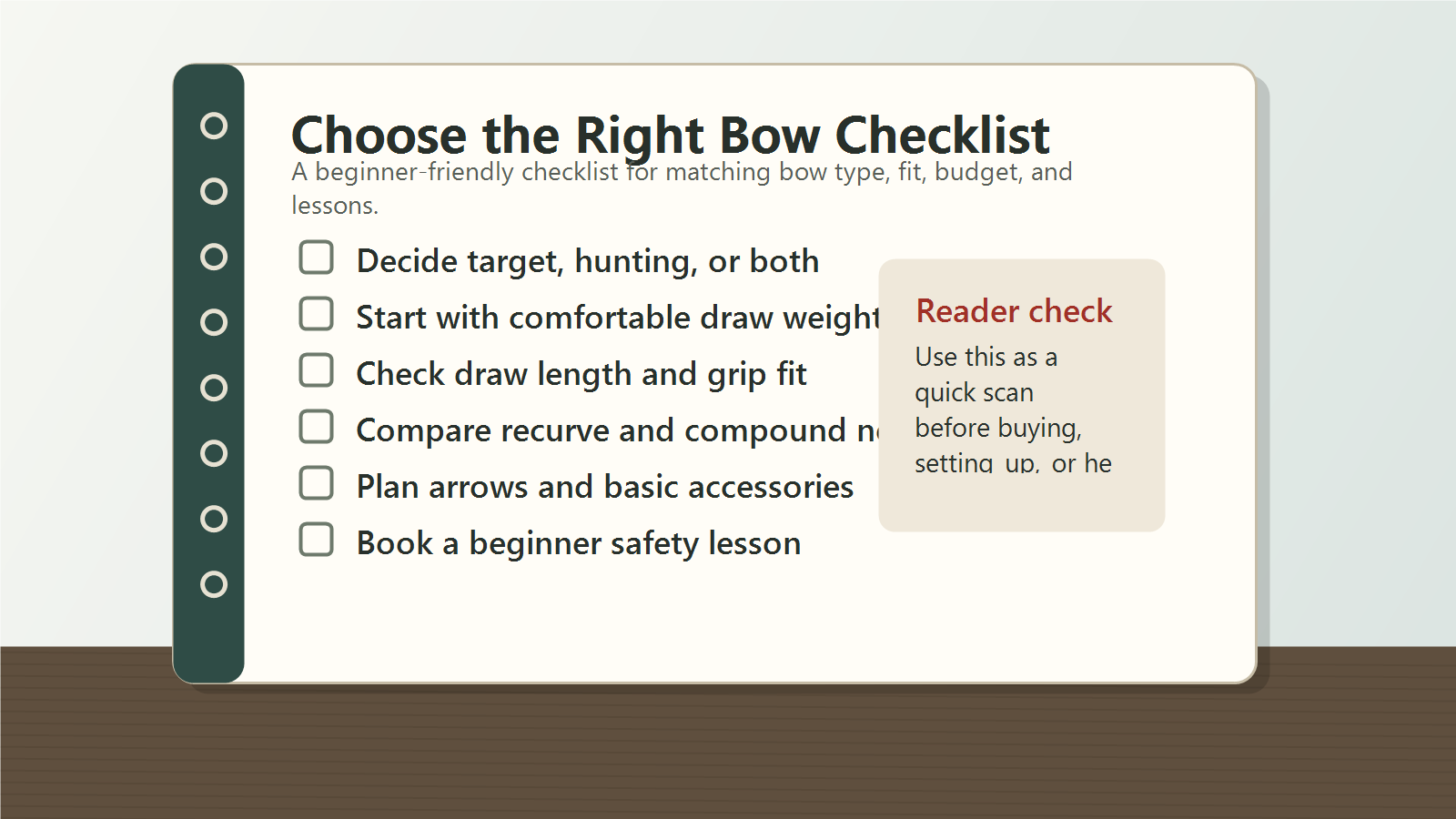
Bow Selection Checklist
- Purpose selected: target, 3D, hunting, youth learning, or traditional practice
- Bow type chosen for skill level and use
- Draw length measured by a coach, range, or shop
- Draw weight is smooth and controllable
- Handedness and eye dominance checked
- Grip and bow length feel stable
- Arrows matched to bow and archer
- Safe range, target, and backstop confirmed
- Local hunting or practice rules checked where relevant
- Instruction or shop setup planned before serious use
FAQ
What type of bow is best for beginners?
Many beginners start well with a light recurve or adjustable compound. The better choice depends on the archer’s goal, draw length, draw weight, and access to instruction.
How do I know my draw length?
Get measured at an archery shop, club, or supervised range. Online estimates can help, but real fitting is more reliable.
Should I buy a heavy bow to grow into?
No. A bow that is too heavy can create poor form and strain. Start with a bow the archer can draw and let down safely.
Do I need a pro shop to set up a bow?
It is strongly recommended for compound bows and helpful for most beginners. A shop can check fit, arrows, rest, sight, peep, and safe setup.
Can the same bow work for target shooting and hunting?
Sometimes, but hunting requires legal equipment, ethical range, broadhead setup, and field practice. Check state rules before using any bow for hunting.
Final Takeaway
The right bow is the one the archer can fit, draw, aim, and use safely for the intended purpose. Start with measured draw length, manageable draw weight, safe range habits, matched arrows, and instruction. Speed and looks can wait; control comes first.
When in doubt, test before buying and choose the setup that supports clean practice.
A comfortable bow gets used more often.
Related reading: best bows for women.
Related reading: best bow release aids.