Rifle Scope Magnification Explained for Beginners
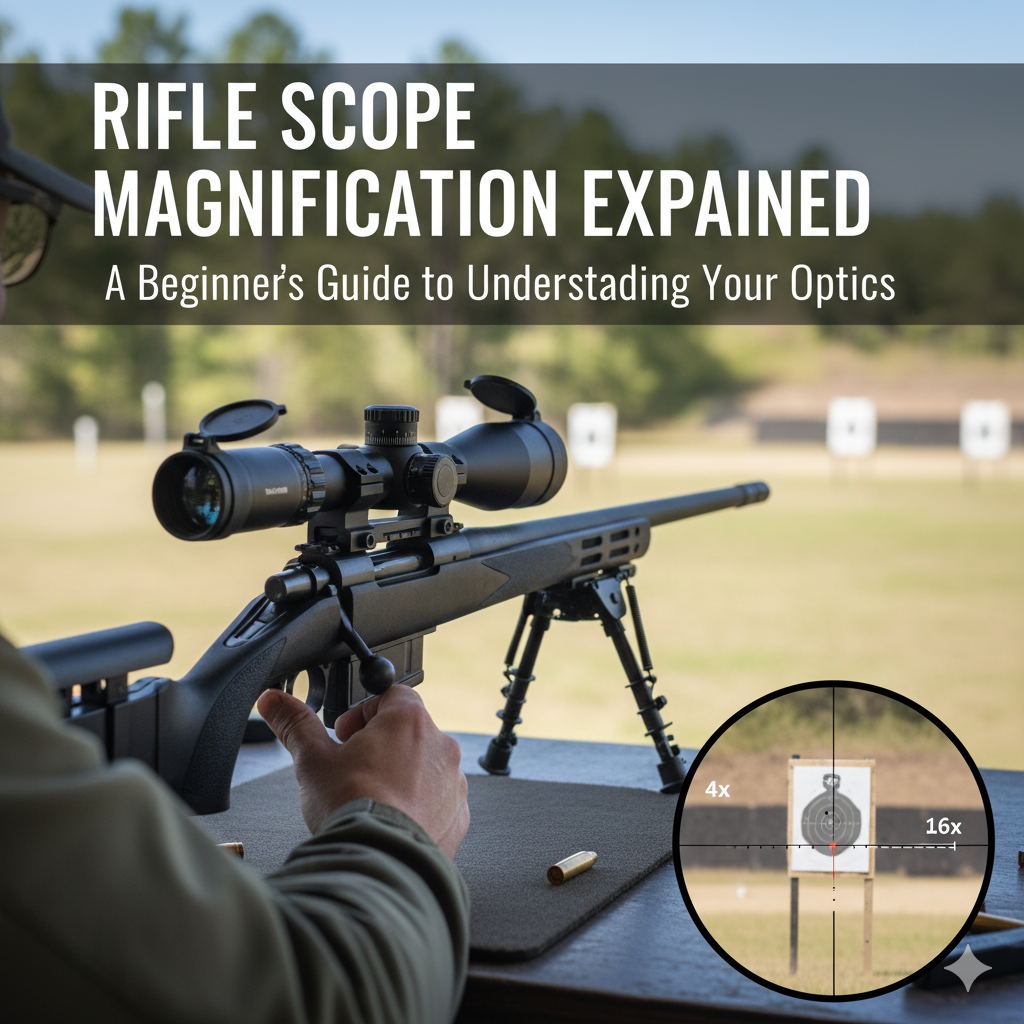
Rifle scope magnification tells you how much larger the target appears through the optic compared with your naked eye. A 3-9x scope can show the image about three times larger at the low end and nine times larger at the high end. For beginners, the best magnification is not always the highest number; it is the range that gives enough detail while still keeping a useful field of view, comfortable eye relief, and a steady sight picture.
This beginner guide explains fixed vs. variable magnification, what common scope numbers mean, why field of view changes, and how to choose practical magnification for hunting, range practice, and general rifle use. It is an educational support article, not a product roundup.
Table of Contents
What Rifle Scope Magnification Means
Magnification is the amount of visual enlargement a scope provides. If a target looks three times larger through a scope than it does with the unaided eye, the scope is being used at 3x. If it looks twelve times larger, it is at 12x.
A telescopic sight is built to help the shooter see and aim more precisely, but magnification is only one part of the system. Glass quality, reticle design, adjustment tracking, eye relief, mounting height, and shooter fundamentals all matter.
How To Read Scope Numbers
Example: 3-9×40
In a 3-9×40 scope, 3-9x is the magnification range. The image can be set from 3x to 9x. The 40 usually means a 40 mm objective lens. A larger objective can help with light transmission and exit pupil, but it can also add weight and require higher rings.
Example: 4-16×50
A 4-16×50 scope gives more top-end magnification and a larger objective lens. That can help for target work or longer distances, but it may be heavier and less handy for quick close-range use.
Example: 1-6×24
A 1-6×24 scope is a low-power variable optic. It favors speed, wide field of view, and short-to-medium distance use over high-magnification detail.
Fixed vs. Variable Magnification
Fixed-Power Scopes
A fixed-power scope has one magnification setting, such as 4x or 10x. Fixed scopes can be simple, rugged, and consistent. The tradeoff is that you cannot zoom out for a wider view or zoom in for more detail.
Variable-Power Scopes
A variable scope lets you adjust magnification within a range. This is the most common choice for beginners because one optic can cover different distances and situations. The key is choosing a useful range, not simply the highest top number.
Common Magnification Ranges
1-6x and 1-8x
These low-power variable scopes are useful when speed and field of view matter. They are common for short-to-medium distance range work and situations where the shooter may need to find the target quickly.
2-10x, 3-9x, and 3-12x
These are practical general-purpose ranges for many hunters and new rifle shooters. They provide enough magnification for many normal distances while staying lighter and easier to use than extreme high-power optics.
4-16x and 5-25x
These ranges can make sense for target shooting, longer-range practice, and precision-oriented rifles. They also demand more attention to position, parallax, glass quality, and stable support.
Why More Power Is Not Always Better
Higher magnification makes the target look larger, but it also narrows field of view and makes wobble easier to see. At high power, heat shimmer, mirage, low light, and small movements can become distracting. Beginners often shoot better with moderate magnification because the sight picture feels steadier.
More power can also slow target acquisition. If a deer steps out close, a scope set too high may show only a patch of hair instead of the whole animal and background. For hunting, a usable low end is often more important than an impressive high end.
How Beginners Should Choose
- For woods hunting: prioritize low-end magnification and field of view.
- For general deer hunting: 2-10x, 3-9x, or 3-12x is often practical.
- For range practice: choose enough power to see the target clearly, but do not overlook glass and tracking quality.
- For long-range learning: consider 4-16x or higher only if you also have stable support and training.
- For lightweight rifles: watch size and weight; a huge scope can make the rifle awkward.
A good beginner scope should make practice easier. If the optic is too heavy, too complex, or too powerful for your actual use, it can slow learning instead of improving it.
Common Beginner Mistakes
The most common mistake is buying the biggest magnification range before understanding the rifle’s real use. A scope that looks impressive on paper can be slow in the woods, awkward on a light rifle, or frustrating if the eye box is tight.
- Leaving the scope on high power: this can make close targets harder to find.
- Ignoring eye relief: poor eye relief can make the sight picture uncomfortable and may be unsafe on heavier-recoiling rifles.
- Forgetting parallax: some higher-power scopes need parallax adjustment for the clearest and most consistent view.
- Choosing too much weight: a large optic can change how the rifle carries and balances.
- Skipping zero confirmation: magnification does not matter if the rifle is not properly zeroed and verified.
A beginner-friendly scope is usually the one you can mount correctly, see through comfortably, adjust without confusion, and practice with consistently. That is more valuable than chasing a number you rarely use.
Safe Setup and Use
Magnification does not replace safe firearm handling. Review rules from sources like the NSSF, keep the muzzle in a safe direction, know your target and what is beyond it, and use a safe backstop.
Use the rifle and scope manuals for mounting, torque, eye relief, zeroing, and adjustment procedures. If you are unsure about ring height, eye relief, bore alignment, or zeroing, ask a qualified gunsmith, instructor, or experienced range officer.
FAQ
What does 3-9x mean on a rifle scope?
It means the scope can adjust from 3x magnification to 9x magnification. The image appears about three to nine times larger than it does with the naked eye.
Is 3-9x enough for deer hunting?
For many deer hunters, yes. A 3-9x scope is still practical because it offers a useful low end and enough top-end magnification for many common hunting distances.
Does higher magnification make a rifle more accurate?
No. Higher magnification can help you see the target, but rifle accuracy depends on the rifle, ammunition, optic setup, shooter fundamentals, and conditions.
What magnification should beginners start with?
Beginners usually do well with moderate magnification. For many hunting and range setups, a 2-10x, 3-9x, or 3-12x scope is easier to learn than an extreme high-power optic.
Why does my scope look shaky at high power?
High magnification makes normal movement easier to see. The rifle may not be moving more than before; you are simply seeing the movement enlarged. Use stable support and avoid overcorrecting.
Final Takeaway
Rifle scope magnification is useful only when it matches the job. Beginners should choose a practical range, learn what the scope numbers mean, and avoid chasing maximum power before mastering safety, zeroing, steady position, and trigger control.