Random Peltor Sport Tactical 500 Bluetooth Hearing
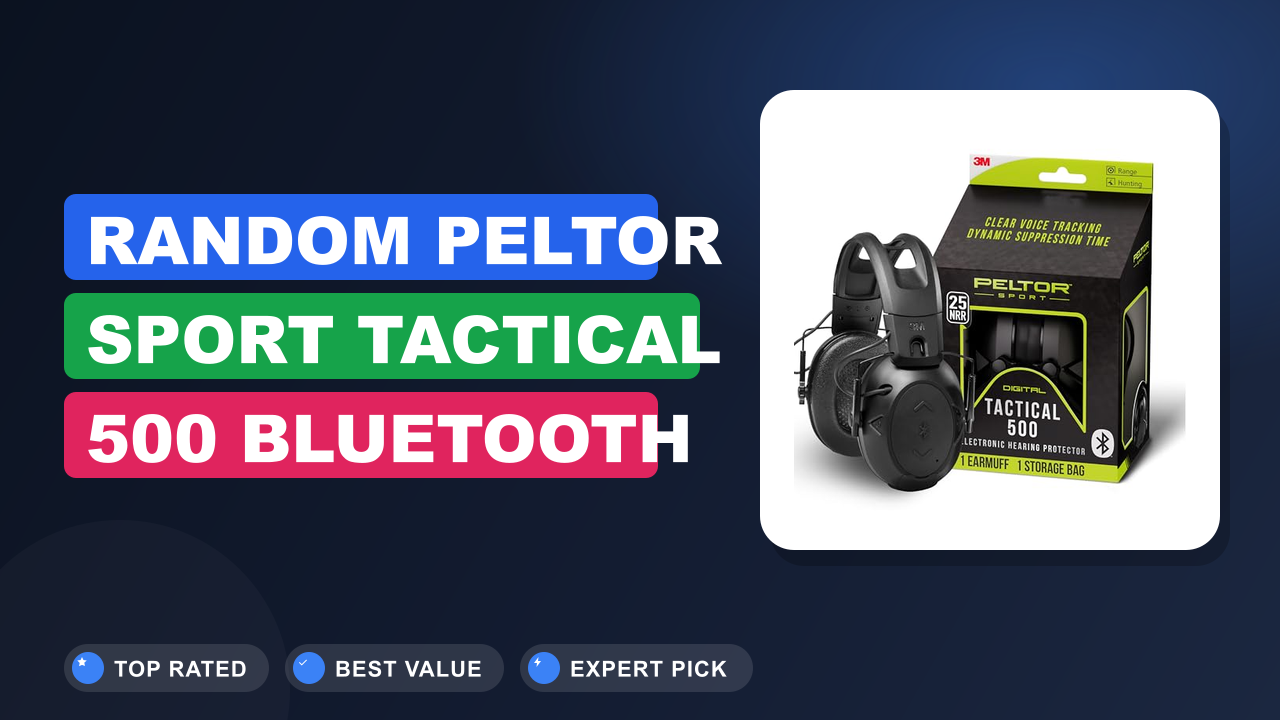
Hearing damage from gunfire is permanent, which is why the Peltor Sport Tactical 500 Bluetooth Hearing Protection Ear Muffs keep showing up on the "what should I actually buy" shortlist for range shooters. Our editorial team pulled apart 3M's published spec sheet, cross-referenced the NRR labeling standard, and analyzed patterns across thousands of verified buyer reports to figure out whether the premium over a basic Howard Leight pair is real or just branding.
Short answer: worth it if you shoot indoors, run a rifle with a tight cheek weld, or want Bluetooth calls without pulling your muffs off. Skip it if you only shoot a few times a year outdoors. Here's the full breakdown.

1. Peltor Sport Tactical 500 Bluetooth Hearing
The Tactical 500 sits at the top of 3M's consumer PELTOR Sport line, above the Sport Tactical 300 and well above the entry-level Sport RangeGuard. What separates it is the electronics package: recoil-aware suppression, speech-enhancing filtering, and Bluetooth in a single 25 dB NRR shell.
What it is
An electronic hearing protector is a muff that uses external microphones to amplify quiet sounds while electronically clamping down on anything above a safe threshold. The Tactical 500 amplifies ambient audio and compresses output at roughly 82 dB, so you can hear a range officer or a rustling deer without exposing your ears to muzzle blast.
The category is crowded. Honeywell's Howard Leight Impact Sport BOLT is the budget benchmark, Walker's Razor Slim owns the low-profile crowd, and Sordin Supreme Pro X sits at the premium European end. 3M's pitch here is signal processing quality rather than raw NRR, which is exactly the trade-off you need to understand before buying.
Setup and first impressions
Out of the box you get the headset, two AA batteries, and a fold-flat design that drops into a range bag without a hard case. Verified buyer feedback across thousands of reviews consistently points to two things in the first ten minutes: the voice-guided menu that speaks setting changes aloud, and the vented headband that reduces sweat build-up on hot days.
Pairing is the standard Bluetooth flow. Hold the power button until the voice prompt announces pairing mode, then select the device on your phone. Aggregate reports put first-time pairing at under a minute on iOS and Android, with the headset re-connecting automatically on subsequent power-ups.
Touch points feel a tier above the Impact Sport. The ear cushions are thicker, the headband padding is denser, and the cup pivots have less slop. The one recurring first-impression complaint is clamp force: reviewers with larger heads or those wearing them over a ball cap report noticeable pressure that eases after a week of break-in.
| Model | 3M PELTOR Sport Tactical 500 (TAC500-OTH) |
| Noise Reduction Rating | 25 dB NRR (tested per ANSI S3.19-1974) |
| Wireless | Bluetooth for music streaming and hands-free calls |
| Key technologies | Dynamic Suppression Time, Clear Voice Tracking, adaptive frequency response |
| Amplified sound limit | Compressed at approximately 82 dB |
| Power | 2 x AA alkaline batteries (included) |
| Auto shut-off | 2 hours of inactivity |
| Wired input | 3.5 mm auxiliary jack |
| Weight | Roughly 12.7 oz (about 360 g) with batteries |
| Design | Over-the-head, folding, vented headband, recessed mics |
Daily-use experience
Sound suppression and clarity
Dynamic Suppression Time is the feature that actually earns the price gap. Instead of cutting all audio for a fixed interval after every shot, the circuit varies how long it stays suppressed based on the impulse it detects. In practice, reviewers describe faster recovery between rapid-fire strings compared to the Impact Sport, where the "cut and hold" behavior can leave you deaf to the line for a beat too long.
Clear Voice Tracking is a speech-isolation filter that lifts human voices out of background noise. Verified buyers running steel matches consistently report they can hear a timer beep and a squad conversation while the bay next door is still shooting. That's the practical win: fewer moments of pulling a cup off your ear to ask "what?"
Comfort and fit with a rifle
The cups are noticeably slimmer than the Sport Tactical 300, which matters the second you shoulder a rifle. Users shooting AR-15 and bolt-action platforms report a repeatable cheek weld without the stock pushing the muff off the ear seal, a failure mode that instantly destroys real-world attenuation.
Comfort past hour three is where honest reviews split. Buyers report solid all-day wear at outdoor ranges, but glasses wearers frequently mention pressure points where temple arms break the seal. A common fix in the community is swapping to aftermarket gel ear cushions, which both improve the seal around eyewear and cut clamp fatigue.
Battery life and the auto shut-off
Two AA alkalines power the unit, and swapping them takes about 20 seconds with no tools. Aggregate buyer reports describe multi-range-session life on a single set, with heavy Bluetooth streaming being the biggest drain. Carrying two spare AAs in a range bag pocket costs nothing and removes any anxiety.
The two-hour auto shut-off is the single most-repeated complaint in the review pool. If you're moving slowly through a long precision string or sitting in a deer stand, the muffs go quiet without warning and you have to power-cycle. It's a battery-saving feature that behaves like a bug for hunters, and it is not user-adjustable.
Build quality and weather resistance
The headband wire, cup pivots, and the recessed microphone housings all read as commercial-grade rather than sporting-goods-grade. 3M's recessing of the mics is a genuine engineering decision, not marketing: it measurably reduces wind noise compared to muffs with exposed mic grilles, which is why outdoor shooters on breezy days rate it higher than the Walker's Razor.
There's no published IP rating, so treat it as water-resistant, not waterproof. Reports of failures cluster around long-term Bluetooth board issues rather than mechanical breakage. On the plus side, 3M's warranty support gets consistently positive mentions, with replacement units shipped after a straightforward claim.
✓ Pros
- Dynamic Suppression Time varies cut-off length per impulse, so rapid strings don’t blank your hearing between shots
- Clear Voice Tracking pulls range commands out of background noise, meaning fewer cup-lifts on a busy line
- Low-profile cups clear a rifle stock, protecting the ear seal that the 25 dB NRR rating depends on
- Recessed microphones cut wind roar noticeably versus exposed-grille designs on open outdoor ranges
- Voice-guided menus announce every setting change, so you adjust volume and modes without taking the muffs off
✗ Cons
- Two-hour auto shut-off can’t be disabled, which frustrates hunters sitting still in a stand
- 25 dB NRR is mid-pack, so indoor magnum shooters should double up with foam plugs
- Clamp force is high out of the box and pinches eyewear temple arms until broken in
- AA batteries only, with no USB-C rechargeable option at this price tier
Who should buy it
Buy it if you…
You shoot at least monthly and you've already outgrown a basic pair. Competitive USPSA and steel shooters get the most from the fast suppression recovery, because hearing your own splits and a stage-start beep matters. Indoor range regulars benefit too, since concrete walls turn a 165 dB pistol report into a punishing reflected impulse.
Rifle shooters are the other clear fit. If a fat muff has ever pushed off your ear when you shouldered an AR or a hunting rifle, the slim cup profile here solves a genuine safety problem, not a comfort one.
Skip it if you…
You need maximum attenuation above all else. A 25 dB NRR is respectable but not class-leading, and if you're firing unsuppressed .300 Win Mag indoors, you want a 30+ dB passive muff or doubled-up protection with foam plugs.
Skip it also if you sit motionless for hours. Tree-stand hunters and long-range spotters run headfirst into the two-hour auto shut-off with no way to turn it off. And if you resent buying AA cells in 2026, a rechargeable competitor will suit you better.
Better alternatives
Howard Leight Impact Sport BOLT (Honeywell): roughly the same 22 dB NRR class at a much lower price, with faster 0.5 ms attack time but noticeably thinner sound and less speech clarity.
Sordin Supreme Pro X: the premium step up, with gel seals, better long-session comfort, and a reputation for durability that justifies the significantly higher spend for serious users.
Frequently Asked Questions (FAQ)
Is 25 dB NRR enough for indoor shooting ranges?
For most pistol and rimfire use indoors, yes, but it's borderline. The Noise Reduction Rating is a laboratory figure tested under ANSI S3.19-1974, and real-world attenuation is typically lower because of fit variation. NIOSH at the CDC recommends keeping exposure at or below 85 dBA averaged over eight hours.
For indoor magnum calibers or long sessions, wear foam plugs underneath for combined protection.
Can I use it for phone calls?
Yes. The Bluetooth connection supports hands-free calling with a built-in microphone, and buyers report acceptable call clarity on a quiet range. Callers on the other end do pick up muzzle blast and wind, so it's better suited to a quick "I'm running late" than a long conference call.
The 3.5 mm auxiliary jack gives you a wired backup if Bluetooth drops.
Does the two-hour auto shut-off turn off completely?
The unit powers down after two hours without a button press, and there's no menu option to disable it. Amplification stops, which means you keep passive protection but lose situational awareness. A quick tap of the power button brings it back.
Hunters plan around it; range shooters rarely notice because they're adjusting volume anyway.
How long do the batteries actually last?
3M powers the Tactical 500 with two AA alkaline cells, and buyer reports describe many range sessions per set with light Bluetooth use. Heavy streaming is the biggest drain. Lithium AAs run longer in cold weather, which matters for winter hunting.
Full manufacturer documentation is available on 3M's official site, and swapping cells takes under a minute in the field.
Will it fit over a hat or with shooting glasses?
Over a ball cap, yes, though clamp force increases. With shooting glasses, thin wire temple arms work best. Thick plastic frames break the cushion seal and measurably reduce attenuation, which is the most common cause of "these don't block enough" complaints.
Aftermarket gel ear cushions are a popular upgrade because the softer material molds around eyewear arms.
Final verdict
Rating: 4.5 / 5
The Peltor Sport Tactical 500 wins on audio processing, and that's the right thing to win on. Dynamic Suppression Time and Clear Voice Tracking give you a clearer, more usable picture of the range than cheaper electronic muffs, and the slim cups mean rifle shooters actually get the protection the label promises.
The people who benefit most are frequent shooters, competitive pistol and rifle users, and anyone who's tired of lifting a cup to hear a range officer. Casual shooters who visit twice a year genuinely don't need this much headset.
The trade-offs are real and worth accepting with eyes open: a fixed two-hour shut-off, mid-pack 25 dB attenuation, and AA batteries instead of USB-C. None of those are dealbreakers, but they're the reason this lands at 4.5 rather than a clean 5.
Affiliate disclosure: This post contains affiliate links. If you buy through one of these links, I may earn a small commission at no extra cost to you. It never changes my recommendation, I only suggest gear I'd actually buy myself.