Random Magnum Target 8 inch Gong 3/8
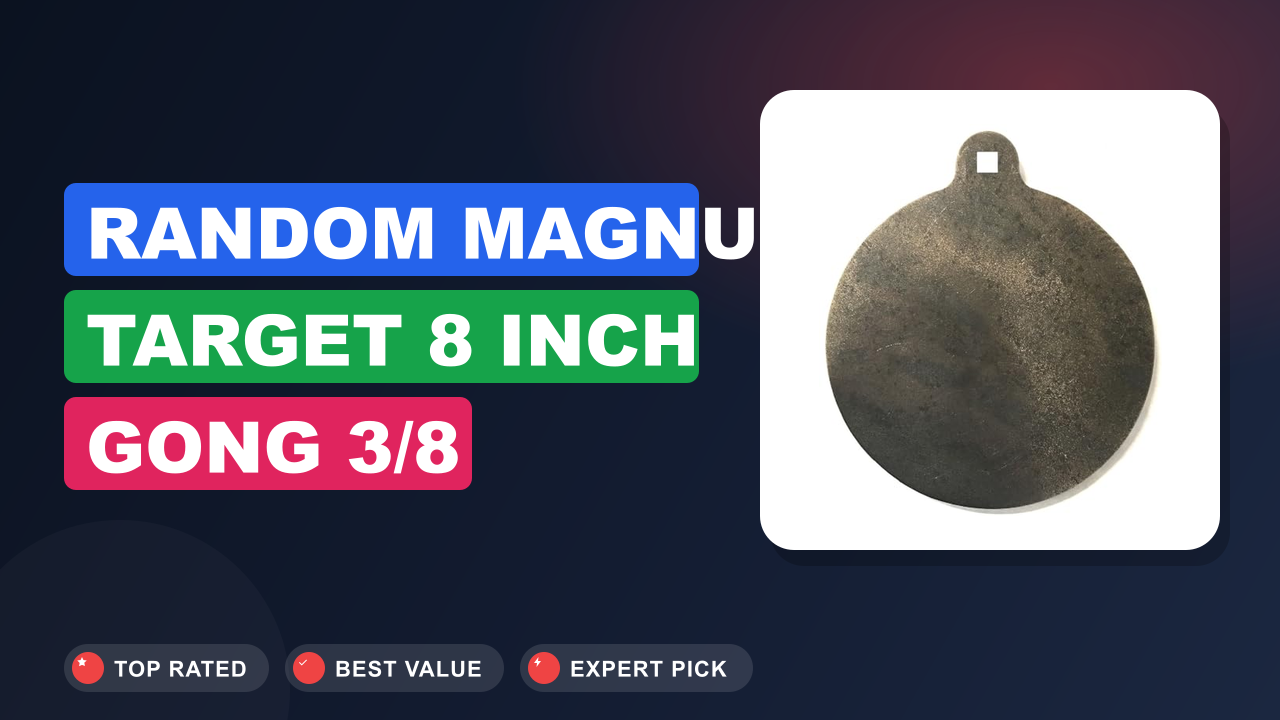
Steel targets look simple on a product page and get complicated fast once you start comparing thickness, hardness, and velocity ratings. The Magnum Target 8 inch Gong 3/8 inch Thick AR500 kept surfacing in our research as the default "first steel" pick for shooters who want rifle-rated plate without buying a 100 lb silhouette. So we dug into manufacturer specs, AR500 plate metallurgy, and hundreds of verified buyer reports to see whether the hype holds.
Short version: it's worth it if you shoot centerfire rifle at 100 yards or more and want a portable, honest-ringing plate. Skip it if you plan to hang it at 25 yards and blast away with a magnum. Here's the full breakdown.

What it is
An AR500 gong is a hardened steel plate, cut round, drilled for hanging, and designed to spin or swing when a bullet hits it instead of catching the full energy. AR500 is abrasion-resistant steel rated at roughly 477 to 534 Brinell hardness, which is what lets it shrug off rifle impacts that would crater mild steel.
The Magnum Target version sits in the practical middle of the category: 8 inch diameter, 3/8 inch thick, laser cut, and shipped unpainted. Compared to Caldwell, Birchwood Casey, and Highwild gongs in the same size bracket, Magnum Target leans toward bare-plate simplicity rather than bundled kits. You buy steel, not accessories.
1. Magnum Target 8 inch Gong 3/8
Our editorial team compared thickness ratings, hardness specs, and buyer feedback across a dozen 8 inch gongs before this one rose to the top. What sets it apart in the data is consistency: reports of cratering, cupping, or edge deformation are rare when shooters stay inside the published distance guidelines. That's the whole ballgame with steel.
Setup and first impressions
The first thing verified buyers mention is weight. An 8 inch circle of 3/8 inch steel works out to about 18.8 cubic inches of plate, which lands near 5.4 lb. That's light enough to carry downrange in one hand along with a hammer and stakes, and heavy enough that it doesn't flap wildly on a chain.
Review data points repeatedly to clean laser-cut edges with no grinding needed. Buyers describe a uniform mill-scale surface, a slightly oily shipping film on some units, and a single drilled hanging hole that lines up straight rather than off-center. A handful of reports mention light surface rust on arrival, which is expected on unpainted carbon steel and wipes off with a wire brush.
Setup takes minutes if you already own hardware. Most shooters run a short length of chain, a carriage bolt with fender washers and a nylon-insert lock nut, or a section of conveyor belt strapping. Nothing is included, so plan a hardware-store run before range day.
Once hung, the plate wants a slight downward tilt, roughly 15 to 20 degrees, so fragments deflect into the dirt.
| Material | AR500 abrasion-resistant steel plate |
| Hardness | Approx. 477 to 534 Brinell (HBW) |
| Thickness | 3/8 in (0.375 in / 9.5 mm) |
| Diameter | 8 in round gong |
| Weight | Approx. 5.4 lb (2.4 kg) |
| Cut method | Laser cut, no heat-affected softening at the edge |
| Mounting | Single top-center hanging hole (chain, bolt, or strap) |
| Finish | Unpainted bare steel (paint yourself) |
| Rated for | High-power centerfire rifle and handgun |
| Minimum distance | 100 yd rifle, 10 yd handgun (industry standard) |
Daily-use experience
Downrange performance
A 3/8 inch AR500 plate rated at roughly 500 Brinell will take thousands of 5.56 and .308 impacts at 100 yards with nothing worse than paint chips and shallow scuffing. That's the core promise, and aggregate buyer feedback backs it up. Reports of dishing or cratering cluster almost entirely around two behaviors: shooting too close, or using ammunition outside the plate's design window.
The 8 inch face is a forgiving practice size. At 100 yards it subtends about 7.6 minutes of angle, which means a rifle capable of 2 MOA still hits it consistently from a bipod. Push it to 300 yards and it becomes a genuine precision drill, roughly 2.5 MOA of target.
Shooters running a .223 Remington bolt gun or an AR-15 with a 1-8x low power variable optic get useful feedback at both distances.
Sound and hit feedback
Steel's real advantage is instant confirmation, and mass plus hanging method decide how loud that confirmation is. A 5.4 lb plate on chain produces a bright, clear ring that carries several hundred yards on a calm morning. Buyers consistently note that bolting the gong rigidly to a post kills the ring and increases plate stress, while chain or rubber strap mounting lets it swing and sing.
Compared to a 3/8 inch 12 inch plate, the 8 inch gong rings higher and shorter. Compared to a 1/4 inch mild steel gong, it sounds noticeably deeper and doesn't develop the flat, dead thud that comes from a deformed face. If you shoot with a suppressor, the ring becomes the loudest thing on the range.
Mounting and portability
One hanging hole is efficient and also the biggest ergonomic limitation. You can hang it from chain, run a bolt through with washers, or thread rubber strapping through, but you can't easily bolt it flat to two points for a static presentation. Practically speaking, that's fine, because free-hanging is the safer and longer-lived setup anyway.
At 5.4 lb it drops into a range bag alongside a spotting scope without wrecking your shoulder. Many owners pair it with a 2×4 target stand kit and a pair of eye bolts, which turns any patch of dirt into a steel bay in about five minutes. Chain, quick links, and a hammer are worth keeping in a dedicated ammo can so you're never improvising.
Durability and the unpainted finish
Bare AR500 oxidizes. That's the honest trade-off with an unpainted plate, and buyer reviews reflect it: leave it outside through a wet week and you'll get a layer of orange surface rust. It's cosmetic on hardened plate and doesn't affect impact performance, but it will stain a truck bed and a range bag.
The fix is cheap and standard practice. Wire-brush the mill scale, hit it with flat white or high-visibility orange spray paint, and repaint after each session so hits show up as fresh black craters. Magnum Target sells the plate unpainted specifically because most shooters repaint anyway.
Store it dry, and a light coat of oil on the back face buys you months.
✓ Pros
- Genuine 3/8 inch AR500 at roughly 500 Brinell, so .308 impacts at 100 yd leave scuffs instead of dents
- About 5.4 lb total, light enough to carry downrange one-handed with your hammer and stakes
- Laser-cut edge avoids the softened heat-affected zone that plasma cutting can leave behind
- 8 inch face equals about 7.6 MOA at 100 yd, forgiving for zeroing yet challenging at 300 yd
- Free-hanging design lets the plate swing on impact, which extends plate life and produces a clear ring
✗ Cons
- Ships unpainted, so it starts surface-rusting within days outdoors unless you prime and paint it
- No chain, bolts, or hanging hardware included, which means a hardware-store trip before range day
- Single hanging hole limits mounting options if you want a rigid two-point bracket setup
- Not suitable for centerfire rifle inside 100 yards, so short indoor and 50 yd bays are off the table
Who should buy it
Buy it if you…
You have access to private land or a rifle range with 100 yards or more, and you're tired of walking downrange to check paper. This gong is the right first plate for an AR-15 shooter zeroing a red dot, a deer hunter confirming a .308 load before season, or a family teaching kids that hits are supposed to make noise. It also suits anyone already running a 2×4 stand who wants to add a second, smaller plate for a two-target transition drill.
Skip it if you…
Your shooting happens in a 25 yard indoor bay, or your club bans steel entirely. Centerfire rifle at close range is exactly how AR500 gets cratered, and a damaged plate throws fragments unpredictably. Skip it too if you want a complete kit, since there's no chain, no hooks, no paint, and no stand in the box.
Anyone shooting steel-core surplus 5.56, armor-piercing loads, or .338 Lapua magnum-class cartridges should move up to AR550 or thicker plate instead.
Better alternatives
- Caldwell AR500 Gong Target: often ships with a hanging kit and orange coating, better for buyers who want zero extra shopping.
- Highwild 10 inch 3/8 inch AR500 Plate: a larger face for beginners or longer ranges, at the cost of about 3 lb more carry weight.
Frequently Asked Questions (FAQ)
Is 3/8 inch AR500 thick enough for .308 and 5.56?
Yes, at proper distance. A 3/8 inch AR500 plate is the industry-standard thickness for high-power centerfire rifle when shot at 100 yards or beyond. At that range, common .308 Winchester and 5.56 NATO loads have shed enough velocity that the bullet fragments on the surface rather than deforming it.
The failure cases in buyer reports almost always involve rifle fire inside 100 yards or steel-core ammunition.
How far back do I need to stand?
Standard safe-distance guidance is 100 yards minimum for centerfire rifle and 10 to 15 yards minimum for handguns and rimfire. Those numbers exist because bullet fragments travel back toward the firing line at unpredictable angles. Angle the plate 15 to 20 degrees downward so splatter is driven into the ground.
Eye protection meeting the ANSI Z87.1 impact standard is mandatory, and OSHA guidance on eye and face protection is a useful reference for what "impact rated" actually means.
Does the unpainted finish rust?
It does, and quickly if left outdoors. Bare carbon steel develops orange surface oxidation within days in humid conditions. It's purely cosmetic on hardened plate, so performance is unaffected, but most owners wire-brush the mill scale and spray the face with flat white or safety orange paint.
Repainting between sessions is the standard practice anyway, because fresh paint makes every hit visible as a black mark from the firing line.
Can I shoot it with a shotgun or .22 LR?
Rimfire .22 LR is perfectly safe at 10 yards and up, and it produces a satisfying ping without marking the plate. Birdshot at 15 yards and beyond is generally fine too. Slugs and buckshot are a different story, since a 1 oz slug delivers heavy localized energy, so keep those well past 50 yards or use a dedicated slug plate.
Never use steel-core, tracer, or armor-piercing ammunition on AR500.
What hardware do I need to hang it?
Nothing is included, so budget for one of three setups. A 12 to 18 inch length of 3/8 inch chain with quick links is the simplest. A carriage bolt with two fender washers, a rubber spacer, and a nylon-insert lock nut works if you're bolting to a crossbar.
Rubber conveyor belting strapping is the most durable option, because it absorbs impact and doesn't shatter when a stray round clips the mount.
Final verdict
4.6 out of 5 stars. As of 2026, this remains one of the most sensible entry points into steel shooting: a properly hardened 3/8 inch AR500 gong at an honest mid-range value, sized so you can actually carry it and hang it without a truck and a winch.
The shooters who win here are rifle owners with 100 yards or more of usable distance who want instant hit feedback for zeroing, practice, and plinking. Anyone constrained to short bays, or expecting a boxed kit with chain and paint included, will be happier elsewhere.
Buy the plate, spend a little extra on chain or belting and a can of orange paint, and you've got a target that will outlast several thousand rounds of ordinary practice ammo.
Affiliate disclosure: This post contains affiliate links. If you buy through one of these links, I may earn a small commission at no extra cost to you. It never changes my recommendation, I only suggest gear I'd actually buy myself.