Random 3M Peltor Kids Green Ear Defenders/Protectors
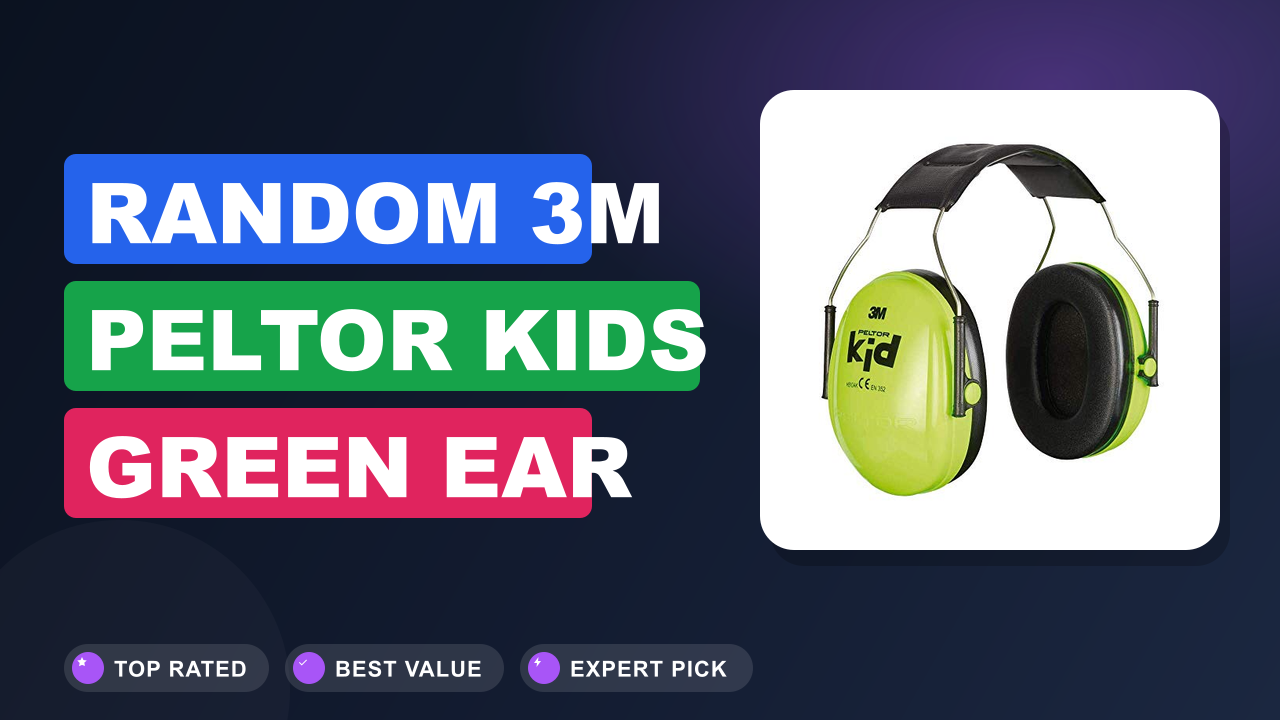
Every Fourth of July and every county tractor pull, parents end up doing the same frantic search: how do you protect a toddler's ears without the muffs sliding off every ten minutes? That question is what put the 3M Peltor Kids Green Ear Defenders/Protectors on our research bench, alongside a stack of buyer reports, 3M's own spec sheets, and the ANSI standard behind the numbers on the box.
Short version: worth it if you need reliable passive protection your kid will actually keep on for hours, and skip it if you're shopping for an infant under six months or a teenager with an adult-sized head. Here's the full breakdown.

1. 3M Peltor Kids Green Ear Defenders/Protectors
We pulled this model into our research because it keeps surfacing in the same three buyer stories: fireworks meltdowns, sensory overload in loud public spaces, and dads who want their kid at the range without risking a lifetime of tinnitus. Peltor is 3M's industrial hearing-protection line, so this is a shrunken version of gear built for airport ramps and sawmills. That pedigree is the whole reason it costs more than the no-name muffs sitting next to it.
What it is
A passive earmuff is a hearing protector that seals over the whole outer ear with foam-filled cups, blocking sound purely through mass and sealing pressure with no electronics involved. The Peltor Kids (model H510AK-442-GN) is 3M's child-scaled version of that design, carrying a Noise Reduction Rating (NRR) of 22 dB under the ANSI S3.19-1974 test method that the EPA requires on the label.
The kids' hearing-protection shelf is crowded. Baby Banz and Em's 4 Bubs sell soft banded muffs for infants, Alpine Muffy leans into the sensory-processing market, and Walker's and Howard Leight by Honeywell sell youth-sized shooting muffs. 3M's angle here is industrial engineering scaled down rather than a toy with padding.
Setup and first impressions
There's no setup beyond sliding the cups up or down the headband, which is exactly the point when you're wrangling a four-year-old in a parking lot.
Aggregate user reviews are unusually consistent about the first-touch impression: buyers repeatedly note the cushions feel softer and more pliable than the stiff vinyl on budget muffs, and that the headband pad spreads pressure instead of digging into the crown. Verified buyer feedback also flags the clamping force as noticeably lighter than adult industrial muffs, which is deliberate. Lower clamp means less protection on paper but far better odds the child leaves them on.
The other detail that shows up again and again in review data is the sizing surprise. Parents of one-year-olds report the muffs sit slightly large but still seal, while parents of nine and ten-year-olds report the headband running out of travel. 3M's own product literature positions the H510AK for children, not teens, and 3M's official site is the cleanest place to confirm current model coding before you buy.
| Model | 3M Peltor Kids H510AK-442-GN |
| Noise Reduction Rating (NRR) | 22 dB (ANSI S3.19-1974) |
| European rating | SNR 27 dB (EN 352-1) |
| Type | Passive over-ear, dielectric (no metal parts) |
| Power source | None, zero batteries required |
| Headband | Padded, height-adjustable, low clamp force |
| Best-fit age (buyer-reported) | Roughly 2 to 10 years |
| Color | Neon green (high-visibility) |
| Care | Wipe cups and cushions with mild soap and warm water |
Daily-use experience
How much noise does it actually block?
A 22 dB NRR does not mean the world goes silent, and understanding that number prevents disappointment. Under the EPA's labeling math, real-world protection is typically estimated by subtracting 7 from the NRR and halving the result, which puts practical attenuation closer to 7 or 8 dB for a casual fit and more when the seal is good.
In practice, buyer reports line up with that: fireworks still register as a soft thump, a leaf blower drops to background hum, and a NASCAR pack sounds distant rather than physical. Parents consistently describe kids falling asleep at loud events, which is the most useful field signal you'll find. For indoor pistol ranges where peak pressure exceeds 160 dB, 22 dB is thin, and doubling up with foam plugs is the standard fix.
Comfort and ergonomics for small heads
Comfort is where this model separates itself from generic muffs, and it comes down to clamp force. Industrial adult muffs squeeze hard because adults tolerate it for an eight-hour shift. 3M dialed the pressure down here so a preschooler doesn't get a headache in twenty minutes.
Verified buyer feedback repeatedly mentions two-hour and three-hour wear sessions without complaint, which is rare in this category. The trade-off is real, though: lighter clamp plus a child's smaller jaw means the seal can break when a kid chews snacks or turns their head hard against a car seat. Reseating them takes two seconds, but you'll be doing it.
Build quality and durability over seasons
These are built like scaled-down industrial PPE rather than a seasonal toy. The cups are rigid ABS-style plastic, the headband is a single continuous piece with a padded crown, and the dielectric construction means there's no exposed metal wire to bend out of shape or conduct.
Longevity reports skew strongly positive across multiple seasons of fireworks, tractor pulls, and mowing sessions. The recurring wear point is the cushion foam. Like every earmuff, the seals eventually compress and stiffen, and unlike 3M's adult Optime line, replacement cushion kits for the kids' model are harder to source, so a well-worn pair usually gets replaced rather than refurbished.
Fit range and how long they last as kids grow
Expect roughly four to six usable years per pair, which is the honest ceiling here. Buyer reports cluster around a sweet spot from age 2 through age 8, with some families getting to 10 before the headband tops out and the cups start sitting on the ear instead of around it.
That matters for value math. If you buy at age six, you might get three good years. Buy at age two and this thing rides along to kindergarten graduation.
For infants under six months, audiologists generally recommend soft-band muffs instead, since a rigid headband doesn't fit a skull that size and pressure distribution is different. The CDC's hearing-loss prevention resources are a solid neutral reference on safe exposure levels for children.
✓ Pros
- 22 dB NRR tested to ANSI S3.19-1974, so the rating is a regulated figure rather than a marketing number
- Low clamping force tuned for kids, which is why buyers report 2 to 3 hour wear sessions without complaints
- Fully passive with no batteries, so it can’t die during the fireworks finale
- Dielectric build with no exposed metal, meaning nothing to bend permanently when it gets tossed in a bag
- Neon green cups are easy to spot in a stadium seat or grass field when they inevitably get left behind
✗ Cons
- Headband runs out of adjustment around age 9 or 10, so bigger kids age out faster than parents expect
- 22 dB is modest for indoor gun ranges, where doubling up with foam plugs becomes necessary
- Cushions are not easily replaceable compared with 3M’s adult Optime line, so worn seals mean a new pair
- Priced well above generic kids’ muffs, which stings if your child only wears them twice a year
Who should buy it
Buy it if you…
You're the parent who takes kids to loud things regularly: airshows, monster truck rallies, farm equipment days, indoor hockey, or a garage where the compressor kicks on. You want protection that works without a charging cable, an app, or a pairing routine. You're also a strong candidate if your child has sensory-processing sensitivity and needs a predictable, comfortable way to dial down a grocery store or a school assembly.
The comfort tuning is what makes daily wear realistic instead of a five-minute experiment that ends in tears.
Skip it if you…
You've got a newborn or an infant under about six months, in which case a soft banded muff distributes pressure far better on a developing skull. Skip it too if your kid is 11 or older and heading to an indoor range, where a youth-fit adult muff with a 25 to 31 dB NRR does more real work. And if the muffs will come out of the closet exactly once a year for New Year's fireworks, the premium over a basic pair is hard to justify.
Better alternatives
Baby Banz Earmuffs are the go-to for infants and young toddlers, using a soft adjustable band instead of a rigid headband so there's no pressure point on a small head.
Howard Leight by Honeywell Leightning L3 is a better call for older kids and teens at a range, with a 30 dB NRR class rating and an adult-scaled headband that still cinches down small enough for a 12-year-old.
Frequently Asked Questions (FAQ)
What age are the 3M Peltor Kids muffs actually for?
3M positions the H510AK for children, and aggregate buyer reports put the practical sweet spot between roughly age 2 and age 8, stretching to 10 on smaller heads. Below six months, use a soft-band infant muff instead, since a rigid headband can't fit properly or distribute pressure safely. Above age 10, most families report the cups sitting on the ear rather than sealing around it, which kills the attenuation.
Is 22 dB NRR enough for fireworks?
Yes, for spectator fireworks it's appropriate. Consumer fireworks displays typically produce peak levels in the 140 to 155 dB range at close distance, and even after applying the EPA derating formula, a properly sealed muff brings that into a far safer zone for a child seated at a normal viewing distance. Buyer reports consistently describe kids staying calm or even sleeping through finales.
Keep some distance from the launch site and you're in good shape.
Can kids wear these at a shooting range?
Outdoors at a rifle or shotgun range, yes, and many parents do exactly that. Indoors, 22 dB is on the light side because concrete walls reflect muzzle blast and stack the exposure. The standard practice is dual protection: foam earplugs underneath the muffs, which adds roughly 5 to 8 dB of real-world attenuation rather than simply summing the two ratings.
Do they fold up for travel?
No. These use a fixed continuous headband, so they take up backpack space and won't collapse flat like some folding adult models. That fixed design is also why they hold their shape after years of being tossed into a truck door pocket.
If a folding hinge matters more than durability to you, this isn't the pick.
How do you clean them?
Wipe the cups and cushions with a cloth dampened in mild soap and warm water, then air dry fully before storing. Do not soak them, and skip alcohol or solvent wipes, which dry out and crack the cushion material faster. 3M's care guidance for its hearing-protection line is consistent on this point. If the cushions feel hard or cracked, attenuation is already compromised and it's time for a new pair.
Final verdict
4.5 out of 5 stars. The 3M Peltor Kids Green Ear Defenders/Protectors earn their reputation by getting the boring engineering right: a regulated 22 dB NRR, a clamp force tuned so children actually keep them on, and construction that survives years of being thrown in a diaper bag.
The clear winners here are parents of two to eight year olds who face loud environments more than a couple times a year, and families managing sensory sensitivity who need something reliable and comfortable enough for regular wear. If your child is an infant or nearly a teenager, or if your only use case is an annual fireworks show, your money goes further elsewhere.
Affiliate disclosure: This post contains affiliate links. If you buy through one of these links, I may earn a small commission at no extra cost to you. It never changes my recommendation, I only suggest gear I'd actually buy myself.