Archery Hunting Ethics: Practice, Shot Distance, Recovery, and Field Decisions
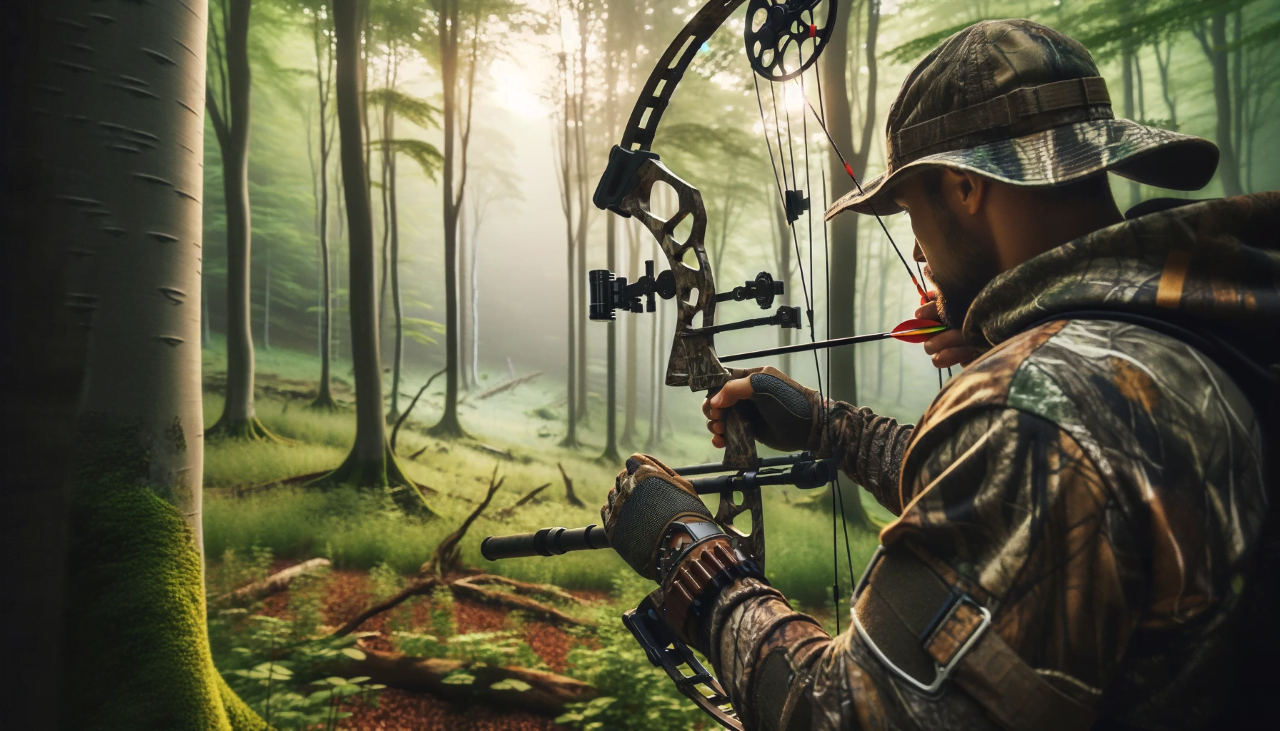
Archery hunting is ethical only when the hunter is legal, practiced, patient, and willing to pass shots that do not give the animal a high chance of fast recovery. The bow does not forgive guesswork. A clean archery hunt starts before opening day with current regulations, a tuned bow, realistic practice, and a clear personal limit on distance and shot angle.
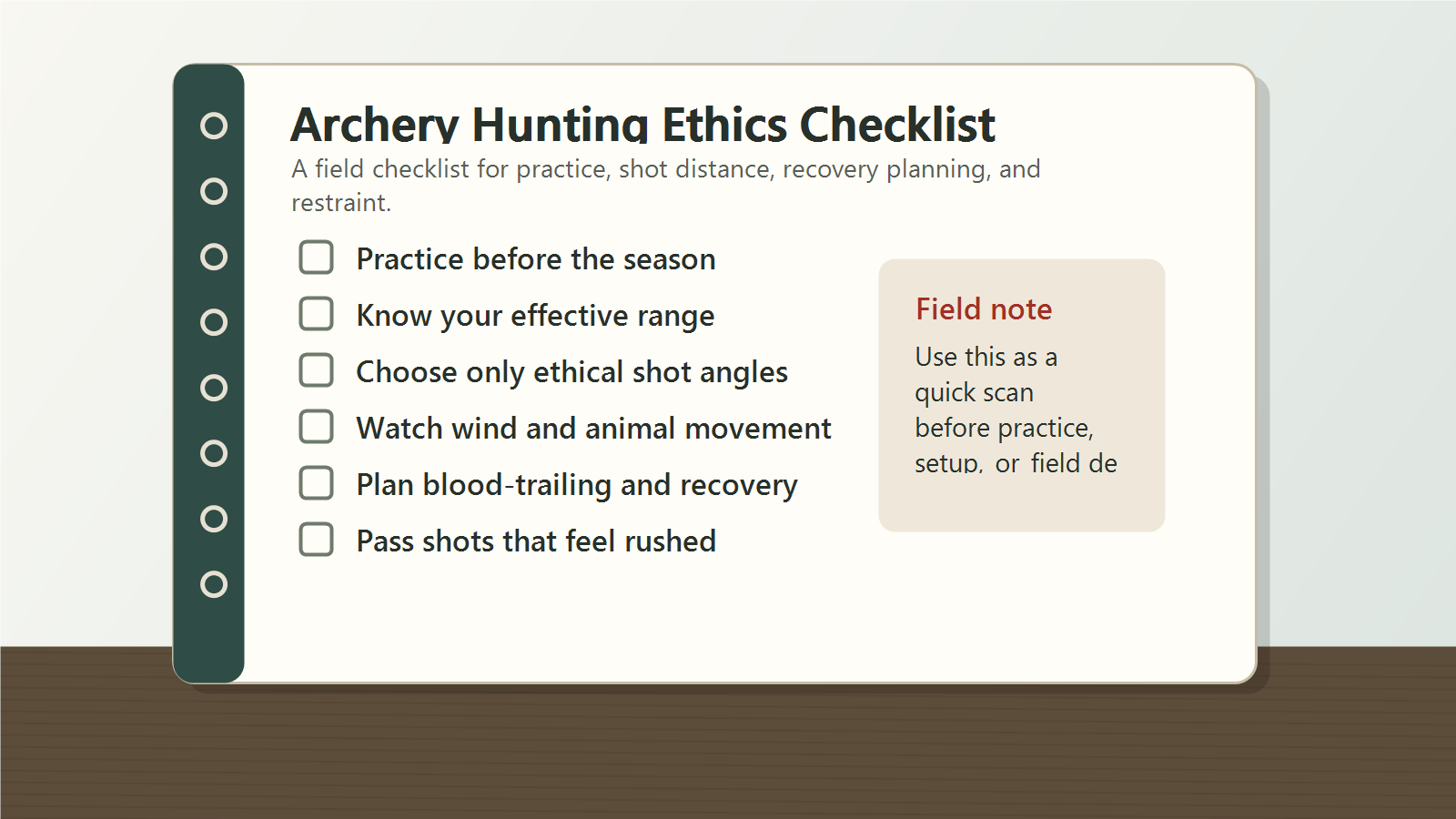
This guide is for hunters who want a plain, responsible framework for bowhunting deer, elk, turkey, hogs, and other legal game. It does not replace your state hunting regulations, hunter education course, bowhunter education course, landowner rules, or local conservation officer guidance. Use it as a field-minded checklist for the decisions that matter most: whether you can hunt, where you can hunt, when you can hunt, whether the shot is right, and what to do after the arrow is released.
Table of contents
- Start With Legal Seasons, Tags, and Local Rules
- What Ethical Archery Hunting Means
- Preseason Practice Standards
- Shot Distance and Shot Angle Ethics
- Field Decision Checklist Before Drawing
- Arrow Impact, Tracking, and Recovery
- Land Access, Other Hunters, and Public Trust
- Common Archery Hunting Mistakes
- Frequently Asked Questions
Start With Legal Seasons, Tags, and Local Rules
Legal archery hunting starts with the current rule book for the exact state, species, unit, weapon type, and date you plan to hunt. Do not rely on last year’s dates, a friend’s memory, an old forum answer, or a general article. State wildlife agencies can change season dates, tag quotas, antler rules, crossbow rules, broadhead requirements, blaze orange rules, and check-in procedures.
Before scouting or setting a stand, confirm these items from official sources:
- Your hunting license is valid for the state and season.
- You have the required tag, permit, stamp, or draw result for the species and unit.
- The archery season is open on the date and property you plan to hunt.
- Your bow type, draw weight, broadhead style, arrow setup, and crossbow use are legal where you hunt.
- You understand bag limits, antler rules, sex restrictions, harvest reporting, tagging deadlines, and transport rules.
- You know whether hunter orange or other visibility clothing is required during overlapping firearm seasons.
- You have written permission for private land or have checked public land maps, closures, access hours, and local restrictions.
The U.S. Fish and Wildlife Service hunting page is a useful national starting point, but state wildlife agencies are the authority for most resident game seasons and tags. For example, state outdoor annuals and hunting digests explain legal dates, methods, zones, and reporting rules. If anything is unclear, call the state wildlife agency before the hunt. That one phone call is better than learning the rule from an officer in the field.
Bowhunter education is also worth treating as part of the legal and ethical baseline. Many states require hunter education for certain hunters, and some states or provinces recognize bowhunter education for archery-specific seasons or access. The National Bowhunter Education Foundation supports bowhunter education through the International Bowhunter Education Program, and online state hunter education providers such as Hunter-ed and Bowhunter-ed can help hunters find state-specific study material.
What Ethical Archery Hunting Means
Ethical archery hunting means making choices that respect the animal, the law, other hunters, landowners, and the non-hunting public. It is not measured only by whether a hunter fills a tag. A legal hunt can still be careless if the hunter takes low-percentage shots, ignores recovery duties, crowds other hunters, damages property, or treats wildlife like a prop.
The practical standard is simple: take only shots you can make under real field conditions, recover what you hit, use the meat when required or expected, and leave the place better than you found it. That standard requires restraint. Archery gear can be accurate, but a living animal is not a foam target. Animals move, brush deflects arrows, wind changes, nerves rise, and low light can make distance and angle harder to read.
Fair chase is part of that discussion. Rules vary by state, but the idea is to give game a real chance to use its senses and natural behavior. Baiting, electronic calls, trail cameras, drones, motorized access, and tracking technology are regulated differently across the country. Some tools may be legal in one place and banned in another. Even when a tool is legal, ask whether it helps you make a better decision or pushes the hunt toward shortcut behavior that harms public trust.
Ethical archery hunting has three parts
The first part is competence. A hunter should be able to place arrows consistently at known and unknown distances, from the positions and angles expected in the field. That includes broadhead confirmation, not only field-point groups on a calm range.
The second part is judgment. A hunter should know when not to shoot. Passing a poor shot is not failure. It is one of the clearest signs that the hunter understands the limits of the setup and the responsibility that comes with the tag.
The third part is accountability. After the shot, the hunter owns the result. That means watching the animal, marking the last location, reading the sign, waiting when needed, tracking carefully, asking for help when legal and useful, and making a serious recovery effort.
Preseason Practice Standards
Preseason archery practice should copy hunting conditions instead of only building confidence on easy shots, and our target panic practice guide can help if the shot process gets rushed. A flat backyard group at 20 yards is useful, but it does not prove readiness for a steep treestand angle, a kneeling shot from a blind, a cold morning with gloves, or a quick range estimate under pressure.
Start by confirming that the bow is safe and tuned; our bow tuning for beginners guide covers that setup mindset in more detail. Inspect strings, cables, limbs, cams, serving, nocks, rests, sights, peeps, releases, bolts, arrows, and broadheads. If anything looks damaged or inconsistent, stop and have a qualified archery shop inspect it. The USA Archery safety resources are a good reminder that archery equipment deserves the same controlled handling every time, whether at a range or in camp.
Then practice the shots you might actually take. If you hunt from a treestand, practice from a raised position where it is legal and safe. If you hunt from a ground blind, practice seated and kneeling, with the same clothing and release style. If you hunt spot-and-stalk, practice after a short walk so your breathing is not perfect. If you hunt in cold weather, shoot with the layers you expect to wear and make sure sleeves, chest fabric, and face coverings do not contact the string.
A practical preseason standard
A reasonable personal standard is to keep every hunting arrow inside the vital-zone size of the animal you intend to hunt at your chosen distance, from the position you will use in the field. If your groups open up when you add broadheads, shoot from a stand, or wear hunting clothing, shorten your field limit until the groups are honest again.
Do not set your max range from your best group of the summer. Set it from your normal group on an average day, after a warmup, with the exact arrow and broadhead style you will hunt. A hunter who can occasionally hit well at 50 yards may still be a 25-yard hunter under real conditions. That is not a weakness. It is useful information.
Practice also includes range estimation and shot sequence. Use a rangefinder where legal, but do not let it become a substitute for judgment. Range the landmarks around your stand before game appears. Know the 15, 20, 25, and 30 yard points. Build a calm shot routine: stance, range, angle, clear lane, draw timing, anchor, aim, steady squeeze, follow-through, watch impact.
Shot Distance and Shot Angle Ethics
Ethical shot distance is the distance at which you can place a sharp broadhead into the vital area under the actual field conditions in front of you. It is not the distance printed on a bow ad, the farthest target you can hit, or the longest shot someone else made online.
For many bowhunters, close shots are better shots. A shorter shot gives the arrow less time in flight, reduces the chance of animal movement before impact, makes small range errors less damaging, and usually improves visibility of shot placement. Long shots can look clean on video, but they leave more time for the animal to step, turn, duck, or react.
Use a personal maximum, then reduce it when conditions are not right. Wind, low light, rain, brush, steep angles, heavy clothing, cold fingers, animal alertness, unknown distance, and a racing heart all lower your real effective range. If the animal is tense, looking at you, quartering sharply, moving, or partly covered, the ethical range may be zero.
Broadside and slightly quartering-away shots
Broadside and slightly quartering-away shots are generally the highest-percentage archery angles because they expose the heart and lungs with a clearer path through the chest. Even then, the hunter must aim for the right exit path, not only the near-side entry point. With quartering-away animals, choose a point that sends the broadhead through the vitals instead of into the shoulder, paunch, or one lung.
Wait for the near-side leg position to open the chest when possible. If the leg is back and the shoulder area is tight, be patient. A few seconds can turn a marginal view into a clean lane. If the animal walks out of range while you wait, that is still a better result than forcing a poor angle.
Angles to avoid
Frontal shots, hard quartering-to shots, straight-down shots from steep stands, and shots through heavy brush create higher risk with archery equipment. Some hunters may argue about rare exceptions, but a support guide should set the standard for common, repeatable decisions. Most hunters are better served by waiting for a broadside or quartering-away angle.
Do not shoot at sound, movement, antler tips, or an animal you cannot clearly identify. Do not shoot through brush because you “think there is a gap.” Small branches can change arrow flight. Do not shoot at running game. Do not shoot outside legal light. If you cannot see the aiming point and the arrow path, you do not have a shot.
Field Decision Checklist Before Drawing
A field decision checklist keeps the hunter from letting excitement outrun judgment. Run through the questions before drawing, not after the pin is floating on hair.
- Is this the right species and a legal animal under my tag?
- Is the season open here today, and am I inside legal shooting hours?
- Is the animal inside my practiced field distance for today’s conditions?
- Do I have a clear lane from bow to vitals, with no brush, fence, feeder leg, blind fabric, or other obstruction?
- Is the animal broadside or slightly quartering away?
- Is the animal calm enough that it is unlikely to jump, whirl, or step during the shot?
- Can I draw without being seen and settle without rushing?
- Do I know where the arrow should enter and where it should exit?
- If I hit this animal, can I safely and legally track it onto the land it may enter?
If any answer is no, wait. The checklist is not meant to drain the hunt of excitement. It is meant to keep the hunter from making a decision that cannot be taken back.
Arrow Impact, Tracking, and Recovery
Recovery begins the moment the arrow leaves the bow. Watch the impact, listen to the animal, note its direction, and mark the last place you saw it. Do not climb down, celebrate, text friends, or walk to the impact site without a plan.
Try to identify the hit from what you saw and heard, then confirm with sign at the arrow and first blood only when enough time has passed. Bright blood, dark blood, hair type, smell, stomach matter, arrow location, and the animal’s reaction can all help, but none of them should lead to careless rushing. When in doubt, wait longer and get help from an experienced tracker or legal tracking dog service if your state allows it.
Why waiting matters
A well-hit animal may go down quickly, but a marginally hit animal can travel far if pushed too soon. Archery recovery is not a race. The goal is to find the animal with the least disturbance and the best chance of success. Mark each blood spot with tape or pins if legal and practical. Move slowly. Look ahead, not only at the ground. Avoid stepping on sign. If the trail weakens, back up to the last confirmed sign and restart the search pattern.
Know your state rules for leaving and reentering property, using lights, tracking at night, carrying a weapon during recovery, using dogs, and tagging before moving the animal. Some states have specific requirements for carcass tags, harvest confirmation numbers, evidence of sex, chronic wasting disease sampling, and transport. This is another reason to read the current state regulations before the season starts.
When recovery becomes a responsibility beyond pride
Every hunter misses at some point. Every hunter can make a poor hit. What separates responsible hunters is what happens next. A serious recovery effort may mean calling the landowner, asking another hunter to help grid search, contacting a conservation officer for rule clarification, or giving up the next morning’s hunt to continue tracking.
If you cannot recover the animal, be honest with yourself about why. Was the shot too far? Was the angle poor? Did you rush? Did your broadheads group differently than field points? Did you misread yardage? Use that answer to change your practice and your personal limits before hunting again.
Land Access, Other Hunters, and Public Trust
Archery hunters share the field with landowners, hikers, bird hunters, firearm hunters, farmers, livestock, pets, and other bowhunters. Ethical hunting includes how you act when no game is in range.
On private land, get permission in writing where possible, follow parking instructions, close gates, avoid crop damage, report broken fences or trespass concerns, and do not bring guests unless the landowner agreed. Ask how the landowner wants carcass remains handled. Ask whether tracking onto neighboring land is possible and who to call if the animal crosses a boundary.
On public land, do not crowd another hunter’s setup. If you find a stand, blind, or active setup, give it space. Public land does not mean you own every good tree. Pack out trash, flagging where required, broadhead packages, food wrappers, and spent hand warmers. Follow rules for temporary stands, screw-in steps, trail cameras, e-bikes, camping, fires, and vehicle access.
Public trust matters because wildlife is a shared resource. Hunters who make careful shots, recover game, obey access rules, and speak plainly about limits help protect the future of hunting. Hunters who wound animals through poor choices, trespass, leave waste, or brag about risky shots make it harder for everyone else.
Common Archery Hunting Mistakes
The most common archery hunting mistakes are usually not gear problems. They are decision problems.
Shooting past your real limit
A long shot may feel possible at full draw, especially after a slow season. The better standard is whether you would bet the animal’s recovery on that shot, at that angle, in that light, with that wind, from that body position. If not, let it walk.
Skipping broadhead practice
Broadheads can change point of impact compared with field points. Fixed blades, mechanical heads, arrow spine, fletching, tuning, and bow speed can all affect flight. Confirm your hunting arrows before the season. Do not assume they group because your field points group.
Drawing at the wrong time
Many close-range archery chances fail because the hunter draws while the animal is looking, steps into the lane too soon, or holds too long and starts shaking. Let the animal’s head, body angle, and cover dictate the draw, then be ready to let down if the shot does not develop.
Tracking too soon
Rushing the trail is one of the worst recovery mistakes. If you are unsure of the hit, back out quietly and wait. Pushing a wounded animal can turn a recoverable hit into a lost animal.
Letting content replace education
Videos, podcasts, and articles can help, but they do not replace hunter education, bowhunter education, state rules, or local mentoring. The Archery Trade Association and its public education efforts through archery programs can help people find a starting point in the sport, while formal safety and hunting courses give structure that random advice often lacks.
Frequently Asked Questions
How far should a beginner shoot at deer with a bow?
A beginner should use a personal limit based on consistent broadhead groups under field conditions, not a fixed internet distance; for a broader starting point, read our hunting tips for beginners. Many new bowhunters are better served by keeping shots close, often around the distance where they can place every hunting arrow inside the vital area from a real hunting position. If that distance is 15 or 20 yards, hunt that way until practice supports more.
Is archery hunting more ethical than rifle hunting?
Archery hunting is not automatically more ethical than rifle hunting. Ethics depend on legality, skill, shot choice, recovery effort, and respect for wildlife. A careful rifle hunter can be ethical, and a careless bowhunter can be unethical.
Do I need bowhunter education if my state does not require it?
Bowhunter education is still useful even when it is not required. It covers archery-specific topics such as shot placement, treestand safety, blood trailing, recovery, and fair chase. Check your state’s rules first, then consider a course through official state education channels or NBEF-supported programs.
What is the most ethical shot angle for archery hunting?
Broadside and slightly quartering-away angles are usually the best choices for archery hunting because they offer a clearer path through the vital area. Hard quartering-to, frontal, steep straight-down, running, and brush-obstructed shots carry more risk. When the angle is wrong, wait.
Should I shoot if the animal is alert?
It is usually better to pass on an alert animal, especially at longer archery distances. An animal that is tense, staring, crouched, or ready to move can change position before the arrow arrives. Close, calm, unaware animals give the hunter a better chance of clean placement.
How long should I wait before tracking after an archery shot?
The wait depends on the hit, species, weather, and local conditions. If the hit looked good and you saw the animal go down, recovery may be quick. If the hit is uncertain, back out quietly, give the animal time, and seek experienced help or legal tracking assistance rather than pushing too soon.
Can I use a crossbow during archery season?
Crossbow rules vary widely by state, season, age, disability permit, and species. Some states allow crossbows broadly during archery seasons, while others restrict them or treat them separately. Check the current state regulation page before hunting.
What should I do if a wounded animal crosses onto private land?
Do not trespass. Mark the last sign, back out, and contact the landowner for permission. If the situation is urgent or unclear, call the local conservation officer or wildlife agency for guidance on legal recovery options.
Final Field Standard
The best archery hunting standard is not complicated: know the law, practice honestly, keep shots close enough for your real ability, wait for the right angle, and commit fully to recovery. The animal does not owe the hunter a perfect shot. The hunter owes the animal the discipline to take only the shots that should be taken.