Archery Classes for Kids: Safety, Age Readiness, and What Parents Should Check
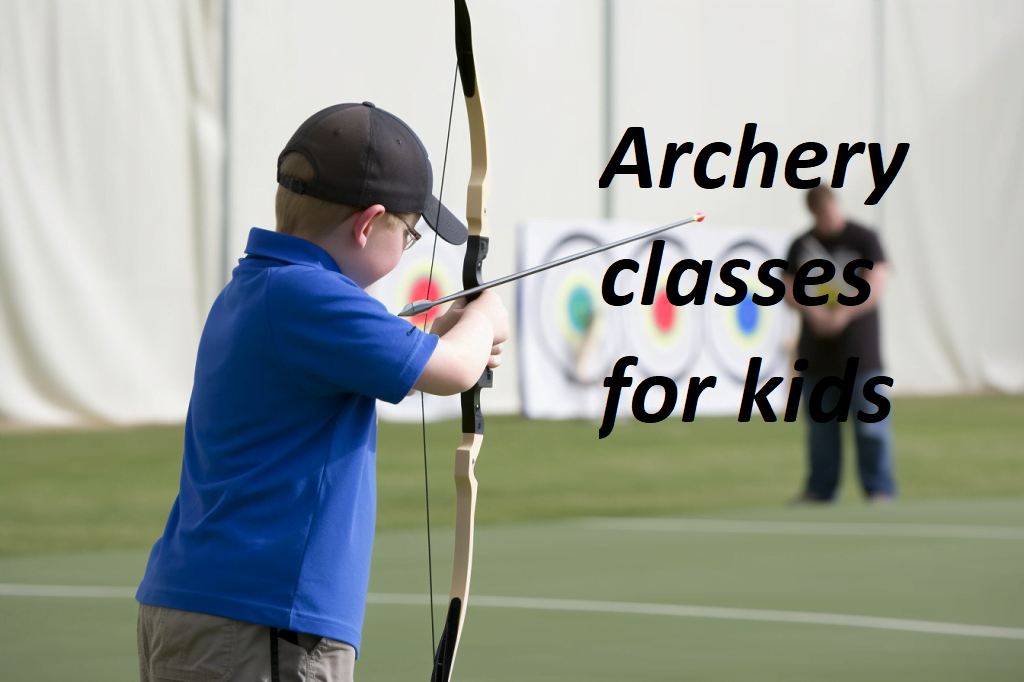
Archery Classes for Kids: Safety, Age Readiness, and What Parents Should Check
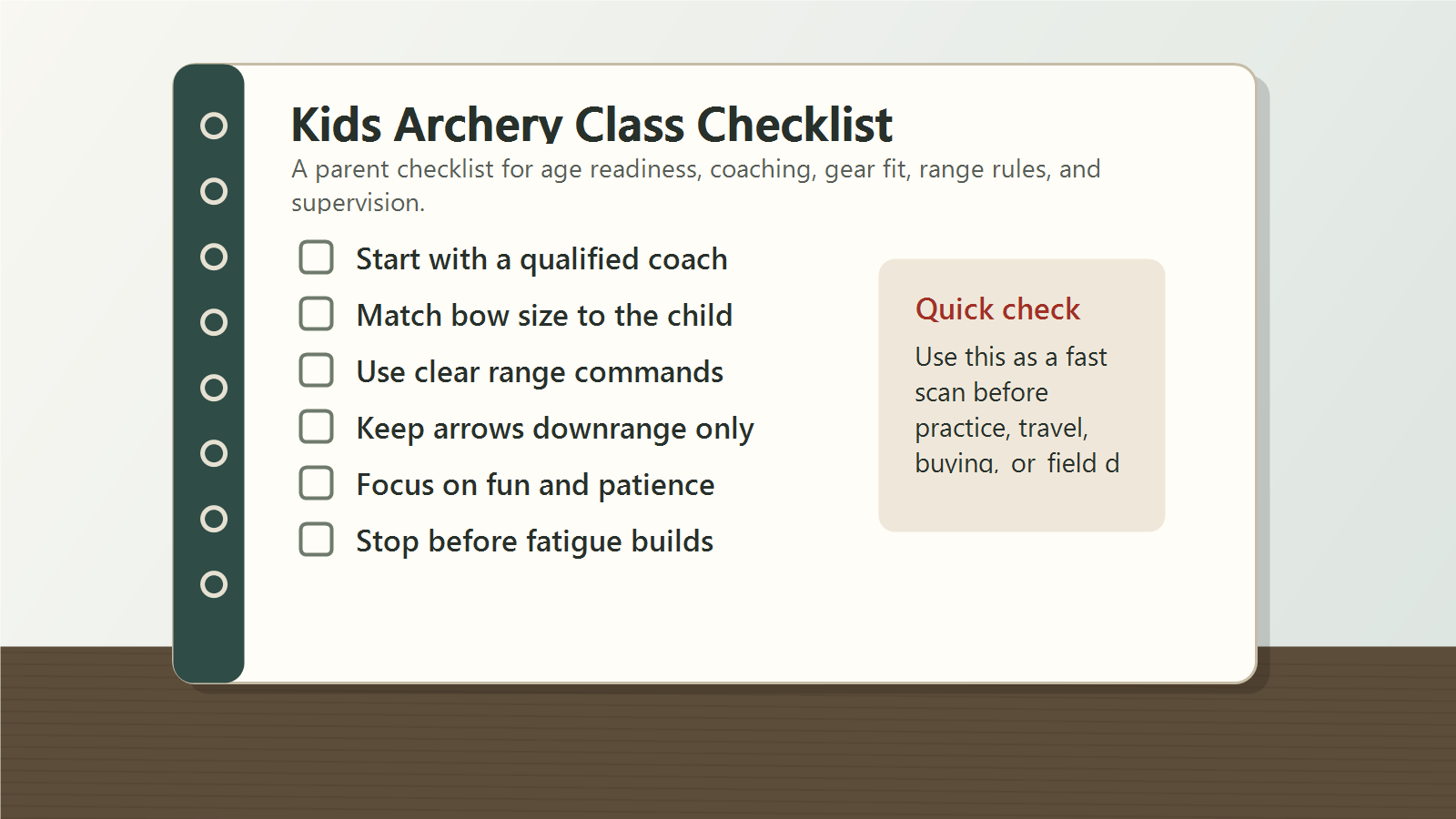
Parents usually come to archery with the same question: is this a good fit for my child, and how do I tell whether a class is set up well? The short answer is that archery can be a solid youth activity when the range is organized, the coach is qualified, the equipment fits, and the child can follow directions. The longer answer is below, because the details matter more than the label on the class flyer.
This guide is written for parents, not for athletes chasing performance claims. It focuses on safety, age readiness, supervision, equipment fit, and the practical checks that help you judge a class before you sign up. For related setup help, see our archery safety rules and youth compound bow guide.
Table of contents
How to Think About Age Readiness
Age is a starting point, not the whole answer
A child can be old enough on paper and still not be ready for a class that asks for steady attention, simple follow-through, and calm behavior on a range. The better question is not “What age does the class allow?” but “Can my child listen, wait, and repeat a short safety routine without breaking it apart?” Age gives you a first filter; behavior gives you the real answer.
Look for basic readiness signs
A ready child usually can stand in place for a short lesson, keep hands to themself around equipment, and remember a small set of directions without constant rescue. That does not mean perfection. It does mean the child can stay with the group long enough to learn how a range works. If the child needs repeated one on one correction for every step, the class may be a better fit later.
Do not force a start just because a program accepts the child
Some programs, including USA Archery’s JOAD, are set up for youth as young as 8, but “allowed in the program” is not the same as “ready this month.” It is reasonable to wait until the child can keep still, hear a coach the first time, and treat equipment with care. A later start can be the better start.
What a Good Kids Class Looks Like
The range should feel ordered, not crowded
A good beginners’ class has a clear structure. There should be a shooting line, a waiting area, a place to set gear down, and a coach who can see the whole lane. The room should not feel improvised. If kids are wandering around bows and arrows with no visible traffic pattern, that is a red flag. Good archery teaching depends on routines that are easy to repeat.
Commands should be short and consistent
A child should hear the same basic language every time: when to step up, when to wait, when to shoot, and when to stop. Long speeches are not the goal. Clear, repeated commands are. The less a coach has to explain in the moment, the easier it is for a child to stay safe and not guess at what comes next.
Beginners need enough attention to stay on track
A class can be social without turning into a free-for-all. The best beginner classes keep group size small enough that the coach can correct a child before bad habits become habits. If the room is so large that the coach is always reacting, ask how supervision works, who handles lane control, and how often each child gets direct feedback.
Coach Credentials That Matter
Ask what training the coach actually has
USA Archery says its coach certification courses are built to support safety, and that is the kind of answer parents should want. Ask whether the coach has current certification, how long it lasts, and whether the class follows a recognized youth program or a home-made lesson plan. A confident answer should be easy to hear and specific.
Background screening and SafeSport are worth asking about
For youth settings, it matters whether coaches and club administrators have background screening and current SafeSport training. USA Archery notes both as part of its coaching safety setup. That does not replace good judgment, but it does tell you that the program takes adult oversight seriously. If a program gets vague at this point, keep asking until the answer is plain.
Prefer coaches who welcome parent questions
A solid coach does not act annoyed when a parent asks about safety, class structure, or what happens if a child gets overwhelmed. Parents are not being difficult when they ask for details. They are doing their job. The right coach should be able to explain how children are introduced to equipment, how errors are corrected, and when a child is told to step back.
Equipment Fit Before Effort
Draw weight should stay light enough for clean form
Kids should not be pushed into a bow that is too heavy just because it looks more serious. A bow that is hard to draw changes the whole lesson. It invites twisting, leaning, shoulder strain, and sloppy release. The child should be able to draw with control, hold position briefly, and let down safely without fighting the bow. If the setup looks like a struggle, it is the wrong setup.
Fit should include the grip, not just the poundage
A child can have a low poundage bow and still have a bad fit if the grip is too large, the stance feels awkward, or the arrows are not matched well. Fit is about the whole body. The bow should sit in the hand without forcing the wrist into a bad angle, and the child should be able to anchor consistently without reaching. A calm shot begins with a bow that does not fight the shooter.
NASP uses a simple equipment model for a reason
NASP’s school program is built around a uniform, beginner-friendly approach, including a Genesis bow setup that is designed to keep the system straightforward for students. That kind of simplicity helps parents understand the value of starting with equipment that is predictable, not flashy. A beginner class should choose ease of use over variety if that keeps the child safer and less confused.
Eye Dominance and Hand Choice
Check eye dominance before locking in a side
Eye dominance matters because the aiming eye and the shooting side should not be guessed at random. A child who is left eye dominant may shoot better left handed, but not always. The point is to check before you commit. A quick dominance test can save a lot of awkward retraining later. Good beginner programs check this early instead of waiting until the child is already frustrated.
Do not force a child into the wrong hand
Some children are naturally comfortable on one side but see better with the other eye. That does not mean there is a crisis. It means the coach needs to choose the cleaner learning path. For a young beginner, the best side is often the one that creates less body tension and less confusion. If the child is fighting the setup from day one, ask the coach to reassess.
Cross-dominance needs patience, not drama
Cross-dominance is common enough that it should not surprise anyone. The answer is usually a patient fit check, not a hard push. Some children adapt quickly; some need extra time. Either way, the class should help the child settle into a repeatable stance, not turn handedness into a test of will.
Range Rules Kids Need to Learn
Every line has a stop-and-wait rhythm
Children need to learn that archery is controlled by the line, not by excitement. There is a time to step up, a time to nock, a time to shoot, and a time to stay still. The structure may seem simple, but it is the whole safety system. A child who rushes ahead or wanders across the line has to be corrected right away.
Going downrange is never casual
Going to the target area should happen only after the line is made cold and the coach has clearly said it is safe. That is not a moment for side conversations or guesses. A class should teach kids to wait, check, and listen for the exact command. If a program is loose about this, the whole setup is too loose.
Do not assume backyard habits transfer to a range
A child may have seen a bow on television or in a game, but those images are not range rules. A real class should correct myths early: no pointing bows around, no drawing unless told to draw, no wandering past the line, and no acting as if the target zone is a playground. The rules are there because arrows do not care about casual mistakes.
Supervision and the Parent Role
Stay involved, especially at the beginning
For younger kids, a parent should expect to stay close enough to understand the routine and step in if the child needs help after class. That does not mean coaching from the sideline every minute. It does mean being present, paying attention, and asking how the session went before the child heads home. A little calm involvement goes a long way.
Ask how the coach handles breaks and distractions
Kids get thirsty, tired, and distracted. A thoughtful class plans for that. Ask where children go if they need a break, who notices if someone is overwhelmed, and how the coach resets the line after a distraction. Good supervision is not only about watching the shot. It is also about managing the in between moments.
Safety rules should survive sibling energy and group chatter
If siblings are in the same class or a child is attending with friends, the coach still needs control of the room. Social energy can be useful, but it can also turn into horseplay. A range that can handle kids only when they are quiet is not doing enough. The rules should hold even when the room is lively.
Home Practice Needs Boundaries
No backyard setup should be treated as automatically safe
Parents sometimes imagine that a fence, a patch of grass, and a target are enough. They usually are not. Backyards have neighbors, windows, hard surfaces, pets, and blind spots. Unless a professional has set up a proper practice area with a full safety plan, treat the backyard as the wrong place to shoot. A child needs range discipline, not a guess-and-hope setup.
Dry practice can still be useful
Not all practice needs arrows. A child can work on stance, grip, posture, and drawing form without live shooting if the coach says that is appropriate. That kind of dry practice is safer because it removes the flight path while keeping the body mechanics in view. It is also easier for parents to supervise in a normal room, provided the bow is handled under clear instructions.
Storage matters between sessions
Bows and arrows should be stored out of casual reach when not in use. The goal is not to hide the sport; it is to avoid accidental handling. A child who treats a bow like a toy outside class needs more structure, not more freedom. Good habits at home support good habits at the range.
Choosing Between JOAD and NASP
JOAD is a club path with a clear youth ladder
USA Archery’s JOAD program is for youth as young as 8 and is built around range safety, proper technique, and a step-by-step learning path. It can be a good fit for families who want a club environment and a flexible pace. The club setting also makes it easier to keep equipment and class format consistent from one lesson to the next.
NASP is built for school-based participation
NASP is a school-centered program with curriculum and equipment rules designed for a broad student group. That makes it a practical option when you want archery to fit inside school schedules and school oversight. The parent-side question is simple: does the school follow the NASP model, and is the adult leadership current and easy to verify?
The right choice depends on schedule and supervision
Some families want after-school club time. Others want a class attached to school. Neither path is automatically better. What matters is whether the environment is structured, the coach or instructor is accountable, and the child can learn safely without pressure to move faster than readiness allows.
What to Ask Before Enrolling
Start with the plain safety questions
Ask who supervises the line, how many kids are in the class, what happens if a child stops listening, and whether the class uses recognized youth guidance. Those questions are not intrusive. They are basic due diligence. The answers should help you picture a normal class night, not just a polished brochure.
Ask about equipment, not just the schedule
Find out whether the class provides bows, whether it fits them by hand size and draw weight, and whether the coach checks eye dominance before assigning a setup. If the answer is “we will figure it out later,” keep looking. Good beginner archery is built on fit from the beginning.
Ask how they handle parent communication
You want a program that tells parents what to bring, what to wear, how early to arrive, and what the class expects from a child on the first day. If the staff is organized, those answers come easily. If they are unclear, that tells you something useful before you hand over time or money.
Source Notes
USA Archery anchors
USA Archery’s JOAD page notes that the program is for youth as young as 8 and teaches range safety and proper shooting technique. Its Archery Safety page says USA Archery’s coach certification courses are a foundation for keeping archery safe, and that coaches and club administrators need background screening and current SafeSport training. For parents, the Find a Coach page is the practical starting point when you want to check who is teaching your child.
NASP anchors
NASP’s official site describes the program through its mission and principles pages, and its parents area points readers to coach certification verification. The ATA Safety Brochure and the wider NASP structure are useful anchors for school-based youth archery because they reinforce the idea that instruction, equipment, and supervision should be standardized rather than improvised.
Common-sense parent check
Beyond the official pages, the safest practical rule is simple: if the space, the coach, or the equipment depends on guesswork, the class is not ready for your child. Archery should be calm, supervised, and repeatable. Backyard shortcuts, loose supervision, and heavy bows do not belong in a beginner setup.
References: USA Archery JOAD, USA Archery Youth, USA Archery Archery Safety, USA Archery Find a Coach, NASP What is NASP, NASP ATA Safety Brochure, NASP Schools Home.