Airgun Hunting Laws by State: 10 Checks Before You Hunt
Airgun hunting laws by state must be checked before every hunt because the legal answer depends on your state, species, season, land type, airgun setup, and local rules. Do not rely on an old forum post, a product listing, or a single chart. Start with your state wildlife agency, read the current hunting digest, then check the rules for the land where you plan to hunt.
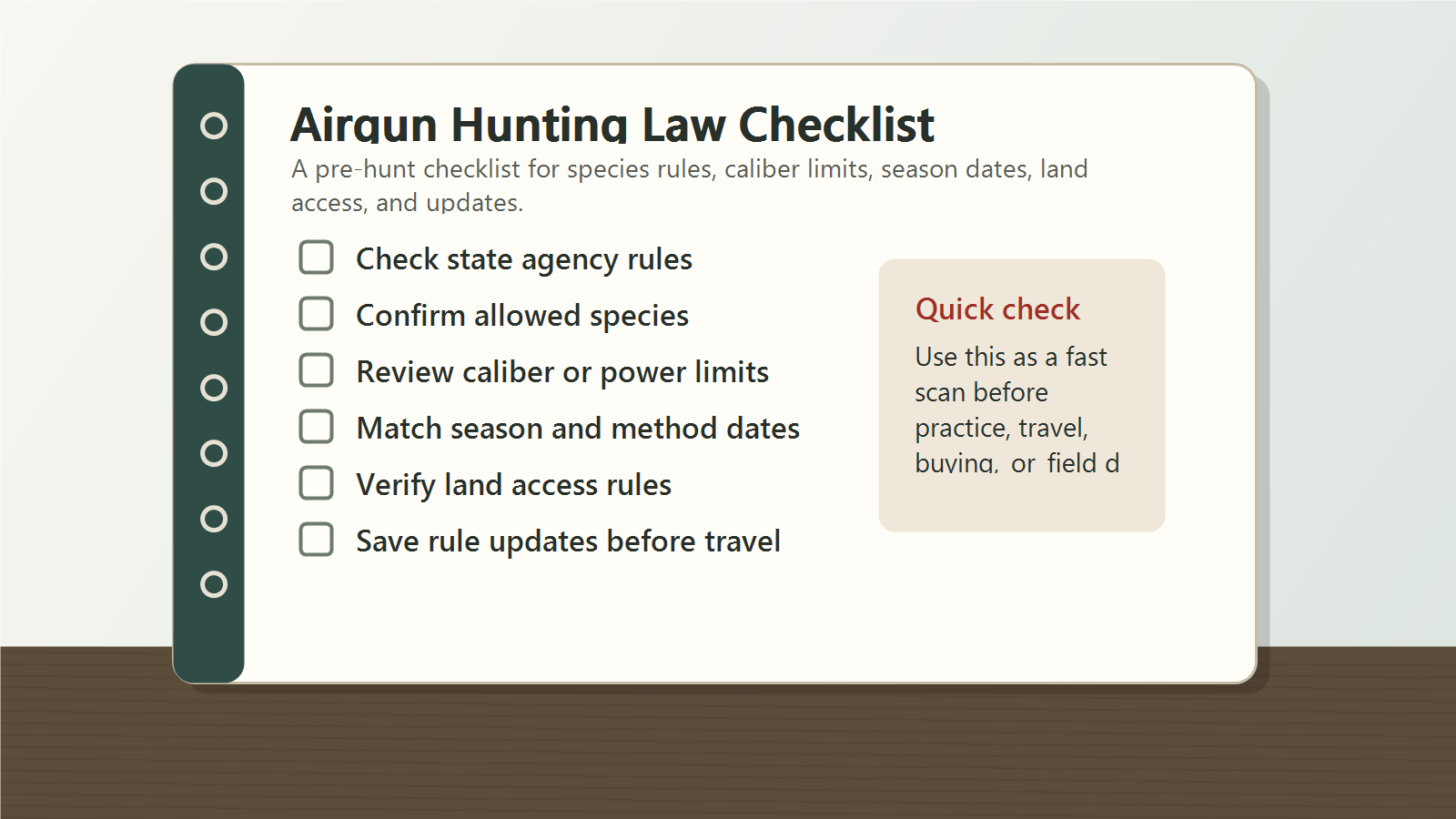
This guide is a verification checklist, not legal advice. It is built to help you find the right official source and avoid the common mistakes that can turn a legal hunt into a problem.
Table of Contents
- Quick answer
- Check your state wildlife agency first
- Confirm the exact species
- Match the legal season and method
- Check airgun caliber and power rules
- Check projectile and ammunition rules
- Check license, tag, and permit needs
- Check public-land and refuge overlays
- Check city, county, and discharge rules
- Check transport and handling rules
- Keep proof with your hunt plan
- Sample verification workflow
- FAQ
Quick Answer: What Makes Airgun Hunting Legal?
Airgun hunting is legal only when your state rules allow that air-powered method for the animal you plan to hunt, during the season you plan to hunt, on the land where you plan to hunt. A state may allow airguns for one species and not another. A wildlife area, refuge, city, or county can add extra limits even when state rules allow the method.
Use official sources, not seller claims
A retailer may describe an air rifle as hunting-ready, but that does not make it legal for deer, turkey, small game, or predators in your location. Product pages can help you identify caliber, projectile type, and power. They cannot replace the hunting digest or agency rule page.
Check again before the season opens
Rules can change by season year, commission action, emergency order, disease response, public-land closure, or local ordinance. A page you saved last year may be stale by opening day.
1. Check Your State Wildlife Agency First
Your first stop should be the official wildlife agency for the state where the hunt will happen. Many states publish online regulation digests, species pages, license instructions, and rule updates. USA.gov maintains a state government directory that can help you reach the correct state portal if you are not sure where to start.
Find the current hunting digest
Look for the current hunting, trapping, or big-game digest. Confirm the year printed on the PDF or webpage. If the page has separate sections for big game, small game, furbearers, turkey, and migratory birds, open the section that matches your planned hunt.
Look for method-of-take wording
The key wording is usually in a method-of-take, legal equipment, weapons, or lawful arms section. Search within the official page for terms such as air gun, air rifle, pneumatic, pre-charged pneumatic, caliber, arrow gun, and nonpowder.
Use state examples only as examples
For example, Colorado Parks and Wildlife keeps a public rules and regulations hub, Florida FWC has a hunting regulations page, and Georgia DNR publishes hunter resources. Those links show the kind of official agency source you should use. They do not tell you what is legal in every state.
2. Confirm the Exact Species
The species matters as much as the state. A state may treat squirrel, rabbit, raccoon, deer, turkey, coyote, feral hog, and nuisance wildlife differently. Do not assume that an airgun rule for small game also applies to deer or turkey.
Separate small game from big game
Small game rules often appear in a different section than big game rules. If you are checking airgun deer hunting, read the deer section and the legal-equipment section together. Our airgun deer hunting guide explains why deer-sized game needs a stricter ethics check than casual target shooting.
Check protected, unprotected, and nuisance categories
Some animals have seasons and bag limits. Others may fall under nuisance, invasive, or damage-control rules. That category can change the license, landowner permission, reporting, and equipment requirements.
Do not mix target shooting rules with hunting rules
An airgun may be legal to own or shoot at a range but still be illegal for a specific hunt. Ownership, range use, pest control, and regulated hunting are separate questions.
3. Match the Legal Season and Method
Once you confirm the species, match it to the season and weapon method. Some seasons are open only for firearm, archery, muzzleloader, youth, special permit, or limited-entry methods. Airguns may be listed by name, included under a broader term, or excluded.
Read the season table and the method section
A season table may tell you the date range, but the legal-equipment section tells you what tools are allowed. You need both before you hunt.
Watch for county or unit differences
Some states manage hunting by zone, unit, county, wildlife management area, or permit area. A method that is allowed in one unit may not be allowed everywhere.
Check emergency updates
Disease, wildfire, flooding, land access, or population-management decisions can create rule changes after the main digest is printed. Check the agency news or alerts page before leaving home.
4. Check Airgun Caliber and Power Rules
Many airgun hunting rules turn on equipment details. Common items to verify include caliber, minimum projectile weight, muzzle energy, projectile type, whether the gun is pre-charged pneumatic, and whether arrow guns are treated separately from pellet rifles.
Do not round up your specs
Use the exact caliber and projectile shown for your setup. If your rifle can shoot several projectile weights, verify the load you will carry in the field.
Keep manufacturer data separate from law
Manufacturer specs help identify the gun. The agency rule decides whether that setup is legal for the animal and season. If the listing is unclear, contact the manufacturer for specs and the wildlife agency for legal interpretation.
Match power to ethics, not only legality
A legal setup can still be a poor choice if it cannot deliver clean shot placement at your real field distance. Use a conservative range limit, confirm accuracy from field positions, and pass on shots that stretch your equipment.
5. Check Projectile and Ammunition Rules
Projectile rules can be easy to miss. Some regulations focus on the gun. Others specify pellet, slug, arrow, bolt, expanding projectile, broadhead, or non-toxic requirements. If the digest separates firearms, archery, and air-powered arms, read each section that could apply.
Confirm pellet, slug, or arrow-gun status
A pellet rifle, big-bore slug rifle, and air-powered arrow launcher may not be treated the same. Search the regulation text for each term that describes your setup.
Check lead and non-toxic rules
Some areas restrict lead ammunition or require non-toxic shot for certain species or lands. That can apply even when the airgun itself is otherwise legal.
Check broadhead rules for arrow guns
If your setup launches arrows or bolts, read the broadhead and archery-equipment section too. Do not assume an air-powered arrow gun follows normal vertical-bow rules.
6. Check License, Tag, and Permit Needs
Legal equipment does not remove license requirements. You may still need a hunting license, species tag, quota permit, habitat stamp, hunter education card, land-access permit, or special draw authorization.
Verify resident and nonresident rules
Nonresident hunters may face different license fees, application dates, tag limits, or draw rules. Confirm your status before buying gear or booking a trip.
Check youth and apprentice rules
Youth hunting rules may include age limits, supervision rules, hunter education requirements, and special season dates. Do not apply adult assumptions to a youth hunt.
Keep licenses with your field plan
Save a digital copy and carry what the state requires in the field. If the agency requires harvest reporting, note the deadline before the hunt.
7. Check Public-Land and Refuge Overlays
State rules are only one layer. Public lands can have extra restrictions. A national wildlife refuge, state wildlife area, wildlife management area, park, forest unit, or leased access property can limit weapons, dates, parking, check-in, blinds, bait, retrieval, or night access.
Check federal refuge rules separately
The U.S. Fish and Wildlife Service explains hunting access through the National Wildlife Refuge System hunting page. If your hunt is on a refuge, read the refuge-specific hunting brochure or station rules before assuming state rules are enough.
Check state wildlife area rules
State wildlife areas often add property-level rules. These can cover access hours, parking, method restrictions, check stations, maps, and closures.
Get written landowner permission when needed
Private land does not erase state wildlife rules. It may also require written permission, lease terms, or damage-control authorization. Keep those details with your license documents.
8. Check City, County, and Discharge Rules
Airguns can trigger local rules even when state hunting rules allow the hunt. Cities and counties may regulate discharge, noise, parks, roads, schools, setbacks, and possession in certain places.
Search the local code
Use the city or county code search for air gun, BB gun, pellet gun, projectile, weapon, discharge, and hunting. If the wording is unclear, call the local law-enforcement or wildlife office before hunting.
Check road, building, and boundary setbacks
Many hunting rules include distance limits from roads, homes, livestock, trails, occupied structures, or property boundaries. Mark those distances on your map before the hunt.
Do not rely on rural appearance
A place can look remote and still fall inside a municipality, subdivision rule, park boundary, or restricted public area.
9. Check Transport, Storage, and Handling Rules
Airgun rules may also cover how the gun is carried, transported, stored, or used near roads and vehicles. Some rules are hunting-specific. Others are general weapon or local safety rules.
Check loaded and uncased definitions
Read how your state defines loaded, uncased, in vehicle, and readily accessible. Those words may not match how a shooter uses them in casual conversation.
Keep range and field use separate
A safe range setup is not a field transport plan. Before driving to hunt, confirm how the gun, tank, magazine, projectiles, and hunting license should be carried.
Plan for public contact
Carry your license, permission, and rule notes where you can access them calmly. A clear plan helps if a landowner, officer, or agency staff member asks what you are doing.
10. Keep Proof With Your Hunt Plan
Good hunters verify the rule and keep the proof. This is not only about avoiding a ticket. It helps you make a clean, ethical decision under field pressure.
Save the official page or PDF
Save the current regulation page, the PDF digest, your license, your tag, your permit, and any property-specific rules. Name the file with the state, season year, species, and date you checked it.
Record who answered questions
If you call an agency office, write down the office, date, phone number, and summary of the answer. Ask where the rule is written so you can verify it yourself.
Update the file before each trip
Repeat the check before each season and before hunting a new land unit. Rules from your home state may not apply on a travel hunt.
Sample Airgun Hunting Law Verification Workflow
Use this workflow before buying an airgun for hunting or before taking one into the field. It is slower than reading a single chart, but it is much safer.
Step 1: Write down your exact hunt
State, county, land unit, species, season date, hunter age, resident status, and planned airgun setup.
Step 2: Open the state agency regulation page
Use the state wildlife agency, the current hunting digest, and species page. The eRegulations directory can help locate many official season and rule pages, but confirm the page is the current state-approved version.
Step 3: Search legal equipment terms
Search for air gun, air rifle, pneumatic, PCP, nonpowder, caliber, projectile, lawful arms, and method of take. Read the full surrounding section, not only the line you find.
Step 4: Check land-specific rules
Open the property page for the wildlife area, refuge, forest, lease, or private permission. Confirm access hours, weapon limits, and any additional permits.
Step 5: Check ethics before legality feels enough
Confirm field accuracy, shot distance, backstop, retrieval plan, and animal recovery. Our ethical hunting practices guide is a good second read before any hunt with equipment that has tight range limits.
FAQ
Are airguns legal for hunting in every state?
No single answer is safe. Each state sets its own hunting rules, and the legal answer can change by species, season, land type, and equipment. Verify through the state wildlife agency for the exact hunt.
Can I hunt deer with an air rifle?
Only where the state rules allow that method for deer and your setup meets every equipment requirement. Read the deer section, legal-equipment section, license rules, and property-specific rules before hunting.
Is an airgun treated like a firearm?
It depends on the rule you are reading. Some laws treat airguns separately from firearms, while others regulate them under weapon, discharge, public-land, or hunting-method rules. Check state and local wording.
Can I trust an airgun hunting chart?
Use charts only as a starting point. Always click through to the official agency source and confirm the current year, species, equipment, season, and land rules.
What should I do if the rules are unclear?
Contact the state wildlife agency or local conservation officer before hunting. Ask for the written rule location, then save it with your license and hunt plan.
Should I buy the airgun before checking state law?
No. First write down the species, state, season, and land type. Then check the legal equipment rule. Buy only after you know the setup fits your actual hunt.
Final Takeaway
The safest way to handle airgun hunting laws by state is to treat every hunt as a fresh verification job. Check the state agency, species rule, season, equipment language, land overlay, and local code before you go. For broader planning habits, pair this with our state-by-state hunting rules guide. If any part is unclear, pause and ask the agency. A clean hunt starts with the right source.