What Is Airsoft? Rules, Safety Gear, and Beginner Field Basics

Airsoft is a team sport played with replica devices that launch 6mm plastic BBs, governed by referees, velocity limits, and an honour system in which players call their own hits. That last part surprises newcomers more than anything else: there is no paint mark, no electronic scoring, and no umpire watching every lane. The sport works because players are honest and because everybody follows the same short list of non-negotiable safety rules.
This guide is written for someone who has never set foot on a field. It covers what airsoft is and how it differs from paintball and BB guns, what the shared rules actually mean in practice, which protective gear is mandatory versus optional, how the chronograph station works, what a first day looks like hour by hour, and what it typically costs. It is a safety and orientation guide, not a tactics manual — for how squads actually move and communicate once you're comfortable, team play fundamentals are a separate subject worth reading later.
One rule outranks everything below: the field's own rule sheet and the instructions of its staff are the final authority. Standards, federal regulations, and articles like this one are reference points, not permission slips.
What Airsoft Actually Is
The short definition
Airsoft is a recreational shooting sport in which participants use replica devices — usually electric, gas, or spring powered — to fire 6mm (occasionally 8mm) plastic BBs at each other during refereed games on a designated field. Games run in short cycles, typically 10 to 25 minutes, with a briefing before each one. Fields fall into two broad categories: outdoor woodland or "milsim" sites with long sightlines, and indoor CQB (close quarters battle) arenas built from shipping containers, plywood rooms, or repurposed warehouses.
The equipment is deliberately realistic in appearance, which is why the surrounding etiquette is strict. A replica leaves its case only inside the field's designated areas, travels covered everywhere else, and is treated with the same muzzle discipline you would give a real firearm.
What airsoft is not
Airsoft is not hunting, not marksmanship training, and not a licence to carry a realistic-looking object around in public. It is also not the same thing as a steel-BB or pellet air gun, which is a genuine projectile tool intended for paper targets and pest control, never for use against people. Confusing the two is the single most dangerous mistake a beginner can make.
Why the honour system is the whole sport
Because nothing marks you, a hit only counts when you announce it. Fields build their entire culture around this. A player who calls hits instantly gets invited back to squads and lent gear. A player who ignores hits gets quietly frozen out within two visits — and if a marshal sees it repeatedly, ejected. In practice, the fastest way to enjoy your first day is to call marginal hits in your opponent's favour. It costs you thirty seconds of respawn time and buys you a reputation immediately.
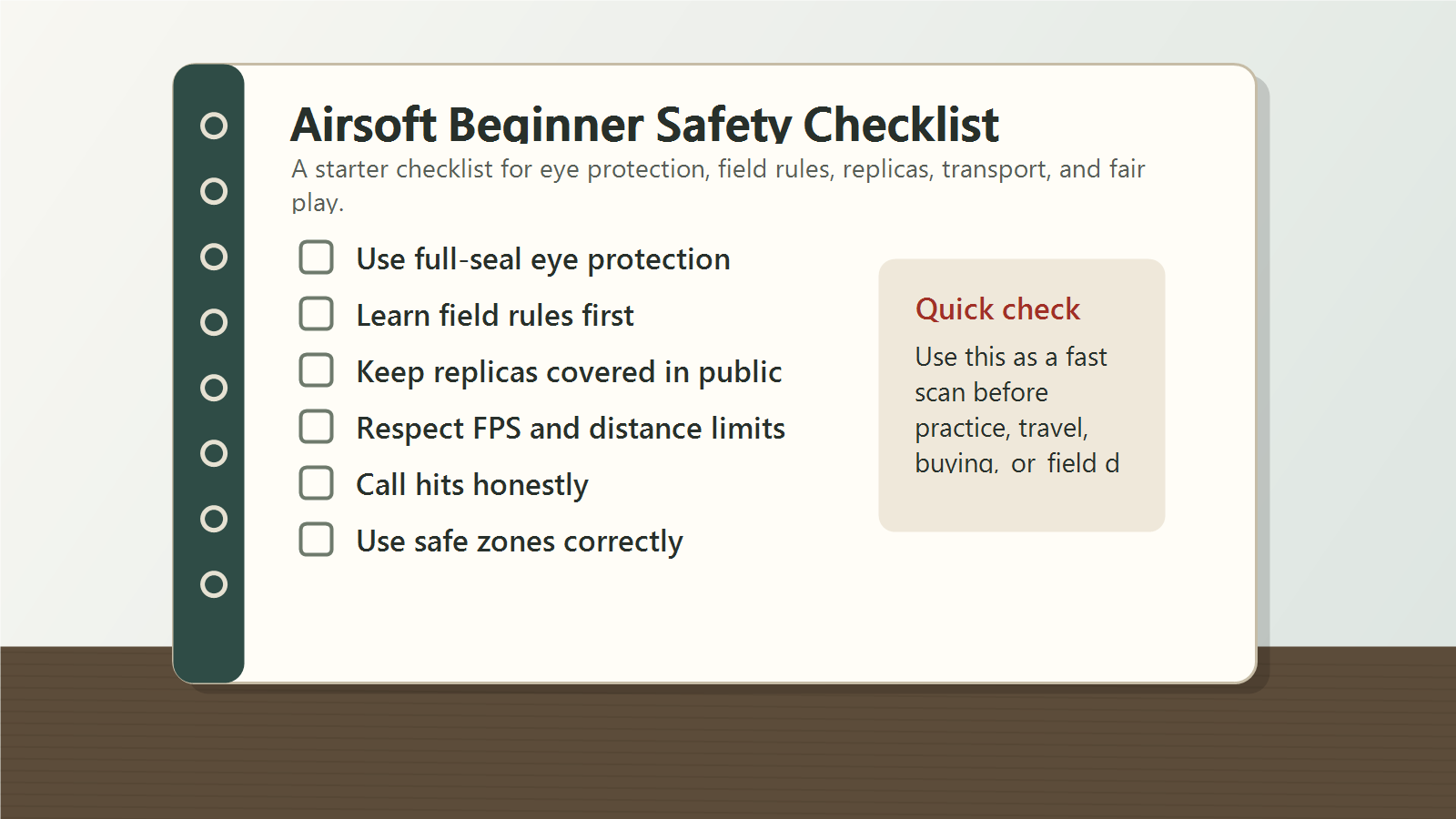
The six habits new players are most often reminded of at check-in: eye protection, the rule sheet, cased transport, velocity limits, honest hit calling, and safe-zone conduct.
Airsoft vs Paintball, Laser Tag, and BB Guns
Most beginner confusion comes from expectations borrowed from a different activity. The table below separates them cleanly.
| Activity | What it launches | How a hit is confirmed | Required protection | Beginner note |
|---|---|---|---|---|
| Airsoft | 6mm (sometimes 8mm) plastic BBs | Honour system — you call your own hit | Full-seal, impact-rated eye protection; lower-face protection often required | Velocity is verified at a chrono station before play |
| Paintball | Frangible paint-filled capsules | Visible paint mark, verified by a referee | Full-face goggle system covering eyes, ears, and mouth | Hits are obvious, so disputes are rarer; gear is bulkier and messier |
| Laser tag / IR variants | Infrared light — no projectile | Electronic sensors and scoring | Minimal, venue dependent | No impact risk, but the rules do not transfer to airsoft |
| Steel-BB / pellet air guns | Metal BBs or lead pellets | Not a person-target activity at all | Impact-rated shooting glasses plus a proper backstop | Never used against people, ever. No field will permit one on site |
The last row matters most. If someone suggests joining a game with a metal-BB gun, that session ends there. No airsoft-rated eyewear is tested for steel projectiles, and the same eye and hearing protection habits that apply on a live range apply with even more urgency to metal-projectile air guns.
How the Equipment Works
Understanding the four power systems helps you rent intelligently and avoid an expensive first purchase you regret. None is objectively "best" — they trade cost, reliability, cold-weather behaviour, and maintenance differently.
| Type | How it works | Strengths | Trade-offs |
|---|---|---|---|
| Spring | Manually cocked before every shot | Cheapest, no battery or gas, very consistent | Single shot; too slow for most open games |
| AEG (electric) | Battery-driven motor turning a gearbox | Reliable in any weather, huge parts support, easiest first buy | Battery care required; gearbox internals wear over time |
| GBB (gas blowback) | Green gas or CO2 cycles a moving bolt or slide | Realistic recoil and function; the standard for sidearms | Performance drops in cold; more seals to maintain |
| HPA | External air tank feeding a regulated line | Extremely consistent; trivially easy to tune to a field limit | Highest entry cost; tank testing and hose management |
Hop-up, BB weight, and why heavier isn't "more powerful"
Every airsoft replica has a hop-up — an adjustable rubber nub that puts backspin on the BB, generating lift that extends its flight. Set too low, the BB drops early; too high and it climbs and stalls. A correctly tuned hop-up flattens the trajectory for a stretch and then drops off. Renting staff will usually set this for you; ask them to show you the adjustment wheel.
BB weight is the other half of the equation. Heavier BBs (0.28 g, 0.30 g, 0.32 g and up) leave the barrel slower but hold their line better through wind and light brush, which is why experienced outdoor players run heavy weights at the same energy rather than chasing raw speed. Cheap, seamed, or previously-fired BBs are false economy — they jam barrels, chew hop-up rubbers, and destroy accuracy, so buying decent 6mm ammunition is one of the few places where spending a little more genuinely pays.
The Rules Every Field Shares
Rule sheets vary in detail, but these appear at essentially every venue in some form.
1. Eye protection on, from the moment you cross the line. Full-seal, impact-rated protection stays on your face for every second you are inside the play area — including between games, during clean-up, and while walking back. Lifting goggles inside the boundary is an ejection offence at most sites, and it is the number one cause of airsoft eye injuries.
2. Call your hits, loudly and immediately. A BB touching any part of you or your equipment counts at most fields, including ricochets and gear hits. Shout "Hit!", raise a hand or a dead-rag, keep the muzzle down, and walk to respawn without talking to teammates.
3. Observe minimum engagement distance (MED). Inside a set distance — commonly around 10 to 25 feet outdoors, sometimes waived indoors with a lower energy limit — you call "Bang!" instead of firing. If someone calls it on you, you are out. Higher-energy setups usually carry a longer MED.
4. No blind fire. Shooting around cover without eyes on the target is banned everywhere, because you cannot see who is inside your MED.
5. No overkill, no physical contact. Stop firing the moment someone calls a hit. Tackling, grabbing, or striking another player is a removal offence at every site worth visiting.
6. Safe zone means safe. In the staging area the magazine comes out, the barrel gets a cover or plug where required, the safety goes on, and the replica points somewhere harmless. Muzzle awareness, trigger-finger discipline, and always knowing the state of the device are exactly the core handling fundamentals taught on any range — a common mistake is assuming they don't apply because the projectile is plastic. Staff will read sloppy muzzle direction as a red flag regardless of what the device fires.
7. "Blind man" or "Man down" stops everything. These are genuine emergency calls. Every player ceases fire instantly and the game pauses. Never use either as a tactic or a joke.
FPS, Joules, and the Chrono Station
Why energy is the honest measure
FPS (feet per second) measures BB speed. Joules measure the energy the BB actually carries, accounting for both speed and mass — and energy is what determines how hard a hit lands. Energy rises with the square of velocity and in direct proportion to BB weight, which is why a light 0.20 g BB moving fast can produce the same energy figure as a heavier BB moving slower.
This is why swapping to heavier ammunition after your chrono check is a real rule breach rather than a technicality: the same replica firing heavier BBs delivers more energy downrange.
Typical limit structures
Exact numbers are set by each venue, but the pattern is consistent:
| Play type | Commonly seen limit | Usual conditions |
|---|---|---|
| Indoor CQB | Lowest energy band on the site | Short or no MED; full-auto often permitted |
| Outdoor standard AEG | Mid band, the default for open play | Standard MED applies |
| Support / DMR roles | Higher band | Semi-auto only, longer MED, sometimes a separate chrono card |
| Youth or family sessions | Reduced band | Full-face protection usually mandatory |
Chrono with the BB weight the field specifies, present the replica exactly as staff ask, and accept any downgrade request without debate. If you're new, staying at the lower end of the energy range keeps you eligible for indoor nights, family sessions, and rental-friendly games without needing a second setup.
Safety Gear: What to Wear and What It Must Do
Eye protection comes before everything else
Buy or rent full-seal, impact-rated protection approved by the field. Everyday prescription glasses, sunglasses, and open shooting glasses are not acceptable — a BB can travel through the gap at the temple or under the lens. The seal against your face is the whole point.
Broad guidance from bodies such as the American Academy of Ophthalmology on recreational eye injuries is consistent with what fields enforce: correctly-fitted, impact-rated protection worn continuously in the hazard zone is what prevents injury — not the brand on the strap.
Goggles vs mesh: the honest trade-off
Sealed polycarbonate goggles give a solid, fragment-proof barrier but will fog in cold or humid conditions unless vented, anti-fog treated, or fan-equipped. Mesh goggles never fog, but a direct hit can in rare cases deform the mesh or send fragments through; many fields restrict them to adults and some ban them entirely. Mesh lower-face protection is a different matter and is widely accepted.
Four things that save a first day:
- Anti-fog is a routine, not a purchase. Apply it the night before, let it dry, buff lightly. Smearing it on mid-game with a sweaty finger makes it worse.
- Never push goggles onto your forehead inside the field. Walk to the safe zone.
- Test the seal wearing your hat, hood, or helmet. Straps lift goggle edges just enough to open a gap.
- Choose a model with replaceable lenses. A scratched lens is a safety issue, not a cosmetic one.
Lower face and teeth
Teeth do not grow back. A mesh lower-face mask, a full-face setup, or at minimum a mouth guard significantly reduces the risk of chipped teeth, split lips, and hits to the nose. Many venues make it mandatory for under-18s and for all players indoors, where engagement distances collapse.
Clothing, gloves, and boots
Skin coverage is the cheapest pain management in the sport. Mid-weight long sleeves and trousers absorb most of the sting; gloves protect knuckles and fingertips, which are bony and unpleasant to be hit on. Ankle-supporting boots with real tread matter far more outdoors than any camouflage pattern — most beginner injuries are trips and rolled ankles, not BB impacts.
Resist a full loadout before you know you enjoy the game. The same restraint that applies to assembling a practical kit for any shooting discipline applies here: protection first, comfort second, cosmetics last. Knee pads, a plate carrier, and a helmet are all optional and can wait.
The Legal and Venue Baseline in 2026
Federal markings, then state, then city
In the United States, imitation firearm marking requirements — the familiar blaze-orange muzzle marking — sit under 15 CFR Part 272. That regulation governs manufacture, import, and sale; it is not a field rule sheet and it says nothing about how a venue wants replicas handled on site.
State and municipal law layer on top and vary widely. Several jurisdictions have added airsoft-specific language over recent years covering transport, brandishing, and minimum ages. A rule that was accurate a few seasons ago may have been amended, so check your state's current code directly rather than trusting a dated forum post.
Standards references
If a retailer or field cites a standard such as an ASTM specification for airsoft products, treat it as a product-category reference, not as permission to bypass venue policy. Standards are periodically revised, renumbered, or withdrawn — always confirm the current edition with the standards body itself, such as ASTM International, rather than relying on a retailer's copy of an older designation.
Age limits and waivers
Most fields set a minimum around the low teens for open play, with younger children permitted only in supervised, reduced-energy family sessions where full-face protection is mandatory. Expect to sign a waiver in person, and expect a parent or guardian to sign in person too — a photographed form is rarely accepted. A structured introduction always beats a casual one, which is the same reasoning behind taking a formal safety class before handling anything unfamiliar.
The rule sheet wins
Where the field sheet and any other source disagree, the sheet wins. Where staff and the sheet appear to disagree, staff win on the day.
Transport, Storage, and Public Handling
Keep it cased. Replicas travel in a closed case or bag through every public space, and the case stays shut until you are in the field's designated area. No parking-lot unpacking, no resting a replica on a car seat where it is visible, and no showing off at the fuel station on the way. A bystander cannot tell at a glance what they are looking at, and the consequences of that misunderstanding are severe.
Store it out of reach. At home, store the replica secured and unloaded, along with BBs, batteries, and gas, away from anyone not permitted to handle it.
Consumables have their own rules. Lithium-polymer batteries belong at a storage charge in a fire-resistant bag, out of hot cars; a puffed pack goes to disposal, not back in the gearbag. Green gas and CO2 cartridges are pressurised — keep them cool, stored as the manufacturer specifies, and never on a dashboard in summer. BBs go in a sealed container somewhere dry, because moisture and grit crack them and cracked BBs jam barrels. If you already keep other shooting supplies, the discipline behind keeping cartridges cool and dry transfers directly.
Your First Field Day, Step by Step
Before you book
Call the field or read its rule sheet and confirm four things: the minimum age and waiver process, the eye protection they accept, the velocity or Joule limit, and whether walk-in rentals are available. Book a standard open-play day, not a milsim event — open play runs short game cycles with frequent briefings and staff who expect to explain things twice.
What to bring
| Bring | Why |
|---|---|
| Field-approved full-seal eye protection (or confirm rental) | Non-negotiable; the single most important item |
| Lower-face protection or a mouth guard | Often required indoors and for youth sessions |
| Long sleeves, long trousers, gloves | Reduces sting dramatically |
| Boots with ankle support and tread | Outdoor fields are uneven; sprains outnumber BB injuries |
| Water and real food | Long days, short breaks, easy to under-eat |
| Case or bag | For transport, and for anything you buy on site |
| Spare lens, spare strap, or a backup mask | Prevents a single failure ending your day |
| Cash or card for entry, rental, and BBs | Some sites still charge separately for each |
Check-in, chrono, and briefing
You will sign the waiver, collect rental gear, and take the replica to the chronograph station where staff verify it is inside the limit. Follow their order of operations exactly and do not modify anything afterwards without asking for a re-check.
The safety briefing is the most valuable ten minutes of the day. Listen specifically for: field boundaries, the safe zone line, hit-call procedure, respawn rules, medic rules if any, MED distance, and the emergency call. If you missed something, ask immediately — nobody thinks less of a beginner for asking, and everybody notices the one who guessed instead.
Your first games
Play conservatively. Stay near a more experienced player, watch how they move between cover, and call every hit fast. Take a break every couple of games, drink water, and check your goggle seal each time you re-enter. If you want a broader orientation before you go, a first-timer's primer covers the same ground from the equipment side.
End of day
Return rentals, empty magazines where the field directs, case everything before you leave the safe zone, and note what you actually wished you had. That list — not a shopping video — is your buying guide for visit number two.
Game Modes You Will Meet
- Team deathmatch — simplest format, usually with unlimited or timed respawns.
- Objective games — flag capture, bomb arming or defusing, VIP escort.
- Attack and defend — one team holds a position, sides swap halfway.
- Domination / king of the hill — hold marked points for cumulative time.
- CQB rounds — short, fast, indoors; lower energy limits, no or minimal MED.
- Milsim events — long, limited respawns, kit and role requirements. Excellent, but not a first-day experience.
Field Vocabulary: The Words You Will Hear
| Term | Meaning |
|---|---|
| Hit! | The call you make the instant a BB touches you or your gear |
| Bang! | Courtesy call inside MED instead of firing; if called on you, you're out |
| Blind man / Man down | Genuine emergency; everyone ceases fire immediately |
| Dead rag | Bright cloth raised to show you're out and walking off |
| Overkill | Continuing to fire after a hit is called — poor form and often a warning |
| Blind fire | Shooting around cover without eyes on target; banned everywhere |
| Chrono | The velocity/energy check every replica passes before play |
| MED | Minimum engagement distance |
| Safe zone / dead zone | Staging area where eye protection may come off and magazines come out |
| Hop-up | Backspin adjustment that extends BB range |
Common Beginner Mistakes
- Lifting goggles inside the field. Sweat, fog, an itch — none of it matters. Walk out first.
- Skipping anti-fog prep. Fogged lenses lead directly to the mistake above.
- Buying a full loadout before playing. Rent twice, then buy what you actually missed.
- Using cheap or reused BBs. Jams, damaged hop-up rubbers, wrecked accuracy.
- Hesitating on hit calls. The fastest way to be remembered for the wrong reason.
- Under-hydrating. Long outdoor days catch out more people than impacts do.
- Leaving a LiPo battery charging unattended. Charge on a hard surface, in a bag, in the room.
- Opening the case in the car park. Wait for the designated area, every single time.
After the Game: Cleaning and Simple Maintenance
A ten-minute routine prevents most of the reliability complaints beginners have by their third outing. Wipe down the exterior, brush dirt out of magazine wells and mesh, and remove the battery or vent the gas as the manufacturer directs. Run an unjamming rod with a patch through the inner barrel — a dirty inner barrel is the most common cause of sudden accuracy loss. Gas systems want a drop of the correct silicone oil on the fill valve at the maker's stated interval; never substitute a petroleum product, which swells rubber seals.
Anything with steel in it — rail sections, screws, external accessory springs — should be dried before storage, particularly after a wet woodland game. If you also keep firearms, the habits cross over: the same attention that goes into tackling surface corrosion early is what keeps a gearbag from becoming a repair bill, and a proven metal protectant belongs in the same cupboard — applied to metal parts, not to airsoft seals. Keep a small kit of hex keys, a spare magazine catch spring, an unjamming rod, silicone oil, and a rag, packed the way you would when organising gear before an outing.
What It Costs: Rent vs Buy
Prices vary by region, so treat these as planning categories rather than quotes.
| Item | Rent for the day | Buy your own (entry level) |
|---|---|---|
| Replica | Included in most rental packages | Mid-range AEG with good parts support |
| Eye protection | Usually included, sometimes shared | Buy this first — fit and hygiene are personal |
| Lower-face protection | Often included for youth sessions | Inexpensive; mesh masks are the common choice |
| BBs | Field-supplied, quantity limited | Bagged in bulk; buy quality, not cheap |
| Battery or gas | Included | Charger plus a spare pack pays for itself fast |
| Transport case | Not needed with rentals | Required the moment you own a replica |
Rent for your first one or two visits, then buy a mainstream AEG if you stay with the sport. In practice, a moderately priced AEG with widely available spares outlasts a cheap "starter bundle" by a wide margin and is far easier to get serviced. Entry kits do go on sale around the usual seasonal cycle, and the same wait-for-the-right-moment logic behind seasonal outdoor gear discounts applies here too — patience buys a better platform.
If you make only one purchase before your second visit, make it your own well-fitting, field-approved full-seal goggle. It eliminates the biggest risk of the day, ends fogging problems that cut games short, and it protects the one thing you cannot replace.
Frequently Asked Questions
Does airsoft hurt?
A hit stings briefly — roughly like a hard flick or a rubber-band snap — and usually leaves a small welt at most. Long sleeves, trousers, and gloves reduce it considerably. Close-range hits sting more, which is exactly why fields enforce minimum engagement distances and require a "Bang!" call instead of firing inside them.
How old do you have to be to play airsoft?
There is no single national answer; the field's rule sheet and local law decide. Many venues set a minimum in the low teens for open play, with younger children allowed only in supervised, reduced-energy family sessions. A parent or guardian normally must sign the waiver in person. Call ahead before driving out.
Is airsoft legal in the United States?
Ownership is broadly lawful across most of the country, subject to federal imitation-firearm marking requirements and to state and municipal restrictions that vary considerably. Some cities regulate transport or public use specifically. Always carry replicas cased, never display them in public, and verify your current state and city rules — they do get amended.
What eye protection do I need?
Full-seal, impact-rated protection that the field approves. Everyday glasses, sunglasses, and open shooting glasses are not acceptable. Sealed polycarbonate goggles are the safest general choice; mesh goggles avoid fogging but are restricted at some venues. Treat lenses with anti-fog beforehand, never lift them inside the play area, and replace any lens that becomes scratched.
What's the difference between FPS and Joules?
FPS measures BB speed; Joules measure the energy the BB actually carries, accounting for both speed and BB weight. Because energy determines impact, most fields set Joule limits and specify which BB weight to chrono with. Switching to heavier BBs after the chrono check raises energy and breaks the limit.
Do I need my own gear to try airsoft?
No. Nearly every field rents a package covering the replica, eye protection, a battery or gas, and a set quantity of BBs — the cheapest, lowest-risk way to find out whether you enjoy the sport. Bring water, closed shoes, and clothing that covers your skin.
Is airsoft safe for kids?
With the right session, yes. Look for family or youth days with reduced energy limits and mandatory full-face protection, and stay for the briefing yourself. Supervision plus correct protective equipment is what makes the difference, not the child's age alone.
How long does a typical airsoft day last?
Open play usually runs a half or full day, with games of 10 to 25 minutes separated by short briefings and resets. Plan on arriving 30 to 60 minutes early for the waiver, rental fitting, chrono, and safety brief.
Conclusion
Strip airsoft back and it comes down to four habits: impact-rated full-seal eye protection worn every second you are inside the play area, a replica kept cased and controlled outside the safe zone, an energy level verified at the chrono and left untouched afterwards, and hits called honestly the moment they land. Everything else — replica type, kit, camouflage, favourite game mode — is preference, and preference is cheap to change later. The rules are not.
Your next step is one phone call or one look at the rule sheet for your nearest field. Confirm the age policy, the eye protection standard they accept, the velocity or Joule limit, and whether walk-in rentals are available. Then book a single standard open-play day, rent rather than buy, listen through the entire briefing, and let the first session run slower than your excitement wants.
Do one thing before your second visit: buy your own field-approved, full-seal goggles. It is the cheapest possible insurance on your eyesight, it ends the fogging that ruins first-timers' games, and it is the only piece of equipment that repays its cost the moment you put it on.