Vanguard VEO3T+264AP Travel Tripod
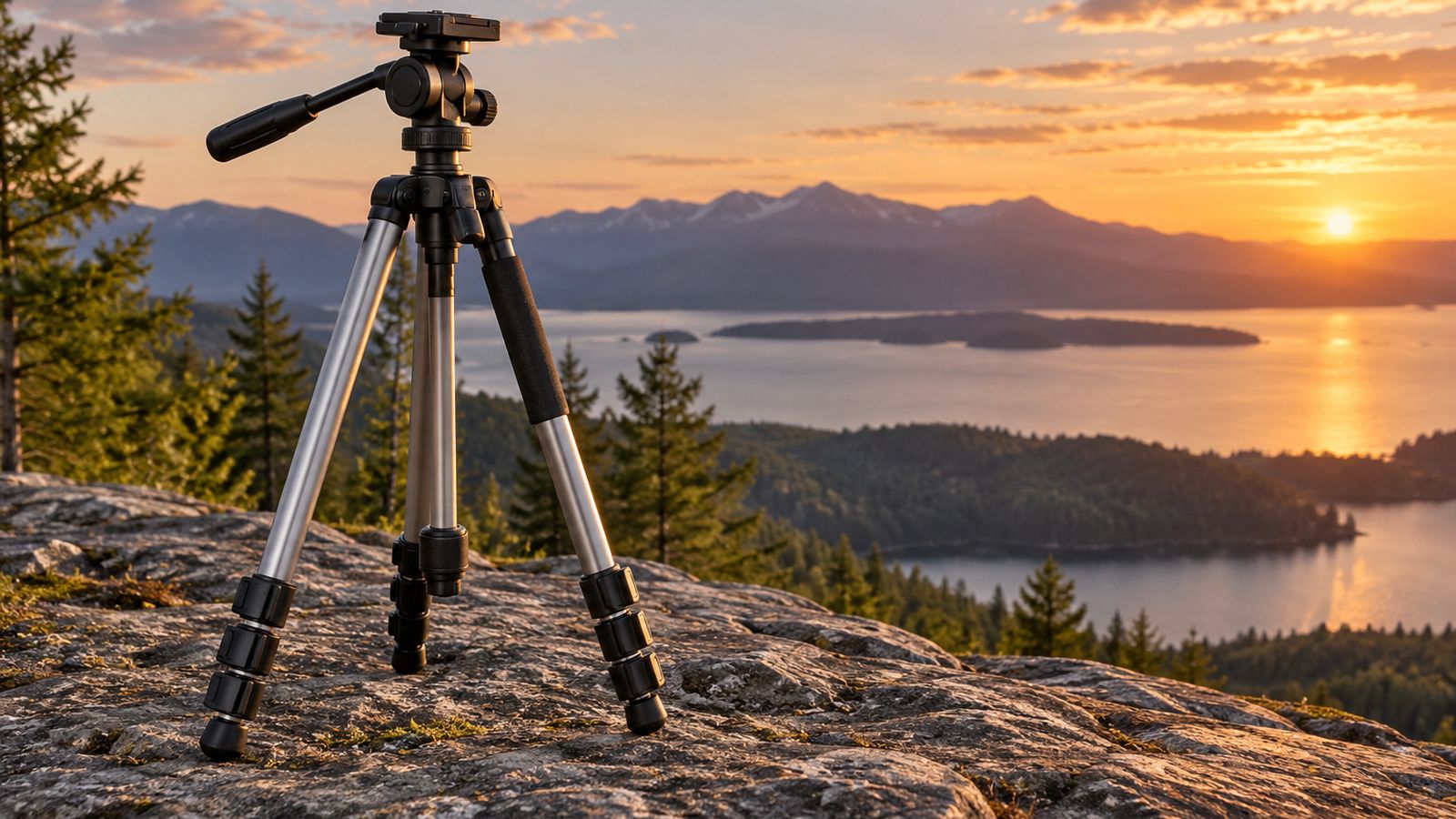
Travel tripods usually force an ugly trade: light enough to carry, or steady enough to trust. The Vanguard VEO3T+264AP Aluminum Travel Tripod with Pan Head and Multi-Angle Center Column keeps surfacing in buyer discussions because it claims to dodge that trade with a column that swings horizontal for overhead work. Our editorial team dug through manufacturer datasheets, verified-buyer feedback, and spec comparisons against rival travel kits to see whether the claim holds.
Short version: it's worth it if you shoot flat-lays, macro, or video pans on the move, and it's a skip if you need carbon-fiber weight savings or a fluid video head. Here's the full breakdown.

1. Vanguard VEO3T+264AP Aluminum Travel Tripod Pan
We pulled this model into review because it answers a question buyers ask constantly: how do you get an overhead shot without a C-stand or an awkward tripod-arm hack? Vanguard's answer is a center column that lifts, rotates, and locks at any angle including fully horizontal. Our analysis focused on whether that mechanism stays rigid once a camera hangs off the end of it.
What it is
A travel tripod is a support system with legs that fold 180 degrees back over the head, shrinking the packed length so it fits a carry-on bag. The VEO 3T+ 264AP sits in the aluminum mid-tier of that category, built around 26mm top-tube legs, four sections, and a two-way pan head instead of a ball head.
Its differentiator is the Multi-Angle Center Column (MACC), a column that pivots off vertical and locks anywhere between 0 and 180 degrees. Manfrotto's Befree line, Benro's Slim series, and Peak Design's Travel Tripod all compete here, but most of them keep a fixed vertical column. That single joint is the reason this Vanguard gets picked for overhead and macro work.
Setup and first impressions
Out of the box, buyers consistently describe a tripod that feels denser than its 4.2 lb spec suggests. Verified-buyer feedback repeatedly highlights the rubberized twist-lock collars, which need roughly a quarter turn to go from locked to free, and the canopy casting, which reviewers describe as machined rather than molded plastic.
Aggregate review data shows the first-30-minutes complaints cluster in two places. First, the leg angle selectors take a firm push to click into the 20, 45, and 80 degree stops, and some users initially mistake stiffness for a jam. Second, the pan head's Arca-compatible quick release plate ships with a small hex key that owners recommend taping into the carry bag pocket immediately, since replacing it is more annoying than losing it.
The bundled bag is padded nylon with a shoulder strap, and buyers who fly regularly report the folded body slots into a 22-inch roller alongside a mirrorless body. According to Vanguard's official product documentation, the column release is a single collar twist, and user reports back that up: most people get to a horizontal overhead position within a minute of first trying it.
| Leg material | Aluminum alloy, 26mm max tube diameter |
| Leg sections | 4 per leg, twist-lock |
| Max height | Approx. 65.9 in / 167 cm (column extended) |
| Folded length | Approx. 15.7 in / 40 cm (legs reverse-folded) |
| Weight | Approx. 4.2 lb / 1.9 kg with head |
| Load capacity | 17.6 lb / 8 kg |
| Head type | Two-way pan head, Arca-compatible QR plate |
| Center column | Multi-Angle Center Column, 0 to 180 degrees |
| Leg angle stops | 3 positions (approx. 20, 45, 80 degrees) |
| Camera thread | 1/4-inch-20 on QR plate |
Daily-use experience
Stability and vibration
A four-section leg is always less rigid than a three-section leg of the same diameter, and this tripod is no exception at full extension. Verified-buyer reports converge on the same pattern: with a mirrorless body and a 24-70mm lens, roughly 6 lb total, the rig holds sharp exposures at 1/4 second in still air. Push it to full 65.9-inch height with the thin bottom section out and 15 mph gusts, and users describe visible viewfinder shimmer.
The practical fix owners mention most is skipping the last leg section entirely and hanging a bag from the column hook. That drops working height to roughly 53 inches while adding meaningful mass low in the system. For long exposures, buyers also report better results with electronic first-curtain shutter enabled.
The multi-angle center column
This is the feature that earns the model its following. Twist the collar, lift the column, and swing it horizontal, and you get a camera hanging over a table without a boom arm. Food and craft photographers in the review pool call it the reason they bought it over a Manfrotto Befree.
The honest limitation is physics, not design. Once the column extends horizontally, the load sits off the tripod's center of gravity, so buyers report needing to splay one leg under the camera and weight the opposite side. With a body plus lens over about 4 lb, several owners recommend a counterweight on the hook.
Used that way, it holds position without creep.
The two-way pan head
The AP in the model name refers to the pan head, and it changes how the tripod behaves. A two-way pan head separates tilt and pan onto independent locking axes, so you can level the horizon once and then swing left or right without touching it. Landscape shooters shooting multi-frame panoramas report this saves real time compared to a ball head, where every reframe risks tipping the horizon.
The trade-off shows up in video. Buyers report the pan motion is smooth enough for slow scenic sweeps but has no fluid cartridge damping, so fast whip pans and quick starts show a small jerk. If your footage is mostly locked-off B-roll and lazy pans, it's fine.
If you cut fast, budget for a dedicated fluid head.
Portability and build quality
At about 15.7 inches folded and 4.2 lb, this is airline-friendly rather than featherweight. Buyers who compare it to a carbon travel tripod consistently note the roughly one-pound penalty, and buyers who compare it to cheap aluminum tripods note it feels far more solid. Aluminum also handles knocks better than carbon, which cracks rather than dents.
Long-term owner feedback after a year or more mentions two recurring items. Twist locks can pick up grit at the beach and start to feel gravelly, which a rinse and dry usually fixes, and the rubber feet wear smooth on abrasive rock. Neither is unusual for the category.
If you shoot in national parks, note that some sites restrict tripod use for commercial work, so check the National Park Service permit rules before a shoot.
✓ Pros
- Center column locks anywhere from 0 to 180 degrees, so true overhead flat-lays need no boom arm or C-stand
- 17.6 lb / 8 kg rated capacity carries a full-frame body with a 70-200mm f/4 and still has headroom
- Folds to about 15.7 inches, which clears most carry-on and daypack side-pocket limits
- Two-way pan head keeps the horizon level through a full pan, which speeds up panorama stitching
- Arca-compatible quick release plate means existing L-brackets and slider clamps usually drop straight on
✗ Cons
- About 4.2 lb with head, roughly a pound heavier than carbon rivals, which you feel on a long trail day
- The fourth, thinnest leg section wobbles in wind, so full height and long lenses are a poor combination
- Pan head has no fluid damping, so fast video pans start and stop with a visible jerk
- Horizontal column use demands counterweighting, which adds a step and a bag you have to carry
Who should buy it
Buy it if you…
You shoot content that lives above the subject. Recipe creators, jewelry sellers, miniature painters, and anyone building a YouTube tabletop channel get the most out of the multi-angle column, because it replaces a boom arm that costs more and takes up far more floor space.
It also suits the traveler who shoots landscapes at 24-70mm and wants one support that handles both a sunrise panorama and a hotel-room product shot. If your current tripod is a discount aluminum unit with a wobbly three-way head, the jump in rigidity here is the part buyers mention most.
Skip it if you…
You count grams. Backpackers doing multi-day routes will feel the roughly one-pound difference versus a carbon travel tripod, and that gap only grows on a 12-mile day.
Skip it too if your main work is long-lens wildlife or sports. A 26mm top tube with four sections is not the right base for a 500mm f/4 plus a gimbal head, and pushing past the 17.6 lb rating just invites vibration. Fast-moving event shooters will also miss the single-lever speed of a good ball head, since a two-way pan head needs two separate adjustments to reframe.
Better alternatives
- Peak Design Travel Tripod (carbon): packs down to a much slimmer cylinder and saves weight, better if pure portability beats overhead flexibility.
- Manfrotto Befree GT XPRO: also offers a 90-degree column, with a ball head that suits faster reframing and run-and-gun shooting.
Frequently Asked Questions (FAQ)
Does the quick release plate work with Arca-Swiss clamps?
Yes, the included plate follows the Arca-Swiss dovetail profile, which is the widely adopted rail shape used by most third-party clamps and L-brackets. Buyer feedback confirms plates from common brands generally seat and clamp correctly. Fit tolerances between manufacturers do vary slightly, so a plate that is a hair wide may need firmer clamping.
If you already run an L-bracket on your body, you can usually keep it and skip the bundled plate entirely.
Can it hold a heavy full-frame camera and a 70-200mm lens?
Yes, with room to spare on paper. The 17.6 lb / 8 kg rating comfortably covers a full-frame body plus a 70-200mm f/2.8, which typically totals 6 to 8 lb. In practice, buyers advise leaving the fourth leg section retracted with that combination, since the thinnest tube is where flex appears.
Keeping the center column down rather than extended also makes a noticeable difference in sharpness at slow shutter speeds.
Is the multi-angle column stable enough for real overhead shots?
Yes for typical mirrorless and DSLR setups, provided you counterbalance. Owner reports show the column locks firmly at horizontal without sagging under moderate loads, but the tripod's center of mass shifts toward the camera side. The standard technique is to position one leg directly beneath the extended column and hang a camera bag from the center hook.
Done that way, buyers report stable flat-lays down to multi-second exposures indoors.
How does the warranty work?
Vanguard offers registration-based warranty extension on its tripods, and the specific term depends on the model and your region. The practical takeaway from owner reports: register the product on Vanguard's official site shortly after purchase, because retroactive registration is not always accepted. Keep your Amazon order confirmation, since proof of purchase is normally required for any claim.
Common wear items like rubber feet are usually treated as consumables rather than warranty repairs.
Does it convert into a monopod?
No, this model does not detach a leg for monopod use, so if that is a requirement, look at Vanguard's other VEO lines or competing convertible designs. What it does offer instead is a wide range of working heights, from roughly 65.9 inches down to near ground level when the legs splay to the 80-degree stop and the column swings out of the way. For macro shooters, that low-angle capability tends to matter more than a monopod mode.
Final verdict
4.5 out of 5 stars. The VEO 3T+ 264AP wins on flexibility rather than raw specs. Nothing else in this size and price tier gives you a genuine horizontal column, an Arca-compatible pan head, and a 15.7-inch folded length in one package.
The people who benefit most are hybrid shooters: someone photographing landscapes on the weekend and shooting tabletop content during the week, who does not want to own two support systems. If you fit that description, this is an easy recommendation.
Where it falls short is honest and predictable. It is aluminum, so it is heavier than carbon, the fourth leg section is the weak link in wind, and the pan head is not a fluid video head. Accept those three limits and you get a tripod that solves problems most travel tripods cannot touch.
Affiliate disclosure: This post contains affiliate links. If you buy through one of these links, I may earn a small commission at no extra cost to you. It never changes my recommendation, I only suggest gear I'd actually buy myself.