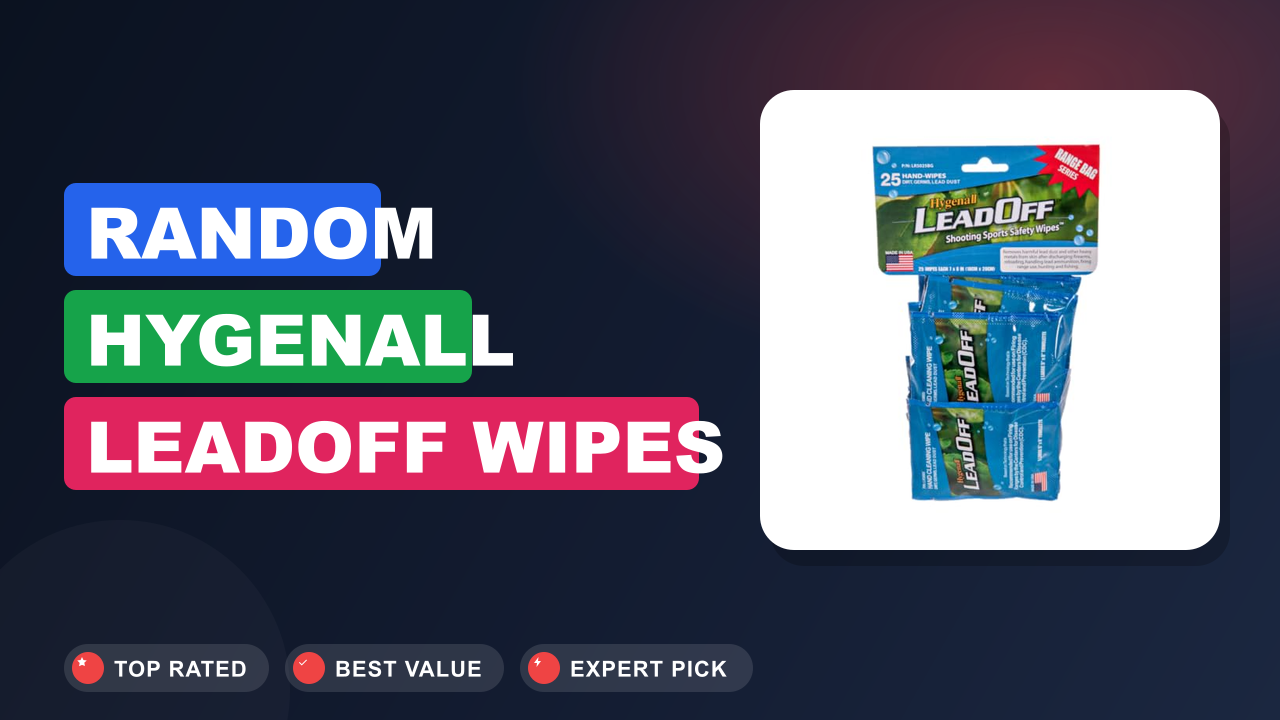
Random Hygenall LeadOff Wipes 25 Individually Wrapped
Lead dust doesn't announce itself. It settles on your hands at an indoor range, hitches a ride on the steering wheel, and ends up on a sandwich two hours later. That's the exact problem Hygenall LeadOff Wipes are built for, and why they keep surfacing in reloading forums, USPSA club chatter, and renovation-crew supply lists.
Here's the bottom line up front: worth it if you shoot indoors, reload, or handle lead in a job where a sink isn't three steps away. Skip it if your range has a proper wash station and you actually use it. Our editorial team compared manufacturer documentation, aggregate buyer feedback, and published exposure guidance to figure out where these earn their keep.

What it is
A lead-removal wipe is a pre-moistened towelette with a chelating surfactant formula designed to bind heavy-metal particles so they lift off skin instead of smearing around. Hygenall LeadOff sits in the personal-decontamination category alongside D-Lead wipes from ESCA Tech and Hygenall's own bulk canisters and hand soaps.
What separates this 25-pack is the packaging format. Each wipe lives in its own sealed foil sachet, so nothing dries out in a glove box over a summer, and you can stash one in a range bag pocket, a pistol case, or a jacket.
It's a non-rinse product. You wipe, you're done, no sink and no towel needed. That's the whole pitch, and for shooters and trades workers, it's the right pitch.
1. Hygenall LeadOff Wipes 25 Individually Wrapped
We looked at this pack specifically because it answers the question most shooters actually ask: what do I use in the parking lot? Aggregate buyer feedback points to the same use pattern over and over, one wipe for hands and forearms right after a session, before touching the car door or a phone screen. That single habit is where the value shows up.
Setup & first impressions
There's no setup, which is exactly the point, but the first-open experience still tells you something. Verified buyer feedback consistently describes the sachets as thick foil-style packets rather than the thin plastic used on cheap restaurant hand wipes, and reviewers who've kept boxes in a truck console for a season report they were still wet on opening.
The wipe itself is a substantial non-woven cloth, closer to a shop towel in feel than a baby wipe. Buyers repeatedly note it's damp rather than dripping, so you're not chasing runoff down your wrists.
Scent is the recurring surprise in reviews. Multiple buyers describe it as mild and faintly soapy, with no solvent bite and no alcohol sting on cracked winter hands. That matters more than it sounds, because a wipe that burns is a wipe you skip.
The one consistent gripe in the first 30 minutes: the sachets tear open unevenly if you rush, and a few reviewers mention needing a fingernail or teeth to start the seam.
| Pack size | 25 wipes per box |
| Packaging | Individually sealed single-use sachets |
| Format | Pre-moistened non-woven towelette |
| Rinse required | No (non-rinse formula) |
| Target residue | Lead dust and other heavy-metal residue on skin |
| Formula claim (manufacturer) | Non-toxic, non-abrasive, no harsh solvents |
| Country of manufacture | Made in USA |
| Storage | Room temperature, sealed packets survive vehicle storage |
| Typical use rate | 1 wipe covers hands plus forearms for one range session |
| Amazon buyer rating | 4.6 / 5 |
Daily-use experience
Does it actually lift lead residue?
Lead removal wipes work by chemistry, not scrubbing: a chelating surfactant surrounds metal particles so they release from skin oils instead of being pushed into pores and cuticles. That's the mechanism that separates a product like this from a baby wipe, which mostly redistributes dust.
The honest limit is that you can't see lead. Buyers who verify results tend to use lead-detection swabs on their hands afterward, and that group is where the strongest reviews come from, reporting clean or near-clean swab results after one wipe following an indoor pistol session.
Where reviewers report weaker results: heavy, visible carbon fouling after cleaning a suppressed rifle. One wipe handles the invisible dust well. Baked-on black fouling needs solvent first, then the LeadOff wipe as the final skin pass.
Skin feel, dry-down, and the winter-hands problem
Nothing kills a hygiene habit faster than a product that leaves you sticky. Buyer feedback here is unusually consistent: the wipe dries down in roughly 30 to 60 seconds with no greasy film, and no need to rinse at a sink.
Compared with the harsher industrial hand wipes used in auto shops, which lean on citrus solvents and pumice, this one is gentle. Shooters with eczema and dry winter skin report they can use it after every session without cracking, which is the entire reason compliance stays high.
The trade-off is that gentleness costs grip on grime. If your hands are visibly filthy from bench work, you'll want a degreasing wipe first and this one second.
Range-bag practicality
Individual sachets are the feature that makes or breaks this product. A canister lives at home. A flat foil packet lives in a magazine pouch, a truck door, a shooting bag pocket, or a hunting vest, and it's still wet six months later.
Verified buyers describe the same routine repeatedly: finish shooting, tear a packet in the parking lot, hands and forearms, then face and neck if it was a hot indoor lane. Then the car door. Then the phone.
Instructors and range safety officers in the review pool mention handing packets to students, which is where the sealed format really pays off. You can't do that from a shared tub without contaminating it.
Coverage and how far one wipe goes
Plan on one wipe per person per session for hands and forearms. Reviewers who try to stretch a single wipe across hands, face, neck, and a firearm consistently report it drying out partway through.
A useful rule of thumb from buyer patterns: if you clean guns after every range trip, budget two wipes for that day, one after shooting and one after cleaning. A 25-pack then covers roughly 12 to 25 range days for a solo shooter.
Families and clubs burn through boxes faster. If two or three of you shoot together, the per-wipe cost climbs quickly, and a bulk tub for the workbench plus this pack for travel is the smarter split.
✓ Pros
- Individually sealed sachets stay wet in a hot truck for months, so the wipe is usable when you finally need it
- Non-rinse formula works in a parking lot, which is exactly where the lead-transfer risk actually happens
- Chelating surfactant chemistry lifts metal particles rather than smearing them like a standard baby wipe
- Mild, non-stinging feel means shooters with dry or cracked winter hands actually keep using it
- Flat packets hand out easily to students, guests, or kids at a club match without cross-contaminating a shared tub
✗ Cons
- Cost per wipe is high next to a bulk canister, so wiping benches and gun cases gets expensive fast
- One wipe won’t cover hands, face, and a firearm before drying out, which surprises first-time buyers
- Sachet seams tear unevenly in cold weather or with gloves on, and a few buyers report needing a fingernail to start them
- No visible feedback: you can’t tell it worked without a separate lead-detection swab, so trust rests on the chemistry
Who should buy it
Buy it if you…
Buy these if lead exposure is a recurring part of your week and a sink usually isn't nearby. That's indoor-range regulars, competitive pistol shooters running 300-round practice days, reloaders casting or handling bare lead projectiles, and hunters processing game shot with lead-core ammunition.
Trades workers count too. If you scrape or sand painted surfaces in pre-1978 housing under the EPA Renovation, Repair and Painting Rule, a sealed wipe in a tool pouch is a realistic habit in a way that a jug of soap on the truck isn't.
Parents in that group should pay extra attention, since the Centers for Disease Control and Prevention is clear that there's no known safe blood lead level for children and take-home dust is a documented exposure route.
Skip it if you…
Skip them if your range already has a lead-specific wash station with cold water and heavy-metal soap, and you genuinely stop and use it every visit. Soap and cold running water plus a proper dry is still the reference standard, and a wipe is the field substitute.
Skip them too if your actual problem is surfaces rather than skin. Wiping a shooting bench, a gun case, a steering wheel, and a workshop chair with individually wrapped packets gets expensive quickly, and a bulk container or a dedicated surface cleaner does that job for far less per square foot.
And if you're an occasional outdoor rimfire plinker with jacketed ammo, your exposure profile is low enough that this may be more product than you need.
Better alternatives
D-Lead Hand Wipes (ESCA Tech): the most direct competitor, widely used in industrial hygiene programs and available in larger canisters, which makes it the better pick if you're stocking a whole club or a job site rather than a range bag.
Hygenall LeadOff bulk canister or hand soap: same chemistry family from the same maker, dramatically cheaper per use, and the right choice for a home reloading bench or a shop sink where portability doesn't matter.
Frequently Asked Questions (FAQ)
Do lead wipes really work better than regular baby wipes?
Yes, and the difference is chemical rather than physical. Standard baby wipes rely on water and mild detergent, which lifts oil but tends to move fine metal particles around the skin instead of releasing them. Lead-specific wipes use chelating surfactants that bind heavy-metal ions so they wash away with the cloth.
If you've ever swabbed your hands after using a baby wipe post-range, the result usually explains the price gap.
Can I use them on my face, phone, or car interior?
Buyers commonly use them on face, neck, and forearms after indoor sessions, which makes sense because that's where airborne dust lands. Phones and steering wheels are also a reported use, and they're arguably the highest-value surfaces because you touch them constantly. Just know one wipe won't stretch across skin plus multiple surfaces before it dries.
For routine surface cleaning, a bulk product is the economical route.
Will these lower my blood lead level?
No, and it's important to be honest about that. These wipes prevent new exposure by removing surface residue before it reaches your mouth, food, or family. They do nothing to an existing body burden.
If you shoot indoors frequently or work with lead professionally, ask your doctor about a blood lead test, and review the workplace exposure limits published by OSHA if lead is part of your job.
How long do the sealed packets last?
Reviewers who've kept boxes in vehicles across a full season consistently report the sachets still moist on opening, which is the practical advantage of individual foil sealing over a canister. Canisters dry out from the top down once opened, especially in low humidity. Store the box at room temperature and out of direct sun.
If a packet ever feels flat or dry through the foil, discard it and grab another rather than rubbing a half-dry cloth on your skin.
Are they safe to use on kids after a range trip?
The manufacturer describes the formula as non-toxic and non-abrasive, and parents in the review pool report using them on children's hands after family range outings without irritation. As of 2026, that's still the common-sense move, since kids absorb lead more readily than adults. Wipe hands before the car, change clothes at home, and wash range clothing separately.
As with any skin product, patch-test if your child has sensitive skin or eczema.
Final verdict
4.4 out of 5 stars.
Hygenall LeadOff Wipes solve a narrow problem extremely well: they make post-range decontamination possible in the 90 seconds between the lane and the car, which is precisely when lead transfer happens. Indoor shooters, reloaders, instructors, and renovation crews get the most out of them, especially anyone who drives home with kids in the back seat.
The knock is cost per wipe, and it's a real one. Individually wrapped convenience carries a premium, so the smart setup is a bulk container at home for benches and gun cleaning, plus this 25-pack living in the range bag, glove box, and hunting vest.
Skip them only if your range already has a proper wash station and you actually use it. Otherwise this is one of the few pieces of shooting gear that protects the people who never touch a firearm.
Affiliate disclosure: This post contains affiliate links. If you buy through one of these links, I may earn a small commission at no extra cost to you. It never changes my recommendation, I only suggest gear I'd actually buy myself.