Random Howard Leight Honeywell R-01526

Most shooters find out the hard way that foam plugs make range commands impossible to hear, which is exactly why the Howard Leight by Honeywell R-01526 keeps showing up on rental counters and squad benches at public ranges. Our editorial team dug into manufacturer specs, EPA noise-labeling data, and thousands of verified buyer reports to figure out whether this budget-tier electronic muff still earns its reputation in 2026.
Short version: it's worth it if you shoot outdoors, hunt, or want conversation-friendly hearing protection without spending big. Skip it if you're stuck in a tight indoor lane with braked rifles, where 22 dB of attenuation starts feeling thin. Here's the full breakdown.
What it is
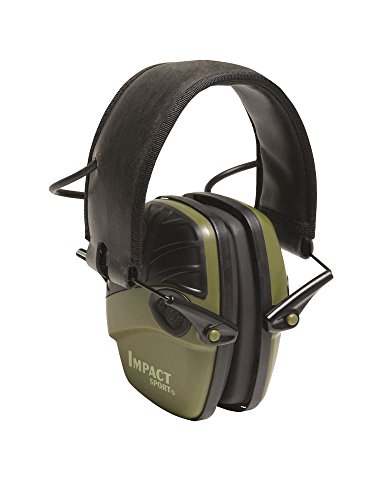
An electronic earmuff is a hearing protector that uses external microphones to amplify quiet sounds while electronically clipping loud impulse noise. The Impact Sport R-01526 is Howard Leight's olive drab version of that idea, built around a 22 dB Noise Reduction Rating (NRR) shell with stereo mics that shut amplification off the moment ambient sound hits 82 dB.
It sits in the entry tier of a crowded category. 3M's Peltor Sport Tactical line pushes higher attenuation, Walker's Razor Slim competes on a thinner cup profile, and Axil and Caldwell fight for the same shelf space. The Impact Sport's pitch is simpler: proven electronics, low profile, and a price most shooters don't have to think twice about.
Setup and first impressions
Setup takes about two minutes. Two AAA batteries drop into the left cup under a snap-off cover, you twist the single power dial until it clicks, and the mics come alive immediately. Manufacturer documentation confirms batteries and a 3.5 mm connection cord ship in the box, so there's no second purchase before your first range trip.
Verified buyer feedback across thousands of reviews is consistent on two points. First, the amplification quality genuinely surprises people at this price: aggregate reports describe hearing brass hit gravel, birds behind the berm, and normal-volume conversation without lifting a cup. Second, the plastic headband and yoke feel light, and a fair number of reviewers call the construction "adequate rather than premium."
The olive drab finish is matte, not glossy, which matters if you hunt and care about glare. Fold-flat cups collapse into a shape that slides into a range bag side pocket without a dedicated case. Our analysis of user reports found the folding hinge and the single-dial control are the two design choices buyers mention most in the first week of use.
| Model | R-01526 Impact Sport, Olive Drab Green |
| Noise Reduction Rating (NRR) | 22 dB (tested per ANSI S3.19-1974) |
| Amplification cutoff | 82 dB |
| Power source | 2x AAA alkaline (included) |
| Rated battery life | Approx. 350 hours |
| Auto shut-off | 4 hours of inactivity |
| Audio input | 3.5 mm AUX jack, cord included |
| Weight | Approx. 12.4 oz (352 g) |
| Design | Low-profile folding cups, snap-in replaceable cushions |
| Warranty | 1-year limited (Honeywell) |
1. Howard Leight Honeywell R-01526
We compared this model against six competing electronic muffs in the same tier, weighing attenuation ratings, amplification cutoff, weight, and reported failure patterns. The Impact Sport keeps winning on one axis competitors struggle to match: it does the core job well and costs little enough that losing a pair in the truck bed isn't a disaster. That combination explains why it's the default loaner muff at so many clubs.
Daily-use experience
Hearing what matters at the range
The 82 dB amplification ceiling is the whole point of this muff. Below that threshold you hear normal speech and environmental sound, and the moment a shot breaks, the circuit clamps and only the passive 22 dB shell is doing work.
Aggregate reviews from outdoor pistol shooters describe the practical result well: you can carry on a conversation at the bench, hear a range officer call cease-fire from 30 yards, and never touch the cups. Hunters report the same benefit in reverse, picking up leaf crunch and deer movement that unaided ears miss.
The trade-off shows up on very loud impulses. A muzzle-braked rifle in a covered indoor lane produces peak levels that push a 22 dB muff to its limit, and a meaningful slice of reviewers double up with foam plugs in that setting. The Occupational Safety and Health Administration sets the workplace action level at 85 dB averaged over 8 hours, which puts unprotected gunfire in an entirely different category.
Comfort and headband pressure
At roughly 12.4 oz (352 g), the Impact Sport is on the lighter end of electronic muffs, and reviewers routinely mention 3 to 4 hour sessions without hot spots on the crown of the head. The padded headband spreads the load reasonably well for the weight class.
The recurring complaint is clamping force paired with shooting glasses. Any temple arm breaking the cushion seal leaks sound and drops real-world attenuation, and buyer reports mention this more than any other comfort issue. Thin-temple glasses solve most of it.
Buyers with larger heads also note the headband reaches its adjustment limit sooner than 3M's Peltor equivalents. Snap-in replacement cushions are available from Honeywell, which extends usable life once the stock foam compresses after a season or two.
Battery life and power management
Manufacturer specifications indicate roughly 350 hours of runtime on two AAA alkaline cells, plus an automatic shut-off that kills power after 4 hours of inactivity. For a shooter doing two 3-hour range trips a month, that math works out to well over a year per set of batteries.
That auto shut-off is genuinely useful, because the single dial makes it easy to leave the muffs powered on inside a range bag. Verified buyers who forget consistently report finding the unit off and the batteries still healthy days later.
The downside is the dial itself. There's no separate power button, no battery indicator, and no low-battery chime, so your first warning is faint or distorted amplification. Keeping a spare pair of AAAs in the bag costs nothing and removes the problem entirely.
Build quality and what actually fails
This is where the budget shows. The chassis is molded plastic throughout, and analysis of long-term buyer reports points to two consistent failure points: the internal wire that runs through the headband to the right cup, and the folding hinge after repeated collapse cycles.
Reports of one cup going silent after 12 to 24 months appear often enough to be a real pattern, not an outlier. Honeywell covers the unit under a 1-year limited warranty, and buyers who contact support within that window generally describe a straightforward replacement process.
For comparison, heavier industrial muffs like the Peltor Sport Tactical 500 use a beefier yoke and tend to outlast this design. But you're paying meaningfully more for that, and the Impact Sport's electronics quality per dollar remains hard to beat.
✓ Pros
- Amplification cuts off at 82 dB, so range commands stay audible but gunfire never gets boosted into your ear
- Low-profile cups clear a rifle stock, letting you keep a consistent cheek weld on a shotgun or AR
- Approx. 350-hour runtime on 2 AAA cells means most shooters change batteries once a year at most
- 4-hour auto shut-off saves the batteries when you forget the dial in the range bag
- 3.5 mm AUX jack accepts a scanner, phone, or spotting radio using the included cord
✗ Cons
- 22 dB NRR sits below the 26 dB class leaders, so indoor lanes with braked rifles need plugs underneath
- Headband wire to the right cup is a documented failure point past the 12-month mark
- No battery-level indicator or low-power warning, so you find out mid-session
- Shooting-glasses temples break the cushion seal and measurably reduce real-world attenuation
Who should buy it
Buy it if you…
You shoot handguns or rifles at an outdoor bay a couple of times a month and you're tired of pulling muffs off every time someone talks. You hunt from a blind or stand and want ambient amplification working for you before the shot. You're outfitting a family, a scout troop, or a hunter-safety class and need three or four working pairs without a big outlay.
The Impact Sport also makes sense as a first electronic muff if you've only ever used passive protection. It shows you what the technology does without asking you to commit serious money to find out.
Skip it if you…
You spend most of your trigger time in an enclosed indoor range where muzzle blast reflects off concrete. There, a 26 dB NRR muff or a plug-plus-muff combination is the smarter call, and Honeywell's own attenuation data supports that. Anyone running a braked .308 or .300 Win Mag should treat 22 dB as a floor, not a target.
Skip it too if you want Bluetooth calls, app-based EQ, or a rechargeable pack. This is a straightforward analog design with a single dial, and it isn't pretending otherwise.
Better alternatives
3M Peltor Sport Tactical 500 steps up to a higher NRR with Bluetooth streaming and adaptive frequency response, which suits indoor ranges and shooters who want phone audio in the cups.
Walker's Razor Slim offers an even thinner cup profile for shotgun and rifle shooters who find any earcup interferes with cheek weld, at a similar budget-tier position.
Frequently Asked Questions (FAQ)
Is 22 dB NRR enough for shooting?
For most outdoor shooting, yes. The Noise Reduction Rating is a laboratory-derived number measured under ANSI S3.19-1974, and real-world attenuation is typically lower because of seal imperfections, glasses, and hair. Outdoors, where blast energy dissipates, 22 dB paired with the 82 dB electronic cutoff protects the vast majority of pistol and rifle shooters.
Indoors, or beside anything with a muzzle brake, add foam plugs underneath for meaningful additional protection.
Do these fit under a rifle stock without breaking cheek weld?
The low-profile cup design is the specific reason this model gets recommended for long guns. Buyer feedback from shotgun and AR-15 shooters consistently reports the cups clear the stock comb without pushing the head off the gun. That said, "low profile" is relative.
If you shoot a rifle with a very high or fixed comb, a slimmer muff like the Walker's Razor may still serve you better.
How long do the batteries really last?
Manufacturer specifications indicate roughly 350 hours on two AAA alkaline cells, and buyer reports broadly line up with that figure under normal volume settings. Running amplification at maximum volume shortens it. The 4-hour auto shut-off is the feature that actually preserves battery life, since the single dial makes it easy to leave them powered on in a bag.
There's no low-battery indicator, so carry spares.
Can I use them for mowing, woodworking, or a concert?
They'll work, with caveats. Lawn mowers and leaf blowers sit in a range where 22 dB of attenuation plus the 82 dB clamp keeps things comfortable while you still hear someone calling your name. For chainsaws, table saws, or sustained industrial noise, check whether your workplace requires a higher-rated protector.
The National Institute for Occupational Safety and Health publishes guidance on selecting protection by exposure level.
What does the warranty actually cover?
Honeywell provides a 1-year limited warranty covering defects in materials and workmanship, which is the window that matters given the documented headband-wire failures. Buyers who contact Honeywell support with proof of purchase generally describe replacement rather than repair. Damage from drops, moisture intrusion, or a chewed-up cord isn't covered.
Replacement ear cushions are sold separately and are worth budgeting for after a heavy season of use.
Final verdict
4.4 out of 5 stars.
The Howard Leight Honeywell R-01526 wins for the outdoor shooter and the hunter who wants to hear everything except the gunshot, and for anyone buying multiple pairs without wanting to think hard about the total. Its electronics punch far above its price tier, and the 350-hour battery life plus 4-hour auto shut-off means it just works whenever you pick it up.
It loses points honestly. The 22 dB NRR is below the class leaders, the plastic construction has a known wire failure pattern past the first year, and there's no battery warning. None of that changes the core recommendation, because at this price you're not comparing it to a premium muff.
You're comparing it to shooting with foam plugs and hearing nothing, and that's not a close call.
Affiliate disclosure: This post contains affiliate links. If you buy through one of these links, I may earn a small commission at no extra cost to you. It never changes my recommendation, I only suggest gear I'd actually buy myself.