How to Read a Compass: Bearings, Declination, Map Orientation, and Safety

Reading a compass is not about memorizing fancy navigation terms. It is about knowing which way you are facing, matching that direction to the map, and making calm decisions before the trail gets confusing. A compass is still useful even when you carry a phone or GPS, because batteries die, screens crack, and thick cover can make digital navigation less helpful than expected.
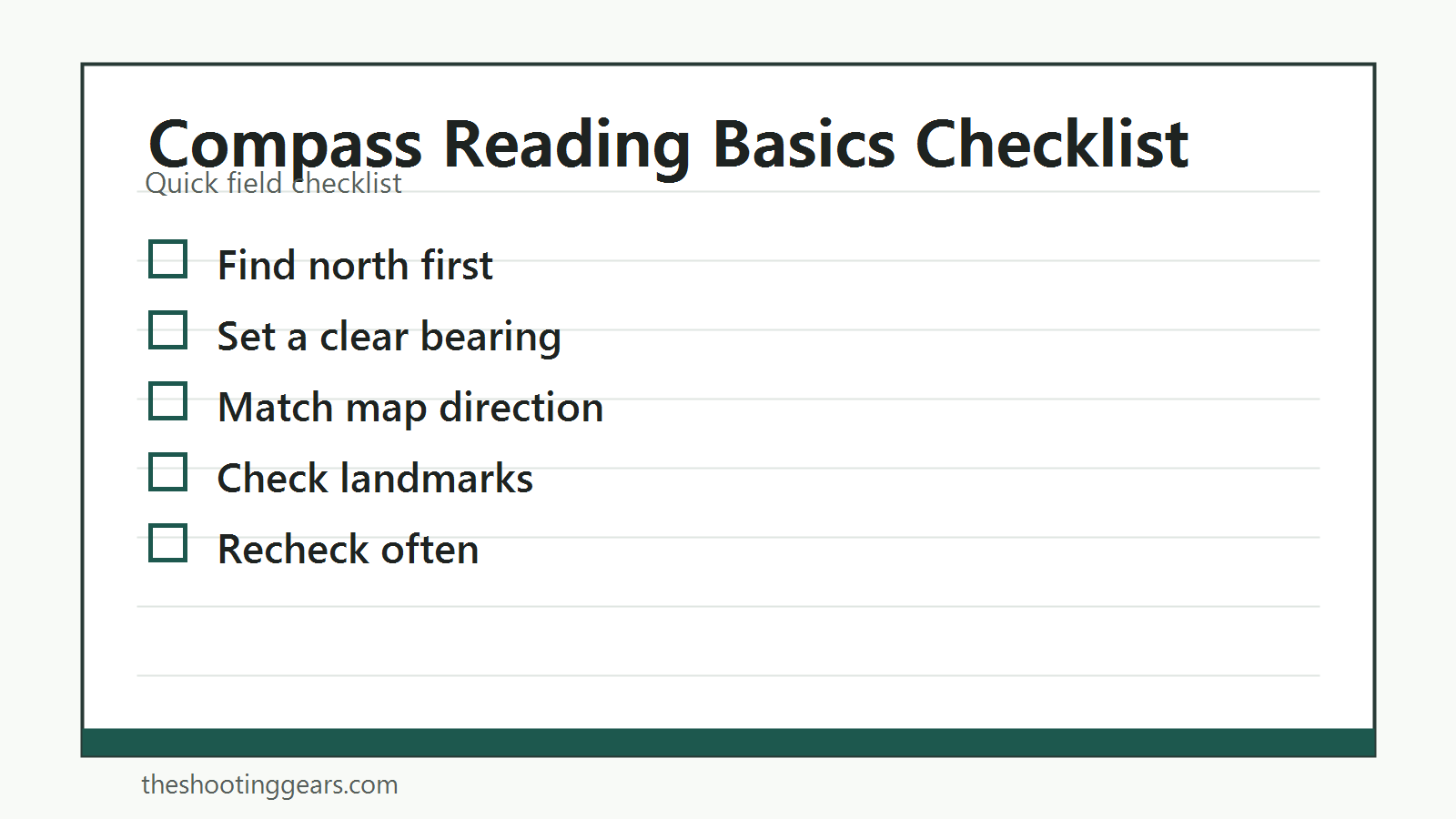
The safest way to learn is to practice in easy country first. Use a real map, check the local magnetic declination, learn how to orient the map, and take short bearings you can verify with landmarks. A compass should make your route clearer, not give you confidence to wander into terrain you cannot read. For a backup-only survival skill, see our guide to making an improvised compass, but treat it as a last-resort lesson rather than your main navigation plan.
Table of Contents
Compass Parts That Matter
Baseplate and direction arrow
Most outdoor users learn on a baseplate compass. The clear base lets you see map details underneath it, and the direction-of-travel arrow shows where the compass is pointing. When you walk a bearing, that arrow points the way your body should move. Keep it level and away from metal, magnets, phones, knives, and vehicle bodies while you read it.
Needle and rotating bezel
The magnetic needle points toward magnetic north. The rotating bezel holds degree marks from 0 to 360, plus orienting lines inside the housing. The simple idea is this: turn the bezel to the bearing you want, turn your body until the needle lines up inside the orienting arrow, then walk in the direction shown by the travel arrow.
Different compasses have extra features, such as mirrors, sighting notches, global needles, or adjustable declination. Those can help, but the basics are the same. You need to know where north is, where your map points, and which direction your chosen route requires.
True North, Magnetic North, and Declination
Maps and compasses do not use the same north
Most topographic maps are drawn to true north, which points toward the geographic North Pole. A compass needle points toward magnetic north, which is not in the same place. The difference between the two is called magnetic declination. Declination changes by location and slowly changes over time, so you should check it for the area and date you are using.
Check declination before relying on a bearing
The National Oceanic and Atmospheric Administration provides tools for finding magnetic declination, and many modern maps print a declination diagram. If your compass has adjustable declination, set it before your trip and confirm you know how the setting works. If it does not, you need to add or subtract the local declination when moving between map bearings and compass bearings.
For short practice walks in a park, a small declination error may not matter much. In big country, poor visibility, or steep terrain, it can matter a lot. A few degrees of error can move you far off line over distance. That is why declination belongs near the start of the process, not as a footnote.
How to Orient a Map
Set the map to the ground
Orienting a map means turning the map so the printed north on the map lines up with north in the real world. Lay the map flat. Place the compass on it with the edge aligned to a north-south grid line or the map margin. Rotate the map and compass together until the needle lines up with the orienting arrow, after accounting for declination.
Use landmarks to confirm
Once the map is oriented, the terrain should start to make sense. A ridge on your right should appear on the right side of the map. A creek crossing, road bend, pond, saddle, or field edge should line up with what you can see. If the map and land do not agree, stop and solve that problem before walking farther.
This is where map reading and compass reading work together. A compass gives direction. A map gives context. Direction without context can still lead you into cliffs, water, private land, closed roads, or thick cover that a smarter route could avoid.
How to Take a Bearing
From map to field
To take a bearing from a map, place the compass edge from your current location to the destination. Keep the direction-of-travel arrow pointing toward the destination. Rotate the bezel until the orienting lines match the map’s north-south lines. Lift the compass, hold it level, and turn your body until the magnetic needle sits in the orienting arrow. The direction-of-travel arrow now points toward the route.
From field to map
To take a bearing to a visible landmark, point the direction-of-travel arrow at the landmark. Rotate the bezel until the needle lines up with the orienting arrow. Read the degree number at the index line. You can then transfer that bearing to the map to help identify the landmark or draw a line of position.
Do not rush bearings. Small mistakes at the start become bigger over distance. Hold the compass level, keep it away from metal, and double-check that the travel arrow points the correct way. Many beginner errors happen because the compass is pointed backward on the map.
How to Follow a Bearing
Pick near targets
Once you have a bearing, do not stare at the compass for every step. Line up the needle, then pick a tree, rock, stump, or opening in the exact direction of travel. Walk to that near target. Then check the compass again and pick the next target. This keeps you moving steadily without weaving across the route.
Adjust for obstacles without losing the line
If you need to go around brush, water, or unsafe ground, do not wander casually. Use a simple offset: move around the obstacle, keep track of which side you went around, and return to the original line when safe. In poor visibility, slow down and shorten the distance between checks.
Compass travel is not a promise that the straight line is the best line. It is a tool for holding direction. Good navigation still respects terrain, weather, daylight, property lines, and your own energy level.
Backtracking and Safety Checks
Use a reverse bearing
A reverse bearing points back along the line you came from. Add 180 degrees to the original bearing if it is under 180. Subtract 180 degrees if it is over 180. For example, a 70-degree bearing reverses to 250 degrees, while a 240-degree bearing reverses to 60 degrees. This is useful when you need to retrace a route in fog, timber, or fading light.
Leave a route plan
Navigation safety starts before the trip. Tell someone where you are going, when you expect to return, and what route you plan to use. Carry a map, compass, light, whistle, water, layers, and a backup way to communicate when possible; our survival gear guide for hunters can help you think through the wider emergency kit. A compass is valuable, but it is not a full safety plan by itself.
Common Compass Mistakes
Reading near metal
Metal objects and magnets can affect the needle. Keep the compass away from vehicles, firearms, knives, phones, radios, buckles, trekking poles, and magnetic closures when taking a serious reading. If the needle behaves oddly, move away from gear and check again.
Forgetting declination
Declination is easy to ignore because the compass still appears to work without it. That is the trap. In some places the difference between true north and magnetic north is large enough to put you well off line. Check it before the trip and write the value on your map notes.
Walking without map context
A bearing can keep you straight and still send you into a bad route. Before walking, look at the map for cliffs, water, private property, roads, trails, and safer handrails such as ridges or creeks. The best compass users are not just good at numbers. They are careful about terrain.
Simple Practice Drill
Use a short square route
Find a safe open area. Start at one point and walk 50 steps north, 50 steps east, 50 steps south, and 50 steps west. If you read the compass well and keep your steps steady, you should finish near the starting point. This drill teaches direction, pacing, and how quickly small errors show up.
Practice before you need it
Do the same drill with different distances and in light cover where you can still stay safe. Then practice orienting a map and identifying nearby features. The goal is to make the process boring before you rely on it in cold weather, fog, thick timber, or unfamiliar country.