How to Choose a Scope for a .308 Rifle

A good .308 scope should match how far you really shoot, how much weight you can carry, and how clearly you need to see the target in normal light. For most deer hunters and range shooters, a 3-9x, 2.5-10x, or 4-12x scope with steady eye relief, repeatable adjustments, and a useful reticle is a better choice than chasing the highest magnification number.
The .308 Winchester is flexible enough for timber, open fields, and range practice, so the right scope depends on the job. Use this guide to narrow the choice by distance, magnification, objective size, eye relief, reticle style, turret setup, mount height, and budget.
Table of contents
- Quick answer
- Match the scope to your real shooting distance
- Choose useful magnification, not just more power
- Pick an objective size that fits the rifle
- Check eye relief before you buy
- Choose a reticle you can read quickly
- Know whether you need capped or exposed turrets
- Do not ignore rings, bases, and scope height
- .308 scope buying checklist
- FAQ
Quick Answer: What Scope Works Best on a .308?
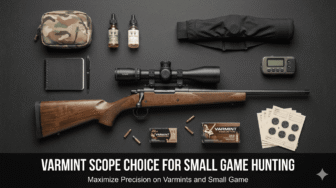
For a typical .308 hunting rifle, start with a 3-9×40, 2.5-10×40, or 4-12×40 scope. These ranges give enough low-end field of view for close deer woods and enough top-end magnification for common field shots. If you mostly shoot paper or steel beyond 300 yards, a 4-16x or similar scope can make sense, but only if the glass, tracking, and mounting setup are good enough to support that use.
Best all-around setup
A 3-9×40 remains a practical all-around .308 scope because it is light, easy to mount low, and forgiving behind the rifle. It also avoids turning a handy hunting rifle into a heavy bench gun.
Best range-focused setup
If the rifle spends more time on a bench than in a deer stand, look at 4-12x, 4-16x, or 3-15x scopes with a clean reticle and reliable adjustments. Do not buy extra magnification if the image gets dim or fuzzy at the top end.
Match the Scope to Your Real Shooting Distance
Start with your normal distance, not the longest shot you can imagine. A .308 can reach farther than many hunters should shoot in the field, and the scope should help you make clean, controlled decisions rather than tempt you into poor ones.
Inside 150 yards
For woods, brush, and short food-plot shots, a low bottom-end setting matters more than a huge top-end setting. A scope that starts around 2x, 2.5x, or 3x helps you find the animal faster and keeps more of the surroundings visible.
150 to 300 yards
This is where many .308 rifles live. A 3-9x or 2.5-10x scope is usually enough. You can sight in, confirm holds, and still keep the rifle balanced for walking or climbing into a stand.
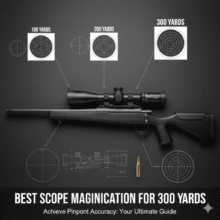
Beyond 300 yards
Longer range use puts more pressure on the whole setup. You may want more magnification, a reticle with hold marks, parallax adjustment, and turrets that track well. Before stretching distance, review safe backstop habits and firearm handling basics from the NSSF firearm safety rules.
Choose Useful Magnification, Not Just More Power
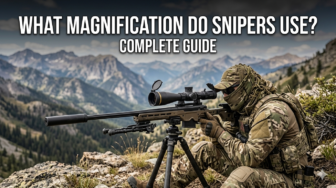
Magnification helps you see detail, but it also narrows field of view and can make wobble look worse. A scope that is easy to use at 4x to 8x often serves a .308 better than one that looks impressive on the box but feels slow in the field.
3-9x
Choose this range for a light hunting rifle, especially if most shots are inside 300 yards. It is simple, common, and easy to mount.
2.5-10x or 3-12x
These ranges add a little room on the top end without giving up much speed on the low end. They are strong choices for mixed hunting and range practice.
4-16x and higher
Higher magnification can help on small targets or range work, but it adds size and can reduce low-light comfort. Pick it only when your use case calls for it.
Pick an Objective Size That Fits the Rifle
The objective lens is the front lens of the scope. A larger objective can help with image brightness when glass quality is equal, but it may force taller rings and a higher cheek position. On a .308 hunting rifle, a 40mm to 44mm objective is often the easiest size to live with.
40mm to 44mm
This size range usually mounts cleanly, keeps weight reasonable, and works well for daylight hunting and normal range sessions.
50mm and larger
A large objective can be useful in some low-light setups, but it may need higher rings. If your cheek floats off the stock to see through the scope, the rifle becomes harder to shoot well.
Check Eye Relief Before You Buy
Eye relief is the distance from your eye to the eyepiece where you see the full image. It matters on a .308 because recoil can drive the scope back toward your face if the rifle is mounted poorly or the scope sits too close. A general optics reference like eye relief explains why eye position affects the visible image.
Look for forgiving eye relief
Many hunters prefer around 3.5 inches or more, but the listed number is only part of the story. The scope should feel forgiving when you shoulder the rifle quickly.
Test it in real shooting positions
Check the view from standing, kneeling, sitting, and prone if those positions matter to you. A scope that looks fine from a bench may feel cramped from a field position.
Choose a Reticle You Can Read Quickly
A .308 scope reticle should be easy to see against the target and simple enough to use under pressure. Fine target reticles can be precise, but they may disappear in dark timber. Heavy hunting reticles are fast, but they can cover small targets at distance.
Simple duplex reticle
A duplex reticle is still a strong choice for normal deer hunting. It is clean, fast, and does not ask you to solve a math problem while the animal is moving.
BDC or holdover reticle
A BDC-style reticle can help if you confirm the marks with your rifle and ammunition at the range. Do not assume the marks match your load until you test them.
Mil or MOA reticle
Mil and MOA reticles are useful when paired with matching turrets and enough practice. If you want more help comparing reticle styles, read our guide on how to choose the right reticle.
Know Whether You Need Capped or Exposed Turrets
Capped turrets are usually better for a hunting .308 because they are protected from bumps. Exposed turrets are better when you plan to dial elevation often and can confirm tracking at the range.
Capped turrets for hunting
If you sight in and mostly hold on the animal, capped turrets keep the scope simple. They also reduce the chance of turning a dial by mistake while carrying the rifle.
Exposed turrets for range work
If you dial for distance, choose turrets with clear clicks and a zero stop if your budget allows it. Then test them. A turret is only useful if it moves predictably and returns to zero.
Do Not Ignore Rings, Bases, and Scope Height
A good scope can perform poorly if the mounts are wrong. The rings should match the tube diameter, clear the objective, and keep the scope low enough for a steady cheek weld. The base should fit the rifle action, and screws should be tightened to the maker’s torque guidance.
Check tube diameter
Common scope tubes include 1 inch, 30mm, and 34mm. Rings must match the tube, not the objective lens size.
Keep the scope as low as practical
Low mounting helps your cheek meet the stock naturally. If the scope sits too high, you may need a cheek riser or different rings. For mount choices, see our guide to the best scope mounts.
.308 Scope Buying Checklist
Before you buy, use this checklist to keep the decision practical.
- Distance: Pick magnification for your normal shots, not rare long shots.
- Weight: Keep a hunting rifle light enough to carry comfortably.
- Eye relief: Confirm the scope gives a full view from real shooting positions.
- Reticle: Choose a reticle you can read quickly in the light you hunt in.
- Turrets: Use capped turrets for simple hunting setups and exposed turrets only when you will practice dialing.
- Parallax: Consider side-focus or adjustable parallax for range work beyond normal hunting distance. Our rifle scope parallax guide explains the issue in plain terms.
- Mounting: Budget for quality rings, bases, and proper setup.
FAQ
Is a 3-9x scope enough for a .308?
Yes, a 3-9x scope is enough for many .308 hunting rifles, especially inside 300 yards. It is light, simple, and gives a useful low-end setting for close shots.
What scope magnification is best for deer hunting with a .308?
For most deer hunters, 2.5-10x, 3-9x, or 3-12x is a sensible range. Keep the scope low enough for fast target pickup and clear enough for the legal light you hunt in.
Do I need a 50mm objective on a .308 scope?
No, not always. A 40mm or 44mm objective is often easier to mount and carry. A 50mm objective can help in some low-light setups, but it may require higher rings.
Should I choose first focal plane or second focal plane?
For simple hunting, second focal plane is often easier and more familiar. First focal plane can help if you use hold marks across different magnification settings. A general telescopic sight reference can help you understand the main scope terms before comparing models.
How much should I spend on a .308 scope?
Spend enough to get clear glass, reliable adjustments, good eye relief, and a warranty you trust. A dependable mid-priced scope is better than a feature-heavy scope that will not hold zero.
Bottom Line
Choose a .308 scope around the way you actually shoot. Most hunters are well served by a clear 3-9×40, 2.5-10×40, or 4-12×40 with safe eye relief, a readable reticle, and sturdy mounts. Range-focused shooters can step up in magnification and turret features, but only after confirming the rifle, ammo, mounts, and safety habits are ready for that work.