How Not to Introduce Kids to Guns: Parent Safety Mistakes to Avoid
The safest way to introduce kids to firearms starts with what not to do: do not rely on curiosity, secrecy, casual demonstrations, unsecured storage, movie myths, or one-time lectures. Children need clear rules, secure storage, age-appropriate conversations, and direct adult responsibility. A firearm in a home should be inaccessible to children unless a responsible adult is actively supervising a lawful, structured training setting.
This guide is for parents, guardians, and mentors who want a safer approach. It is not a shooting lesson and it is not legal advice. Firearm storage, transport, youth hunting, range access, and training rules vary by state, local law, and range policy. Use official safety resources, follow the law where you live, and choose professional instruction when a child is old enough and emotionally ready.
Table of contents
Quick Answer: What Is the Wrong Way to Introduce Kids to Guns?
The wrong way is to treat firearms as normal household objects, assume a child will remember one warning, or show a gun before you have secure storage and clear rules. The safer order is storage first, conversation second, professional or structured education later, and hands-on handling only when the child is mature enough, legally allowed, and directly supervised.
For younger children, the lesson may be simple: stop, do not touch, leave the area, and tell an adult. For older youth, the lesson can grow into safe handling, lawful range behavior, hunter education, or supervised sport shooting. The key is that the adult controls access, not the child’s interest level.
The Big Rule for Parents
Never use education as a substitute for secure storage. A child who has learned safety rules is still a child. Firearms should be locked, unloaded where appropriate, and stored so unauthorized people cannot access them. Ammunition should also be secured according to your household risk, local law, and manufacturer guidance.
Do Not Start Before Secure Storage Is Solved
The first mistake is introducing guns before the home is secure. If a child can access a firearm without adult permission, the household has a storage problem. Conversations matter, but they cannot carry the whole safety burden. Secure storage is the foundation.
Project ChildSafe emphasizes secure firearm storage as a core prevention step. The ATF also publishes firearm safety and security guidance for owners. Use those resources as starting points, then follow your state and local storage laws. If children visit your home, treat them as part of the safety plan even if they are not your children.
Storage Questions to Ask Yourself
- Can any child, visitor, or unauthorized adult access a firearm?
- Are keys, combinations, and backup access methods protected?
- Is ammunition secured in a way that fits your household risk?
- Are firearms stored according to local law and manufacturer instructions?
- Would your storage still be secure if a curious child searched the room?
Do Not Let Curiosity Become the Teacher
Children are curious. If adults avoid the topic completely while firearms exist in the home, curiosity may fill the silence. That does not mean every child needs hands-on exposure. It means parents should provide clear, calm, age-appropriate rules before a child encounters a firearm unexpectedly.
A useful early message is simple: if you see a gun, do not touch it, leave the area, and tell an adult. Repeat the rule in normal conversation. Do not turn it into a scary performance or a challenge. The goal is to make the safe response automatic.
Avoid Secrecy and Avoid Showing Off
Secrecy can increase curiosity, but showing off can normalize unsafe attention. A better middle path is honest, boring safety language. Firearms are serious tools. They are not toys, props, or status symbols. Children should know that any firearm they find is an adult emergency, not an invitation to investigate.
Do Not Use Age Alone as Readiness
There is no universal age when every child is ready for firearm handling or youth hunting. Maturity, impulse control, emotional response, attention span, respect for rules, and legal requirements all matter. One child may be ready for a structured safety class earlier than another child of the same age, while another may need more time and no hands-on exposure.
Avoid saying a child is ready just because they are interested. Interest is not the same as responsibility. If a child treats safety rules as a game, argues with supervision, hides mistakes, acts impulsively, or seems fearful or overly fascinated, slow down and keep the lesson at the rule-and-storage level.
Readiness Signs Are Behavioral
- The child follows instructions without repeated reminders.
- The child can explain safety rules in their own words.
- The child understands that mistakes can have permanent consequences.
- The child accepts correction calmly.
- The child is not trying to impress friends or siblings.
Do Not Make Firearms Seem Casual
Another mistake is treating a firearm like a conversation piece. Do not casually pass one around, use it as a prop, joke with it, or demonstrate it without a structured safety context. Adults set the emotional tone. If adults act careless, children learn carelessness.
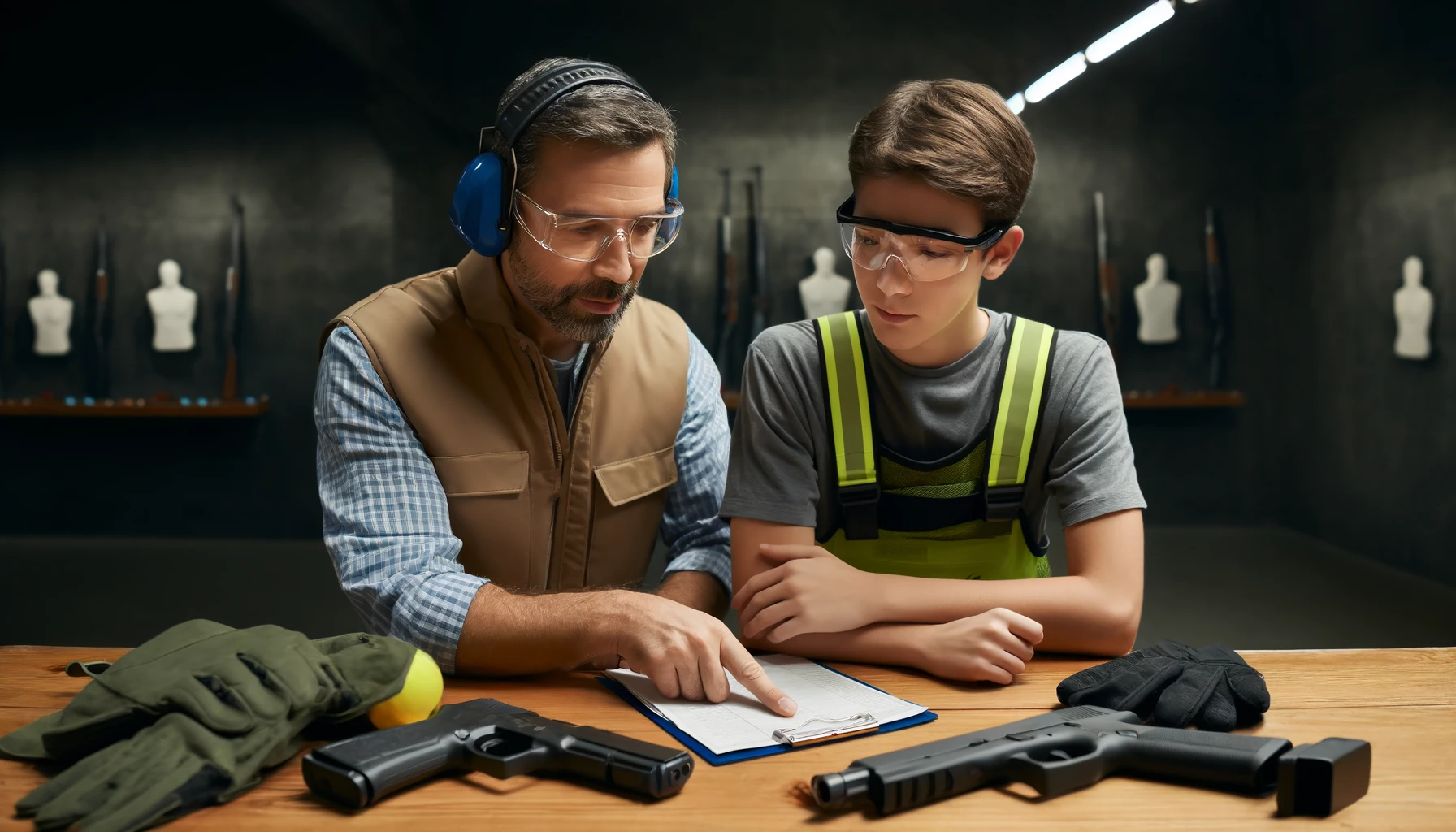
When an older youth is ready for formal handling, the setting should be deliberate: unloaded verification by a responsible adult, muzzle direction control, finger off the trigger, clear instructions, no distractions, and a stop point if the child becomes nervous or careless. For many families, a certified instructor is the better first hands-on teacher.
Do Not Use Fear as the Whole Lesson
Fear can make a child freeze, hide mistakes, or avoid asking questions. Respect is better than panic. Be serious, direct, and calm. The message is not “guns are mysterious.” The message is “firearms require adult control, secure storage, and strict rules.”
Do Not Practice Without Structure and Supervision
Unstructured practice is a major risk. Do not let a child handle firearms alone, dry-fire without permission, use air guns unsupervised, or practice with friends as the audience. Even non-firearm trainers, toy guns, and air guns can teach bad habits if adults treat them casually.
If a youth is ready for range education, choose a controlled environment with proper eye and ear protection, one-on-one supervision, clear commands, and a stop rule. Review our shooting range safety rules guide before any range visit, and follow the range’s own rules above all else.
One Adult, One Learner Is Better
Group attention is hard for beginners. For a first supervised lesson, one responsible adult and one learner is usually safer than a crowd. Remove phones, jokes, competition, and pressure. The adult should be close enough to stop the session immediately.
Do Not Let Movies, Games, or Social Media Set Expectations
Many children first see firearms in games, movies, short videos, or social media. Those portrayals often skip storage, recoil, legal rules, backstops, hearing protection, and consequences. Parents should explain that entertainment is not training.
Keep the conversation practical. Real firearms are not reset buttons. Real bullets do not disappear when a game ends. Real handling rules apply every time, even when a firearm is believed to be unloaded. This is also a good time to discuss peer pressure and what to do if another child shows a firearm.
Give Children an Exit Script
Children should have simple words ready: “I am leaving,” “Do not touch that,” or “I am telling an adult.” They do not need to win an argument with another child. They need permission to leave immediately and get help.
Do Not Rush Youth Hunting or Range Time
Youth hunting and youth shooting sports can be positive when they are legal, supervised, structured, and matched to the child’s maturity. They can also be harmful if rushed. Do not make a child hunt, shoot, or pose with a firearm to satisfy adult expectations.
Before youth hunting, check state age rules, hunter education requirements, mentor rules, blaze-orange rules, legal equipment, tag requirements, and public-land restrictions. Our first-time hunting guide covers the broader planning side, while this page focuses specifically on child firearm safety and introduction mistakes.
Keep Youth Hunting About Learning
The first goal should be safe learning, not filling a tag. A child can learn by scouting, identifying sign, glassing, carrying water, practicing quiet movement, and watching ethical decisions. Hands-on firearm use is only one possible part of a much larger outdoor education.
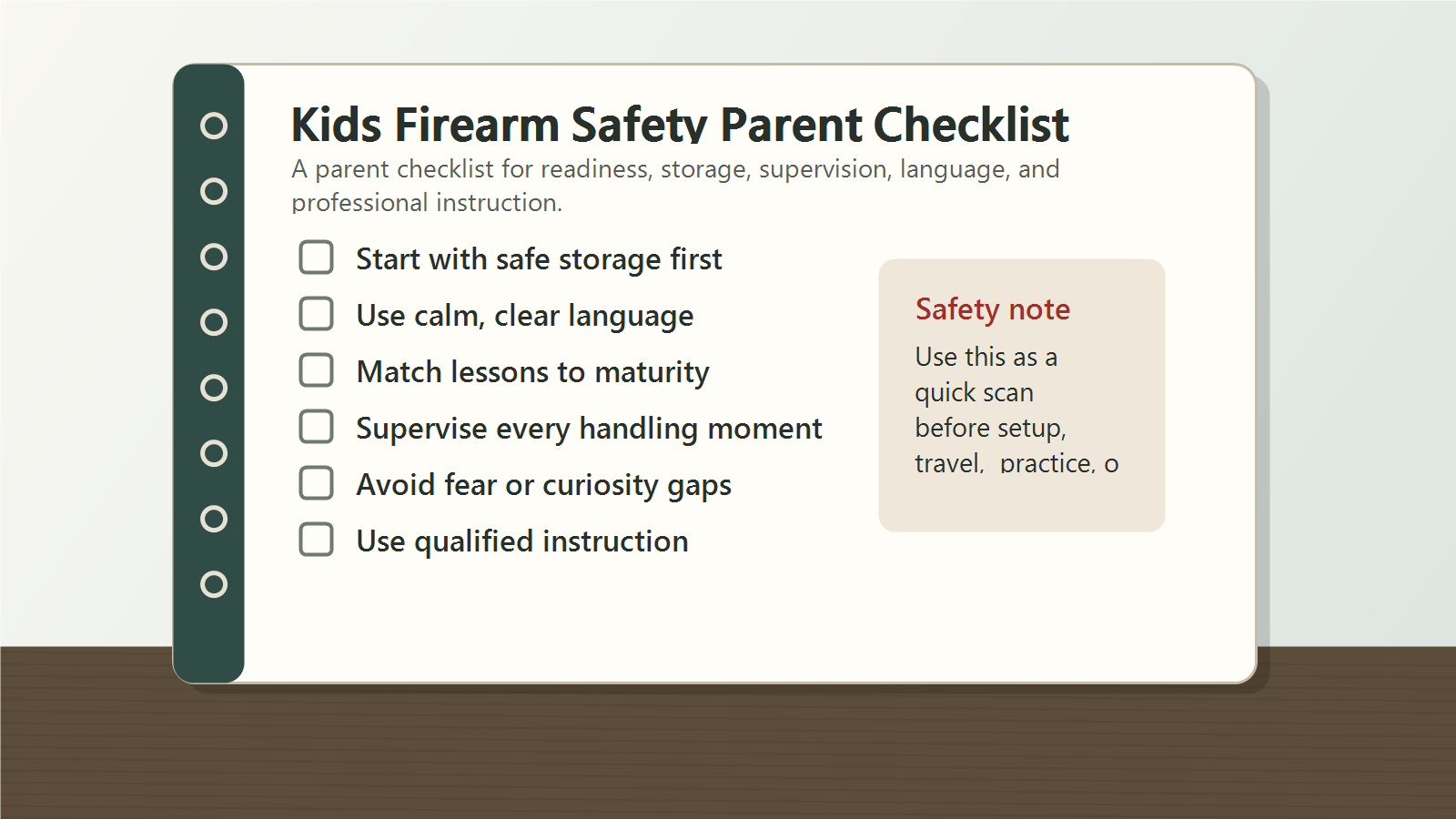
Parent Safety Checklist Before Any Firearm Introduction
Use this checklist before moving beyond basic conversation. If any answer is uncertain, slow down and fix the gap before adding more exposure.
- All firearms are secured from unauthorized access.
- Ammunition is secured according to your household plan and local law.
- The child knows what to do if they find a firearm.
- The child is not pressured, fearful, or overly fascinated.
- You have reviewed current state and local laws.
- You have chosen a certified instructor, hunter education course, or structured range program if hands-on learning is appropriate.
- You have eye and ear protection for any lawful range setting.
- You have a stop rule: the session ends immediately if safety slips.
Authority Sources to Review
For a safety-first foundation, review Project ChildSafe secure storage guidance, the ATF firearm safety and security page, and the American Academy of Pediatrics’ parent-facing gun safety guidance on HealthyChildren.org. For youth hunting, use your state wildlife agency and approved hunter education program as the final authority.
FAQ
What is the first gun safety lesson for a child?
For many children, the first lesson should be: do not touch, leave the area, and tell an adult. The adult’s responsibility is secure storage and supervision, not expecting a child to manage the risk alone.
At what age should kids learn about guns?
There is no universal age. Basic safety rules can be age-appropriate for young children, while hands-on handling should wait until the child is mature, legally allowed, and directly supervised in a structured setting.
Should I show a child a firearm to remove curiosity?
Not casually. If a child is old enough for a structured lesson, use a controlled setting with a responsible adult or certified instructor. Never use a casual demonstration as a shortcut for storage and safety education.
Is a gun safe enough if my child knows the rules?
No. Rules help, but secure storage is still essential. Children can forget, act impulsively, respond to peer pressure, or misunderstand risk. Access control remains the adult’s job.
Can kids safely go to a shooting range?
Only when legal, allowed by the range, age-appropriate, and directly supervised. Choose a family-friendly range or professional instructor, use proper protection, and stop immediately if the child is uncomfortable or careless.
What should I ask before my child visits another home?
Ask whether firearms are in the home and how they are secured. The question can feel awkward, but it is a normal safety question, like asking about pools, pets, allergies, or supervision.
Final Thoughts
Introducing kids to firearms should never be rushed, casual, secretive, or built around adult pride. Start with secure storage, clear rules, calm communication, and professional guidance when appropriate. A child does not need access to understand respect. They need adults who take safety seriously every day, especially when no one is watching.