Common Rifle Scope Mistakes (And How to Avoid Them)
A rifle scope is not just an accessory; it is a precision instrument designed to translate the shooter’s intent into an accurate point of impact on the target. Even the most expensive optic will fail to perform if it is not mounted, adjusted, and used correctly. Many shooters invest heavily in rifles and ammunition, yet overlook the fundamentals of scope setup and operation.
As a result, they experience inconsistent groups, unexplained point-of-impact shifts, and poor confidence in their shooting. These problems are rarely caused by defective equipment. More often, they stem from common and entirely avoidable mistakes. Understanding these errors in depth and learning how to correct them is essential for anyone who wants to achieve reliable accuracy, whether for hunting, target shooting, or long-range precision work.
Table of Contents
Improper Scope Mounting
One of the most critical and frequently overlooked issues is improper scope mounting. The scope must be perfectly aligned with the rifle’s bore and secured in a way that allows its internal adjustment system to function without stress or distortion.
When rings are misaligned, unevenly tightened, or of poor quality, they can bend the scope tube slightly. This bending may not be visible, but it can interfere with the internal erector system, causing erratic tracking and inconsistent zero.
Equally important is leveling. If the scope is mounted with even a slight cant, elevation adjustments will no longer move the reticle straight up and down in relation to gravity. At short distances this may go unnoticed, but at longer ranges it results in significant horizontal deviation as distance increases.
Proper mounting requires quality bases and rings, precise alignment, correct torque applied with a torque wrench, and careful leveling of both the rifle and the reticle before final tightening. This foundation determines whether every other adjustment will work as intended.
Incorrect Eye Relief Setup
Eye relief is the distance at which the shooter’s eye can see a full, clear image through the scope without dark shadows around the edges. Setting this incorrectly forces the shooter into an unnatural head position. Some shooters mount the scope too far forward, stretching their neck to reach the full sight picture, while others mount it too far back, pulling their head away and risking contact with the scope under recoil.
Inconsistent head position leads directly to inconsistent cheek weld and point of aim. Each time the head is placed slightly differently, the line of sight through the scope changes, even if the rifle itself remains steady. Proper eye relief should be established in the shooter’s natural firing position, whether prone, seated, or standing, so that the full field of view appears immediately and comfortably. This ensures fast target acquisition, reduced eye strain, and consistent alignment from shot to shot.
Unleveled Reticle
A reticle that is not perfectly aligned with true vertical and horizontal is a hidden source of error that becomes more serious as distance increases. When a shooter dials elevation to compensate for bullet drop, the reticle should move strictly up and down. If the scope is canted, the reticle moves along a diagonal path, introducing unwanted windage error along with elevation. This makes wind calls appear inconsistent and causes unexplained horizontal dispersion.
Leveling the reticle involves securing the rifle in a stable position, establishing a true vertical reference such as a plumb line, and rotating the scope until the vertical crosshair aligns exactly with gravity. This step ensures that all ballistic corrections correspond correctly with the real-world trajectory of the bullet.
Poor Zeroing Technique
Zeroing is the process of aligning the scope’s point of aim with the rifle’s point of impact at a chosen distance. Many shooters rush this step or perform it under poor conditions. Zeroing from an unstable rest, using inconsistent ammunition, or making adjustments based on single shots rather than groups can result in a false zero.
A proper zero requires a solid shooting platform, consistent ammunition, and a methodical approach. Groups of three to five shots should be fired to determine the true center of impact, and adjustments should be made based on the average, not on individual outliers.
Environmental conditions such as wind and temperature should be considered, and the zero should be confirmed after the rifle has cooled and again after any transport or handling that might shift the scope.
Ignoring Parallax Adjustment
Parallax error occurs when the target image and the reticle are not on the same focal plane. This causes the reticle to appear to move across the target when the shooter’s eye shifts slightly behind the scope. At low magnification and short distances, this effect may be minimal, but at high magnification and long range it can introduce significant point-of-impact errors.
Many shooters rely solely on the distance markings on the parallax adjustment knob, assuming they are precise. In reality, these markings are only approximate. True parallax adjustment requires the shooter to fine-tune the setting while observing reticle movement, eliminating any apparent shift when the head moves. This ensures that the point of aim remains constant regardless of minor variations in eye position.
Overusing High Magnification
The belief that maximum magnification always leads to better accuracy is one of the most widespread misconceptions. High magnification narrows the field of view, making it harder to locate and track targets. It also magnifies every small movement of the rifle and every shimmer of heat mirage in the air, creating the illusion of instability and encouraging overcorrection.
In many shooting scenarios, moderate magnification provides a clearer, steadier, and more usable sight picture. It allows the shooter to maintain better situational awareness, manage recoil, and track targets more effectively. Learning to select the appropriate magnification for the distance and conditions is a key skill in precision shooting.
Misunderstanding Turret Tracking
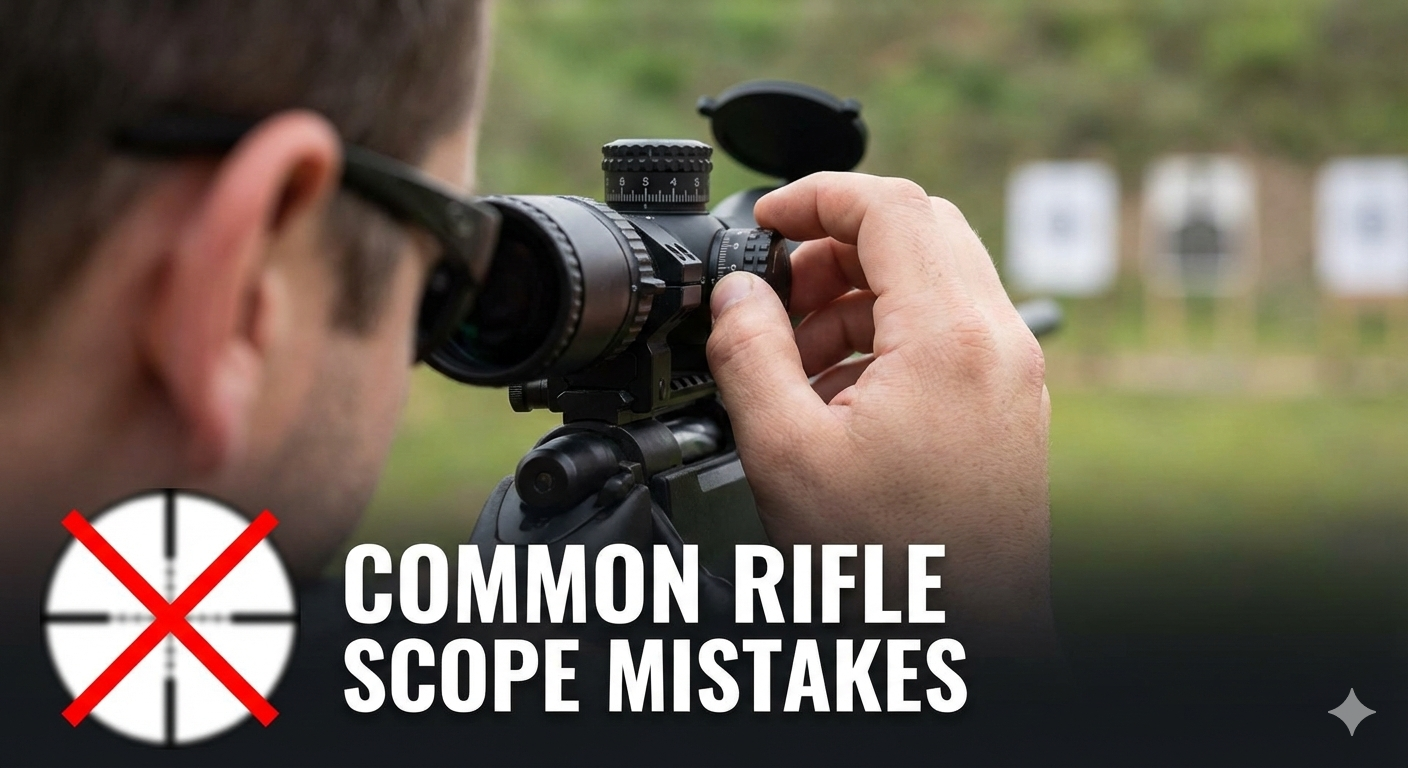
Turret adjustments are designed to move the reticle in precise, repeatable increments. However, not all scopes track perfectly, and even high-quality optics should be tested. Some shooters dial elevation and windage without ever verifying that the scope returns to zero accurately or that each click corresponds to the correct amount of movement.
If a scope’s tracking is inconsistent, ballistic data and long-range calculations become unreliable. Performing systematic tracking tests, such as box tests, helps confirm that the scope’s internal mechanisms are functioning correctly and that adjustments are both accurate and repeatable.
Neglecting Diopter Adjustment
The diopter focuses the reticle to match the shooter’s eyesight. It does not focus the target; it ensures that the reticle itself appears sharp and well-defined. If this adjustment is incorrect, the shooter may experience eye strain, slow target acquisition, and subtle aiming inconsistencies.
Many shooters skip this step and attempt to compensate by adjusting parallax or changing head position, which only masks the underlying issue. Proper diopter adjustment should be done by briefly looking through the scope at a bright, featureless background and setting the diopter so that the reticle appears instantly sharp.
Failing to Account for Environmental Factors
Atmospheric conditions play a major role in external ballistics. Changes in altitude, temperature, air density, and wind can all affect bullet trajectory. A rifle zeroed at one location may not produce the same point of impact at another. Light conditions and mirage can also influence how the reticle appears against the target.
Ignoring these factors can lead to incorrect adjustments and misinterpretation of shot placement. Understanding and accounting for environmental variables is essential for consistent accuracy, particularly at extended ranges.
Poor Scope Maintenance
Finally, even the best scope will suffer if it is not properly maintained. Dust, fingerprints, and improper cleaning can degrade lens coatings and reduce clarity. Loose mounting screws can cause gradual zero shift, and exposure to moisture or extreme temperatures can affect internal components. Regular inspection, proper cleaning with suitable tools, and secure storage help preserve both optical quality and mechanical reliability.
Conclusion
Most rifle scope problems are the result of simple, preventable mistakes rather than faulty equipment. Improper mounting, incorrect eye relief, unlevel reticles, rushed zeroing, neglected parallax, excessive magnification, unverified turret tracking, poor diopter setup, environmental ignorance, and lack of maintenance all contribute to inconsistent performance. By understanding these issues in depth and applying careful, methodical setup and shooting practices, a shooter can fully realize the potential of their rifle and optic, achieving greater precision, confidence, and consistency in every shot.