Shooting Glasses and Eye Protection: Safety Standards, Fit, and Range Use

Contents
Table of Contents
Why Eye Protection Matters
Small impacts, fragments, and spray
Shooting glasses are not just about looking prepared at the firing line. They are there because the eye is one of the few places where a tiny piece of brass, powder, grit, target material, or a bit of shattered jacket can turn a normal range session into a problem fast. The hazard is usually not dramatic. It is the small stuff that moves fast enough, lands at the wrong angle, and only needs one opening.
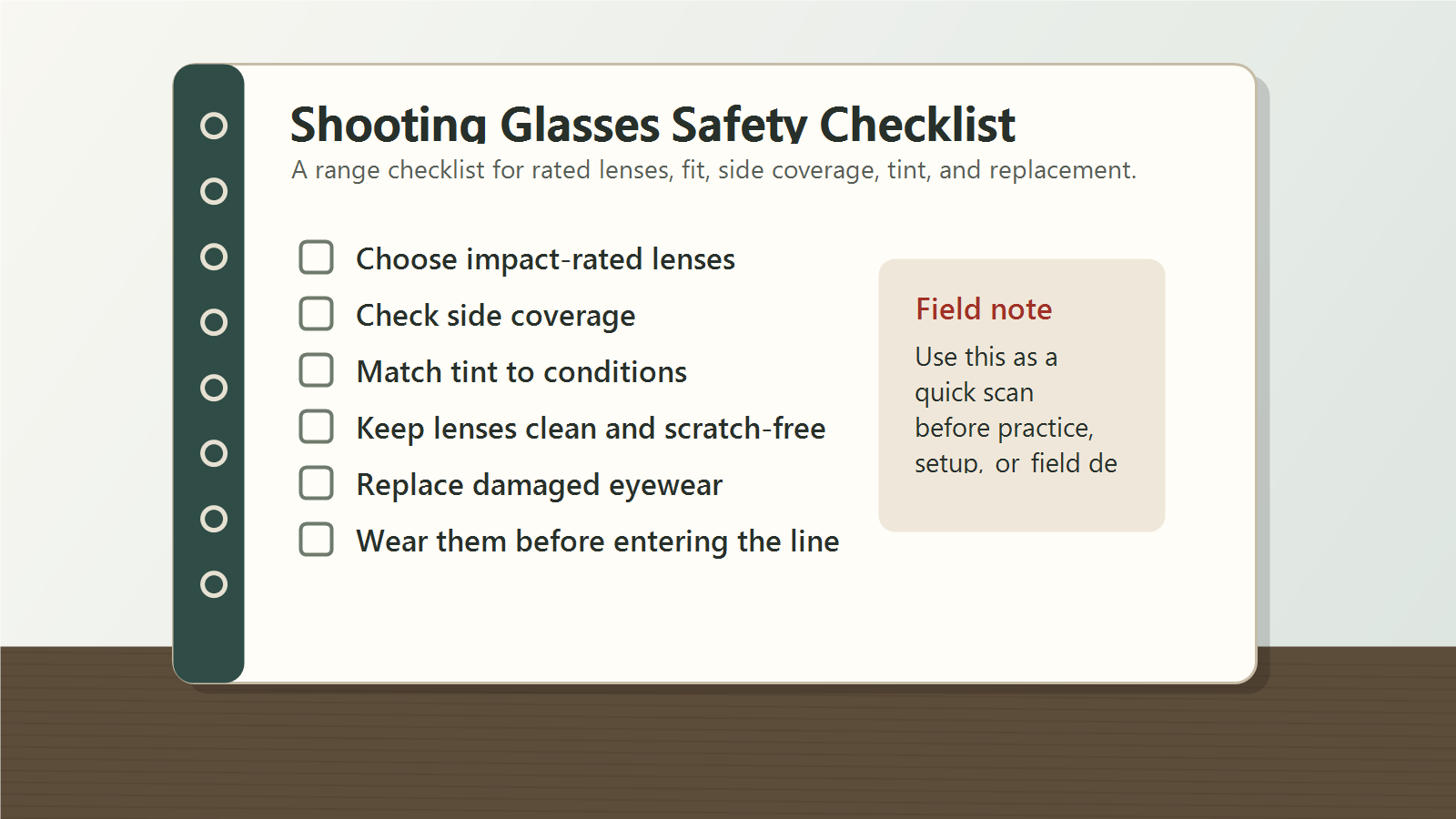
That is why this topic belongs in the same conversation as muzzle control, trigger discipline, and target awareness. The danger is not only the bullet path. It is also the splash zone around the shot: ejected brass, blowback, dust, fragments, and the odd piece of debris that comes back from steel or hard backstops. Ricochets are not the everyday outcome, but they are real enough that sensible eye coverage should be treated as standard range habit, not a special case.
Wear it every time, not just when it feels busy
Good range habits work best when they are boring and automatic. Eye protection should go on before the first round and stay on until the firearm is cleared and the line is truly cold; pair that habit with the broader shooting eye and ear protection guide. The point is not to guess which stage, target, or drill will be the risky one. The point is to remove the guesswork.
If your range has a posted PPE rule, follow it. If it does not, set the same standard for yourself. On a clean indoor lane, on a dusty outdoor berm, during practice, during sight-in, and while helping someone else troubleshoot a firearm, the same basic rule still applies: protect your eyes first and then get on with the session.
What Z87.1 Means
The standard behind the frame
In the United States, OSHA’s eye and face protection rule points to ANSI/ISEA Z87.1 as an accepted consensus standard for protective eyewear. In plain language, that means the glasses are not just regular street eyewear with a sporty shape. They are designed and tested for eye hazards, including flying particles and other impacts that ordinary eyewear is not built to absorb.
For a shooter, that matters because range hazards are about impact and intrusion. You want eyewear that has been made with that job in mind, not a pair that happens to fit your face and darkens the sunlight a little.
Impact-rated is the baseline, not the bonus
When people say impact-rated glasses, they mean protective eyewear that is intended to stand up to impact exposure rather than just dust or glare. That is the level to start with for shooting use. It is a better match for the realities of brass bounce, target fragments, and handling mistakes around benches, bags, and bencheside gear.
Do not treat fashion frames, fashion sunglasses, or ordinary prescription glasses as enough on their own. They may be fine for walking around town. They are not the same thing as eye protection for a firing line.
Check the marking before you trust the glasses
The habit here is simple: look for the protective marking, not just the marketing copy. If a lens is described as “shooting glasses” but has no relevant protective designation, keep shopping. The frame shape may be right, but the frame shape alone does not prove impact performance.
That check is especially useful when buying online. Product photos can make almost anything look rugged. The label and the standard claim are what matter.
Fit and Coverage
Wraparound and side coverage
OSHA says eye protection should provide side protection when there is a flying object hazard, and that is exactly the right mindset for a range. The side of the lens, the hinge area, and the gap near the temple are all places where debris can sneak in if the design is too open. Wraparound styles help because they reduce exposed edges and keep the lens closer to the face.
This does not mean every wraparound style is automatically good. Some sit too close to the lashes, some pinch the nose, and some tilt upward when paired with hearing protection. The goal is coverage that stays put while you move your head, shoulder a long gun, or look through a sight picture.
Bridge, brow, and temple fit
A protective lens only works if you actually wear it. A frame that slides, fogs constantly, or digs into the nose will get left in the bag. Fit matters as much as impact rating. The brow should be covered, the bridge should sit stable, and the temples should not create a big open path for dust or fragments from the side.
Before you trust a pair for range use, do a simple movement check. Look down, look up, shoulder your firearm, and turn your head from side to side. If the frame creeps, gaps open, or the lenses start to tip, try a different shape.
Prescription inserts and over-glasses
OSHA is clear that workers who wear prescription lenses should either use eye protection that incorporates the prescription in the design or wear eye protection that can be worn over the prescription lenses without disturbing the fit. That same logic works well on the range. Your vision correction should not force you to choose between seeing the target and protecting the eye.
Prescription inserts are a neat solution when the frame is stable and the insert does not fog up your whole field of view. Over-glasses work when they seal reasonably well around your everyday eyewear without pushing it out of position. Whichever route you use, the real test is not the box. It is whether the setup stays aligned once you put on ear protection and settle into a shooting stance.
Lens Choice by Light and Range
Clear lenses for indoor work and low light
Clear lenses are the safest default for indoor lanes, shaded bays, and dim light. They keep your sight picture honest and make it easier to read brass ejection, target feedback, chamber checks, and range commands. They also avoid the common mistake of making a lane feel darker than it already is.
If you shoot in a mixed environment, clear or lightly tinted impact-rated glasses are often the most flexible option. They keep the focus on the target and the firearm, not on the tint itself.
Tints can help outdoors, but only where they fit the light
Outdoors, a tint can improve comfort in bright sun and cut glare from pale backstops, steel, or open ground. That is useful. It is also easy to overdo. A lens that is too dark can make it harder to read sights, see hold points, or notice a range officer’s hand signals.
That tradeoff matters even more when weather changes. A lens that feels perfect at noon may feel too dim when clouds move in, the sun drops lower, or you step under a covered firing point. Keep a clear pair nearby if you often move between shade and full sun.
Do not let tint hide the work
The question is not whether a tint looks tactical. The question is whether it still lets you see the details that keep the session safe. You should be able to see your sights, verify the chamber, track brass, and notice what is happening around you without removing the glasses every few minutes.
Good lens choice should reduce strain, not add friction. If you find yourself squinting, lifting the glasses, or switching pairs after every string, the tint is probably not right for that range or time of day.
Hearing Protection Compatibility
Temple shape and earmuff seal
Eye protection and ear protection need to work together, because the best shooting glasses in the world are awkward if the temples break the seal of your earmuffs. Thick arms can create a gap, which is annoying on a quiet day and pointless on a loud one. Low-profile temples are often the smoother choice if you use over-ear protection.
Try the full setup on before the range session starts. Put on the glasses, then the earmuffs, then shoulder the firearm. If one piece pushes the other out of place, change the frame or change the muff.
Fog, pressure, and head movement
Heat and pressure can make a frame fog or shift during a long session. That is not just irritating. Fogged lenses lead to lifting, and lifting leads to broken habit. If your eyes keep getting exposed because the gear is annoying, the gear is not doing its job.
Look for ventilation that does not open a big gap to debris, anti-fog treatment that actually lasts, and a frame that still feels stable after a few minutes of movement. It is worth being picky here.
Range Rules and Safe Handling
The first four rules still set the tone
NSSF’s firearm safety guidance puts the main weight on safe direction, keeping firearms unloaded when not in use, not trusting the mechanical safety as a substitute for handling, and knowing your target and what is beyond it. Those ideas are not separate from eye protection. They are part of the same discipline.
If you already think in terms of muzzle discipline and backstop awareness, it becomes easier to think in terms of eye coverage too; our shooting range safety rules cover that mindset in more detail. Both are about limiting what the shot can reach and what the shot can surprise.
Loading and unloading are not the time to relax
Most range mishaps happen during transitions: taking the firearm out, loading it, clearing it, setting it down, or moving between stations. That is when your hands are busy and your attention can scatter. Keep the glasses on through those transitions.
A good rule is to treat the whole hot session as protected time. If the firearm is on the line and anything could still happen, your eyes stay covered.
Ricochet caution without the drama
Ricochets are worth respect, not panic. The usual fixes are practical: use the right target surface, keep the backstop in good shape, stay within the range’s target rules, and pay attention to angle and distance. NSSF’s wording about safe direction includes possible ricochets, which is a useful reminder that the shot does not always behave exactly as planned.
The job of eye protection is not to make a bad backstop harmless. It is to give you a little more margin when the session throws dust, splash, or fragments back toward the firing line.
Indoor Range Realities
Lead dust and residue are part of the indoor picture
NIOSH says employers and firing range operators should take steps to protect workers and shooters from exposure to hazardous lead concentrations and noise levels at indoor firing ranges. That is a reminder that the indoor range is not just a shooting space. It is also a controlled exposure space.
Eye protection does not solve lead exposure by itself, but it does fit the same disciplined mindset. Keep your face away from unnecessary contact, avoid touching your eyes with unwashed hands, and do not handle food or drinks on the line.
Noise and ventilation change how the day feels
Indoor lanes can make the session feel louder, warmer, and more enclosed than the same firearm outdoors, which is why some shooters also review how to double up ear protection indoors. That can affect how well your glasses fog, how the seal of your earmuffs feels, and how much glare you get from bright lane lighting. Small fit issues become more obvious indoors because the space leaves less room for comfort problems to hide.
If the glasses fog easily, switch to a different frame or anti-fog treatment before you accept the problem as normal. A frustrating setup is one more likely to be removed at the wrong time.
Clean up your face and gear after the session
After shooting, especially indoors, wash your hands and face before eating, drinking, or touching your eyes. If your glasses collect residue, wipe them down before tossing them back into a case with other gear. That keeps grime off the lenses and helps you notice scratches, cracks, or stress points early.
It is also a good moment to check the nose pads, temples, and screws. If the frame is loosening, the next session is where the trouble starts, not the one where you noticed it.
Outdoor Range Realities
Wind, dust, and open air
Outdoor ranges trade indoor lead and noise concentration for sun, wind, dust, pollen, and whatever the ground kicks up that day. That means side coverage still matters, even though the threat looks less boxed-in. Wind can drive grit around the face, and the wrong frame shape can leave a gap exactly where the breeze wants to work.
If you shoot on dry ground, around gravel, or near steel plates, a close-fitting wraparound frame can keep the session cleaner and more comfortable.
Weather changes the lens you need
Bright sun, haze, cloud cover, and late-day shadows do not all ask for the same lens. Outdoors, the right tint is the one that supports steady vision through the whole session, not the first five minutes. If the weather is likely to shift, carry a clear option or a second lens with a lighter tint.
Rain and snow can add another layer. Water on the lens is annoying, but a frame that keeps sitting right while you wipe it is still worth more than one that looks great in the mirror and fails on the line.
Moving between stations safely
At a busy outdoor line, shooters often move between benches, targets, and staging areas. That movement is where gear gets snagged, dropped, or sat on. Keep your glasses on while you are on the range property and treating the firearm as active, and keep them within reach when you are in the middle of gear changes.
If you need to take them off, do it only when the line is clearly cold and your hands are free to stow them properly. Loose eyewear on a tailgate or in a bag pocket gets scratched fast and forgotten even faster.
Choose, Check, and Replace
What to inspect before use
Before each session, look for cracks, warped arms, scratched lenses, and loose hardware. A scratched lens is not automatically unsafe, but it can make it harder to see clearly and may hide a crack that matters. If the frame is bent or the lens is lifting away from the face, replace it or repair it before it becomes the thing you keep adjusting at the firing line.
Also check that the glasses still fit once you add the rest of your kit. Some frames work fine alone and fall apart as soon as the muffs go on.
Know when a pair has done its job
Eye protection is one of the least expensive pieces of range gear to replace. That is a good thing. It means you do not need to keep sentimental frames in service after they are worn out. If a lens has taken a hit, the coating is failing, or the frame no longer sits where it should, retire it.
It is smart to keep a second pair that matches your main setup. That way a lost case, broken temple, or fogging issue does not end the session.
Build a simple eyewear system
A practical setup is usually better than a fancy one. One clear pair for indoor and low light work, one tinted pair for bright sun, and a prescription-compatible option if you need vision correction. Add a case, a microfiber cloth, and a habit of checking fit with your earmuffs before you head out.
That small system keeps the decision tree short. You spend less time improvising and more time shooting safely and comfortably.
Source Notes
NSSF firearm safety rules
Firearm Safety – 10 Rules of Safe Gun Handling. Used here for the four core safety rules, safe direction, unloaded handling when not in use, and the reminder to account for possible ricochets.
OSHA eye and face protection
1910.133 – Eye and face protection. Used here for side protection, prescription lens compatibility, and the link to consensus standards including ANSI/ISEA Z87.1-2010.
NIOSH firing range exposure guidance
Preventing Occupational Exposure to Lead & Noise at Indoor Firing Ranges. Used here for the indoor-range context around lead exposure and noise, and for the reminder that range operators should protect shooters and workers from those hazards.
ANSI/ISEA Z87.1 context
OSHA’s standard cites ANSI/ISEA Z87.1-2010 as an accepted consensus standard for eye and face protection. If an official ISEA page is available in your environment, it can be added as a direct companion source.