How to Use Bear Spray Safely: Carry, Range, Wind, and Practice Basics
How to Use Bear Spray Safely: Carry, Range, Wind, and Practice Basics
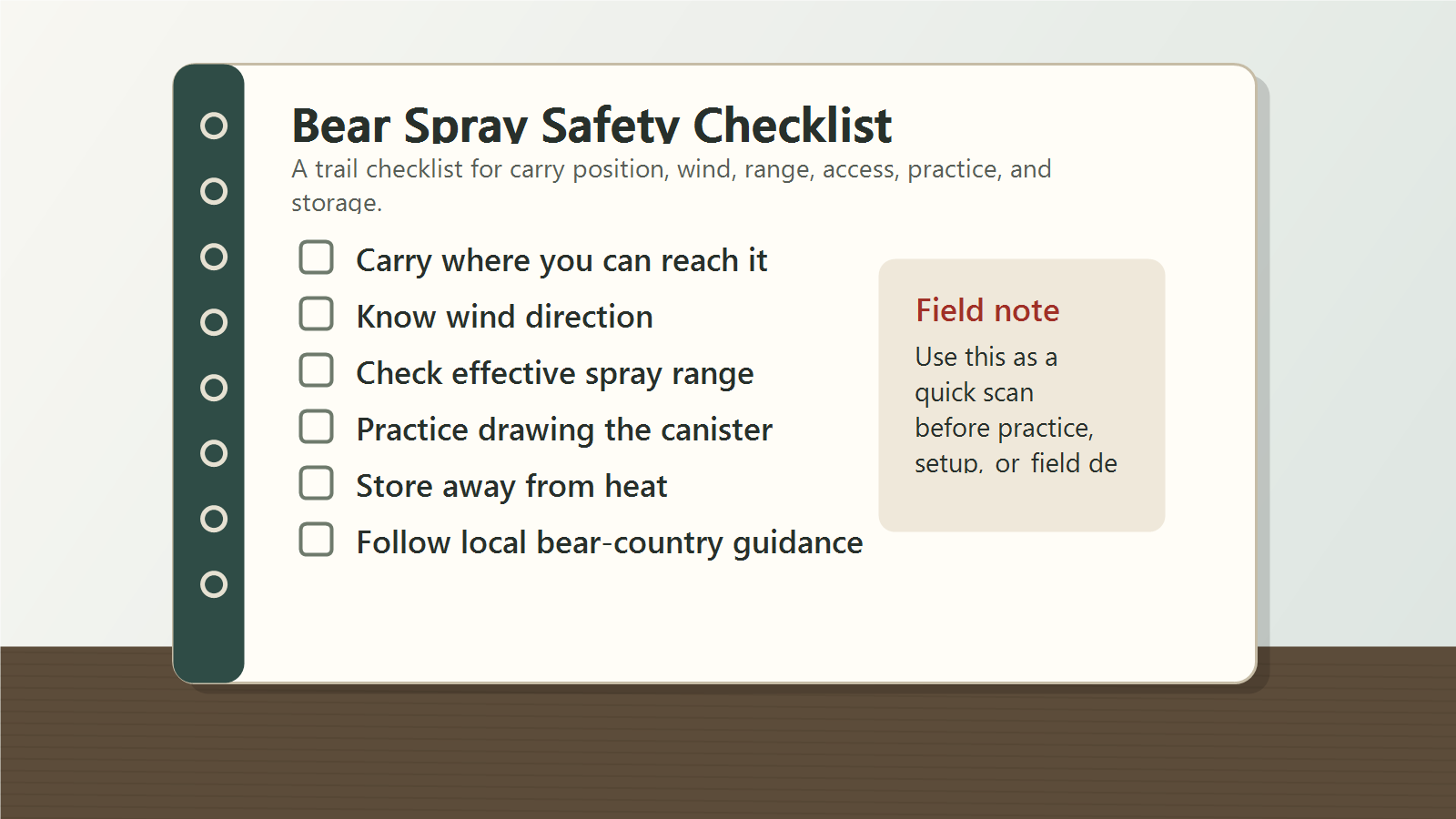
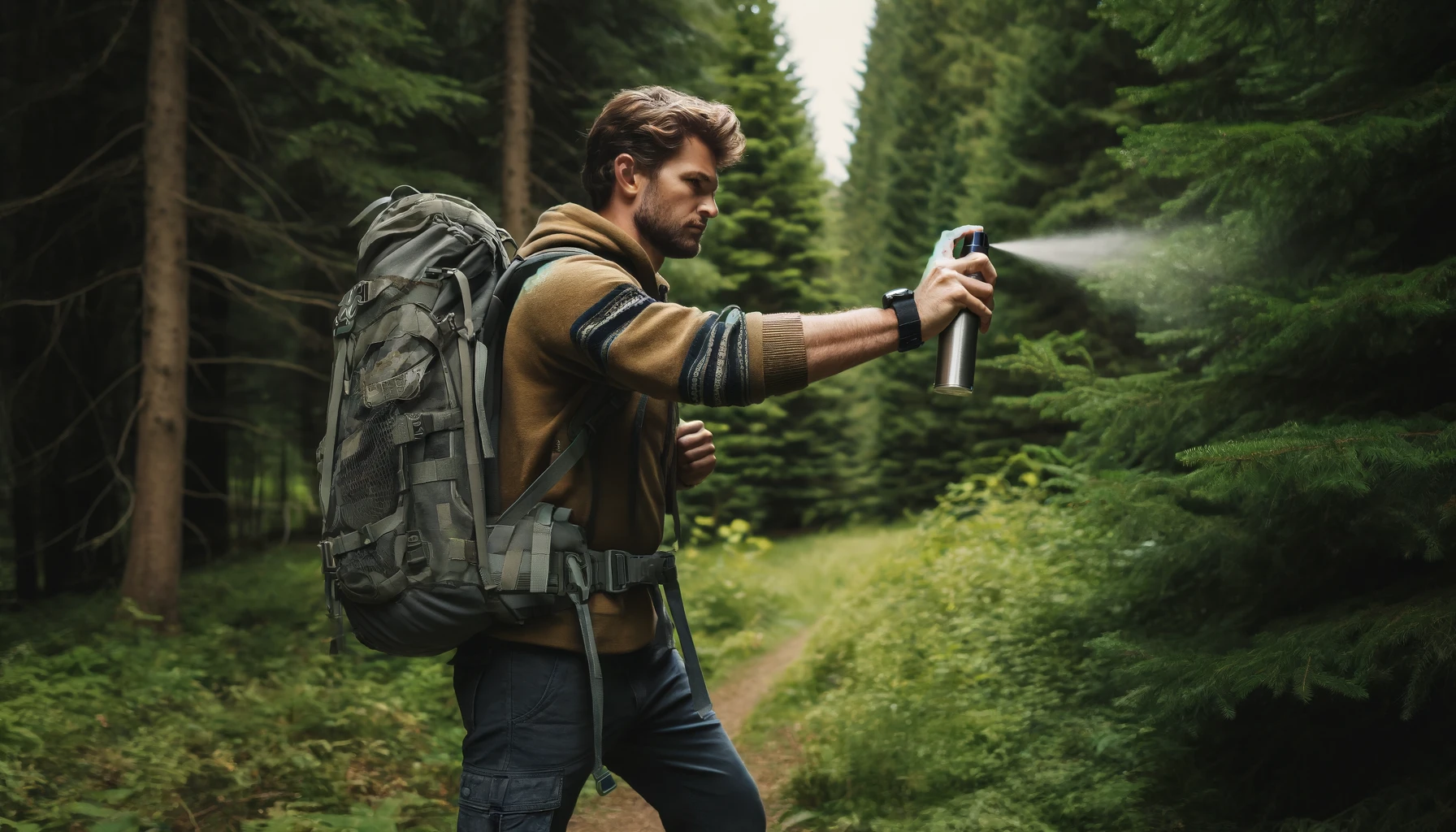
Bear spray works best as a simple, practiced response tool, not a last-minute puzzle. The safest approach is to carry it where you can reach it, know how the safety clip works, understand the spray pattern, and use it only when a bear is close enough that a normal retreat is no longer enough. The National Park Service says bear pepper spray can be an important thing to carry, that it is for defensive use against an aggressive, charging, or attacking bear, and that it is not a repellent for your body or gear. It also notes that park guidance can vary, so local rules matter.
This draft keeps the focus on the field basics: how to wear the canister, how to practice without wasting the live spray, how wind changes the shot, what to do if the spray reaches you, and how park or travel rules can change the plan. The idea is not bravado. It is to make the canister easy to use when your hands are cold, your breathing is fast, and the bear is already close.
Table of contents
What Bear Spray Is For
What it does
Bear spray is a defensive deterrent for an aggressive, charging, or attacking bear. NPS guidance is direct on that point. The goal is to create a painful cloud in the bear’s path so it stops or turns away long enough for you to leave the area. That is very different from trying to push a bear around at a distance, and it is very different from spraying it like a general repellent. The tool is there for the moment when the encounter has already gone wrong and you need a fast, visible barrier between you and the bear.
What it is not
Bear spray is not body spray, camp deodorizer, or a way to make a tent, pack, or food bag smell less interesting. NPS says not to apply it to your body or equipment. It is also not a cure for careless behavior. If food is left out, a pack is dropped in the wrong place, or a bear is surprised at close range, the spray has to do too much work too late. The better use is the one that helps you avoid getting to that point in the first place.
Why access matters more than size
A heavy canister that rides at the bottom of a pack is nearly useless in the seconds that matter. A smaller canister in the right place can be far better than a larger one buried under layers. The main question is not how impressive the can looks on the shelf. It is whether you can reach, aim, and fire it without thinking. The more automatic that motion becomes, the less likely you are to freeze when the moment arrives.
Carry It Where You Can Reach It
Belt or chest carry
Carry the canister where either hand can reach it quickly, and keep the rest of your outdoor safety kit simple enough to manage under stress; our wilderness signaling guide is a useful companion for emergency planning. Belt holsters, chest holsters, and pack strap holsters are common because they keep the spray in front of your body and out of the pack. If you use trekking poles, binoculars, or a camera, think through how those items affect your grab. The right setup is the one that still works when your hands are already busy. If you cannot reach the spray in a single motion, the setup needs to change.
Not in the pack
A canister tucked inside the pack is the wrong answer for a close encounter. You do not want to unzip a pocket, shrug off a shoulder strap, or dig past snacks while a bear is already moving. If the spray is on the outside of the pack, it should still be in a real holster or clip system that keeps it stable and available. A loose can rolling around on a strap is a nuisance. A canister that falls out at the wrong time is worse.
Safety clip check
Every trip should start with a quick check of the safety clip, the trigger, and the holster. You want to know how the lock releases with gloves on, whether the cap is seated, and whether the canister can be drawn cleanly with one hand. That little check is cheap insurance. It also gives you a chance to spot a cracked holder, a bent clip, or a trigger that feels sticky before you are staring at a bear.
Know the Canister Before You Need It
Read the label
Different products can have different spray times, ranges, and triggers, so the canister label matters. Read it before the hike, not on the trail. You want to know the active range, the expected burst duration, and whether the maker recommends any special handling. NPS notes that you should select an EPA-approved product specifically designed to stop aggressive bears. That detail matters because human pepper spray and bear spray are not the same tool.
Practice with an inert canister
Practice with an inert canister if you can get one. That gives you the draw stroke, grip, and aiming motion without wasting the live spray. Practice under the same clothing conditions you expect to wear in the field. Gloves change the feel. Rain sleeves change the grip. A chest strap changes the angle. The first time you figure that out should not be during a real encounter.
Rehearse the motion
Do a few dry runs from the holster to the firing position, then back again. Keep the motion simple: grab, clear, aim, and hold. Do not make the drill fancy. You are not trying to look smooth. You are trying to build a movement that can survive adrenaline. A short rehearsal before a trip can make the real use feel less like guessing and more like a known sequence.
Reset after practice
If you use a trainer canister, reset the habit afterward. Put the real spray back in the same place every time. Reattach the safety clip if it came off. Check that the holster is still oriented the same way it was when you practiced. Consistency is the part that helps under stress. A canister that lives in one place all season is easier to grab than one that seems to drift around your pack and clothing.
Range, Burst, and Wind
Typical range
Range is not a promise. It is a window. Many bear spray products advertise useful distances in the teens or low twenties of feet, but that number assumes decent conditions and a steady hand. In real life, you should think in terms of close range, not long range. The bear has to be near enough that the spray can form a cloud in its path. If you wait until the bear is almost on top of you, even a strong canister becomes harder to use well.
Short burst timing
Short bursts are safer than holding the trigger down until the can is empty. A brief spray gives you more control and leaves room for a second burst if the bear keeps coming. Think in seconds, not in panic. A quick shot into the air or across the bear’s path is usually not the plan. The intent is to build a visible barrier where the bear is headed. If the bear changes direction, your job shifts to getting away, not admiring the spray cloud.
Wind caution
Wind can push the spray back toward you, but it does not make the can useless. It just means you need to think before you fire. Check the breeze on your face and around your ears. If you can, move to a position that puts the wind at your back or side without turning the encounter into a sprint. The older advice that says wind is always a disaster is too simple. The better rule is to know the wind, keep your face clear, and expect some blowback if conditions are rough.
Aim low and forward
Bear spray is usually aimed slightly low and forward so the cloud crosses the animal’s path rather than shooting over it. The goal is not precision in the rifle sense. It is coverage. A bear that is closing ground can move through a spray cloud faster than you might expect, so give yourself a margin. Aiming too high wastes time and material. Aiming too low or too far ahead can leave the bear untouched. A calm, level stance helps more than a dramatic arm swing.
When To Use It
Last resort deterrent
Use bear spray as a last-resort deterrent when the bear is close and the situation is escalating. It is not for nuisance correction, bluffing a bear from afar, or trying to control the animal’s movement in a casual way. NPS says it is used defensively against an aggressive, charging, or attacking bear. That wording is a good guide. The more the moment feels like a possible attack, the more the spray belongs in your hand.
Make space and leave
After the spray does its job, leave the area. Do not linger to see whether the bear has “learned its lesson.” Do not walk closer to check the result. Back away when you can, keep watching the bear, and move toward a safer place with a clear exit. NPS advises that if a bear is stationary, you should move away slowly and sideways and leave the bear an escape route. That same logic applies after spray use. Get distance first, questions later.
Keep calm enough to aim
People often imagine they will yell and wave the can like a flare. In practice, the better response is controlled and simple. Say something in a steady voice if that helps you stay focused. Keep your feet under you. Do not spin, stumble, or throw the can away after the first shot. The canister is still part of the plan until the bear is clearly turning off or you are safely out of the area. A few controlled actions beat a flood of motion.
Do not chase the bear
Once the bear backs off, do not chase it, photograph it, or try to drive it farther away. The point is not to win ground. The point is to end the encounter with as little risk as possible. If the bear returns, be ready to use the spray again, but keep your priorities straight: protect yourself, protect any other people with you, and leave the area as soon as you have a clear path.
Around Camp, Tents, and Gear
Do not spray tents
Do not spray tents as a way to keep bears away. That turns a defensive tool into a contamination problem and can make the shelter miserable or dangerous for the people inside. It also does not solve the underlying issue. If a bear is interested in camp, food storage, scent control, and site choice matter far more than coating fabric with irritant. NPS is clear that bear pepper spray is not a repellent for people or equipment.
Do not treat gear or skin
Bear spray is not a scent shield for boots, backpacks, coolers, or clothing. It should not be applied to skin or used on gear as a protective coating. That kind of misuse can create accidental exposure for you and for anyone nearby. It can also ruin the item and make future handling a problem. If a pack or jacket has been contaminated, treat it like exposed gear, not like a benefit. Clean it, isolate it, and keep it away from food.
Camp habits still matter
Bear spray works best when camp habits are already clean. Store food the right way. Cook away from sleeping areas where required. Keep trash and scented items managed. If a park has rules about canisters, food lockers, bear boxes, or campsite layout, follow them. Spray is there to backstop a good system, not to replace it. A tidy camp lowers the odds that you will ever need the canister at all, which is exactly the point.
If Spray Gets On You
Move upwind and out of the cloud
If the spray blows back, get out of the cloud fast. Turn your face away, move to cleaner air, and keep your hands from rubbing your eyes. The irritant can linger on clothing and skin, so leaving the cloud matters as much as the first reaction. Do not panic and run in a random direction if that sends you deeper into the spray. Pick the clearest air and keep moving there.
Rinse and wash
Wash exposed skin with lots of clean water as soon as you can. If the eyes are affected, rinse them gently and continuously with clean water, and remove contact lenses if you wear them. Contaminated clothing should be changed or bagged so the residue does not spread. The main rule is simple: get the irritant off, get fresh air, and stop touching your face. If you have soap, use it on skin after the first rinse, but water comes first.
When to get help
Get medical help if symptoms are strong, if breathing is hard, if eye pain does not ease, or if the exposure was heavy and prolonged. In a park setting, notify a ranger or visitor center as soon as practical so they can guide the next step. If the reaction seems severe, call emergency services. The spray is designed to irritate, but that does not mean every exposure is minor. Treat it seriously if the response is more than a brief burn.
Decontaminate the area
If you sprayed in camp, think about the area as contaminated until cleaned. Keep food away from the spot. Do not let children, pets, or other hikers wander through the residue. Clean hard surfaces and bag or isolate affected soft goods. If a canister leaked or discharged in a pack, handle the pack carefully so the residue does not spread to your hands, face, or sleeping gear. Slow cleanup is better than spreading the mess around.
Park, State, and Travel Rules
Park rules vary
NPS tells visitors to check with the park before assuming bear spray is recommended or allowed. That advice matters because rules can vary by park, by activity, and by season. Some places want the canister carried in a very specific way. Some backcountry offices will tell you when it is recommended for a route. Some parks will also have their own food storage or campsite rules that matter just as much as the spray itself.
Legal does not mean universal
A product can be legal in one setting and restricted in another. Air travel, border crossings, and some transport systems can each have their own rules. Before a trip, check the carrier, the destination park, and any state or provincial guidance that applies to your route. That is especially important if you are flying with gear, crossing into another country, or shipping equipment ahead of time. A five-minute check can avoid a pointless scramble later.
State and park pages help
Official state and park pages usually explain the local bear pattern better than a generic gear article can. Those pages tell you whether the area has black bears, grizzlies, or both, how active the season is, and what the park expects from visitors. If the park has a bear safety page, read it before you arrive. If the park office says bear spray is recommended, carry it. If the park says to do something differently, follow that local direction.
Before you go
Do not wait until the parking lot to learn the rules. Check the park website, the backcountry office, or the visitor center ahead of time. Make sure the canister is still in date, the holster still works, and the rules at your destination still make sense for your plan. Local guidance is the cleanest way to avoid surprises, and surprises are the one thing you do not want on a bear trip.
Building Good Habits
Make a pre-hike check
Before you leave the trailhead, check the holster, clip, trigger, and label. Confirm that the canister is easy to reach, that the wind looks manageable, and that everyone in the group knows who is carrying what. A short pre-hike check is not fussy. It is what makes the tool feel ordinary instead of mysterious. The less new information you need in the moment, the better your odds of using the spray cleanly.
Practice under stress, lightly
Rehearse while wearing the clothing you expect to use, then rehearse again after a few miles of walking. The point is to see whether the grip still feels right when you are tired or carrying something in the other hand. You do not need to simulate fear. You do need to notice whether the draw is awkward, whether the holster shifts, or whether the canister presses into a hip belt in a bad way. Adjust now, not later.
Reset after every use
After practice, after a campsite drill, or after a real use, reset the whole system. Put the spray back where it belongs. Replace anything that got damaged. Clean residue from the holster if the canister vented or leaked. Write down what worked and what did not while it is still fresh. That little bit of review turns one trip into better habits for the next one.
Keep the plan simple
Simple plans survive stress better than elaborate ones, especially when they match the broader field habits in our survival knife skills and safety guide. Carry the spray where you can reach it. Know the safety clip. Practice with an inert canister. Respect the wind. Use short bursts only when the bear is close and the encounter is turning bad. Leave the area after the spray. That is the core. Everything else is support around that core.
Quick Field Checklist
Before leaving
Confirm the canister is in date, the safety clip works, the holster is secure, and the spray is on your person rather than buried in the pack. Make sure you know the route and the local bear guidance. If you are traveling by air or crossing a border, verify the rules before you pack the canister. That way the first time you think about logistics is not at the gate or at the ranger station.
At the trailhead
Do one last reach check. Close your pack, feel for the canister, and make sure you can draw it with one hand. Remind the group that the spray is for defensive use only and that the plan is to leave if a bear appears. If you are hiking with others, decide who carries the canister, who watches the group, and who will call for help if the encounter goes sideways.
During the hike
Keep the canister accessible, stay aware of the wind, and do not let it slip into the bottom of your pack; the same access-first mindset applies to the essentials in our day hunting pack checklist. If you enter thick brush, loud water, or low visibility, pay even closer attention. Those are the settings where a bear can be close before you know it. If you ever do need the spray, use it with a clear purpose: create space, stop the charge, and move away.
Sources
Official guidance used as source anchors for this draft:
- National Park Service, Staying Safe Around Bears
- National Park Service, Bear Pepper Spray section on Staying Safe Around Bears
- Park-specific bear safety reminder from NPS: check local guidance before you go
- Interagency Grizzly Bear Committee if your local park or agency points you there for bear-spray guidance