How to Hunt Fox Ethically: Safety, Regulations, and Field Basics
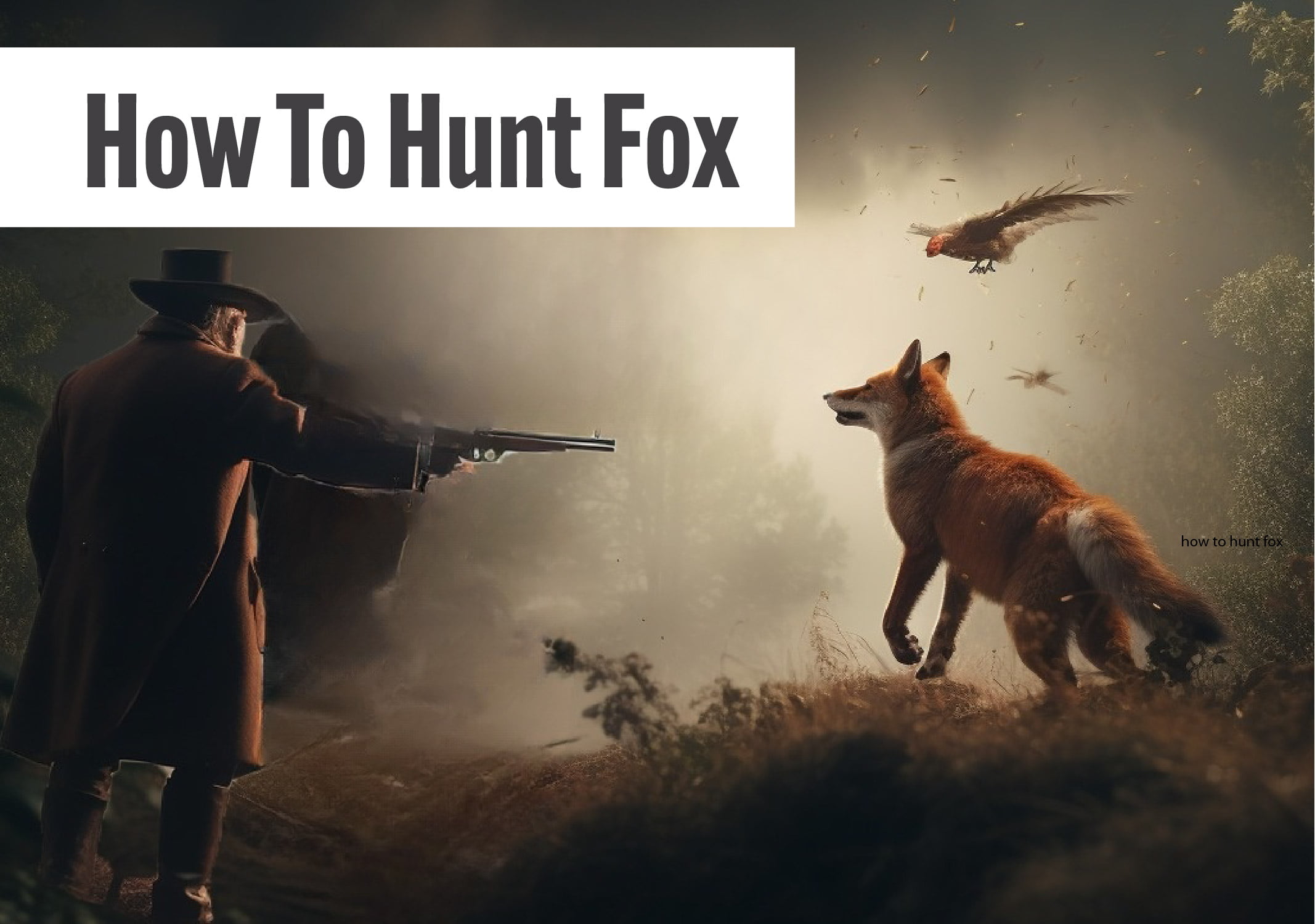
How to hunt fox ethically starts with the law, not the call. Fox hunting sits in a narrow space where species rules, protected populations, land access, time-of-day limits, and disease concerns all matter at once. Before anyone thinks about field tactics, the first job is to identify the animal correctly, confirm the current regulations, and decide whether hunting is legal and appropriate where you are.
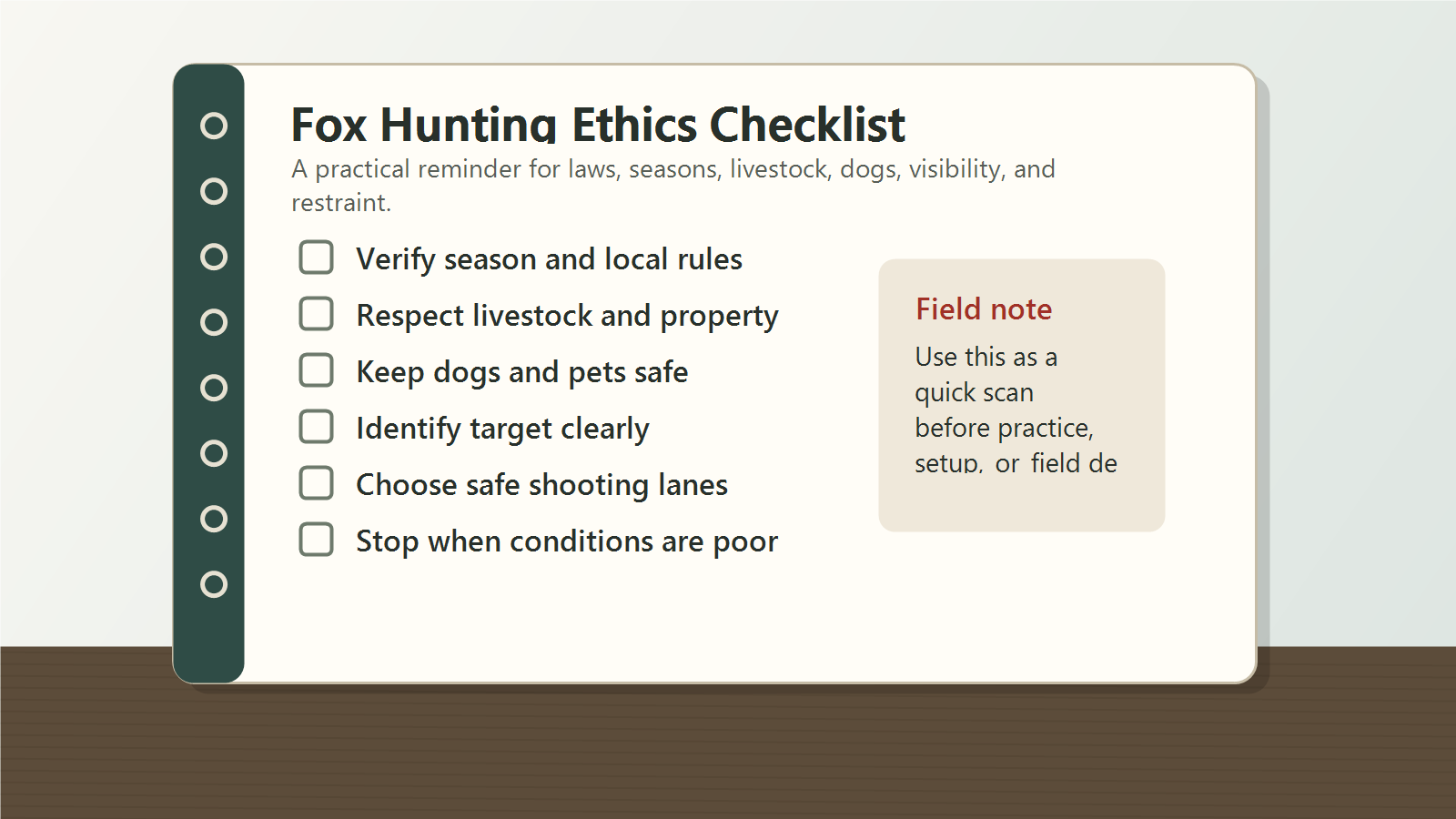
This guide stays on the safe side of the line. It covers legality, fair chase, public and private land, night hunting, lights, electronic calls, dogs, trapping versus hunting, and rabies precautions without getting into harmful field-step details. For a species overview, the U.S. Fish and Wildlife Service pages for the red fox and gray fox are useful starting points, and the Boone and Crockett Club’s Fair Chase Statement is a clean ethics reference.
For health and safety context, the CDC notes that foxes are among the wildlife species most often found with rabies in the United States, and people who hunt are in a higher-risk exposure group. See the CDC’s About Rabies page before any trip where you may handle a sick or abnormal animal.
Table of Contents
Quick Answer
Ethical fox hunting means hunting only where and when foxes are legal game, identifying the exact species and any protected population, using methods allowed by the local season rules, and avoiding anything that turns a hunt into a bad-faith shortcut. That includes checking night-hunting rules, light restrictions, electronic-call limits, dog rules, and land-access conditions before the hunt begins.
What matters most
The most important habit is to slow down before you hunt. If you do not know whether the animal is a legal red fox, gray fox, or a protected fox or canid population, stop and verify. If you do not know the season, stop and verify. If the landowner or state agency has a restriction on lights, dogs, or calls, obey it.
What this guide does not do
This article does not walk through ambush tactics, calling sequences, or shot technique. It is meant to help you avoid legal mistakes, safety problems, and sloppy field judgment. That is the part that matters most anyway.
Know What Fox You Are Dealing With
Fox hunting starts with identification. In the U.S., the two common wild foxes many hunters discuss are the red fox and the gray fox. The U.S. Fish and Wildlife Service pages for Red Fox and Gray Fox are a useful reference point for the scientific names and common names you will see in regulations and reports.
Red fox is not one-size-fits-all
Do not assume every red-looking fox falls under the same legal treatment. State rules can vary, and some fox populations or subspecies may be protected, listed, or managed differently than the everyday game animal language suggests. If a rulebook says to check protected subspecies or special area rules, take that seriously and do not guess your way through it.
Gray fox rules can differ by place
Gray foxes are regulated separately in many states. A unit, county, or season that allows one species may not allow the other, and method restrictions can also differ. That is one reason the species page and the state regulations should be read together, not separately.
Some fox-like animals are not legal game
Do not confuse a fox with a protected canid or a population under special law. On federal lands, in sensitive recovery areas, or in states with unusual listings, the animal in front of you may not be open to harvest at all. The safe rule is simple: if there is any question, do not hunt until you confirm the exact rule.
Start With Law First
The law is the floor, not the finish line. Every fox hunt should start with the current state wildlife regulations, any federal land rules, and any property-specific restrictions from the landowner or manager. The Boone and Crockett Club says fair chase includes lawful pursuit, and its statement also asks hunters to obey regulations, respect local customs, and keep the skills needed for a clean kill.
Check the current season, not last year's memory
Season dates, bag limits, legal methods, and reporting rules can change from year to year. That is true even for species that seem ordinary and common. A fox hunt done from stale memory is how people end up outside the season or on the wrong side of a method rule.
Check whether fox is a furbearer, small game, or predator where you hunt
States classify foxes differently. In one place, fox may be grouped with furbearers and subject to trapping-style regulations; in another, it may be small game or predator hunting with separate rules. That category choice affects license needs, take methods, and closed seasons, so the exact state language matters.
Use a state agency page as a live example
A state agency regulations page is the right place to verify the details before a hunt. For example, the Texas Parks and Wildlife Department’s hunting regulations pages are the kind of official source you should read before any fox hunt: Texas Parks and Wildlife hunting regulations. The page itself may not match your state, but the habit should.
Use Fair Chase as the Ethics Line
Fair chase is the cleanest ethics framework for fox hunting. Boone and Crockett defines it as the ethical, sportsmanlike, and lawful pursuit of free-ranging wild game without giving the hunter an improper or unfair advantage. That does not ban modern gear. It does mean the animal should still have a real chance to detect risk and leave.
Do not turn legality into an excuse
Something can be legal and still feel wrong in the field. If a method leaves no meaningful escape, no chance for the animal to respond, or no room for normal judgment, it may be legal in one place and still be out of step with fair chase. That is especially important when technology, dogs, lights, or bait-like attraction enter the picture.
Respect local customs as well as the rulebook
Boone and Crockett explicitly includes respect for local customs in its ethics statement. That matters on shared ground. Some places expect certain parking habits, certain stand spacing, or special courtesy around access roads and active setups. The law may allow more than the local norm, but the better move is often to stay within both.
Make judgment part of the hunt
Fair chase asks for restraint. If the setup looks off, if identification is weak, if the weather is pushing the animal into unnatural behavior, or if the method would feel like a shortcut rather than a hunt, pass. Restraint is not weakness. It is one of the things that keeps hunting defensible.
Night Hunting, Lights, and Electronic Calls
Night hunting is one of the biggest places where fox rules become state-specific fast. Some states allow night hunting for certain species. Some allow artificial lights only under narrow conditions. Some forbid night hunting except for certain predator or furbearer cases. Do not rely on a general internet answer here. Read the current rule where you are hunting.
Night rules are not universal
A fox hunt that is lawful in one state can be illegal two counties away or across a state line. The most common mistakes involve shooting hours, illumination, and the type of land being hunted. If the rulebook does not clearly allow night hunting for fox, treat it as closed until you have a clear written answer from the agency.
Lights are heavily regulated
Artificial light use is often limited because it can affect identification, fairness, and public safety. Some places allow a specific light type, some require a permit, and some restrict light use to calling predators under narrow conditions. Never assume that because a light can help you see, it is legal to use.
Electronic calls are not always allowed
Electronic calls can be legal in some places and barred in others. Even where allowed, the rule may differ by species, season, land type, or time of day. Read the exact language for fox and for the specific land you plan to hunt. If the rule says no electronic calls, use none.
Do not mix methods by accident
A hunt can become illegal if you combine a legal call with an illegal light, or a legal night season with a prohibited amplified device, or a legal predator method with a land restriction that closes it. Treat the method, the device, the time, and the place as one package.
Dogs, Scent, and Recovery
Dog rules for fox hunting vary more than many hunters expect. In some places, dogs are part of the tradition and are lawful under a defined season. In others, using dogs for fox can be limited, season-bound, or completely barred. If dogs are involved, the rulebook needs to say yes in plain language.
Check dog use before the hunt
Do not assume that because a state allows hounds for one game animal, it allows them for fox. Some states separate fox, coyote, and other furbearers. Some also limit dog use on certain public lands or around livestock areas. Read the current rule and do not improvise.
Keep dog work legal and controlled
If dog use is legal where you are, the ethical duty is still to keep the hunt orderly, safe, and contained. That means staying within the season, avoiding trespass, and preventing the chase from spilling where it should not. Good dog work is disciplined, not chaotic.
Recovery and retrieval matter
Ethical hunting does not end when the animal is hit or downed. If a fox is taken, you still owe the work of confirming what happened, recovering it where legal, and handling the carcass responsibly. If a fox may be sick or acting strangely, do not treat it casually. Back off, avoid contact, and involve the correct authority if needed.
Public Land and Private Land
Land access changes the whole ethics picture. On public land, you are sharing space with other hunters, hikers, land managers, and sometimes neighbors. On private land, your rights come from permission, and permission can be narrower than people like to assume. Either way, do not treat access as a given.
Public land means shared responsibility
On public land, check whether the area even allows fox hunting, whether there are special hunt-unit rules, and whether night use, calling, parking, or artificial lights are restricted. Public land often has more than one layer of regulation, and the site map alone is not enough.
Do not crowd other users
Good public-land conduct means giving other people room, avoiding active setups, and not swinging into an area just because you saw fresh sign. Fox hunting on shared ground works better when hunters act like neighbors, not competitors in a race.
Private land requires clear permission
Private land is not a blank check. Ask for permission, confirm which people may hunt, and understand whether the owner has limits on dogs, vehicles, lights, gates, hours, or guest access. A fox hunt can lose its ethics fast if the access agreement is not respected.
Permission is not the same as a free-for-all
If a landowner says you may hunt fox, that does not mean you may decide the rest on your own. Stay inside the permission given. If the owner did not say you can drive there, use night lights there, or bring extra people, do not assume the answer is yes.
Trapping Versus Hunting
People sometimes blur trapping and hunting because both involve furbearers, but the legal and ethical rules are different. Trapping is a separate activity with its own equipment, placement, checking requirements, and reporting duties. Hunting is not a substitute for trapping regulations, and trapping rules do not automatically authorize hunting methods.
Use the right license category
Some states require a hunting license for hunting fox and a trapping license for trapping fox. Others combine or cross-reference the permissions in different ways. If you are not sure which license you need, do not guess. Read the current state rule or contact the agency before going afield.
Do not borrow trapping logic for a hunt
A legal trap line does not justify hunt behavior, and hunt rules do not justify trap behavior. The same is true for land access. If an area is open to one method, that does not mean it is open to the other. Treat them separately.
Be careful with terminology
In camp talk, people often say they are “fox hunting” when they mean trapping or calling or hound work. Regulations do not care about camp talk. They care about what you actually did. Use the legal term that matches the method you are using.
Rabies, Disease, and Handling
The CDC says foxes are one of the wildlife species most often found with rabies in the United States. It also notes that people who hunt are among the outdoor groups at higher risk of exposure. That means fox hunting is not just a legal question. It is a health question too.
Assume a sick fox is a no-contact situation
If a fox is unusually bold, unsteady, aggressive, or behaving in a way that looks off, do not treat it like a normal field situation. Avoid contact. Keep dogs away. Do not try to handle the animal casually. Rabies is a serious disease, and field judgment matters here.
Use gloves and avoid bare-hand contact
Any time you handle a carcass, use common-sense protection and follow local guidance. Do not touch saliva, broken skin, or suspicious tissue with bare hands. If a bite, scratch, or saliva exposure happens, wash immediately and seek medical advice right away. The CDC says rabies is deadly once symptoms start, but preventable if medical care comes in time.
Keep pets and dogs current on vaccines
Because dogs can be exposed in the field, pet vaccination matters before any fox hunt. The CDC recommends keeping pets up to date on rabies vaccines and staying away from wildlife. That advice is basic, but it is not optional when you spend time around wild canids.
Do not make disease into a camp joke
Foxes are wildlife, not cartoon props, and rabies is not a joke. The serious way to treat wildlife health is to be informed, be careful, and use the proper reporting path when something looks wrong. That keeps you and everyone else safer.
Field Basics Without the Drama
Once the legal and ethical checks are done, fox hunting still rewards quiet discipline. The basics are not glamorous. They are about planning, observation, and self-control. That is also why they work.
Match your plan to the exact legal method
There is a big difference between a daytime hunt on private land, a regulated night hunt on public land, a hound-based hunt in a state that allows it, and a trap-oriented furbearer season. Pick the method that the law allows, then stay inside it. Do not mix in extra tools just because they are handy.
Use the minimum gear that keeps you safe and legal
Bring what you need to identify the animal, navigate the area, recover what you take, and comply with the rules. Extra gear is not a virtue if it encourages carelessness. Good field basics are about precision of judgment, not clutter.
Keep your record-keeping straight
Some states require harvest tagging, check-in, or reporting for fox. Others do not. Either way, it is smart to record date, land type, method, and any unusual conditions as soon as the hunt is over. That makes it easier to stay honest if a question comes up later.
Use solid references before every season
Before opening day, reread the state rules, the relevant public-land page, and the disease guidance. A quick refresher on the Boone and Crockett fair chase statement and the CDC’s rabies overview is worth the time. Those two sources cover the two biggest parts of fox hunting that people often underplay: ethics and safety.
FAQ
Is fox hunting legal in every state?
No. Rules vary by state, season, land type, and species. Some places treat fox as a furbearer, some as small game, and some have special protections or closed seasons. Always read the current state regulations first.
Can I use lights at night to hunt fox?
Sometimes, but not everywhere. Night hunting and artificial light use are heavily state-specific and sometimes land-specific. If the rule does not clearly allow it, do not use it.
Are electronic calls legal for fox hunting?
Sometimes, but not always. The answer depends on the state, the species, the season, and the land you are on. Read the current regulation language and do not assume predator rules carry over to fox.
Can I use dogs to hunt fox?
Only where the law allows it. Dog use is one of the most variable parts of fox regulation, and it can differ by species, season, and land status. Check before you go.
What if I am not sure whether the fox is protected?
Do not hunt it. If identification is uncertain, the ethical answer is to pass and verify the rules later. Protected populations and special subspecies can change the legal status completely.
Why does the CDC matter in a hunting article?
Because foxes can carry rabies and hunters are at higher exposure risk than the general public. If you hunt fox, you should know what to do if you find a sick animal or have a possible exposure.
Conclusion
Ethical fox hunting is mostly about restraint. Know the exact species, confirm the current regulations, respect protected populations, and do not treat night hunting, lights, calls, dogs, or public land as casual extras. The Boone and Crockett fair chase standard, the USFWS species pages, and the CDC rabies guidance all point to the same place: careful hunters are better hunters.
For related reading, see our ethical hunting practices guide and coyote hunting guide for more on legal and field decision-making in predator hunting.