Random Garmin inReach® Mini 2
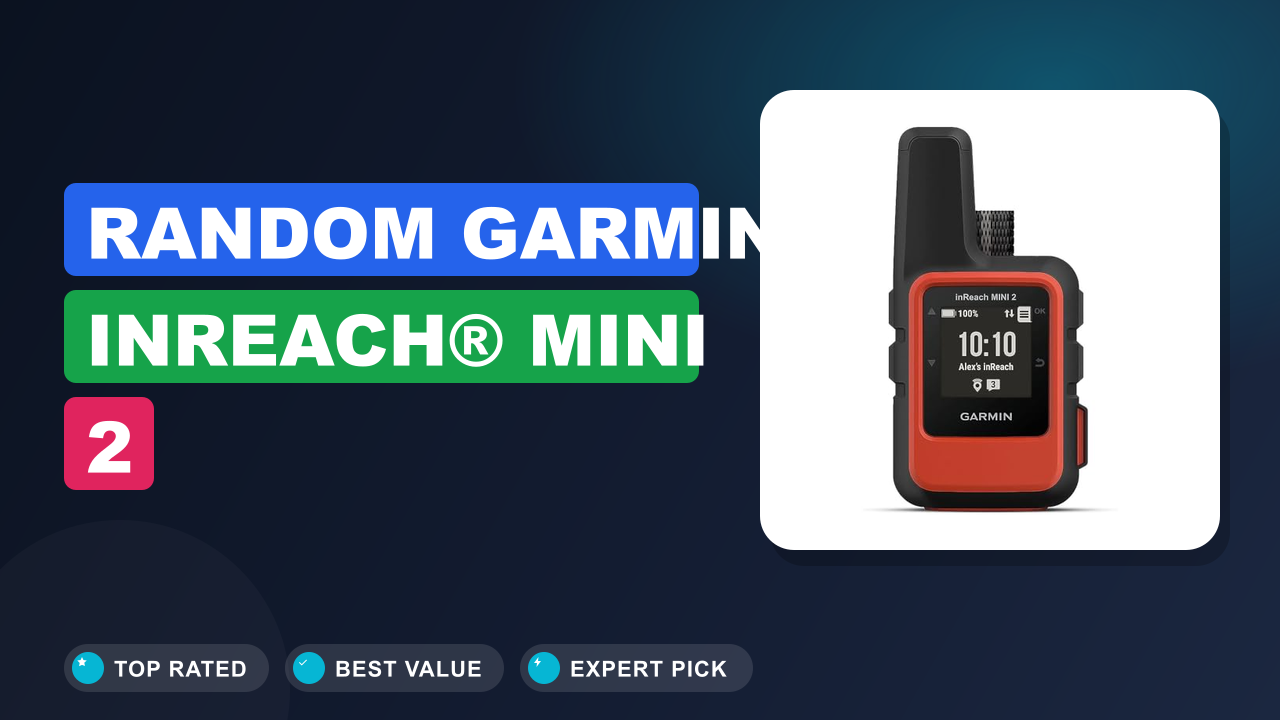
Every backcountry safety thread eventually lands on the same question: is a dedicated satellite messenger still worth carrying now that phones do emergency SOS? That question is exactly why we pulled apart the spec sheet, the subscription terms, and thousands of verified buyer reports on the Garmin inReach® Mini 2, a 3.5-ounce two-way satellite communicator built on the Iridium network.
Short version: it's worth it if you spend real time outside cell coverage and want two-way texting plus 24/7 SOS triage, and it's overkill if you hike busy day-use trails with LTE bars. Here's how it actually performs once the subscription is live.

1. Garmin inReach® Mini 2
We compared the Mini 2 against its own predecessor, its cheaper sibling, and the main third-party messengers on the market, then cross-checked those specs against aggregate buyer feedback. The pattern is consistent: people buy this device once, carry it for years, and mostly complain about the plan cost rather than the hardware.
What it is
A satellite communicator is a handheld device that sends and receives text messages through orbiting satellites instead of cell towers, so it works where there is no coverage at all. The Mini 2 is Garmin's compact entry in that category, running on the Iridium satellite network of 66 low-earth-orbit satellites for genuine pole-to-pole coverage.
It sits between full GPS handhelds like the Garmin Montana and stripped-down beacons. Its direct rivals are the ZOLEO Satellite Communicator, the ACR Bivy Stick, and SPOT X from Globalstar. What separates the Mini 2 is the combination of two-way messaging, interval tracking, and Garmin Response as the round-the-clock rescue coordination service behind the SOS button.
Setup and first impressions
Setup is account-first, not device-first. Verified buyer feedback repeatedly notes the same sequence: create a Garmin Explore account, choose a satellite plan, activate, then pair over Bluetooth. Reviewers who skipped the activation step before heading out reported the exact frustration you'd expect, so plan on doing this at home with Wi-Fi at least a day early.
On physical quality, aggregate reviews are unusually consistent. Buyers describe the orange polymer shell as dense rather than hollow-feeling, with a recessed SOS button under a stiff protective cover that testers say cannot be triggered by pack pressure. The five-button layout uses raised, tactile keys that reviewers say work with light gloves, though not with heavy mittens.
The 0.9-inch monochrome display (176 x 176 pixels) draws the most polarized comments. Users say it's crisp and readable in direct sun where phone screens wash out, but it's small enough that on-device typing is a last resort. Most owners settle into the same workflow within the first hour: message from the phone app, use the device screen for confirmations, battery status, and compass bearings.
| Weight | 3.5 oz (100 g) |
| Dimensions | 2.04 x 3.90 x 1.03 in (5.17 x 9.90 x 2.61 cm) |
| Display | 0.9 in monochrome, 176 x 176 pixels |
| Satellite network | Iridium, 100% global coverage |
| GNSS support | GPS, GLONASS, Galileo, plus digital compass |
| Battery life | Up to 14 days at 10-min tracking, 30 days at 30-min tracking, up to 1 year off |
| Charging port | USB-C (upgraded from micro-USB on the original Mini) |
| Water rating | IPX7 (submersion to 1 m for 30 minutes) |
| Message length | 160 characters per message |
| Subscription | Required; annual or monthly Garmin inReach plans |
Daily-use experience
Messaging performance
A satellite text is not an instant text, and that expectation gap causes most first-week disappointment. Aggregate user reports put typical send times with a clear view of the sky at roughly 30 seconds to 3 minutes, stretching longer under dense conifer canopy or in narrow slot canyons where the sky window is small.
The Iridium constellation's polar orbits are the practical advantage here. Buyers in Alaska, Patagonia, and above the Arctic Circle report successful sends where Globalstar-based units struggled, because Iridium coverage does not thin out at high latitudes.
Messages cap at 160 characters, and the Garmin Explore and Garmin Messenger apps handle composing far better than the device buttons. Preset messages ("Made camp, all good") send free on most plans, which experienced owners use as their daily check-in instead of burning message credits.
Battery and charging
Garmin's published figures give you up to 14 days at the default 10-minute tracking interval and up to 30 days at a 30-minute interval in power-saving mode. Owner reports on week-long trips generally land in that neighborhood, with cold weather being the main variable that pulls numbers down.
Below roughly 20°F, lithium-ion capacity drops measurably, and winter users consistently recommend sleeping with the unit inside your bag liner. Several reviewers describe finishing a five-day snow trip with 40 to 60 percent remaining when they kept it warm, and noticeably less when it lived in an outside pack pocket.
USB-C charging is the quiet upgrade over the original Mini. It means one cable for the messenger, headlamp, and phone bank instead of hunting for a micro-USB cord at 10,000 feet.
Navigation and TracBack
The Mini 2 added TracBack routing, which retraces your recorded track and walks you back along the exact path you came in on. It's a genuine safety feature for whiteouts and after-dark descents, and it pairs with the digital compass so you get a bearing even when standing still.
Set expectations though: there are no basemaps. The screen shows a breadcrumb line and directional arrow, not terrain or trails. Users coming from a Garmin GPSMAP 66i or an Instinct 2X routinely note this in reviews as the biggest functional gap.
Treat navigation here as backup rather than primary. Most owners pair it with a phone running offline maps and carry a paper map, which matches the trip-planning guidance published by the National Park Service for backcountry travel.
Durability and carry
At 3.5 oz and roughly the size of a small energy bar, the Mini 2 disappears on a shoulder strap. The included carabiner clip gets mixed feedback: it holds fine for hiking, but whitewater paddlers and mountain bikers in review threads recommend backing it up with a small tether.
IPX7 means the device survives submersion to 1 meter for 30 minutes, per the IEC ingress protection standard. That covers rain, creek crossings, and an accidental dunk. It does not mean you should tow it behind a raft.
Long-term owners report the polymer housing scuffing rather than cracking after seasons of use, and the button membranes holding up well. The most common physical failure in reviews is the USB-C door seal getting grit in it, which a toothbrush fixes.
✓ Pros
- Iridium network gives true pole-to-pole coverage, so it works at high latitudes where Globalstar units drop out
- 3.5 oz total weight means there’s no honest excuse to leave it behind on a fast-and-light day
- Up to 30 days of battery at 30-minute tracking outlasts any phone-based SOS by an order of magnitude
- USB-C charging shares the same cable as your headlamp and power bank, cutting one cord from the kit
- Garmin Response coordinates SOS 24/7 and can relay two-way details, so rescuers know your injury before they launch
✗ Cons
- Mandatory subscription on top of hardware cost, which stings if you only take three trips a year
- 0.9-inch screen with five buttons makes on-device typing genuinely painful past about 20 characters
- No basemaps at all, so TracBack shows a breadcrumb line without terrain context
- Send times stretch past 10 minutes under heavy canopy or in deep canyons where sky view is blocked
Who should buy it
Buy it if you…
You spend more than about 15 days a year outside cell coverage. That's the rough break-even where the annual plan stops feeling like insurance you never use. Think September elk hunters in Colorado wilderness units, Sierra thru-hikers, sea kayakers on the Inside Passage, and anyone doing solo ski tours.
It's also the obvious pick if you already live in the Garmin ecosystem. A fēnix, Instinct, or epix watch can compose and send inReach messages over Bluetooth, which means you never dig the unit out of your pack. Trip-leader types will also value MapShare, where family follow your track on a live web page.
Skip it if you…
You want one device that navigates and communicates. The Mini 2 deliberately trades the map screen for size, so if you're choosing between this and a full handheld, the GPSMAP 66i or Montana 700i answers both jobs on one battery.
Skip it too if your outdoor time is front-country. State park loops, established campgrounds, and popular day-hike trailheads usually have partial coverage, and modern iPhone and Pixel Emergency SOS via satellite covers the rare gap for free. And if the recurring plan is a dealbreaker, honestly, don't buy hardware you'll leave deactivated in a drawer.
Better alternatives
ZOLEO Satellite Communicator: cheaper monthly plans and a smoother app-based chat experience with a dedicated ZOLEO email and phone number, though it's heavier and has no screen-based navigation at all.
Garmin inReach Messenger: longer battery life (Garmin rates it up to 28 days at 10-minute tracking), lower price, and message-relay over cellular when you have bars. You give up the compass, TracBack, and waypoint tools.
Frequently Asked Questions (FAQ)
Do I really need a subscription, or can I use it without one?
You need an active plan. The Mini 2 cannot send messages, share tracks, or trigger SOS without a subscription, since airtime on the Iridium network is what's actually being sold. Garmin offers annual plans with lower monthly rates plus flexible month-to-month options you can suspend in the off-season, usually with a small activation or reactivation fee.
Check current plan tiers on Garmin's official site before you buy, because features like unlimited messaging sit on the higher tiers.
How fast does an SOS actually get help?
Pressing SOS transmits your GPS coordinates to Garmin Response, a staffed emergency coordination center operating 24 hours a day, 365 days a year. Aggregate incident reports describe first contact from the center typically arriving within a few minutes of a successful transmission, followed by two-way texting so you can describe the injury. Response time on the ground then depends entirely on terrain, weather, and which agency is dispatched.
Coordination is not rescue insurance, so consider adding a search-and-rescue benefit separately.
Does it work indoors, in a car, or under trees?
Not reliably. Satellite communicators need line of sight to the sky, so a roof, a car cabin, or a dense spruce canopy will block or delay transmission. Buyers consistently report that stepping into a clearing and setting the unit antenna-up on a rock or pack lid dramatically improves send times.
The Mini 2's antenna points from the top of the housing, which is why Garmin recommends clipping it to a shoulder strap facing upward rather than burying it in a pocket.
Can I use it with my phone if the phone battery dies?
Yes, and that's a key advantage over phone-only satellite features. The Mini 2 is a standalone device with its own battery, GNSS receiver, and SOS button, so it functions with no phone present. You lose the comfortable keyboard, meaning you'd be scrolling characters on a 0.9-inch screen, but preset messages and SOS still work in one or two button presses.
Many owners program three presets specifically for this dead-phone scenario.
How does the warranty work?
Garmin provides a limited warranty on the inReach Mini 2 covering defects in materials and workmanship, with claims handled through Garmin support rather than the retailer after the initial return window closes. Buyer feedback on Garmin's warranty service is broadly positive, with reports of replacement units rather than repairs for failures like unresponsive buttons. Water damage from exceeding the IPX7 rating and physical impact damage are not covered, so a crushed unit is on you.
Final verdict
Rating: 4.6 / 5
The Garmin inReach® Mini 2 wins for anyone whose margin for error shrinks the moment the bars disappear: solo hunters, alpine tourers, expedition paddlers, and remote-area workers who need a real conversation with a rescue coordinator rather than a one-way distress ping. It also wins for the person at home watching a MapShare dot move, which is a benefit that never shows up on a spec sheet.
It is not the right buy for casual weekenders, and Garmin's subscription model is the one part of the ownership experience buyers consistently grumble about. But at 3.5 ounces with 14 to 30 days of tracking battery and full Iridium coverage, nothing else this small does the job this dependably as of 2026. If your trips regularly leave coverage, this is the easiest safety purchase you'll make.
Affiliate disclosure: This post contains affiliate links. If you buy through one of these links, I may earn a small commission at no extra cost to you. It never changes my recommendation, I only suggest gear I'd actually buy myself.