How to Shoot Skeet Safely: Stations, Lead, Range Commands, and Practice Basics
Table of Contents
Skeet is one of the clearest ways to learn disciplined shotgun handling, because the game is built around a known field, known target paths, and a strict order of fire. That structure is helpful for new shooters, but only if safety stays in front of score. A good round is one where you know where the muzzle is, understand the call for each target, respect the range officer, and leave with the same number of fingers, ears, and eyes you brought with you.
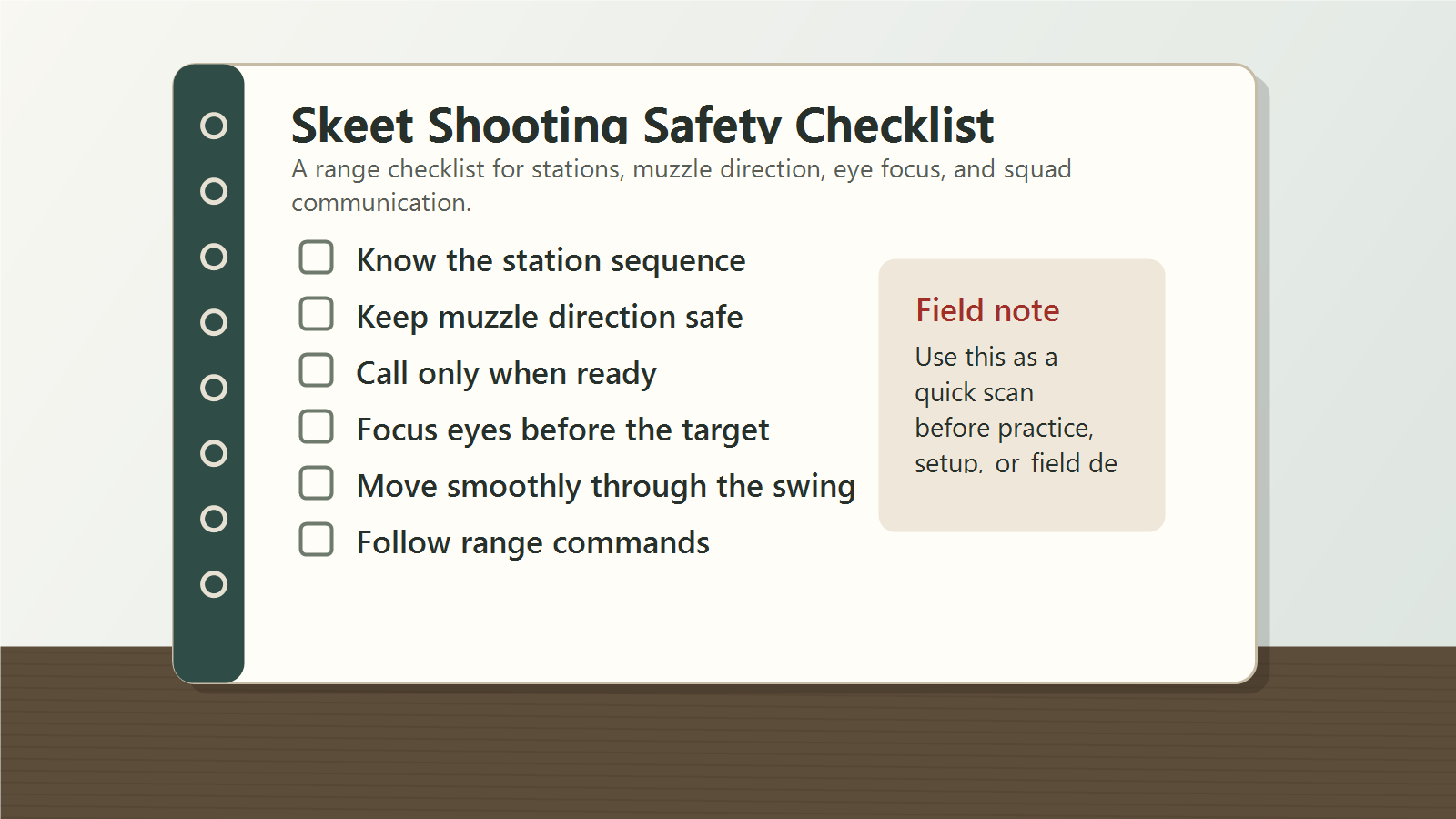
This guide keeps the focus on safe, practical basics, and our trap shooting gear guide gives a companion checklist for another clay-target discipline. It explains the field, the stations, the usual commands, and the simple ideas behind lead and follow-through. It does not promise a score increase, and it does not turn skeet into a trick shot or a defensive skillset. Skeet is a sporting discipline, and the goal here is to help you shoot it cleanly and safely.
Overview
What this guide is for
If you are new to skeet, the first job is not to hit everything. The first job is to learn the rhythm of the field without rushing, guessing, or handling the shotgun carelessly. That means muzzle control, action awareness, listening for commands, and treating every shell and every target call as part of one safe sequence.
What the game rewards
Skeet rewards consistency more than drama. Shooters who mount the gun the same way, call the target with a steady voice, move smoothly, and keep their eyes on the line of flight usually settle in faster than shooters who chase the target or change their routine every shot.
What this guide does not do
This is not a tactical article, a home-defense discussion, or a promise that any stance, choke, shell, or brand will solve every problem. In skeet, there are useful habits and there are unsafe habits, but there is no guarantee that a clean routine will produce instant breaks every time. The game still asks for practice, patience, and a club that follows the rules.
What skeet is and what the field looks like
The basic layout
On a standard American skeet field, the shooter moves through eight stations arranged in a half circle between two trap houses. The high house sits on one side of the field and the low house sits on the other. The layout never feels magical for long, because once you learn the pattern, the field becomes a map of repeatable angles rather than a puzzle.
The target sources
The high house target and the low house target do not behave the same way. They leave from different heights and cross the field on different paths, which is why the game asks you to read angle, not just speed. The important part for a beginner is to understand that the bird is already moving before you fire, so your job is to meet it on a line, not jab at it from behind.
The round format
A round is usually 25 targets. Some are singles and some are doubles, and the order changes by station. The round also includes a repeat shot for the first miss, often called an option in skeet basics, which makes it even more important to stay aware of the sequence. If you lose track of where you are in the round, stop and ask for help before you continue.
Why the pattern matters
People new to skeet often think the sport is about speed. It is really about order. Once you know what each station asks for, you can focus on the target instead of wasting attention on what comes next. That is one reason skeet is such a good learning ground for safe gun handling and repeatable shot timing.
Before you step to the station
Eye and ear protection
Wear eye protection any time you are on the field; our shooting eye and ear protection guide explains why both pieces matter before the first shot. A broken target, shell fragments, dust, and ejected hulls can all become distractions or hazards. Ear protection is not optional either. NIOSH guidance treats 85 dBA as a key occupational noise reference point and uses a 3-dB exchange rate, which is a useful reminder that shotgun noise is not something to take lightly. Double protection, meaning plugs under muffs, is common when the range is especially loud or when a shooter wants extra margin.
Muzzle and action safety
Keep the muzzle in a safe direction at all times, and keep the action open until you are on station and it is your turn. If the gun is open, everyone around you can see that it is not ready to fire. If the gun is closed, people should know exactly why. A closed action should mean you are in position, focused, and under the club’s rules, not wandering around with a live gun in an uncertain state.
Finger discipline and shell discipline
Keep your finger out of the trigger guard until the gun is mounted and you are ready to shoot. Keep shells organized so you are not fumbling for them while watching a target call, because fumbles turn into delays, distractions, and poor gun control. If your club uses a shell pouch or belt, use it the way the club expects so you are not improvising at the line.
What to check on the gun
Before the round, make sure the shotgun is mechanically sound, the bores are clear, the safety functions as intended, and the choke tubes are secure if your gun uses them. You do not need to overthink equipment for a first round. You do need to know the gun is open, unloaded, and ready to be handled in the safe direction until the squad begins.
Clothing and fit
Choose clothing that lets you mount the gun without snagging the stock or blocking the butt from a solid shoulder pocket. A jacket that fights your mount or glasses that slide around can become a real distraction. Good fit is not cosmetic here. It helps you stay in control of the gun and the gun stays easier to manage when the line gets busy.
Range commands and line etiquette
Listen before you move
Every club has its own details, but most skeet lines run on clear commands and clear timing, so it helps to review our shooting range safety rules before joining a new line. Do not assume that a command at one club means exactly the same thing at another. Listen first, watch the squad, and only then step into the routine. If you are unsure, ask the range officer before loading anything.
Typical start commands
You may hear instructions that tell the squad to get ready, load, or make the line hot. The exact words vary, but the message is the same: pay attention now, because firing is about to begin. This is not a moment for side conversations or distracted shell management. It is the moment to settle the gun, set your feet, and focus on the call.
Target calls and response
When it is your turn, call for the target in the way the club expects. Then leave a small pause for the trap to release the bird and for your brain to lock onto the angle. A rushed call often leads to a rushed mount, and a rushed mount often leads to a broken picture before the shot even leaves the barrel.
Stop commands and clear guns
If the range officer calls cease fire, stop immediately. Open the gun, show clear if asked, and keep the muzzle where it belongs. Never assume you can finish a thought or a movement before obeying a stop command. Safety on a shotgun range depends on fast obedience to the person running the line.
Moving between stations
Move with the action open and the gun handled in the direction the club expects. Do not swing the muzzle across other people while stepping from one post to another. The walk around the skeet field should look calm and ordinary. If the walk feels rushed, slow down. The round is not improved by speed between stations.
Stations 1 through 8
Station 1
Station 1 gives you the first chance to read both houses and settle into the round. The target angles are visible and usually manageable, which is why many new shooters like starting here. The key is not to over-aim. Let the target appear, mount cleanly, and keep the barrel moving through the break point instead of freezing on it.
Station 2
At station 2, the angle changes a little and the lesson becomes clearer: the game is about matching the bird’s path, not firing at where the bird used to be. Many shooters feel tempted to speed up because the target seems familiar by now. That is where form tends to slip, so this is a good station to stay deliberate.
Station 3
Station 3 begins to demand more discipline in reading line and distance. The gun does not need to be forced into the shot. It needs to come up smoothly, with your eyes already locked on the target path. If the mount is late, the shot feels rushed. If the mount is early but the eyes are late, the shot feels blind.
Station 4
Station 4 sits near the center of the field and can feel honest in a way beginners respect. The angles are less forgiving of sloppy timing, but the station also helps reveal whether your swing is smooth or jerky. A clean move at station 4 is usually better than a fast one that breaks posture and balance.
Station 5
Station 5 often exposes whether you are looking at the target or at the barrel. The best habit is to trust your mount, keep your eyes on the bird, and resist the urge to make the shot feel busier than it is. A calm body and a simple visual plan usually work better than trying to solve the station with effort.
Station 6
Station 6 asks you to reverse the picture again, and that change is useful because it teaches adaptability. Shooters who do well here usually keep their feet stable and let the upper body do the work. If the gun starts to feel like it is chasing the target, pause mentally and simplify the move.
Station 7
Station 7 can make shooters hurry because they know the round is nearing the end. Do not let that thought pull you out of your routine. The station is just another pair of shots, and the same safety rules still apply. The more ordinary you keep the shot process, the less likely you are to make a small error into a broken rhythm.
Station 8
Station 8 is the center post, and it is where the field feels most symmetrical. The shooter faces the two houses from the middle and learns to manage both directions without drama. For a new shooter, this is a good place to check whether the stance is balanced, the gun mount is repeatable, and the eyes are finding the target quickly.
How the sequence usually runs
American skeet follows a known order. The first pair of stations ask for both singles and doubles, the middle stations use singles only, and the later stations return to doubles before ending at station 8. The exact pattern is worth memorizing, but memorization is not the end goal. The real goal is to know the order well enough that you can focus on safe handling and target reading.
Lead, follow-through, and a calm swing
What lead means in plain language
Lead is the space your shot pattern needs in front of a moving target. In skeet, the target is crossing, so you are not pointing at a fixed point. You are giving the pattern enough room to meet the clay where the clay will be, not where it was. Beginners often think lead is a number to memorize. It is better thought of as a visual relationship that changes with angle and speed.
Why lead is not a guess
Good lead is not random. It comes from seeing the target clearly, mounting the gun consistently, and learning how the shot cloud reaches the line. If you guess wildly, you can sometimes get a break, but you do not build a usable habit. Skeet rewards repeatable sight pictures more than guesswork.
Follow-through keeps the shot honest
Follow-through means the gun keeps moving after the shot breaks. That sounds small, but it matters because many misses happen when the shooter stops the barrel at the moment of firing. A stopping gun can turn a good sight picture into a skim or a miss. If the target is broken, keep the movement going for a beat before you reset.
Mount before you shoot
Mounting the shotgun cleanly is part of the shot, not a separate step. A consistent mount places your eye in the same relation to the rib every time, which helps the gun print where your eyes are looking. If the mount changes from shot to shot, the lead picture changes too, and the shooter starts chasing the target instead of reading it.
Keep the move smooth
Skeet does not need a violent swing. It needs a smooth one. Smooth means the muzzle tracks the bird without bobbing, stopping, or lunging ahead. A smooth move also helps your body stay relaxed enough to notice where the target is going. That calmness matters more than people expect, especially when the field and the squad are moving quickly.
Practice round basics
Start with one clear goal
Do not try to fix everything at once. Pick one thing to improve, such as a cleaner mount, better timing on the call, or a calmer follow-through. Trying to change every part of the shot at once usually leaves a beginner with a confused round and no clear lesson to keep.
Use the first rounds to learn the field
The first few practice rounds are for information, not ego. Learn where you tend to rush, where your eyes leave the target, and whether your stance is balanced when the doubles start. When you know your own habits, practice becomes much more useful because it has something specific to correct.
Ask for coaching with specifics
If an instructor or experienced squad member offers help, ask for one specific observation. A useful comment might be about mount height, head position, or timing. Vague advice often turns into confusion. Specific advice gives you something you can feel on the next station.
Take breaks before fatigue shows up
Fatigue changes posture, slows focus, and invites shortcuts in gun handling. If your shoulder is sagging, your feet are wandering, or your mind is drifting between targets, take a break. A short reset is safer and more useful than pushing through a round while your form falls apart.
Score matters less than the repeatable habit
A decent practice session is one where you leave with a better routine, even if the score did not move much. That is not a soft excuse. It is how people improve in a sport where the same field can punish tiny inconsistencies. There is no guarantee that a better habit will show itself immediately on the score sheet, but it is still the path worth taking.
Common beginner mistakes
Watching the gun instead of the target
One of the easiest ways to lose a target is to stare at the barrel. The eye should stay with the clay. The barrel should be where the eyes send it. If you notice yourself checking the muzzle, reset your focus before the next call.
Breaking the mount into pieces
Some beginners lift the gun, stop, think, and then finish the mount. That pause can make the shot feel disjointed. A better pattern is to move from ready position to mount in one simple motion, then let the shot happen without extra thinking once the target is in view.
Standing too rigidly
A locked-up stance makes it harder to swing cleanly. You do not need to dance around the station, but you do need enough balance to move the upper body without fighting your feet. A stance that is too stiff often makes the target seem faster than it really is.
Overholding the gun
Holding the gun on line for too long before the call can create tension in the shoulders and neck. That tension tends to show up as a harder mount and a poorer follow-through. A relaxed ready position is usually more useful than a strained one.
Ignoring the doubles order
Doubles add another layer of timing, and beginners sometimes forget which bird comes first. That is normal, but it is also why you should know the station order before the round starts. If you are unsure, stop and confirm rather than forcing a guess on the line.
Hearing, vision, and field hygiene
Why hearing protection stays on
Shotgun blast is short, sharp, and loud enough to matter over time. NIOSH guidance on noise makes that clear, and skeet shooters should treat hearing protection as ordinary field gear, not a sign of overcaution. If you leave the field with ringing ears, that is a warning sign, not a badge of honor.
Why eye protection matters every time
Eye protection should stay on for the whole round, not just for the first few stations. The target fragments can come back in odd ways, and tiny bits of debris are easy to underestimate until they hit your face. Good glasses are simple, but they are one of the easiest parts of a safe setup to ignore when people get comfortable.
Lead and residue awareness
Shotgun sports can create residue, so washing hands after a session is a sensible habit. Do not eat with unwashed hands after handling shells or touching the field equipment, and avoid letting dust or residue ride home on gloves or clothing longer than needed. A little routine here keeps the sport cleaner for everyone.
Keep the field tidy
Pick up hulls, respect the squad’s space, and leave the station the way you found it or better. A tidy station helps everyone move more safely. It also makes it easier to notice if something unusual is on the ground where it should not be.
Use club rules as the final word
Club rules, match rules, and the range officer’s direction always outrank a general article. If a local rule is stricter than what you read here, follow the local rule. That is not a burden. It is how a shared shooting field stays orderly and safe.
What steady progress looks like
Better shots look calmer
When a new shooter starts improving, the change usually looks calmer before it looks stronger. The gun mount gets more even, the call gets less rushed, and the eyes stop chasing the clay. That calmness matters because it is repeatable across stations and across different days at the club.
Better rounds have fewer surprises
A useful round is one where you can explain what happened. You do not need to be perfect, but you should know why you missed when you miss. Maybe the mount was late, maybe the head lifted, maybe the lead was off. That kind of honest feedback is more valuable than pretending every miss is random.
Instruction helps, but routine helps too
Lessons and coaching can move you forward, but your own routine does a lot of the daily work. A simple pre-shot routine, a stable stance, and a clean follow-through can keep the round from drifting. You do not need a complicated system to become competent. You need a safe one that you can repeat without strain.
Consistency beats urgency
If you only remember one idea from this guide, make it this: consistency beats urgency. The sport will still be there after this target, after this station, and after this round. Taking a little extra care with the gun, the commands, and your own timing is what makes skeet worth coming back to.
Sources
Official skeet basics and rule-book anchors:
Safety anchors: