Random PRIMOS Hunting Turkey Box Call 259
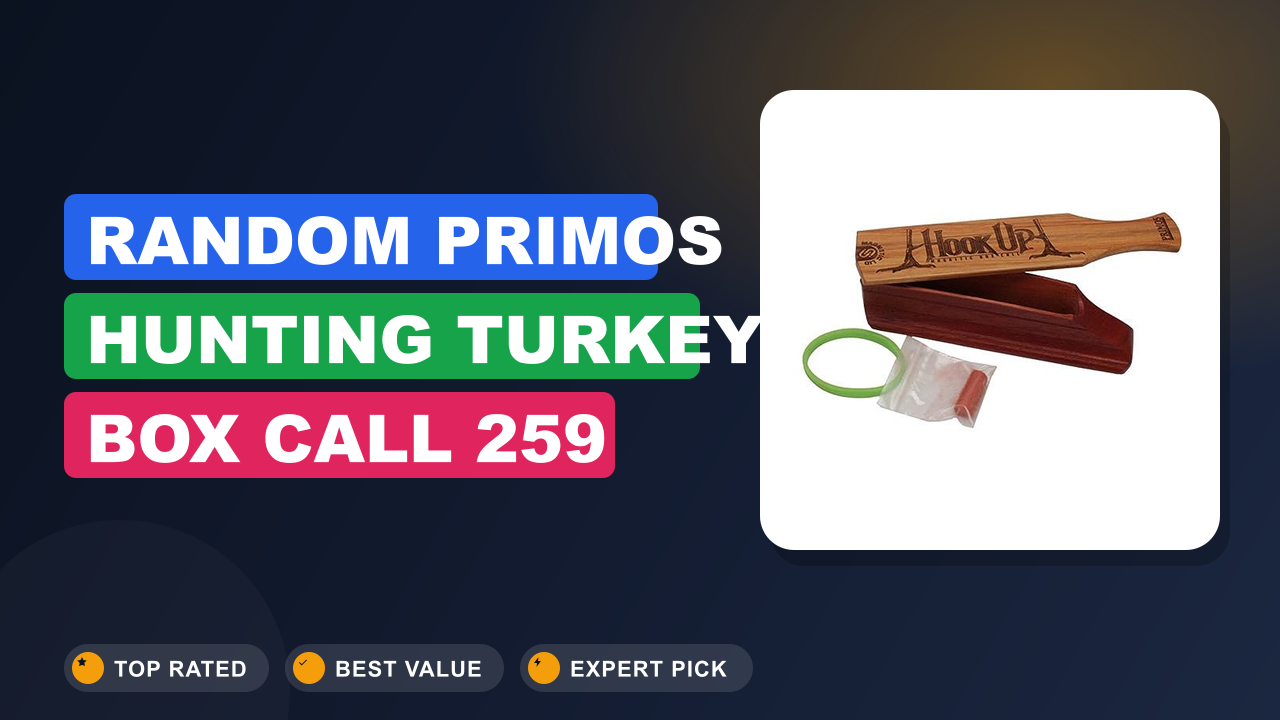
Every spring, a familiar question shows up in turkey camp: can a box call really be run with one hand when a gobbler is closing at 60 yards? That's the exact problem the PRIMOS Hunting Turkey Box Call 259 was built around, using a magnet instead of a screw-and-spring hinge to hold the paddle against the box.
Our team dug through hundreds of verified buyer reports, Primos manufacturer documentation, and comparisons against other friction calls to sort out where it earns its keep. Short version: it's worth it if you hunt from a run-and-gun setup and want loud, forgiving hen yelps without fussing over hinge tension. Skip it if you're chasing subtle, custom-call tone.
Here's the full breakdown.

What it is
A box call is a friction turkey call: a hollow wooden box with thin sidewalls and a hinged paddle lid that scrapes across those walls to imitate hen turkey vocalizations. The Primos Hook-Up 259 is a two-sided version, meaning each sidewall is tuned slightly differently so you can move from raspy hen yelps to higher-pitched cutting by switching sides.
Its signature feature is the magnetic hinge. Instead of a screw and rubber band controlling paddle tension, a magnet pulls the lid back onto the rail, which is why it can be run one-handed.
For context, Lynch, Quaker Boy, and Woodhaven Custom Calls all sell strong box calls in nearby tiers. Primos sits in the mass-market lane: consistent, loud, and easy to learn.
Setup and first impressions
Aggregate buyer feedback across Amazon and outdoor retailer listings points to the same first reaction: it works right out of the package with no tuning. Primos ships the call pre-chalked and pre-tuned, and reviewers consistently report getting recognizable yelps within the first five to ten minutes, which is not typical for friction calls in general.
The touch points read as "solid mid-tier" rather than heirloom. Verified buyers describe a clean hardwood body with a smooth brown finish and no rough edges, but several note the lid and box grain don't match the hand-finished look of a $150 custom call from a small maker.
The magnet is the detail people mention most. Reviewers repeatedly describe carrying the call loose in a vest pocket and finding the paddle still seated instead of flopped open and clacking against gear.
One recurring first-hour complaint: the paddle can feel "grabby" until the chalk settles in. A few light passes usually smooths it out.
| Model | Primos Hunting Turkey Box Call 259, Hook-Up Magnetic |
| Call type | Two-sided friction box call (paddle over open box) |
| Hinge system | Magnetic lid retention, no rubber band or spring tension |
| Sounds produced | Yelps, clucks, purrs, cutts, and gobbles |
| Material and color | Hardwood body and paddle, brown finish |
| Operation | One-handed, works right or left handed |
| Conditioning | Ships pre-chalked; maintain with non-oil-based box call chalk |
| Wet-weather rating | None; friction surfaces must stay dry to sound correct |
| Skill level | Beginner to intermediate |
| Target subspecies | Eastern, Osceola, Rio Grande, and Merriam’s wild turkey |
Daily-use experience
Sound quality and range
Box calls are the loudest friction calls in a turkey vest, and volume is the Hook-Up's headline strength. Buyer reports from open-timber Eastern hunts and Rio Grande country in Texas consistently describe locating gobblers at several hundred yards on a windy morning, which is exactly the job a slate or diaphragm call struggles with.
The two-sided design matters here. One rail produces the raspier, lower two-note hen yelp; the other pushes brighter and cuts harder, which is what you want for aggressive cutting sequences at a hung-up bird.
Where it loses points is at conversational volume. Several reviewers note that soft clucks and purrs under 20 yards take practice, because the paddle wants to bite rather than whisper.
One-handed operation
The magnet is the reason this call exists, and per Primos manufacturer documentation it's designed so the paddle stays "hooked up" to the box without a hinge screw. Practically, that means you can grip the box in your off hand, run the paddle with a thumb, and never break your gun mount.
Verified buyers describe this as the difference between calling and getting busted. Turkeys pick up motion at surprising distances, and a two-handed call reset is exactly the movement that flares a strutter at 40 yards.
The trade-off is control. A screw-tensioned call lets you dial paddle pressure to your preference. Here you get what the magnet gives you, and a handful of reviewers describe wanting slightly more drag for softer notes.
Build quality and durability
The 259 is built as a working call, not a display piece. Hardwood construction with a sealed brown finish holds up to vest carry, and long-term reviewers commonly report multiple seasons of use with no cracking at the rails.
The magnet itself draws the most durability questions. Aggregate feedback shows it holding tension well, though a small minority of buyers report the paddle seating slightly off-center after heavy use, which changes tone until you reseat it.
Compared to a Lynch World Champion box, the Primos feels lighter and less dense in hand. Compared to typical sub-$30 big-box calls, it's a clear step up in finish and consistency.
Maintenance and weather
Friction calls live and die on surface condition. Chalk the paddle with non-oil-based box call chalk every few hunts, and never touch the rails or paddle face with bare oily fingers, because skin oil kills friction fast.
Rain is the real enemy. This call has no waterproofing, and wet wood goes silent or squeaks. Experienced buyers pair it with a waterproof pot call or a diaphragm as a backup, and carry the box in a zip bag on wet mornings.
Storage matters too. Keep the paddle seated and store it dry at room temperature so the wood doesn't swell and change pitch between seasons.
✓ Pros
- Magnetic hinge holds the paddle seated, so you call one-handed and keep the shotgun mounted
- Two-sided rails give you raspy yelps on one side and sharp cutting on the other without carrying two calls
- Loud enough to locate gobblers across a ridge on windy mornings when slate calls disappear
- Ships pre-chalked and pre-tuned, so beginners get usable yelps in the first ten minutes
- No rubber band or hinge screw to snap, lose, or retune in the dark at 5 a.m.
✗ Cons
- Soft clucks and purrs under 20 yards take real practice, since the paddle wants to bite
- Zero weather protection, and wet wood goes flat or squeaks until it fully dries
- Fixed magnet tension means you can’t dial paddle drag the way a screw-hinge call allows
- Tone is good but generic next to hand-tuned custom boxes, which matters on pressured public-land birds
Who should buy it
Buy it if you…
You hunt big timber or open country and cover ground, striking every ridge and field edge looking for a gobble. That's where box-call volume beats everything else in the vest, and where one-handed operation earns its price.
It also fits the hunter who has tried a diaphragm call and hated it. Mouth calls have a real learning curve, and plenty of people gag or can't hold the reed. The Hook-Up gets you a convincing hen yelp fast.
Youth hunters and first-season adults benefit most, since Primos pre-tunes the call at the factory and you're not diagnosing tension problems in the dark.
Skip it if you…
You mostly hunt small, pressured public tracts where birds have heard a thousand box calls by the second week of the season. In that scenario, hunters commonly report better results with a soft slate or a hand-tuned custom box that produces a less familiar tone.
Skip it too if your season runs wet. Coastal spring hunts and Pacific Northwest conditions punish untreated wood, and a call that goes silent in a drizzle is dead weight.
And if you've already got a Woodhaven or Zink box you trust, this isn't an upgrade. It's a different tool, built around convenience rather than tone refinement.
Better alternatives
Lynch World Champion 102: a dense, old-school box with legendary raspy Eastern hen tone, and a favorite among hunters who value sound character over one-handed convenience.
Woodhaven Custom Calls Cherry Classic Box: hand-tuned by a custom shop, with a cleaner, more nuanced two-note yelp that works better on educated birds late in the season.
Primos Power Crystal pot call: if rain is your main problem, a crystal-over-glass surface keeps working when wet wood quits, and it pairs well as a close-range backup.
Frequently Asked Questions (FAQ)
Do you need to chalk a Primos box call?
Yes. Box call chalk is a non-oil-based compound that increases friction between the paddle and the sidewall so the wood grips and releases in a controlled stutter, which is what creates the yelp. Primos ships the 259 pre-chalked, so you can hunt it immediately, but plan on re-chalking the paddle underside every few outings.
Never use blackboard chalk or anything oil-based, because oil kills friction permanently on some surfaces.
Can beginners actually use a box call?
Box calls are widely considered the easiest turkey calls to learn, and the 259 is a fair example. The basic hen yelp is a short, rocking stroke of the paddle across the rail, and most new users get a recognizable two-note yelp within a single practice session. The harder skills are cadence and volume control, not tone production.
The National Wild Turkey Federation publishes calling basics worth reviewing before opening day.
Is the magnet strong enough to hold in a vest?
Verified buyer feedback consistently reports the magnet holding the paddle seated during normal vest carry, walking, and truck rides. That's the whole point of the Hook-Up design: no rubber band to snap and no loose lid clacking as you move. A minority of long-term users note the paddle can seat slightly off-center after heavy seasons, which changes tone until you realign it.
It's a quick fix, not a failure.
Will it work on Merriam's and Rio Grande birds, not just Easterns?
Yes. Wild turkey vocalizations are broadly similar across subspecies, and the same yelps, cutts, and clucks work on Eastern, Osceola, Rio Grande, and Merriam's turkeys. What changes is presentation.
Western birds in open country often respond to louder, more aggressive cutting, which suits a box call well. Eastern birds in tight timber usually want softer, less frequent calling, so dial your volume to the terrain rather than the subspecies.
How do you keep it quiet while walking in?
Two habits handle it. First, the magnet already prevents most accidental paddle movement, unlike screw-hinge calls that swing freely. Second, many hunters slip a thin strip of hook-and-loop or a purpose-made box call silencer between the paddle and rail during the walk in, then pull it once they set up.
A soft neoprene pouch does the same job and adds moisture protection.
Final verdict
4.4 out of 5 stars. The Primos Hook-Up 259 solves a real, specific problem: it lets you call loud and call one-handed without a hinge screw, a rubber band, or a flopping paddle giving you away. Details on the current lineup are available on the Primos Hunting site.
The hunters who win here are run-and-gun public-land hunters who need reach, and newer hunters who want a call that sounds like a turkey in week one instead of week six.
It's not the most refined-sounding box on the market, and it won't survive a rainy morning without help. But as a loud, dependable locator and closer that you can work with one hand while the gun stays up, it does the job it was designed to do at a fair value.
Affiliate disclosure: This post contains affiliate links. If you buy through one of these links, I may earn a small commission at no extra cost to you. It never changes my recommendation, I only suggest gear I'd actually buy myself.