HOLOSUN 510C Multi-Reticle 2 MOA Dot
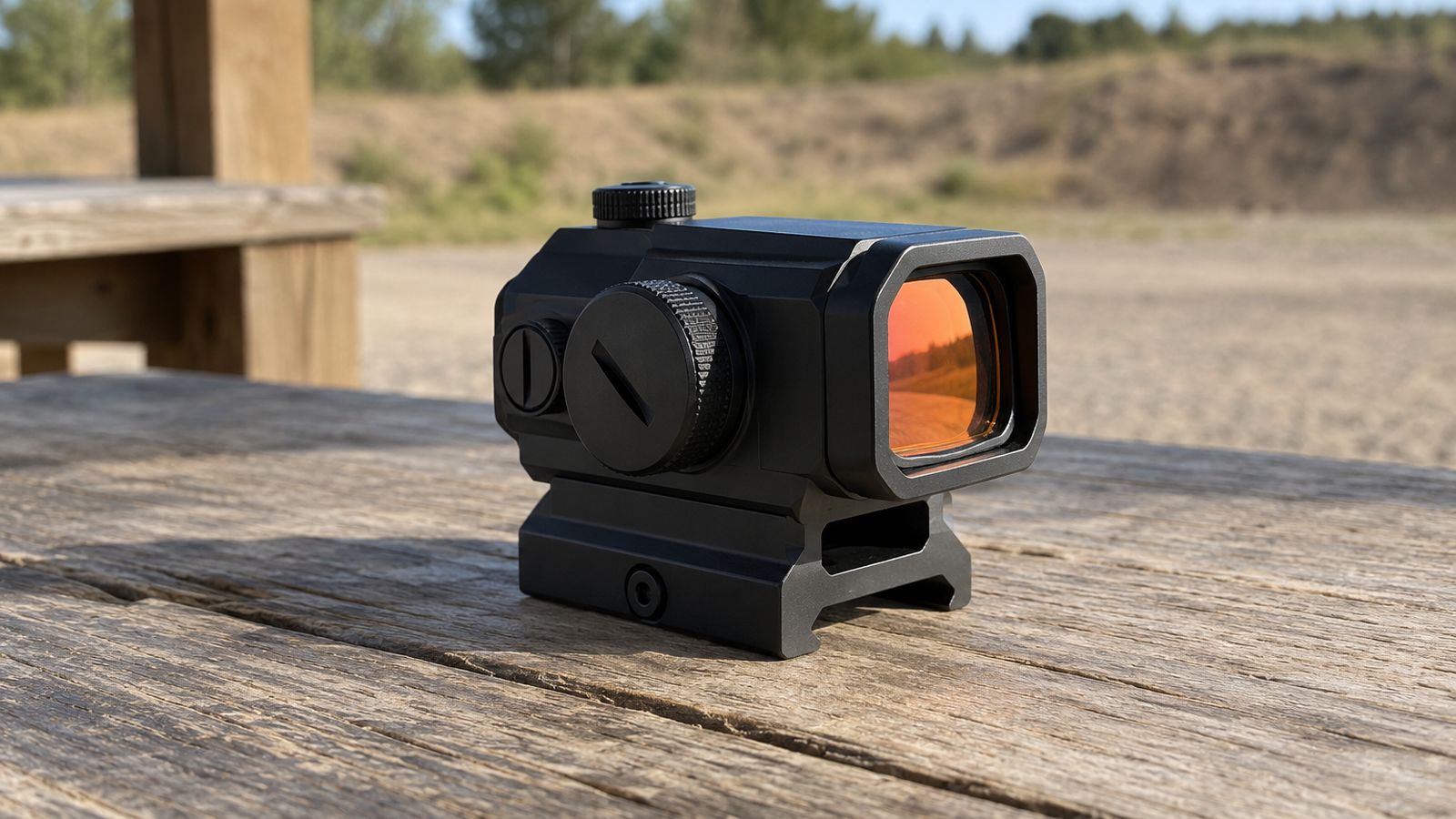
Somewhere between the first AR build and the third one, most shooters hit the same wall: the irons work, but target acquisition is slow. That's the exact question that pushed our team to dig into the HOLOSUN 510C Multi-Reticle 2 MOA Dot & 65 MOA Circle open reflex sight, an optic that keeps showing up on duty guns, 3-Gun rigs, and truck carbines alike. We pulled manufacturer specs, warranty terms, and hundreds of verified buyer reports to figure out whether the hype holds.
Short version: it's worth it if you want a wide-window circle-dot with solar backup and you're not willing to pay Aimpoint money. Skip it if you need a sealed, fully enclosed emitter for heavy rain or dusty duty use. Here's the full breakdown.

What it is
An open reflex sight is a non-magnified optic that projects an illuminated aiming point onto a single coated lens, so your eye can stay on the target instead of hunting for a front post. The HOLOSUN 510C sits in the large-window open reflex class, competing directly with the Trijicon MRO HD, the Sig Sauer ROMEO5 XDR, and the EOTech EXPS2 holographic sight.
What separates it is HOLOSUN's Multi-Reticle System (MRS): one button cycles between a 2 MOA dot alone, a 65 MOA circle alone, or both together. Add the titanium hood, the integrated quick-release mount, and a solar panel that keeps the reticle lit if the battery dies, and you get a duty-adjacent feature set at a mid-tier price.
Setup and first impressions
Verified buyer feedback is remarkably consistent on one point: the 510C feels heavier and denser in the hand than its weight suggests. That's the 7075-T6 aluminum body paired with the titanium hood, a combination reviewers repeatedly compare favorably against polymer-shrouded budget dots.
Mounting is close to tool-free. The integrated quick-detach lever clamps to any MIL-STD-1913 Picatinny rail, and manufacturer documentation specifies a lower 1/3 co-witness height with standard AR-15 iron sights. Aggregate reports from buyers who removed and re-mounted the optic between rifles say the return-to-zero shift stayed within roughly 1 to 2 MOA, which is fine for a general-purpose carbine and not fine for precision work.
Zeroing takes maybe fifteen rounds. Windage and elevation adjust at 1 MOA per click with audible, tactile detents, and the total adjustment range is ±50 MOA in both axes. One consistent gripe in review data: the tiny included hex tool is easy to lose, so keep a 1/16-inch Allen key in your range bag as backup.
| Reticle | 2 MOA dot, 65 MOA circle, or circle-dot (red) |
| Window size | 0.91 x 0.63 in (23 x 16 mm) |
| Brightness settings | 12 total: 10 daylight, 2 night-vision compatible |
| Battery | CR2032, side-loading tray, up to 50,000 hours |
| Power backup | Solar Failsafe panel + Shake Awake motion activation |
| Housing material | 7075-T6 aluminum body, titanium hood |
| Adjustment | 1 MOA per click, ±50 MOA total travel |
| Weight | 4.94 oz (140 g) with QD mount |
| Length | 3.3 in (84 mm) |
| Water resistance | IP67 rated (1 m submersion, 30 minutes) |
1. HOLOSUN 510C Multi-Reticle 2 MOA Dot
Across the review data our team analyzed, the 510C occupies an unusual spot: it's the optic people buy after they've outgrown a budget dot but before they can justify a duty-grade Aimpoint. The circle-dot reticle and solar backup are the two features that keep coming up as the reason buyers picked it over cheaper alternatives.
Daily-use experience
Reticle performance and speed
A 65 MOA circle subtends roughly 65 inches at 100 yards, which is why it functions as a torso-sized "catch me" ring at close range. That geometry is the whole argument for circle-dot optics, and shooters who run steel drills report the ring finds the target faster than a bare dot when the gun comes up off-angle.
The 2 MOA dot is the precision half. At 100 yards it covers about 2 inches of target, tight enough for reduced-size silhouettes without blotting out a groundhog-sized aiming point. Reviewers running the dot-only mode past 200 yards say it stays usable, though the parallax-free lens does show a slight blue tint typical of coated reflex glass.
The honest caveat from review aggregate: shooters with astigmatism describe the dot as a comet or starburst rather than a circle. That's an eye issue, not a defect, but it affects a meaningful slice of buyers.
Brightness and low-light behavior
Twelve brightness settings sounds like marketing until you use the two night-vision levels. Settings 1 and 2 are invisible to the naked eye and designed to pair with a PVS-14 or similar Gen 3 image intensifier, which is a feature most sub-premium dots skip entirely.
At the top end, the daylight settings hold up against snow glare and bright desert conditions in buyer reports, though a handful note the 510C's brightest setting sits slightly below an EOTech's peak output. Under overhead range lighting or in a wooded treeline, most shooters land on settings 6 through 8.
The solar panel handles this automatically in "auto" mode, dimming and brightening as ambient light changes. Manual mode is one button press away when you want a locked-in level.
Battery, solar failsafe, and Shake Awake
HOLOSUN rates the CR2032 at up to 50,000 hours, which works out to roughly 5.7 years of continuous runtime at moderate settings. The side-loading tray is the underrated detail: you swap the cell without breaking zero or removing the optic from the rail.
Solar Failsafe means the panel takes over if the battery dies in daylight, so the reticle stays visible even with a dead cell. Shake Awake shuts the emitter off after a period of stillness and wakes it the instant the rifle moves, a feature verified buyers cite constantly for safe-queen home-defense guns.
Real-world reports from owners who left the optic mounted for two-plus years describe pulling the rifle out of a case and finding the dot already lit before the stock hit the shoulder. That's the whole point of the system working as advertised.
Build quality and durability
The titanium hood is the structural story here. Titanium has a higher strength-to-weight ratio than the aluminum shrouds on most competing open reflex sights, and buyer reports of drops onto concrete and hard bag transport mention the hood absorbing impact without cracking the lens.
IP67 is defined under the IEC 60529 ingress protection standard, published by the International Electrotechnical Commission, and means full protection against dust plus submersion to 1 meter for 30 minutes. Rain, river crossings, and a dropped rifle in a wet field are non-issues.
Where the design shows its limits: it's still an open emitter. Snow, mud, or lint can bridge the gap between emitter and lens and dim the reticle until you wipe it. HOLOSUN's own enclosed models exist for exactly that reason.
✓ Pros
- Multi-Reticle System switches between 2 MOA dot, 65 MOA circle, or both, so one optic covers 5-yard entries and 200-yard steel
- Solar Failsafe keeps the reticle lit in daylight even with a dead CR2032, removing the single biggest red-dot failure point
- Side-loading battery tray means a cell swap never breaks your zero or requires re-mounting
- Titanium hood plus 7075-T6 aluminum body survives concrete drops that crack polymer-shrouded budget optics
- Two night-vision brightness levels work with Gen 3 image intensifiers, a feature most mid-price dots omit entirely
✗ Cons
- Open emitter design collects snow, rain droplets, and pocket lint, which dims the reticle until you wipe the lens
- Shooters with astigmatism frequently report a starburst instead of a round dot, an optical limitation of all LED reflex sights
- At 4.94 oz with mount it’s heavier than a Trijicon MRO, noticeable on a lightweight 10.5-inch pistol build
- Return-to-zero after removing the QD mount typically shifts 1 to 2 MOA, so it’s not ideal for swapping between rifles mid-match
Who should buy it
Buy it if you…
You've got a general-purpose 16-inch AR-15 that does range days, a carbine class or two a year, and sits loaded in a safe the rest of the time. The 510C is built for that exact rifle. Shake Awake plus Solar Failsafe means the optic is ready whenever you are, and the 65 MOA circle makes close-range work fast enough for a home-defense role.
It's also a strong pick for PCC and 3-Gun competitors on a budget, where the big window and circle reticle pay off on tight target transitions inside 25 yards.
Skip it if you…
You already know you see a smeared starburst through LED red dots. Astigmatism is the number one reason buyers return reflex sights, and no amount of build quality fixes it. A holographic sight like the EOTech EXPS2 or a low-power variable optic will serve you far better.
Skip it too if your rifle lives outdoors in genuinely rough weather: patrol work in the Pacific Northwest, waterfowl-adjacent hunting, or anything involving blowing snow. An enclosed-emitter optic is the right tool there, full stop.
Better alternatives
Trijicon MRO HD: a tube-style optic with a 68 MOA circle and 2 MOA dot, lighter at about 4.1 oz and with a legendary durability record, though you'll pay noticeably more and lose the solar backup.
HOLOSUN AEMS or 512C: if you want an enclosed or better-shrouded emitter in the same family, these keep the Shake Awake and solar features while adding weather protection the 510C's open design can't match.
Frequently Asked Questions (FAQ)
Does the HOLOSUN 510C co-witness with AR-15 iron sights?
Yes. The included quick-detach mount places the optical center at a lower 1/3 co-witness height with standard AR-15 backup iron sights, meaning your irons appear in the bottom third of the window rather than dead center. That's the preferred setup for most shooters because it leaves the upper two-thirds of the glass clear for target scanning.
If you want absolute co-witness, you'd need a shorter aftermarket mount.
How long does the battery actually last?
HOLOSUN rates the CR2032 at up to 50,000 hours, which is roughly 5.7 years of continuous use at moderate brightness settings. In practice, Shake Awake and the solar panel stretch that further because the emitter powers down when the rifle sits still and the solar cell supplements output in daylight. Buyers who've owned the optic since 2020 commonly report still running the original cell, though very high brightness settings drain it faster.
Can I use it with night vision?
Yes. Brightness settings 1 and 2 are night-vision compatible, meaning they're dim enough to be invisible to the naked eye but visible through a Gen 3 image intensifier such as a PVS-14 mounted behind the sight. That makes the 510C usable in a passive-aiming setup without washing out your tube.
Most mid-price red dots omit NV settings entirely, so this is a genuine differentiator at this tier.
Is it drop-proof and waterproof?
The 510C carries an IP67 ingress rating (dust-tight, submersible to 1 meter for 30 minutes) and combines a 7075-T6 aluminum housing with a titanium hood. Buyer reports of range drops onto concrete and hard truck-bed transport consistently describe the optic holding zero. It's not rated for the same abuse cycles as a duty Aimpoint, but for civilian, competition, and hunting use, durability complaints are rare in aggregate reviews.
What does the warranty cover?
HOLOSUN publishes a limited lifetime warranty covering the optic's mechanical housing, plus a separate multi-year term on the electronics and LED. Coverage details and registration are handled through HOLOSUN's official site, and as of 2026 the company processes claims directly rather than through the retailer. Buyers who've filed claims generally describe a straightforward replacement process, though turnaround times vary by season.
Final verdict
4.6 out of 5 stars.
The HOLOSUN 510C earns its reputation by solving the two things that actually annoy red dot owners: dead batteries and slow target acquisition. Solar Failsafe plus Shake Awake plus a 50,000-hour cell means the optic is essentially always on, and the switchable circle-dot reticle covers close-quarters speed and 200-yard precision without a compromise reticle in between.
The people who win here are AR-15 owners who want one optic to handle range days, a carbine class, and a safe queen home-defense role, plus competition shooters who value the 65 MOA ring on fast transitions. The people who lose are shooters with astigmatism and anyone whose rifle genuinely lives in bad weather, where an enclosed emitter is the correct answer.
For everyone else in that middle tier, it's one of the strongest value propositions in reflex optics.
Affiliate disclosure: This post contains affiliate links. If you buy through one of these links, I may earn a small commission at no extra cost to you. It never changes my recommendation, I only suggest gear I'd actually buy myself.