Random Eva-Dry E-500 Renewable Silica Gel Dehumidifier
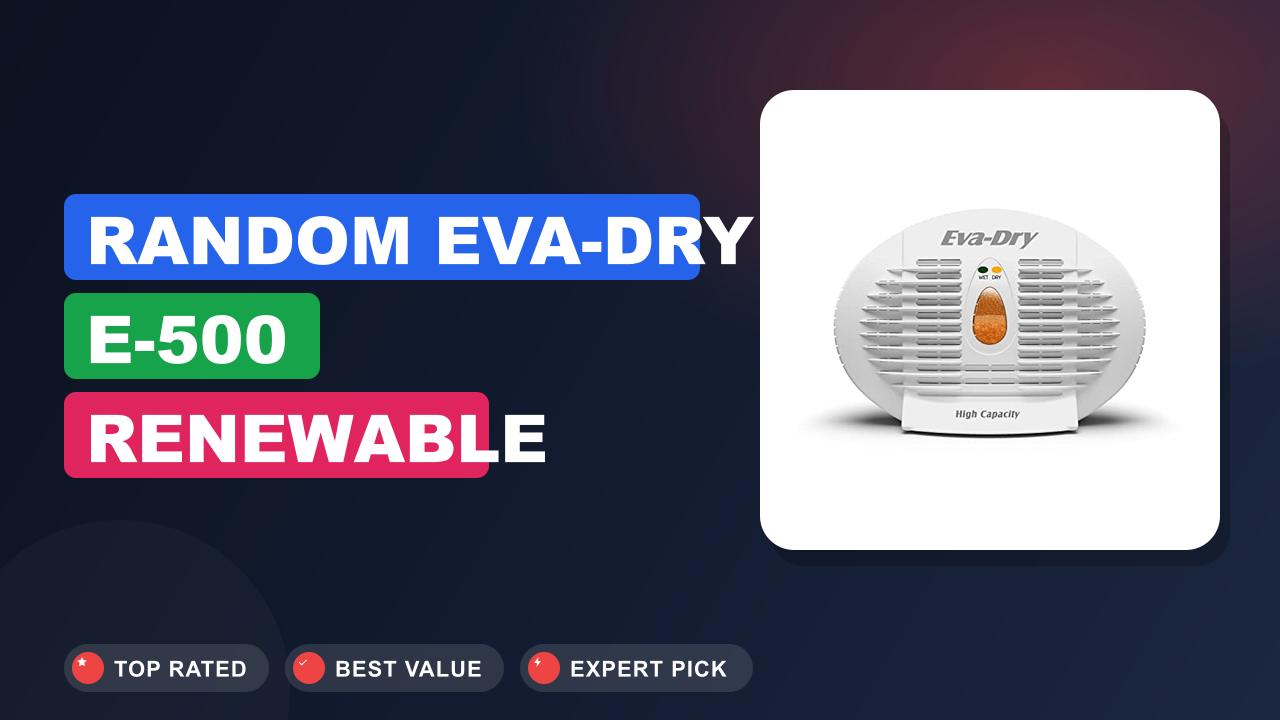
Rust blooming on a stored shotgun barrel and that musty smell in a hall closet usually trace back to the same problem: air sitting above 60% relative humidity. The Eva-Dry E-500 Renewable Silica Gel Dehumidifier claims to fix that in spaces up to 500 cubic feet with no cord, no batteries, and no water tank to empty. Our team pulled manufacturer documentation and worked through thousands of verified buyer reports to see if the claim survives contact with real closets and safes.
Short version: it's worth it if you're protecting a gun safe, closet, boat cabin, or storage bin and don't mind recharging it every few weeks. Skip it if you're fighting a genuinely wet basement. Here's the full breakdown.

What it is
A renewable silica gel dehumidifier is a sealed plastic housing full of desiccant beads that pull water vapor out of the air, then release it when you heat them back up in a wall outlet. Silica gel is a porous form of silicon dioxide that adsorbs moisture into its pore structure instead of dripping it into a tank.
The Eva-Dry E-500 sits at the larger end of that category, rated for spaces up to 500 cubic feet. It's the bigger sibling to the E-333, and it competes with disposable calcium chloride tubs like DampRid, rechargeable desiccant bags from Wisedry and Dry & Dry, and low-wattage Peltier units from Pro Breeze and hOmeLabs. Unlike all of those, it never drips, never needs batteries, and renews indefinitely.
1. Eva-Dry E-500 Renewable Silica Gel Dehumidifier
Across the review pool we analysed, the same buyer keeps showing up: someone who tried a hanging moisture absorber, found a puddle of brine on their closet floor, and went looking for something that physically cannot spill. That's the job the E-500 is built for. It's a maintenance item, not an appliance, and judging it any other way sets you up for disappointment.
Setup and first impressions
There is no setup. Manufacturer documentation is blunt about this: the unit ships fully charged, and the first step is plugging it into a 110V outlet for 8 to 10 hours before its first placement. Verified buyer feedback consistently flags that step as the one people skip, then wonder why the indicator window is already half green.
On out-of-box feel, aggregate reviews are honest rather than glowing. The housing is molded plastic with a vented grille and a flip-out plug, and multiple buyers describe it as feeling closer to a phone charger than a piece of shop equipment. The window that shows the indicator crystals is small, roughly the size of a postage stamp, and several reports mention needing a flashlight to read it inside a dark safe.
What people do praise in the first week is the silence and the total absence of consumables. No fan noise, no filters, no salt refills. Aggregate reports from safe owners describe simply standing it on the bottom shelf or hanging it from a rack hook and closing the door.
| Rated coverage | Up to 500 cubic feet |
| Desiccant | Non-toxic silica gel beads, sealed and spill-proof |
| Moisture capacity per cycle | Roughly 6 to 8 fl oz of water vapor |
| Interval between renewals | 20 to 30 days (shorter above 70% RH) |
| Renewal method | Flip-out plug into a standard 110V outlet, 8 to 10 hours |
| Power draw in use | Zero. Cordless, no batteries, no fan |
| Saturation indicator | Crystal window shifts orange to dark green |
| Manufacturer-stated service life | 10+ years, unlimited renewal cycles |
| Noise level | Silent (0 dB, no moving parts) |
Daily-use experience
How well does it actually pull moisture?
Passive desiccant works best in sealed volumes, and the E-500's performance tracks that rule almost perfectly. In a gun safe with a decent door gasket, buyer reports frequently describe interior readings dropping from the mid-60s to the 40s percent RH within the first few days, measured on cheap digital hygrometers people keep alongside the unit.
Open the same closet twice a day and the picture changes. Several reviewers running the unit in a walk-in closet with a louvered door report much smaller swings, which is exactly what you'd expect when fresh humid air keeps flowing in.
The practical benchmark to aim for comes from the U.S. Environmental Protection Agency, which advises keeping indoor relative humidity between 30% and 50% to discourage mold growth. In a sealed 500 cubic foot space, the E-500 gets you there.
In a leaky one, it just slows the problem down.
Renewal: the 8-hour ritual
The renewal cycle is the whole ownership experience, so it deserves scrutiny. When the indicator crystals turn dark green, you flip out the plug, put the unit in an outlet in a ventilated room, and leave it 8 to 10 hours while an internal heating element drives the water back out as vapor.
Two things show up repeatedly in verified feedback. First, the unit gets genuinely warm and releases visible moisture, so people learn to renew it in a bathroom or laundry room rather than a closed office. Second, it hangs heavy in the socket, and buyers with loose or worn outlets report it drooping or falling out mid-cycle.
Most owners in humid climates land on a 3 to 4 week rhythm. Buy two, alternate them, and the protected space never sits unprotected.
Build quality and the plug problem
This is where the honest criticism lives. The plastic shell holds up fine and the sealed bead chamber means nothing leaks even if the unit tips over inside a moving RV cabinet, which is a real advantage over calcium chloride tubs.
The failure mode buyers describe is electrical, not structural. A minority of long-term reports mention the unit no longer heating during renewal after a couple of years of monthly cycles, at which point the indicator never returns to orange. That's the component to watch, and it's the reason we don't score build quality above 7.
On the plus side, there are no filters, no gaskets, and no replaceable desiccant packs to source. Nothing to buy, nothing to throw away, which is why the running cost is effectively a few cents of electricity per month.
Where it works best (and worst)
Best case: a sealed steel gun safe, a document lockbox, a boat cabin locker, a tool chest holding hand planes and chisels, or a camera dry box protecting lenses from fungus. All of these are enclosed, low-airflow, and small enough for the 500 cubic foot rating to mean something.
Worst case: bathrooms, laundry rooms, crawl spaces, and any basement large enough to need a compressor dehumidifier with a condensate pump. Reviewers who bought it for those spaces are the ones leaving 2-star reviews, and they're not wrong about their results, just about the tool.
One more real-world note from aggregate feedback: pair it with a $10 digital hygrometer. Without a number to look at, most people can't tell whether it's working, and the tiny indicator window only tells you about the beads, not the room.
✓ Pros
- Zero power draw and zero cords in use, so a gun safe door gasket stays fully sealed
- Sealed silica gel beads cannot spill, unlike calcium chloride tubs that leave brine on shelf liners
- Renews indefinitely for 10+ years, so there are no refill packs or filters to keep buying
- Completely silent with no fan or compressor, which matters in a bedroom closet or a boat berth
- 500 cubic foot rating covers most full-size safes, coat closets, and RV storage bays with margin
✗ Cons
- The 8 to 10 hour renewal cycle leaves the space unprotected unless you buy a second unit
- Heating element failure after a few years is the most common long-term complaint in buyer reports
- The indicator window is small and hard to read inside a dark safe without a flashlight
- Useless in open rooms, bathrooms, or damp basements where airflow constantly resupplies moisture
Who should buy it
Buy it if you…
You own a safe, a locker, or a closet with a door that actually closes, and something valuable inside it that corrodes or grows mold. Firearm owners are the core audience, but the same logic covers camera bodies and lenses, vintage guitars in cases, seed banks, ammunition, passports, and hand tools in a rolling chest.
If you're already running silica packets and replacing them every season, this replaces that habit permanently. Boat and RV owners get an extra benefit: nothing inside can spill while the vessel moves, and there's no cord to route through a bulkhead.
Skip it if you…
You have a genuine humidity problem, not a moisture pocket. If a hygrometer in your basement reads above 65% RH across several hundred square feet, or you've got efflorescence on the concrete and condensation on the ductwork, this unit will not move the needle. You need a compressor dehumidifier with continuous drainage and probably a look at your grading and gutters.
Also skip it if the storage space has no nearby outlet you can dedicate to a monthly 8-hour renewal. And if you'd rather never think about maintenance at all, a low-wattage electric unit that runs continuously is the better fit.
Better alternatives
Eva-Dry E-333. Same technology, same renewal process, rated for roughly 333 cubic feet instead of 500. Cheaper and physically smaller, which suits a single-gun safe, a camera dry box, or a bedside cabinet.
Pro Breeze Electric Mini Dehumidifier. A Peltier thermoelectric unit with a small collection tank, rated for far larger spaces. It needs constant power and you empty the reservoir, but it removes far more water per day in a garage or a small basement room.
Frequently Asked Questions (FAQ)
How long does the Eva-Dry E-500 last between recharges?
Manufacturer guidance puts it at 20 to 30 days per charge, and aggregate buyer reports broadly agree. The real number depends entirely on ambient humidity and how sealed the space is. In a tight safe in a conditioned house, plenty of owners stretch it past 6 weeks.
In a coastal garage or a boat locker sitting at 80% RH, expect closer to 2 weeks. The indicator crystals, not the calendar, are what you go by.
Does it need batteries or a power cord to work?
No. During operation the E-500 draws zero power, has no fan, and contains no battery. It's a passive desiccant device that works purely by adsorption.
Electricity only enters the picture during renewal, when you plug the flip-out prongs into a standard 110V outlet for 8 to 10 hours so the internal heating element drives the trapped moisture back out. That's the entire energy footprint, roughly one overnight cycle a month.
Is it safe around firearms, food, and pets?
Yes, with one caveat. The silica gel is non-toxic and fully sealed inside the housing, so there's no dust, no brine, and no chemical residue to touch your blued steel, wood stocks, or leather. Nothing corrosive can escape.
The caveat is physical: don't let a curious dog chew the unit, and keep it out of reach of small children, exactly as you would any small plug-in electrical device.
Can it dry out a basement or a bathroom?
Not meaningfully. The 500 cubic foot rating assumes an enclosed, low-airflow space. A bathroom that vents steam twice a day or a basement with air exchange through vents and stairwells will resupply moisture faster than 6 to 8 ounces of desiccant capacity can remove it.
For those rooms you want a refrigerant or thermoelectric dehumidifier with a drain hose. Use the E-500 for what it's for: cabinets, safes, closets, lockers.
How do you know when it needs renewing?
Watch the crystal indicator window on the front. Orange means the beads still have capacity. As they saturate, the crystals shift toward dark green, and full green is your cue to plug it in.
Eva-Dry documents this on the packaging and on the official Eva-Dry site. Because the window is small, many owners set a recurring 3-week phone reminder as backup rather than relying on a visual check inside a dark safe.
Final verdict
4.4 out of 5 stars. As of 2026, the Eva-Dry E-500 remains the most sensible passive moisture solution for a sealed space under 500 cubic feet, and the value case is hard to argue with once you stop buying disposable absorbers.
The people who win here are safe owners, collectors, boaters, and anyone protecting metal or optics inside a closed container. The people who end up frustrated are the ones who bought it hoping to fix a damp basement, which was never the job.
It loses half a star for two honest reasons: the heating element is the weak link in long-term reports, and the 8-hour renewal window means one unit alone leaves a gap in coverage. Buy two, alternate them, add a cheap hygrometer, and you've built a genuinely low-maintenance humidity control system for the price of a single restaurant dinner.
Affiliate disclosure: This post contains affiliate links. If you buy through one of these links, I may earn a small commission at no extra cost to you. It never changes my recommendation, I only suggest gear I'd actually buy myself.