Hunting Rifle Maintenance Checklist: Safe Basic Care

A safe hunting rifle maintenance routine starts by unloading the rifle, opening the action, removing all ammunition from the cleaning area, and following your rifle’s manufacturer manual. Basic post-hunt care then means drying exterior metal, checking for moisture, cleaning the bore only as the manual directs, applying light lubrication only where specified, and storing the rifle unloaded in a secure place.
This checklist is for manual-led basic care and rust prevention. It does not cover trigger work, headspace, bedding, chamber work, or model-specific disassembly. If anything looks damaged, functions oddly, or is unclear in the manual, stop and take the rifle to a qualified gunsmith.
Table of Contents
Safe Rifle Maintenance Starts Before Cleaning
Every maintenance session begins with making the rifle safe. Unload it, open the action, visually and physically confirm the chamber and magazine are clear, and move all ammunition away from the work surface before any cleaning tool comes out. Keep the muzzle pointed in a safe direction throughout the process.
Before you clean, review established firearm safety rules such as the NSSF firearm safety rules, then read the cleaning section in your rifle manual. The manual is the authority for what can be opened, what should be left alone, and how to handle your exact model.
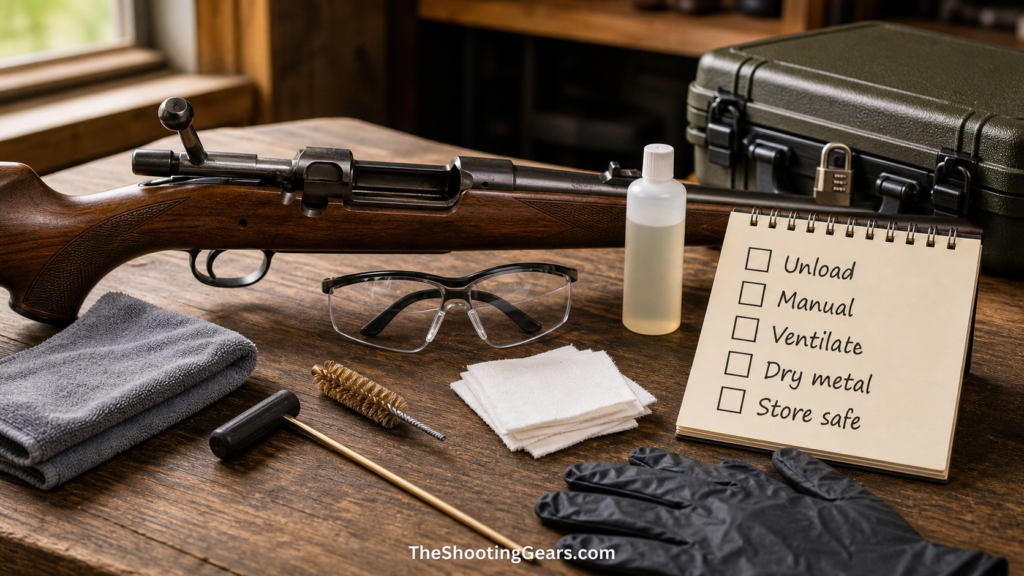
- Unload the rifle and open the action.
- Confirm the chamber and magazine are empty.
- Remove all ammunition from the cleaning area.
- Keep the muzzle pointed in a safe direction.
- Have the specific rifle manual on hand.
- Set up in a ventilated area suitable for solvents.
Basic Post-Hunt Maintenance Checklist
Basic post-hunt maintenance focuses on moisture, fouling, visible wear, and safe storage. After confirming the rifle is unloaded and clear, work slowly through the checklist instead of rushing straight to the bore.
Unload, Clear, and Separate Ammunition
Confirm again that the rifle is unloaded and the action is open. Keep ammunition separated from the cleaning bench for the entire session. Never have live rounds near solvents, lubricants, or the cleaning surface, and never store the rifle loaded.
Dry Exterior Metal and Inspect for Moisture
Wipe down exterior metal to remove water, sweat, fingerprints, and field grime, especially after rain, snow, or humidity. Look for early rust or pitting, and check that the bore is free of obstructions before storage. Do not dry-fire or function-test unless the manual specifically allows it and all safety checks are complete.
Bore, Action, and Exterior Care
Bore, action, and exterior care should follow the rifle manual’s procedure for your model. Use proper tools, correct patch and brush sizes, and cleaning chemicals according to their labels. Do not force rods, brushes, or patches, and do not improvise procedures the manual does not describe.
Follow the Rifle Manual for Bore Cleaning
Clean the bore according to the manual using a proper rod or cable, jag or brush, and patches sized for the bore. Stop if a tool binds, a patch will not pass normally, or you suspect a bore obstruction. For cartridge and chamber terminology, SAAMI technical information is a useful standards reference, but your rifle manual still controls the actual cleaning method.
Use Solvents and Lubricants Carefully
Cleaning solvents and lubricants are chemicals. Use them only as directed, work with ventilation, avoid eating or drinking while cleaning, and wash your hands afterward. Lead residue can be part of shooting environments; the CDC/NIOSH publication on preventing lead and noise exposures at indoor firing ranges and OSHA hazard communication guidance are helpful references for why labels and safety data sheets matter.
Apply lubricant lightly and only where the manual specifies. Over-lubrication can attract debris, and using improvised chemicals can create avoidable problems. Never spray oil into ammunition.
Storage and Rust Prevention
Rust prevention depends on drying the rifle, applying a light protective film where the manual allows, storing it securely in a dry environment, and inspecting it periodically. Moisture is the main enemy after wet hunts, sweaty handling, or transport through changing temperatures.
- Make sure the rifle is fully dry before storage.
- Apply a light protective oil to exterior metal where the manual allows.
- Store the rifle unloaded in a secure, dry, temperature-stable place.
- Avoid sealed cases for long-term storage if they trap humidity.
- Inspect stored firearms periodically for moisture or rust.
- Use secure storage to keep firearms away from unauthorized users.
For secure storage practices, Project ChildSafe is a useful public safety resource. A cleaned and oiled rifle still needs periodic checks because storage conditions change with the seasons.
What to Leave to a Gunsmith
Anything beyond manual-led cleaning, light lubrication, and exterior care should be left to a qualified gunsmith, especially work involving internal parts, function, fit, or safety-critical adjustments. Trying model-specific disassembly without the right training and tools can create safety problems.
- Damaged, worn, broken, or missing parts.
- Failure to feed, extract, or eject.
- A suspected bore obstruction.
- Trigger feel that has changed or seems unsafe.
- Disassembly the manual does not clearly describe.
- Any uncertainty about whether the rifle is safe to use.
This guide does not cover trigger adjustment, bedding, headspace, chamber work, or model-specific disassembly. Cleaning is not a substitute for a professional safety inspection, so a gunsmith is the right call whenever something seems off.
Frequently Asked Questions
How often should I clean my hunting rifle?
Cleaning frequency depends on how much you shoot, the conditions you hunt in, and your manufacturer’s guidance. Many hunters do basic care after each hunt or range session, with more thorough cleaning as the manual recommends. Clean sooner if the rifle was exposed to rain, snow, mud, or saltwater.
What do I need to clean a rifle safely?
At a basic level, you need the rifle manual, a proper cleaning rod or cable, a jag or brush and patches sized for the bore, appropriate solvent, light lubricant, eye protection as appropriate, and a ventilated work area. Remove all ammunition before cleaning.
Can I store my rifle after oiling it without further checks?
No. Even a cleaned and oiled rifle should be inspected periodically because temperature and humidity changes can still cause moisture problems. Store the rifle unloaded, dry, and secure, then check it from time to time.
Is it safe to take apart my rifle for a deep clean?
Only to the extent your manufacturer manual clearly describes for your exact model. Disassembly beyond manual basics, along with trigger, bedding, headspace, and chamber work, is gunsmithing and should be left to a qualified professional.
Do I need eye protection and ventilation to clean a rifle?
Yes, as appropriate. Solvents and lubricants are chemicals, and residue from shooting can be present. Work in a ventilated area, use eye protection where appropriate, avoid eating or drinking while cleaning, follow product labels and safety data sheets, and wash your hands afterward.