Feral Hog Shot Placement: Safety, Ethics, and Recovery Checks
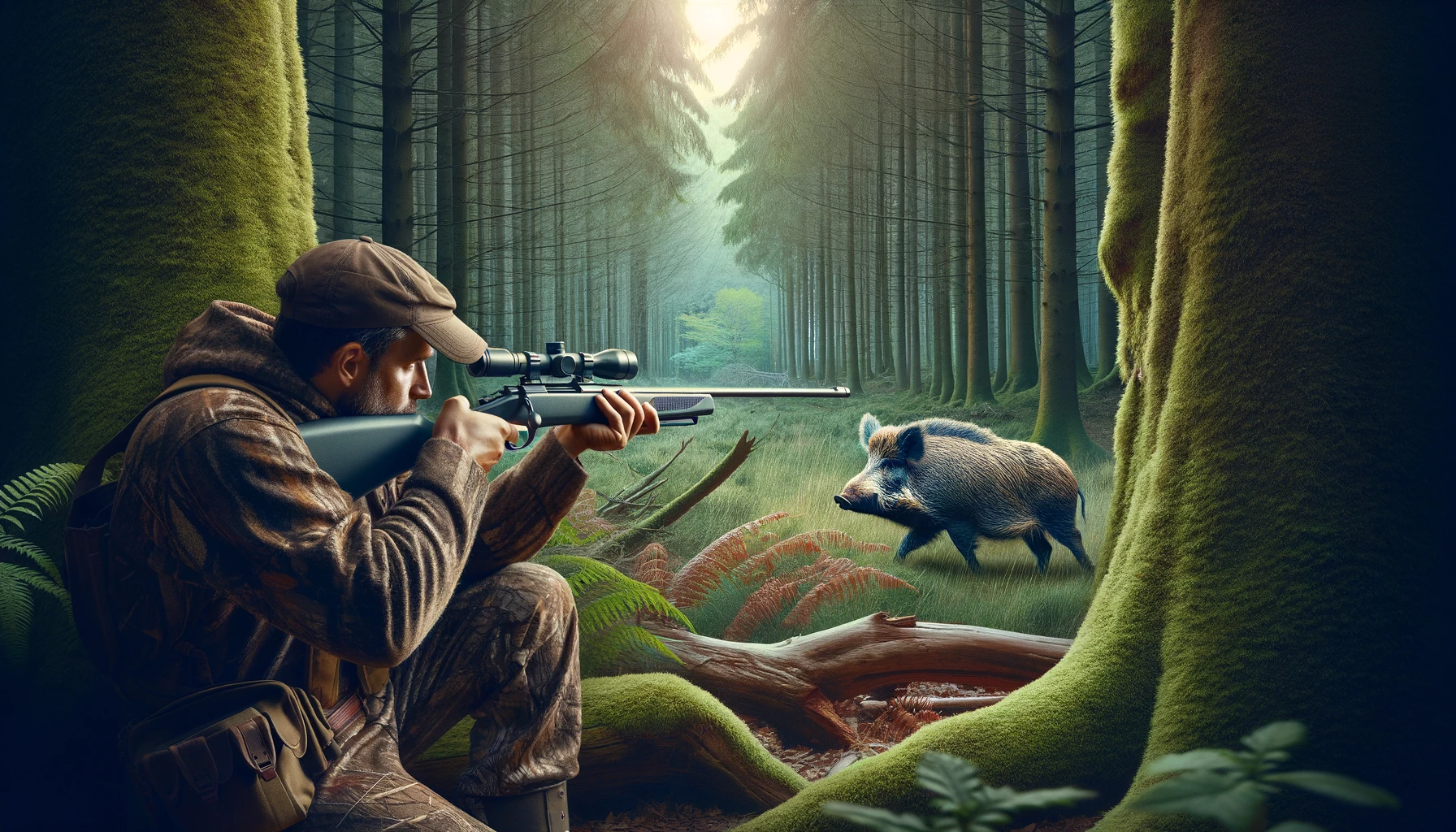
Feral hog shot placement is an ethics and safety decision before it is a marksmanship topic. A responsible hunter should confirm the animal, check current laws, know what is beyond the target, use enough firearm or bow capability for the conditions, and pass any shot that does not offer a clear, legal, and recoverable opportunity.
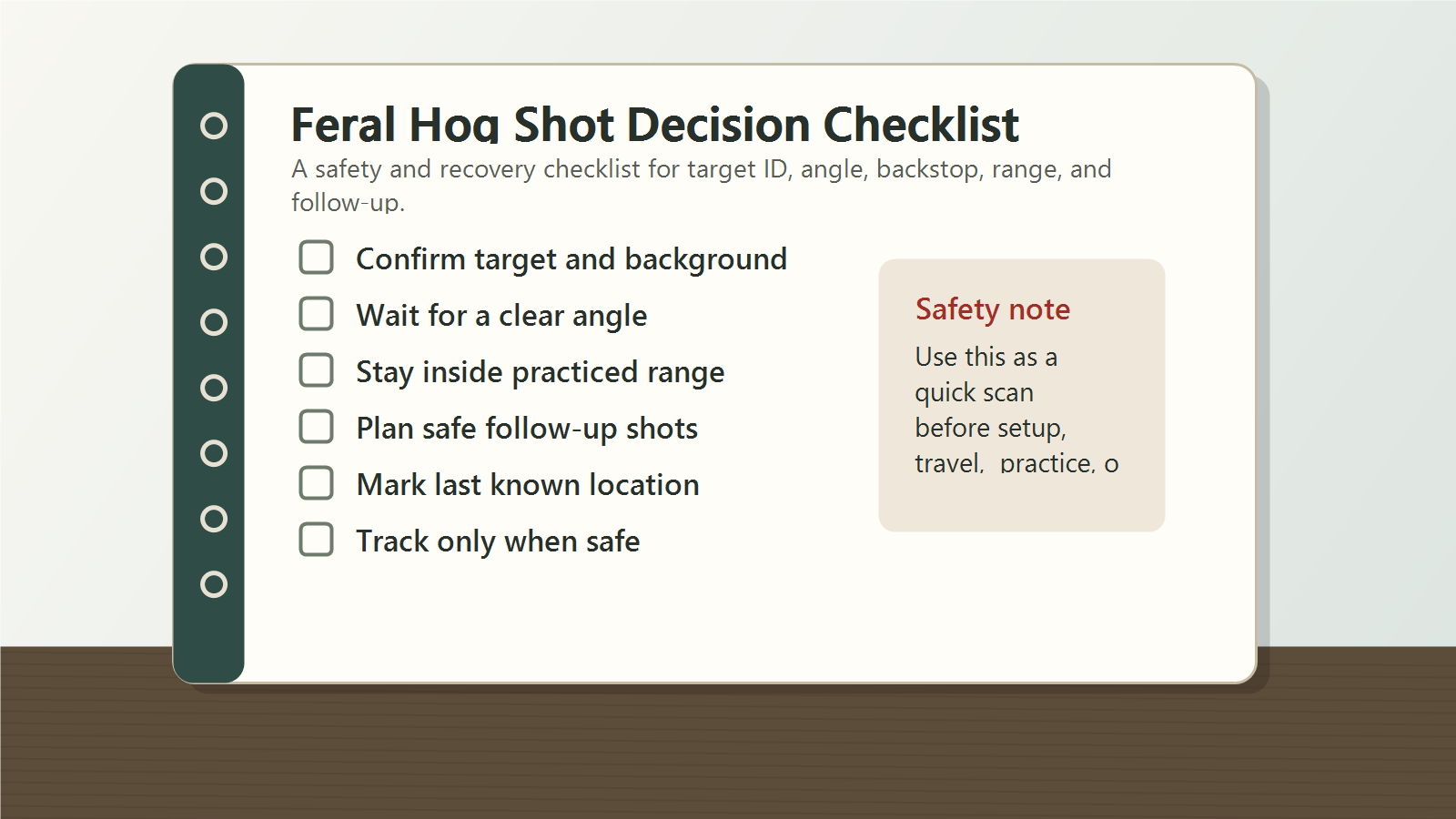
This guide keeps the focus on safe, legal, and responsible hunting judgment. It is not a substitute for local regulations, hunter education, landowner permission, qualified instruction, or species-specific guidance from your state wildlife agency.
Table of Contents
Quick Answer: Where Should Hunters Aim on Feral Hogs?
Hunters should only take a shot on a feral hog when they can clearly identify the animal, see a clean vital-zone opportunity, control the firearm or bow, and recover the animal safely. Broadside or slightly quartering angles are generally easier to judge than steep, moving, crowded, or brush-covered angles. If the angle, background, distance, or identification is uncertain, pass the shot.
Best practical rule
Think in terms of a safe, recoverable vital-zone shot, not a magic aiming point. Feral hogs are compact, tough animals, and poor angles can lead to poor outcomes. Slow down and make the decision before pressure rises.
When to pass
Pass when the hog is moving too fast, facing too sharply, hidden by brush, mixed with other animals, near livestock, beyond your steady range, or standing where the bullet or arrow path is unsafe.
Check Rules First
Feral hog rules vary by state, land type, method, time of day, license status, and public or private access. The USDA APHIS feral swine program explains why feral swine are managed as a serious invasive-species problem, but hunting rules still come from state wildlife agencies and land managers. Check current rules before every hunt.
State wildlife rules
Some states treat feral hogs as invasive animals with broad take rules, while public land, night hunting, bait, dogs, suppressors, transport, or sale of meat may still have limits. Do not assume another state’s rules apply where you hunt.
Private land permission
Permission should be clear before any hunt. Know property boundaries, nearby homes, roads, livestock, equipment, and other hunters. Legal permission does not remove the need for safe shot direction.
Public land limits
Public land can have special seasons, weapon limits, check-in rules, hunter-orange requirements, closed areas, or nighttime restrictions. Review the specific public-land page, not just the statewide summary.
Identify the Animal
Target identification comes before shot placement. Feral hogs can share habitat with livestock, pets, deer, bears in some regions, and native javelina in parts of the Southwest. If identification is not certain, do not shoot.
Hog versus javelina
Javelina are not feral hogs and are regulated differently where they occur. Look up your state wildlife agency’s identification guidance if you hunt in areas where both may be present.
Hog groups
Feral hogs may appear in groups. A clear shot at one animal can become unsafe if another hog steps behind it. Watch the whole group and the background before deciding.
Low visibility
Do not shoot at sound, movement, a dark shape, or a partial outline. Positive identification means you can tell what the animal is, where it is angled, and what is beyond it.
Understand Vital-Zone Limits
Feral hog anatomy is not the same as a deer. Their body is compact, the shoulder area can be heavy, and the vital area can be easier to misjudge if the hunter uses a deer-only mental picture. Keep the shot conservative and recoverable.
For biology and management background, Texas A&M AgriLife Extension’s feral hog resource is a useful reference. Use sources like that to understand the animal, then pair that knowledge with your state’s current hunting rules.
Broadside reference
A broadside animal gives the easiest view of body angle and leg position. Even then, wait until the animal stops or slows enough for a controlled shot. Brush, slope, and distance can still make the shot unacceptable.
Quartering angles
Quartering angles require more judgment because the entry point and exit path are different. If you cannot picture the path through the animal and into a safe background, do not take the shot.
Avoid risky targets
A head-on, running, skyline, brush-covered, or crowded shot leaves too much uncertainty for most hunters. Ethical hunting includes saying no when the shot is not clean.
Read the Shot Angle
Shot angle affects both humane results and safety. The hunter must understand where the projectile will travel, what tissue it is likely to cross, and where it may end up after impact or a miss.
Broadside or slight quarter
These angles are usually easier to evaluate because the animal’s body position is clearer. They still require a steady rest, known distance, enough equipment, and a safe background.
Steep angles
Steep uphill or downhill angles can distort the apparent body position. If you are unsure how the angle changes the path, wait for a better shot or pass.
Moving hogs
Moving animals are much harder to judge. Unless you are trained, steady, and certain of the background, a moving hog is usually a shot to skip.
Know the Background
The NSSF firearm safety rules stress knowing your target and what is beyond it. That rule matters especially with hog hunting because fields, feeders, roads, livestock, houses, water, and hard ground can all create risk.
No skyline shots
Do not shoot at an animal standing on a ridge, levee, hill crest, or any place where the background is open sky or unknown land. Wait until the projectile path ends in safe earth or another known safe background.
Watch hard surfaces
Dry ground, rocks, water, metal, and equipment can create unpredictable deflection risk. If the ground or background is not safe, do not force the shot.
Know the property
Before hunting, mark homes, roads, barns, fences, neighboring property lines, livestock areas, and other hunter positions. A safe plan starts before the hog appears.
Use Enough Equipment
Use equipment suitable for the animal, distance, and conditions. Feral hogs can be tough, and poor equipment choice can lead to poor recovery. Follow firearm, ammunition, broadhead, and bow manufacturer guidance, and check state rules for legal methods.
Firearms
Choose a firearm and load that you can shoot accurately and that is appropriate for the hog size and range. Accuracy from a stable field position matters more than paper specifications.
Archery gear
Bowhunters should be especially conservative with range and angle. Use legal equipment, sharp broadheads, enough draw weight for the setup, and only shots you have practiced from realistic positions.
Optics and lights
Optics, lights, and night-vision equipment must be legal where you hunt and used safely. Better visibility does not remove the need for identification, background, and recovery planning.
Keep Distance Realistic
Your practical hunting distance is the range where you can place shots consistently from field positions, not the longest range your equipment can reach. Wind, rest, light, nerves, and animal movement all shrink real capability.
Use field positions
Practice from the positions you actually use: sticks, blind windows, kneeling, sitting, or a steady rest. Bench accuracy does not automatically transfer to the field.
Range before deciding
If you do not know the distance, range it before the shot if conditions allow. Guessing distance can lead to poor placement, especially with archery equipment or slower projectiles.
Pass beyond confidence
Passing a shot is part of ethical hunting. A closer, steadier opportunity later is better than a rushed shot now.
Plan Recovery Before the Shot
Recovery planning starts before the trigger is pressed or the arrow is released. Know where the hog stands, what direction it may travel, and how you will follow sign safely and legally.
If you hunt with partners, agree on lanes, signals, and recovery roles before the setup begins. Nobody should move into cover, cross a shooting lane, or approach the animal until every firearm or bow is under control and everyone understands the plan.
Mark the spot
Pick a tree, fence post, rock, or GPS point near the animal’s position before the shot. Afterward, mark where the animal stood and where it was last seen.
Give it time
Do not rush into thick cover without thinking. Follow local training and conditions, keep firearm safety in mind, and be careful around wounded animals.
Handle meat carefully
Feral hogs can carry diseases and parasites. Use gloves, avoid contact with fluids, cool meat promptly where legal to keep it, and follow state health or wildlife guidance for safe handling.
Low-Light and Night Cautions
Some areas allow night hunting for feral hogs; others restrict it. Low light increases the risk of misidentification, poor background judgment, and unsafe recovery. Check rules and use more caution than you would in daylight.
Confirm legality
Night hunting, lights, thermal optics, suppressors, bait, and vehicle use can all have specific rules. Confirm them from the current state and land-manager source.
Confirm identity
Do not rely on shape alone. Confirm the animal, the angle, the background, and nearby animals or people before making a decision.
Plan the recovery route
Night recovery can involve fences, water, snakes, livestock, brush, and other hunters. Carry light, communication, navigation, gloves, and a clear exit plan.
Common Shot-Decision Mistakes
Aiming like it is a deer
Feral hogs are shaped differently than deer. Study reputable anatomy references before the hunt and keep the shot angle conservative.
Forgetting the background
A clean-looking animal is not enough. The shot is not safe unless the full path and background are safe.
Shooting into groups
Groups can shift quickly. Make sure no other animal is behind or near the selected hog before deciding.
Feral Hog Pre-Shot Checklist
- Current state, local, and land rules checked
- Landowner or public-land access confirmed
- Animal positively identified as a feral hog
- Safe background and property boundaries confirmed
- Distance is within practiced field ability
- Shot angle is clear and recoverable
- Equipment is legal and suitable for the animal and range
- No livestock, people, roads, buildings, or other animals are in the path
- Recovery route and marking plan are ready
- Meat-handling and health precautions are prepared
FAQ
Is shot placement on feral hogs the same as deer?
No. Feral hogs have a different body shape and heavier shoulder area. Use hog-specific references, keep the angle conservative, and pass uncertain shots.
Should hunters take running shots at feral hogs?
Most hunters should avoid running shots because identification, angle, and background change too quickly. A passed shot is better than a poor or unsafe one.
Do feral hog rules change by state?
Yes. License rules, public-land access, night hunting, equipment, transport, and meat handling can vary. Check the current state wildlife agency and land-manager rules before hunting.
Can hunters keep feral hog meat?
Rules and health guidance vary. If keeping meat is legal where you hunt, use gloves, cool the meat promptly, and follow safe handling guidance from state or extension sources.
What matters most before taking a shot?
Positive identification, safe background, legal method, realistic range, clear shot angle, and a recovery plan matter most. If any one of those is missing, wait.
Final Takeaway
Feral hog shot placement should be guided by ethics, safety, and recovery. Check current laws, identify the animal clearly, understand hog anatomy, avoid risky angles, know the background, use suitable equipment, and pass any shot that does not give a clean and responsible opportunity.