Random Specialty Archery Hooded Peep Black 1/4
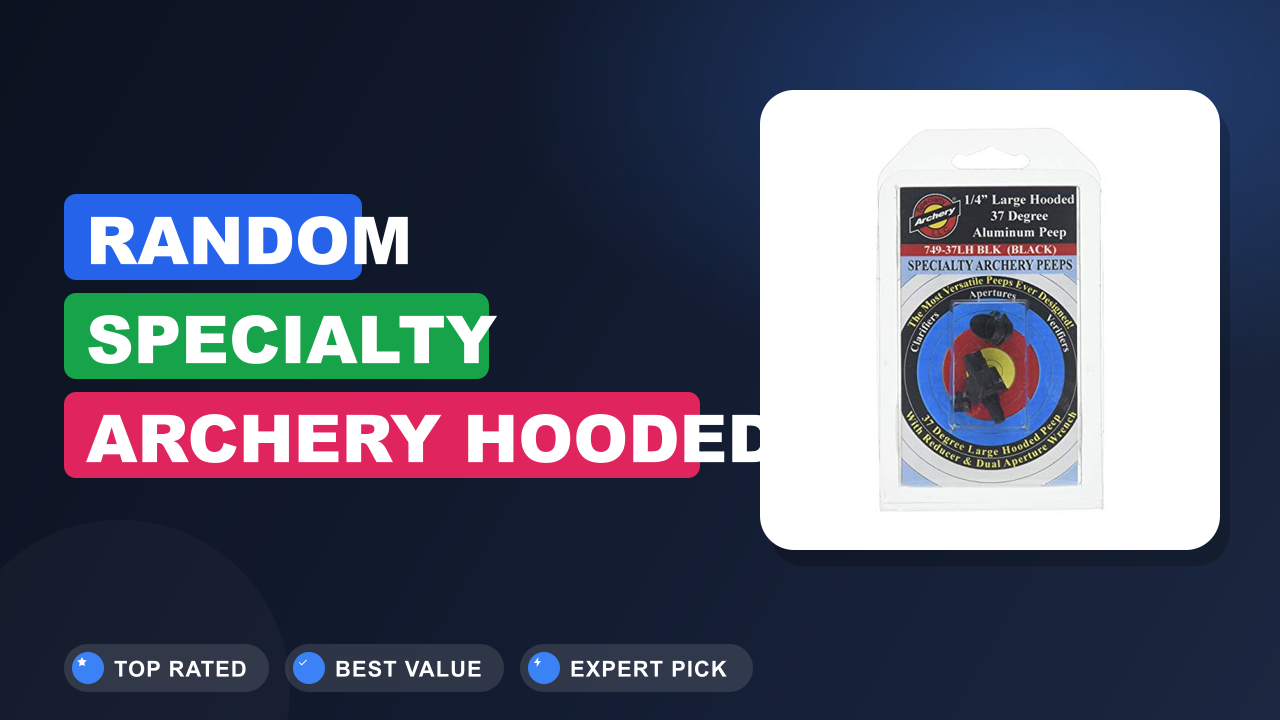
Bowhunters usually reach for the Specialty Archery Hooded Peep Black 1/4 in. for one specific reason: the sight housing looks like a soft blur at full draw, and no amount of squinting fixes it. That was the question driving our research team into peep sights in general and this Iowa-made aluminum housing in particular. It's a peep built to accept threaded apertures and lenses, not a molded rubber ring you tie in and forget.
Bottom line up front: worth it if you shoot a lens-equipped sight, struggle with aging eyes, or hunt the last ten minutes of legal light. Skip it if you want a five-minute tie-in and zero fuss. Here's how it stacks up.

What it is
A peep sight is a small aperture tied into the bowstring that acts as your rear sight, aligning your eye with the front sight housing at full draw. The Specialty Archery Hooded Peep is the modular version of that idea: a machined aluminum body with internal threads that accept interchangeable apertures, clarifier lenses, and verifier lenses.
The "1/4 in." designation refers to the insert diameter the housing accepts, which is the largest in the Specialty Archery lineup and gives the widest field of view. The hood is an extended shroud on the front face that shades the opening from direct sun.
Nearby options include the Hamskea InSight peep, the G5 Meta Peep, and the classic Fletcher Tru-Peep. Only the Specialty and Hamskea designs treat the peep as a modular optical system rather than a fixed hole.
Setup and first impressions
Verified buyer feedback is consistent on one point: this feels like a machined part, not a molded one. Reviewers repeatedly describe the anodized black finish as even and non-reflective, with clean internal threads that let apertures spin in by hand without cross-threading. That matters, because a burr in a peep thread means a lens that never seats square.
Manufacturer documentation from Specialty Archery specifies that the peep seats into the string serving separation, which means a bow press and a string-splitting tool for most installs. Aggregate reviews show this is the single biggest friction point. Buyers who own a press call it a 20-minute job.
Buyers who don't end up at a pro shop.
The first 30 minutes of real use follow a predictable arc in review data. Archers tie it in, draw, and immediately notice the sight housing looks smaller and better defined than through a stock rubber peep. Then they spend the rest of the session swapping apertures to find the right balance between light transmission and precision.
| Model | Specialty Archery Hooded Peep, Black, 1/4 in. |
| Insert size accepted | 1/4 in. (largest in the Specialty lineup) |
| Body material | Machined aluminum, black anodized |
| Hood function | Extended shroud, shades aperture from direct sunlight |
| Accepts | Threaded apertures, clarifier lenses, verifier lenses |
| Aperture included | No, sold separately by size |
| Installation | Ties into string serving separation, bow press recommended |
| Best use case | Target, 3D, and low-light hunting with lens-equipped sights |
| Manufacturer | Specialty Archery LLC, USA |
Daily-use experience
Sight picture and optical clarity
A clarifier lens sharpens a blurred scope lens; a verifier lens sharpens blurred sight pins for eyes that can no longer focus close. That distinction is the whole reason this peep exists, and review data confirms it delivers on both.
Archers running a 6x scope lens on a Sure-Loc or Axcel sight report that dropping the correct clarifier into the 1/4 in. housing turns a fuzzy target dot into a defined edge. Hunters with presbyopia, which the National Eye Institute describes as the age-related loss of near focus, report the opposite fix: a verifier brings the pins back into focus while the target softens slightly.
The 1/4 in. size specifically buys you field of view. Buyers who stepped up from a 3/16 in. housing consistently describe less tunnel effect and an easier time centering the sight ring inside the peep.
Low-light performance
This is where the hood earns its keep, and where the honest trade-off lives. The shroud blocks side-angle sunlight that would otherwise wash out the aperture, which helps enormously on an afternoon 3D range with the sun over your shoulder.
At dusk, the math flips. A hood plus a small aperture cuts light transmission, and multiple hunters note they had to open up to a larger aperture for evening stand sits. The common workaround in review reports is running two apertures: a tighter one for daylight target work, a wider one screwed in before an evening hunt.
That swap takes under a minute and needs no re-sighting as long as the housing itself doesn't move on the string. It's a genuine advantage over a fixed-hole peep, where your only option is a new peep entirely.
Build quality and durability
Aluminum with a proper anodized finish holds up better than molded polymer in cold weather, and that shows in the feedback pattern. Reviewers who hunt late-season report no cracking or brittleness at sub-freezing temperatures, a known failure mode for cheap plastic peeps.
The threads are the part people worry about and the part that seems to hold. Buyers who have swapped apertures dozens of times across a season describe no thread wear or stripping, though several recommend a drop of thread locker if you shoot a bow generating heavy string vibration.
The one recurring durability complaint involves the tie-in itself rather than the peep. If the serving thread isn't burnished tight, the housing can creep and rotate. That's an installation issue, not a manufacturing defect, but it bites first-timers.
Weight and string behavior
An aluminum housing weighs more than a molded peep, and physics doesn't negotiate. Added mass at the string's midpoint reduces arrow speed slightly and can shift your nocking point tune marginally.
In practice, review reports suggest the speed loss is small enough that most shooters never chronograph a difference worth caring about. Target archers shooting 280 fps at 60 pounds aren't chasing IBO numbers anyway. If you're a speed-obsessed hunter running a 6.5-inch brace height bow tuned to the ragged edge, factor it in and re-check your paper tune after install.
✓ Pros
- Accepts threaded apertures, clarifiers, and verifiers, so one housing solves blurry pins or a blurry scope lens without buying a new peep
- 1/4 in. insert size gives the widest field of view in the lineup, which reduces the tunnel effect when centering your sight ring
- Integrated hood shades the aperture from side-angle sun, a real advantage on afternoon 3D courses
- Machined aluminum body with anodized finish resists the cold-weather cracking that kills molded polymer peeps
- Aperture swaps take under a minute and don’t require re-sighting if the housing stays put on the string
✗ Cons
- No aperture included, so the real cost is the housing plus at least one insert before it’s usable
- Requires a bow press and serving separation to install, which pushes most buyers to a pro shop
- Hood plus small aperture cuts light at dusk, forcing an aperture swap before evening stand sits
- Aluminum adds string mass, so speed-focused hunters should re-check paper tune after installation
Who should buy it
Buy it if you…
You shoot a lens-equipped sight and the target dot never looks quite crisp. That's the single clearest buying signal in the review data. Competitive 3D and known-distance archers running Axcel, Sure-Loc, or CBE scopes get the most out of the modular aperture and clarifier system.
The second strong profile is the archer past 40 whose pins started blurring around the same time reading glasses showed up. A verifier lens in this housing is a legitimate fix, not a marketing claim. If you already own a bow press and a serving jig, the setup barrier disappears entirely.
Skip it if you…
You shoot a fixed 3-pin or 5-pin hunting sight, see your pins clearly, and hunt exclusively in low light. In that scenario the hood costs you brightness and the modularity buys you nothing.
Also skip it if you don't have press access and don't want a shop visit. Tying a peep into serving separation is not a field repair, and getting the rotation right takes patience.
Speed-first hunters running short-brace bows and light arrows should think twice too. The added string mass is small but real, and it means re-tuning after install.
Better alternatives
Hamskea InSight Peep: the closest modular rival, with a self-aligning design and its own clarifier and verifier system. Worth comparing if peep rotation has been your recurring problem.
G5 Meta Peep: a simpler aluminum peep with a rotation-limiting design and no lens threading. Good if you want durability and alignment without the aperture shopping.
Frequently Asked Questions (FAQ)
Does an aperture come with the peep?
No. The 1/4 in. hooded housing ships as the body only, and you choose the threaded aperture separately based on how much light you want and how tight a sight picture you can hold. That two-part structure is the main source of one-star reviews from buyers who expected a complete unit.
Budget for the housing plus at least one aperture, and ideally two if you split time between daylight 3D and evening hunting.
What aperture size should I start with?
Most archers land in the middle of the range and adjust from there. A smaller opening sharpens the sight picture and increases apparent precision, but it cuts light and gets punishing at dusk. A larger opening is forgiving and bright but less precise.
The practical approach reported by buyers is to start mid-size, shoot a full session in your normal lighting, then step one size in either direction. Aperture swaps cost a minute, so experimentation is cheap.
Do I need a clarifier or a verifier?
It depends on which image is blurry. If your scope lens or target looks fuzzy while pins look fine, you want a clarifier. If your pins look fuzzy while the target looks fine, you want a verifier.
Getting this backwards is the most common mistake in review reports. Draw your bow, note exactly which element is soft, then order accordingly. Lens strength also varies, so a pro shop test at full draw beats guessing.
Is it legal for ASA and IBO competition?
Peep housings themselves are broadly legal, but lens rules vary sharply by class and organization. Some divisions permit a magnifying lens in the sight, others restrict lenses entirely, and clarifiers are treated differently from magnifiers under several rulebooks. As of 2026, check the current ASA or IBO rulebook for your specific class before a tournament rather than relying on general advice.
Hunting regulations for peeps also vary by state, so verify with your wildlife agency.
Will it fit any bowstring?
It fits standard compound bowstrings, but installation requires separating the string bundle at the serving and seating the housing between the halves. That means a bow press for most setups. String diameter and serving material affect how snug the fit is, and an under-served peep can creep and rotate over time.
If you've never done a peep tie-in, a pro shop install is worth the labor charge.
Final verdict
4.5 out of 5 stars. The Specialty Archery Hooded Peep in black, 1/4 in. is the right answer for a specific problem: a sight picture that won't sharpen no matter how you adjust your anchor. The modular aperture and lens threading makes it the most adaptable peep body you can tie into a string, and the machined aluminum construction holds up in cold that cracks plastic.
Two groups win clearly here. Competitive 3D and known-distance archers running scope lenses get a genuinely sharper aiming point, and archers dealing with age-related focus loss get their pins back through a verifier.
Everyone else should be honest about whether they need it. If your current peep works and your pins look crisp, this is spending money on a problem you don't have. If they don't, nothing else in this price tier solves it as completely.
Affiliate disclosure: This post contains affiliate links. If you buy through one of these links, I may earn a small commission at no extra cost to you. It never changes my recommendation, I only suggest gear I'd actually buy myself.