Mule Deer on the Edge: Habitat Pressure, Conservation, and Ethical Hunting
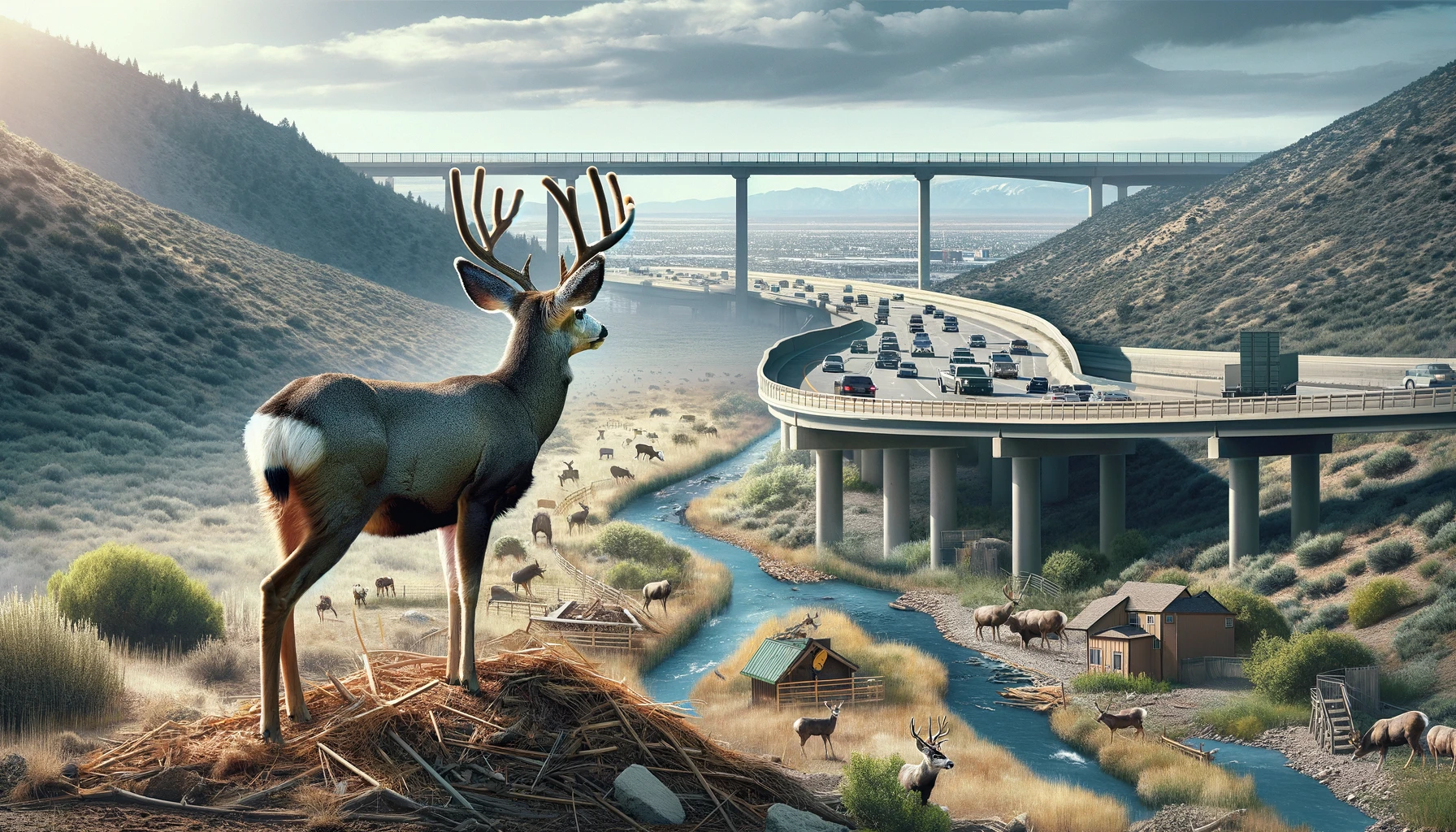
Mule deer live with a lot of pressure that is easy to miss from a distance. Roads split country. Housing and energy development break up cover. Drought can thin forage. Deep winter can raise the cost of every step. In some places, disease monitoring is part of the picture too. None of that means every herd is failing or recovering in the same way. It means the species responds to habitat quality, weather, access, and hunting rules all at once.
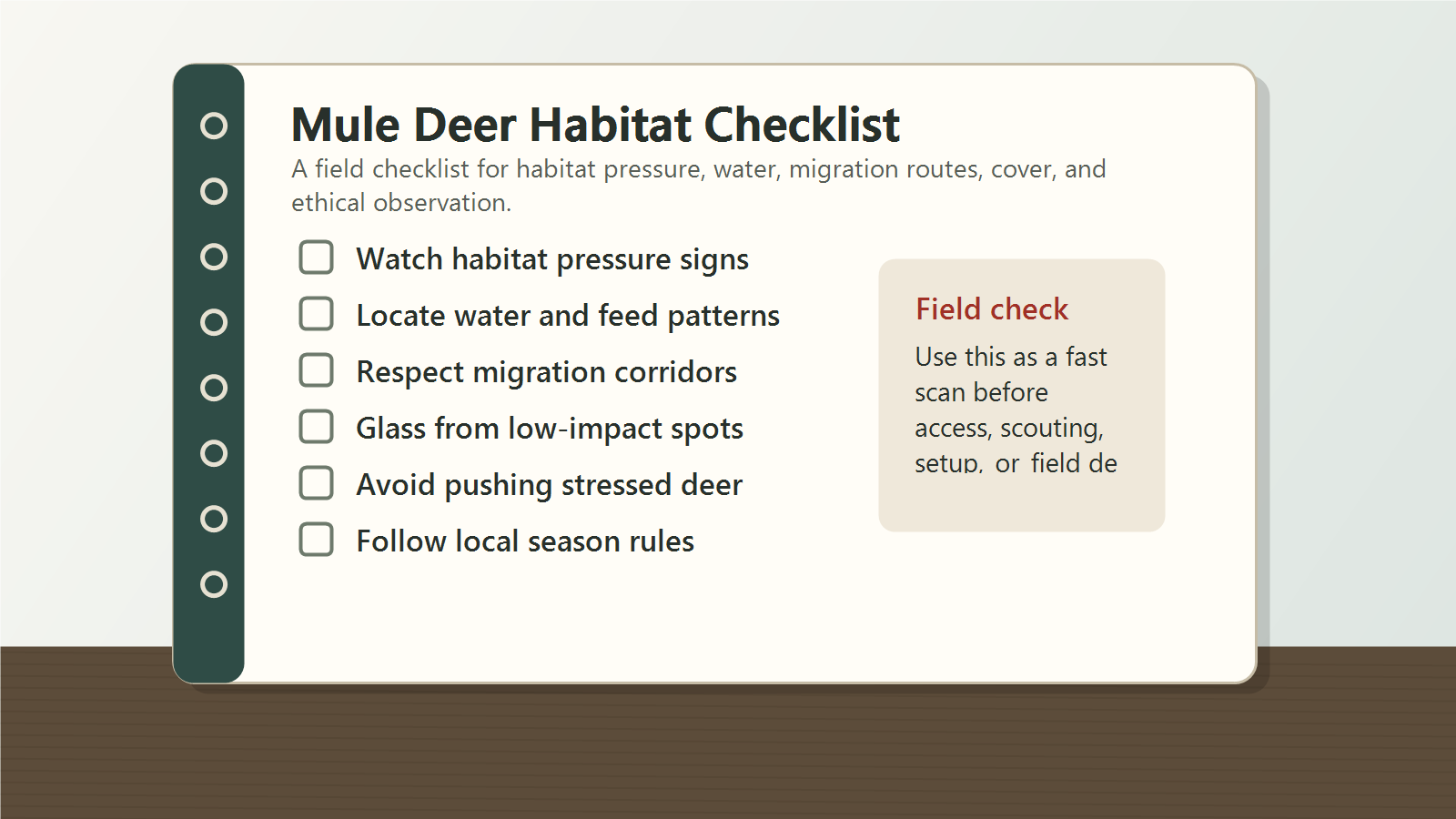
This article looks at mule deer with a practical lens: what habitat pressure does to them, why migration corridors matter, how drought and winter conditions shape survival, how state rules affect the hunt, and what ethical hunting looks like when the animal, the land, and the tag system all matter. The goal is not drama. It is clarity.
Table of contents
- What mule deer need
- Habitat pressure and fragmentation
- Migration corridors and movement
- Drought, snow, and winter stress
- Health, disease, and CWD
- State rules, tags, and season caveats
- Ethical hunting and fair chase
- Shot standards and field judgment
- Field choices that matter
- Conservation role for hunters
- Source anchors
- FAQ
What Mule Deer Need
Mule deer are built for western country with a mix of cover, forage, and room to move. They need places to feed, places to bed, and travel routes between seasonal ranges. In many landscapes, the best habitat is not one big patch. It is a working pattern of slope, sage, aspen, brush, browse, and open travel ground that still connects one season to the next.
Seasonal Range
Mule deer often use higher country in summer and lower or more sheltered country in winter. That seasonal shift is not a quirk. It is part of how the species survives snow, heat, and plant growth cycles. When that pattern is interrupted, deer can spend more energy getting where they need to go and less energy staying in shape.
Browse And Cover
Good mule deer habitat usually gives them enough browse, enough hiding cover, and enough distance from constant disturbance. They are not a grass-only species. Shrubs and forbs matter, as do places that let a deer rest without being pushed around by vehicles, fences, or repeated human traffic.
Space To Move
A healthy herd is not just about the acreage on a map. It is about how easily deer can use that acreage. A landscape can look large and still behave like a set of small traps if roads, subdivisions, fencing, or industrial activity break the country into pieces.
Habitat Pressure and Fragmentation
Habitat pressure is one of the main reasons mule deer management stays complicated. A herd can look stable in one valley while losing access to a winter range, a feeding area, or a migration route somewhere else. The issue is not only total land area. It is continuity and usefulness.
Fragmentation By Roads
Roads can kill deer directly through collisions, but they also change how deer use the landscape. Busy roads can act like walls. Deer may avoid crossing them, shift routes, or bunch into smaller areas where forage gets used harder. That can raise stress and lower body condition over time.
Fragmentation By Development
Housing, fences, energy infrastructure, and associated human activity can turn broad habitat into a set of smaller patches. Even when the species still exists in the region, the function of the land can change. A deer that once had a clear route between ranges may now have to detour, hesitate, or spend more time in exposed ground.
Habitat Quality
Fragmentation is only part of the story. Habitat quality matters too. If browse is overused, invasive plants spread, or cover becomes too thin, deer may still have access on paper while losing value on the ground. That is why habitat work often looks at forage, cover, movement, and seasonal timing instead of acreage alone.
Fences And Access
Fencing can be useful for land use, but it can also block movement, especially where fences are extensive or poorly placed. Wildlife-friendly design helps, but old fencing still matters in many places. A corridor that is usable for one part of the year can become risky or unusable once snow, traffic, or human pressure rises.
Migration Corridors and Movement
Migration corridors are one of the clearest examples of why mule deer conservation cannot be judged by one field or one season. Many herds move between summer and winter ranges, and they often use the same travel paths year after year. If those paths are interrupted, the cost lands on the deer immediately.
Why Corridors Matter
Corridors are not a luxury feature. They are the routes that let deer reach seasonal habitat. If the route is blocked, narrowed, or made risky, the herd can lose access to resources even if the end points still exist. A winter range that cannot be reached is not much of a winter range.
Crossings Help
Wildlife crossings, road fencing, and other connection projects can reduce collisions and help keep movement intact. They are not magic, and they are not a substitute for keeping habitat whole, but they can be a practical fix where roads already cut across known travel routes.
Corridors Are Not Static
Corridors change with snow, vegetation, traffic, and land use. A route that works in one decade can become too costly in another if development grows or disturbance gets heavier. Good management keeps watching movement instead of assuming the old route will still work.
Local Knowledge Matters
Hunters and land managers often learn a lot from trail cameras, glassing, and simple seasonal observation. That field knowledge should be read together with agency data, not against it. When the two agree, the picture gets stronger. When they differ, it is worth asking why.
Drought, Snow, and Winter Stress
Weather does not explain everything, but it can sharpen every other problem. Drought can reduce forage quality and quantity. Heavy snow can raise the energy cost of movement. Ice, crust, and cold can make feeding less efficient. A deer does not need a perfect storm to suffer. It only needs a long enough stretch of hard conditions.
Drought Effects
Drought can change when plants green up, how much nutrition browse holds, and how much water is available in a given area. If deer are already working around roads and development, drought can make the remaining habitat less forgiving. The result is often not a sudden event but a steady drain.
Winter Range Pressure
Winter range is often where the margin gets thinnest. If that land is crowded, overbrowsed, or pinned by disturbance, deer can lose condition faster. Managers watch winter range closely because the season exposes weak habitat fast.
Snowpack And Travel
Deep snow can make movement expensive and feeding harder. Deer may shift elevation, compress into sheltered pockets, or wait longer before moving. That is one reason seasonal timing matters so much. A route that seems open in September can be a poor option by January.
Do Not Overread One Season
One hard winter or one dry summer does not by itself tell the whole story. Mule deer numbers move for many reasons. A serious article should resist easy slogans and look at weather, habitat, recruitment, access, and harvest together.
Health, Disease, and CWD
Health issues belong in a mule deer article, but they should be handled plainly. Chronic wasting disease, or CWD, is a real management concern in many western herds. It is not a reason for panic, and it is not a reason to pretend the issue does not exist. It is a reason to check local guidance and handle harvested animals carefully.
What CWD Is
CDC and USGS both describe CWD as a prion disease affecting deer, elk, moose, and related animals. The disease is fatal in infected animals. For hunters, the practical point is simple: follow state testing and carcass guidance in areas where CWD is known or suspected.
What Hunters Should Do
Use official testing where offered or required. Do not handle or eat animals that look sick or act strangely. Wear gloves when field dressing. Avoid the brain and spinal cord. Use knives and tools carefully so they do not get mixed into kitchen gear without cleaning.
Stay Calm, Stay Current
CWD management changes by state and sometimes by unit. Do not rely on last year. Use the current state wildlife notice, the current check-in instructions, and the current carcass transport rules before you hunt.
Public Health Tone
A careful tone is the right tone here. The issue deserves respect, but alarm helps no one. What matters is practical risk reduction, accurate reporting, and compliance with current wildlife guidance.
State Rules, Tags, and Season Caveats
Mule deer hunting is local work. Even if the species is the same, the legal details are not. State rules can change from year to year, and unit rules can differ inside the same state. That means a responsible hunter checks the exact season, exact weapon type, exact tag, and exact boundary before stepping into the field.
Know The Exact Unit
Unit boundaries matter. A road, a ridge, or a drainage can separate legal ground from illegal ground. Carry the map that matches the current regulations, not a memory from last season.
Read Tag Conditions
Some tags allow one type of hunt, some are antlered or antlerless, and some carry specific restrictions on method, date, or location. A tag is not a broad permission slip. It is a narrow legal key.
Check Transport Rules
Transport and reporting rules can affect how meat, antlers, proof-of-sex parts, or carcass parts move after the hunt. If you cross state lines, the details get even more important. The clean habit is to read the rule before the hunt, not after the truck is loaded.
Do Not Guess On Season Status
Season timing can shift because of wildlife management goals, access changes, or disease response. A good hunter does not hunt by rumor. They hunt by the current agency rulebook.
Ethical Hunting and Fair Chase
Ethical hunting begins before the first stalk or stand. It includes the decision to hunt in the first place, the way a hunter interprets a tag, and the limits a hunter accepts when the shot is not right. For mule deer, fair chase still matters even when technology is strong and the country is open.
Fair Chase Means Restraint
Fair chase does not mean the animal has to be easy. It means the hunt should not erase the animal’s chance to use its normal behavior and the landscape around it. That is why stalking ethics, calling discipline, and shot selection all matter.
No Trophy Obsession
Antlers are part of mule deer hunting culture, but they are not the whole point. Obsession with inches can push people into bad decisions, poor etiquette, and weak respect for the animal. A mature approach keeps the hunt centered on use, discipline, and proper harvest.
Respect The Animal
Respect shows up in preparation, patience, and follow-through. It means you do not chase a shot just because the rack is impressive. It means you pass on poor angles. It means you care what happens after the shot, not only before it.
Respect Other People
Fair chase also includes landowners, other hunters, and non-hunters. Leave gates as found. Do not crowd another setup. Do not turn public land into a stage for ego. A calm, respectful hunter protects more access than a loud one ever will.
Shot Standards and Field Judgment
Shot ethics are where all the talk becomes real. A clean, humane harvest depends on realistic self-assessment. Bench groups do not matter much if the shot is rushed, far, unstable, or badly angled in the field. The animal should not pay for a hunter’s overconfidence.
Know Your Range
Know the distance where you can make a good shot from field positions, not only from a perfect rest. Wind, angle, adrenaline, and clothing all change the picture. If the setup is outside your real range, pass.
Angle Matters
Broadside is not the only factor, but it is often the simplest clean option. Quartering, head-on, steep downhill, and partially blocked angles all raise the risk of a poor hit. Good hunters weigh the whole picture, not just the visible chest.
Background Matters
What sits behind the deer matters just as much as the deer itself. A shot is only ethical if the background is safe and known. If the backstop is uncertain, the answer is no.
Be Honest About Excitement
Excitement can shrink judgment. That is normal. The discipline is to slow down enough to make the same choice you would make in a calm moment. If calm-you would pass, excited-you should pass too.
Field Choices That Matter
Good hunting is not one decision. It is a chain. Small choices about scouting, movement, sound, scent, timing, and recovery all shape the result. Those choices matter even more in pressured country, where mule deer are already dealing with habitat change and seasonal stress.
Scout With Purpose
Scout for movement, feed, bedding cover, and access routes. Do not just look for a big buck. Look at how the deer is using the land and what might push it out. That is often more useful than a single sighting.
Move With Care
In pressured habitat, careless movement burns opportunities fast. Keep noise down, watch the wind, and avoid pushing deer into unsafe places. The point is to take one ethical chance, not create three bad ones.
Plan Recovery First
Recovery planning should be part of the hunt plan. Know how you will mark the spot, track if needed, field dress, cool the meat, and pack out. Ethical hunting is not finished when the trigger breaks. It is finished when the animal is recovered and used properly.
Use Meat Well
Waste has no place in a serious discussion of mule deer hunting. Field care, transport, and processing are part of the responsibility. Even where the law gives some leeway, ethical hunters should aim higher than the minimum.
Conservation Role For Hunters
Hunters are not outside mule deer conservation. They are part of it. License revenue, habitat funding, data reporting, and field observations all help wildlife management work better. That does not make every hunt a conservation act by default. It means hunters carry a duty to behave in ways that support the system that makes hunting possible.
Habitat Work Pays Off
When habitat is protected, restored, or connected, mule deer get more than a place to stand. They get access between seasonal ranges, better forage security, and lower stress from forced bottlenecks. That is the kind of work that lasts longer than a single season.
Report What You See
Hunters often notice changes first: new fences, fresh development, roadkill clusters, poor fawn recruitment, winter loss, or strange animal behavior. Reporting that information through the right agency channels helps managers track what is happening on the ground.
Support Working Habitat
Not every conservation gain comes from a new reserve. Easements, migration protection, better road design, and wise public-land decisions can keep country usable without turning it into a closed exhibit. That kind of work is often quiet, but it matters a lot.
Source Anchors
These are the main reference points used to shape the article and keep it grounded in current public guidance:
- CDC: About Chronic Wasting Disease
- USGS National Wildlife Health Center: Chronic Wasting Disease
- Colorado Parks and Wildlife
- Colorado Parks and Wildlife: CWD Information and Testing
- Utah Division of Wildlife Resources
- Wyoming Game and Fish Department
- Wyoming Game and Fish Department: Chronic Wasting Disease
- Bureau of Land Management
For current hunting legality, tag rules, season dates, carcass movement rules, and CWD testing details, always check the exact state and unit page for the year you plan to hunt.
FAQ
Are mule deer in trouble everywhere?
No. Mule deer conditions vary a lot by region. Some herds are under strong pressure, some are steadier, and some have recovered better than expected. The right question is not whether every herd is in the same state. It is what is happening in the specific landscape you care about.
Why do migration corridors matter so much?
Because they connect seasonal ranges. If the path is blocked or made too risky, deer may lose access to food, cover, and winter refuge even when those places still exist on the map.
Is CWD a reason to stop hunting mule deer?
No. It is a reason to follow current state guidance, test where required or offered, and handle meat carefully. Hunters should stay practical, not panicked.
What is the most ethical shot on mule deer?
The most ethical shot is the one you can make cleanly, with a safe background, a clear target, and a realistic recovery plan. If any part of that is missing, the ethical choice is to pass.
How should hunters think about antlers?
As one part of the animal, not the whole purpose of the hunt. A healthy hunting culture values meat, restraint, legality, and respect as much as antler size.
What is the biggest conservation issue for mule deer?
There is no single universal answer, but habitat pressure, migration interruption, and weather stress are among the most common and important issues across the West. Those factors often interact instead of acting alone.