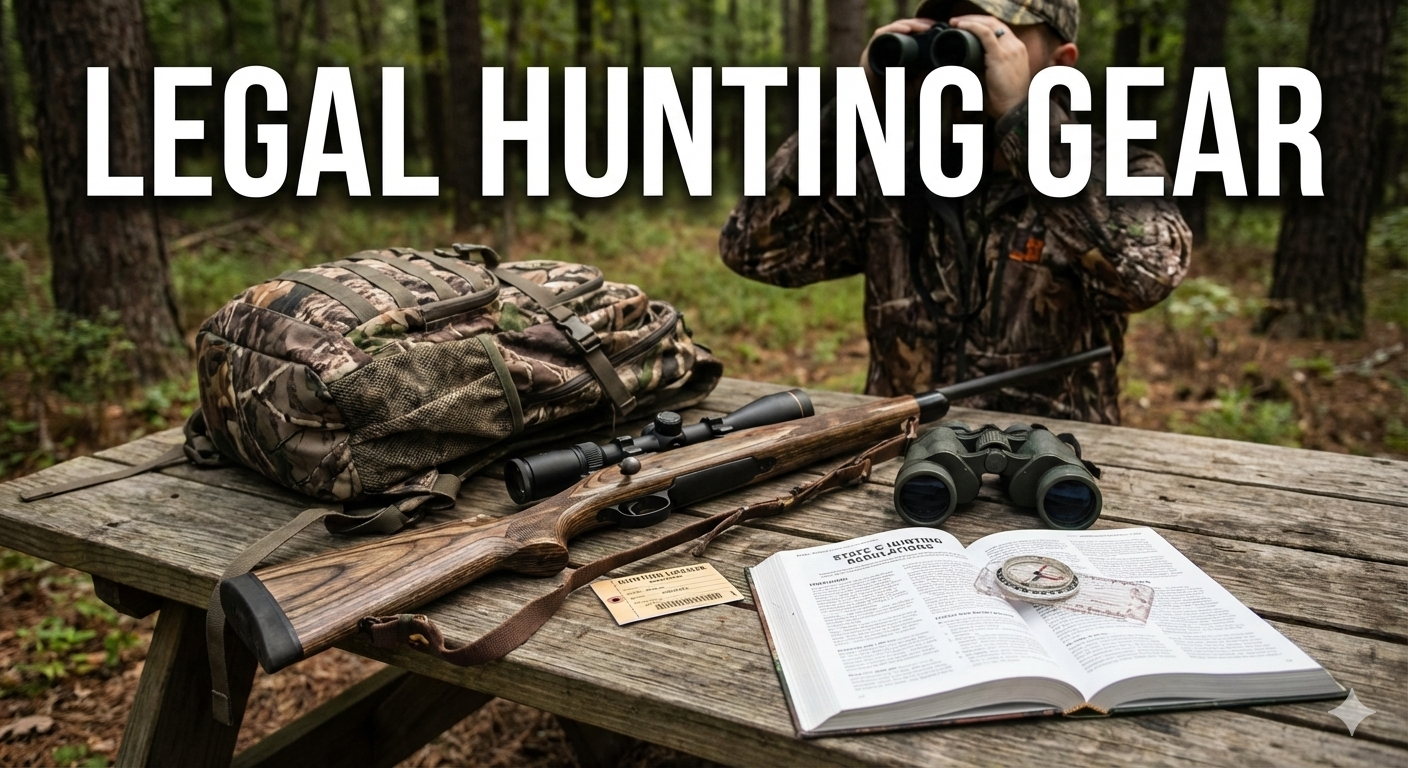
Hunting is a deeply rooted tradition that combines skill, patience, and respect for wildlife. However, beyond marksmanship and outdoor knowledge, every hunter must understand one critical responsibility: using legal hunting gear. Laws governing hunting equipment exist to ensure safety, promote ethical harvest, protect wildlife populations, and maintain fair chase principles. Failing to follow these laws can result in fines, loss of hunting privileges, or even permanent license revocation.
Legal hunting gear is not universal. What is allowed in one state, season, or species may be illegal in another. For this reason, hunters must stay informed and verify that their weapons, accessories, and tools comply with local wildlife regulations before entering the field.
Table of Contents
Hunting gear is considered legal when it meets the specific regulations set by state or regional wildlife authorities for a particular game animal and hunting season. These regulations are designed around conservation goals and safety concerns. A rifle that is legal for deer during firearm season may be illegal during archery season, and equipment approved for small game may be prohibited for big game.
Factors that determine legality include the type of animal being hunted, the method of take, the time of year, and the geographical location. Even minor details, such as magazine capacity or arrowhead design, can determine whether gear is lawful or prohibited.
Firearms are among the most regulated hunting tools. While rifles, shotguns, and handguns are commonly used for hunting across the United States, they are subject to strict rules. Most states specify minimum calibers for big game hunting to ensure humane kills. Using a caliber that is too small may be illegal even if the firearm itself is otherwise lawful.
Shotgun hunting often comes with additional restrictions. In many areas, hunters are required to use slugs rather than buckshot for deer. Magazine capacity limits are common, especially for waterfowl and upland bird hunting, where shotguns must be plugged to restrict the number of shells they can hold.
Automatic firearms are illegal for hunting everywhere, and some states also restrict semi-automatic rifles. Suppressors are legal for hunting in some states but banned in others, making it essential to confirm local laws before use.
Bowhunting is widely accepted and often has its own dedicated seasons. Compound bows, recurve bows, and longbows are generally legal, provided they meet minimum draw weight requirements. These minimums are set to ensure sufficient penetration and ethical harvest.
Crossbows have become increasingly popular, but their legality varies significantly. Some states allow crossbows during archery season, others restrict them to firearm season, and some only permit their use for hunters with disabilities. Broadheads must usually have cutting edges, and mechanical broadheads may be restricted in certain states.
Poisoned arrows, explosive tips, and any broadheads designed to detonate on impact are universally illegal due to safety and ethical concerns.
Muzzleloader hunting seasons are typically regulated more strictly than modern firearm seasons. These seasons are designed to preserve traditional hunting methods and limit effective range. Many states require muzzleloaders to be single-shot and restrict ignition systems.
Powder type is another critical factor. Black powder or approved substitutes are generally legal, while smokeless powder is almost always prohibited. Optics may be restricted during primitive seasons, with some states allowing only iron sights.
Optics such as rifle scopes, red dot sights, binoculars, and spotting scopes are legal in most hunting situations. Rangefinders are also commonly allowed, although models with advanced ballistic calculators may be restricted in some states.
The use of electronic devices is one of the most complex areas of hunting law. Thermal imaging and night vision optics are illegal for hunting big game in most states because they remove the element of fair chase. Electronic calls are often banned for deer and elk but may be legal for predators such as coyotes.
Drones are widely prohibited for scouting or locating game, as they provide an unfair advantage and disrupt wildlife behavior.
Ammunition laws exist to ensure ethical harvest and reduce environmental harm. Expanding bullets, such as soft point or hollow point ammunition, are typically required for big game hunting. Full metal jacket bullets are often illegal because they do not expand reliably and increase the risk of wounding animals.
Lead ammunition has been banned in certain states and wildlife zones due to concerns about poisoning scavenger species. Hunters in these areas must use copper or other non-lead alternatives.
For archery hunters, arrow and broadhead specifications may include minimum cutting diameter and blade count. Lighted nocks are allowed in many states but restricted in others.
Hunting clothing is largely unrestricted, but safety visibility laws are common. During firearm seasons, many states require hunters to wear blaze orange or blaze pink to reduce hunting accidents. The required amount and placement vary by state, but it must be visible from all directions.
Camouflage clothing, insulated jackets, gloves, and boots are all legal, and there are typically no restrictions on materials or patterns outside of visibility rules.
Most basic hunting accessories are legal, including backpacks, knives, GPS units, and headlamps. However, how and when they are used can matter. Artificial light may be prohibited for spotting or shooting game but allowed for tracking wounded animals.
Tree stands are legal in most states but may require landowner permission on private property or special permits on public land. Baiting equipment is heavily regulated and often illegal for deer hunting due to disease concerns.
Certain types of gear are widely prohibited across the country. These include fully automatic firearms, explosive ammunition, poison-tipped weapons, and any equipment designed to herd or harass animals using vehicles or aircraft. Shooting from a vehicle is illegal in almost all cases.
Using artificial light, thermal optics, or night vision for big game hunting is one of the most common violations and carries severe penalties.
The most reliable way to ensure legality is to review your state’s official hunting regulations each season. Laws can change annually, and relying on outdated information can lead to violations. When unsure, contacting a local game warden is often the best course of action.
Responsible hunters double-check their equipment before every hunt and understand that ignorance of the law is not a valid defense.
Using legal hunting gear is about more than avoiding penalties. It supports wildlife conservation, ensures humane harvest, and preserves the integrity of hunting as a respected outdoor tradition. Ethical hunters understand that following regulations protects access to hunting land and seasons for future generations.
Legal hunting gear forms the foundation of responsible and ethical hunting. While regulations can seem complex, they exist to balance human participation with wildlife conservation. Every hunter has a duty to stay informed, prepared, and compliant.
Before stepping into the field, take the time to confirm that every piece of your gear is legal. Doing so protects you, the wildlife, and the future of hunting itself.
3D archery has become one of the fastest-growing disciplines in the archery world. Unlike traditional…
Target archery is a sport where precision matters more than power. Even the slightest movement…
Bow strings are one of the most important components of any bow. Whether you shoot…
Getting started with a compound bow can be exciting. Compound bows offer impressive accuracy, speed,…
When people think about snipers, they often imagine extremely powerful scopes capable of zooming targets…
The .308 Winchester is one of the most respected rifle cartridges ever created. Whether you’re…
This website uses cookies.
