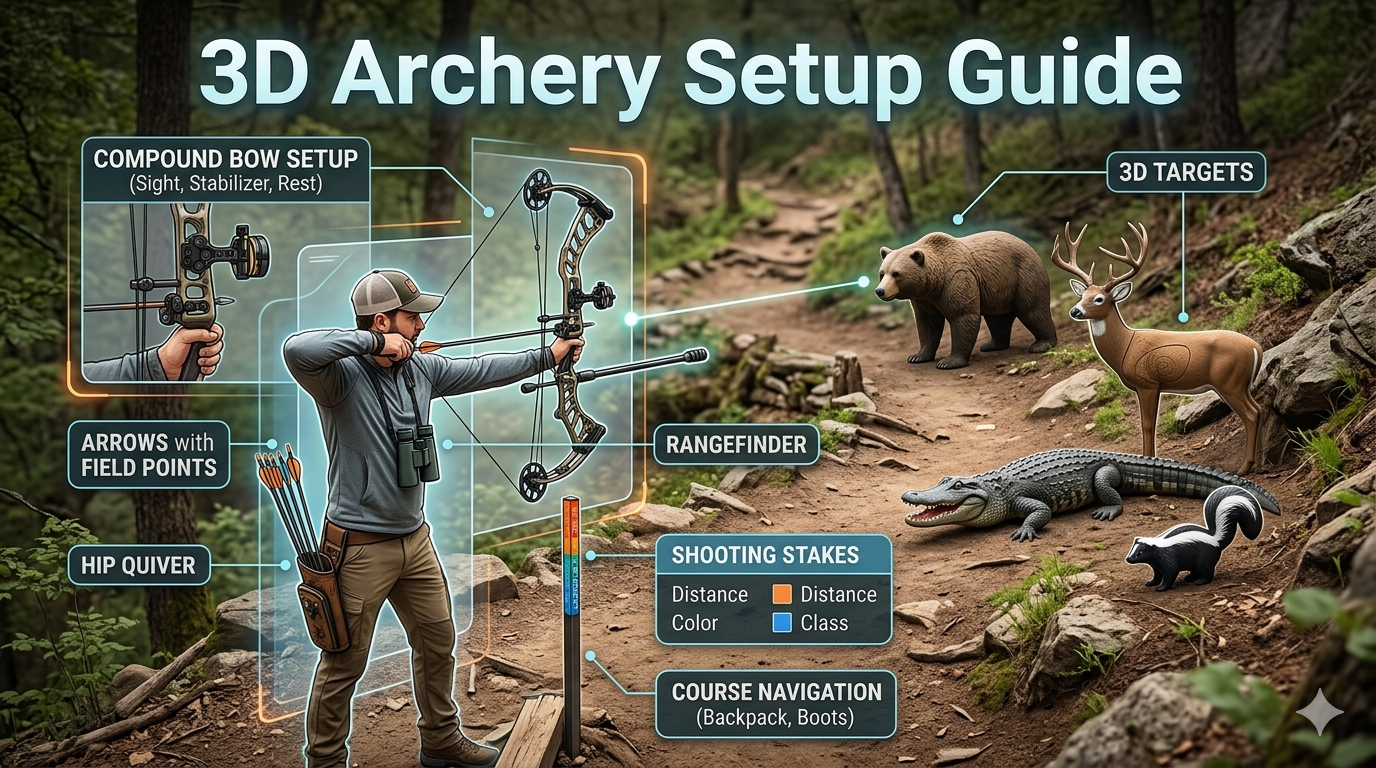
3D archery has become one of the fastest-growing disciplines in the archery world. Unlike traditional target shooting, 3D archery simulates real hunting situations by placing foam animal targets at varying distances, angles, elevations, and terrain conditions. This format helps archers develop realistic shooting skills while providing an exciting competitive environment.
Whether you’re preparing for tournaments, improving your hunting accuracy, or simply looking to challenge yourself, having the right 3D archery setup can significantly improve your performance.
This comprehensive guide covers everything you need to know about building the ideal 3D archery setup, including bow configuration, sight selection, stabilizers, arrows, broadhead practice, and tuning tips.
A 3D archery setup is a bow configuration specifically optimized for shooting life-sized animal targets at unknown or known distances in outdoor environments.
Unlike indoor target setups, 3D archery equipment prioritizes:
The ideal setup balances speed, accuracy, and comfort while allowing the archer to quickly adapt to changing shot scenarios.
Before selecting equipment, it’s important to understand the unique demands of 3D courses.
Table of Contents
Targets can range anywhere from:
Accurate distance estimation becomes a critical skill.
Shots may occur:
Your setup must remain stable in awkward shooting positions.
Unlike target tournaments where archers have ample time, many 3D scenarios require quick target acquisition and execution.
Outdoor ranges introduce:
Equipment must remain reliable under varying conditions.
Most competitive 3D archers use compound bows because they offer:
Popular draw weight ranges:
For 3D archery, bows between:
provide a good balance between:
Longer bows generally offer more forgiveness on longer shots.
Your sight is one of the most important components of a successful 3D setup.
Advantages:
Best for:
Advantages:
Typical configuration:
Many archers prefer a 3-pin movable sight for maximum flexibility.
Stabilizers play a major role in shot execution.
A front stabilizer helps:
Common lengths:
Many competitive shooters add a rear stabilizer to:
Popular lengths:
Proper weight distribution often matters more than stabilizer length.
Arrow choice directly affects:
Advantages:
Advantages:
Many top competitors favor micro-diameter shafts for outdoor shooting.
Typical finished arrow weights:
350–400 grains
Benefits:
400–450 grains
Benefits:
Most 3D archers prefer arrows in the 380–450 grain range.
Most 3D competitions require field points rather than hunting broadheads.
Common choices include:
To maintain realistic hunting practice:
This creates consistency between tournament shooting and hunting preparation.
A quality release significantly affects accuracy.
Benefits:
Benefits:
Benefits:
Many competitive 3D archers use thumb releases due to their balance of precision and speed.
Even the best equipment underperforms without tuning.
Paper tuning helps identify:
Goal:
This verifies:
Shoot from:
Arrows should remain vertically aligned.
Even if you compete with field points, periodically verify broadhead impact.
This ensures:
Incorrect draw length causes:
Signs your draw length is too long:
Signs it’s too short:
A professional fitting can dramatically improve shooting consistency.
Success in 3D archery often depends on accurate range judgment.
Practice estimating:
Common techniques:
Compare target size to known distances.
Assess:
Use:
as visual markers.
Equipment alone does not win tournaments.
Develop a consistent shooting process:
Avoid rushing shots even when under time pressure.
Heavy draw weights can:
Shoot the highest weight you can control comfortably.
Wind affects arrow flight significantly at longer distances.
Practice shooting in:
Many archers continually modify:
Frequent changes prevent mastery.
Build a setup and learn it thoroughly.
Incorrect spine selection leads to:
Always match arrow spine to:
A balanced tournament setup might include:
This configuration offers excellent versatility for most 3D courses.
Building the perfect 3D archery setup isn’t about buying the most expensive equipment it’s about creating a balanced system that fits your shooting style and goals.
Focus on proper bow fit, consistent tuning, quality arrows, and reliable accessories. Combine that equipment with regular practice and distance-estimation training, and you’ll quickly see improvements in both tournament scores and hunting performance.
The best 3D archery setup is one that allows you to shoot confidently, accurately, and consistently under real-world conditions. Invest time in tuning and practice, and your equipment will reward you with better performance on every course.
Target archery is a sport where precision matters more than power. Even the slightest movement…
Bow strings are one of the most important components of any bow. Whether you shoot…
Getting started with a compound bow can be exciting. Compound bows offer impressive accuracy, speed,…
When people think about snipers, they often imagine extremely powerful scopes capable of zooming targets…
The .308 Winchester is one of the most respected rifle cartridges ever created. Whether you’re…
When it comes to hunting rifles, few debates are as common or as important as…
This website uses cookies.
