5 Best Wind Meters for Shooting: Handheld Anemometers Compared
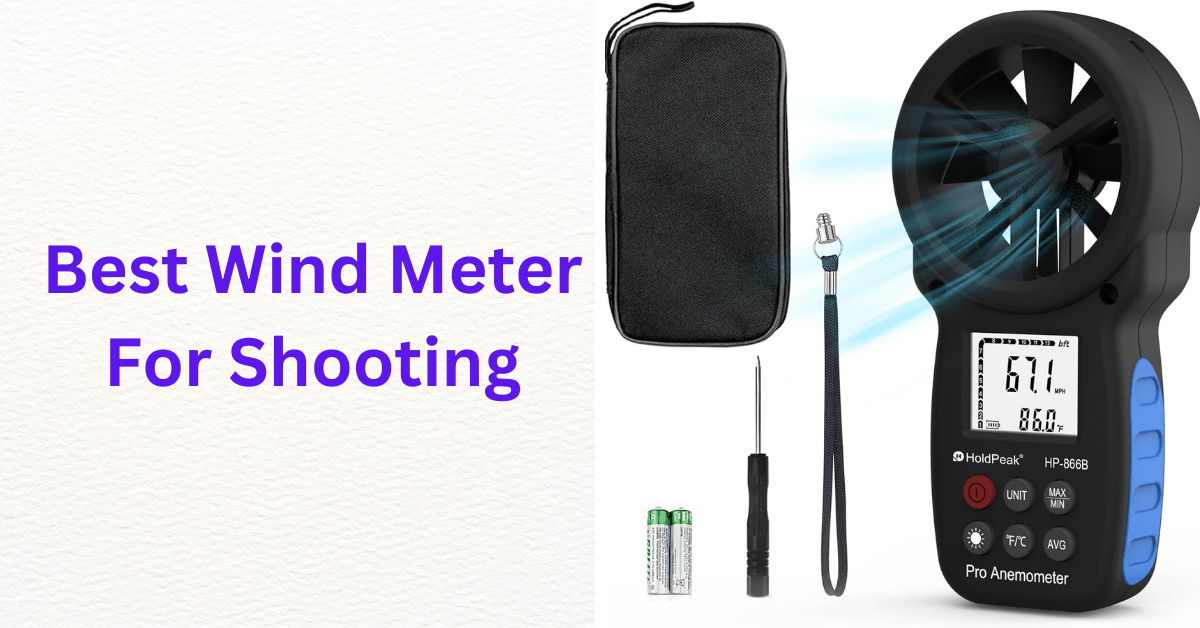
A wind meter helps you read conditions at the firing line, but it does not call the shot for you. It measures what the air is doing right where you stand, such as wind speed, temperature, and wind chill, so you can make a more informed decision before you press the trigger. It is a reading aid, not an accuracy guarantee, and it does not replace marksmanship fundamentals, a zeroed rifle, or a careful read of the wind downrange.
This guide compares five current handheld anemometers that suit shooters who want a portable way to check wind at the bench, in the field, or on a hunt. Picks below cover a simple budget meter, a large-screen option, a Bluetooth app model, a protected field meter, and a compact high-readability unit. Each section lists verified features from the product listing, who the meter suits, honest pros and cons, and a clear reason to skip it.
Table of Contents
Quick Picks
| Pick role | Wind meter | Stands out for | Check it |
|---|---|---|---|
| Best simple field meter | BTMETER BT-100 Handheld Anemometer | Wide wind range and a tripod hole for hands-free reading | View on Amazon |
| Best app-connected option | BTMETER BT-100APP Wireless Bluetooth Anemometer | Bluetooth app with data logging and export | View on Amazon |
| Best large-screen readability | TopTes TS-301 Digital Anemometer | 2.26-inch backlit screen plus humidity and temperature | View on Amazon |
| Best protected field meter | Clatoon Handheld Anemometer | Wide wind range with a protective case | View on Amazon |
| Best compact carry meter | BTMETER BT-816B Mini Digital Anemometer | Small size with max, average, and current modes | View on Amazon |
How We Chose These Wind Meters
We chose these wind meters through research, not hands-on testing, and we say so plainly. We started from a current list of handheld anemometers with live Amazon availability signals, then narrowed to models whose listed features make sense for shooters: a usable wind-speed range, multiple units, a backlit screen for low light, and field-friendly extras such as a tripod hole, a case, or app logging.
We only state specifications that appear in each product’s listing or manual. We do not list prices, star ratings, review counts, or invented test numbers. Where a feature matters for shooting, we explain what it does for you and where it falls short, so the page helps a real buyer decide rather than just describing boxes on a shelf.
Best Wind Meters for Shooting
These five handheld anemometers cover the common ways shooters use a wind meter: a quick check at the bench, a logged reading on a tripod, or a pocket meter for a walk-in hunt. Read each meter as a tool for gathering information about local conditions, then apply your own wind call.
Best Simple Field Meter: BTMETER BT-100 Handheld Anemometer

The BTMETER BT-100 is a straightforward handheld anemometer that does the core job a shooter wants: measure wind speed, wind temperature, and wind chill, and show them on a backlit screen. It reads wind speed across a wide range and switches between five units, so you can work in mph at the line or in m/s if that is how your data card is set up.
Best for: Shooters who want a no-frills meter for checking wind at the bench or in the field without paying for app features.
Verified specs (from the listing): Wind speed range 0.67 to 67.1 mph; wind temperature range -10 to 60C (14F to 113F); five wind-speed units; wind chill reading; tripod hole for mounting; backlit LCD; data hold.
What stands out: The tripod hole lets you mount the meter and read it hands-free, which is useful when you want to keep a wind value in view while you set up behind the rifle. The wide wind-speed range covers calm mornings through stronger gusts, and the backlight keeps the screen readable in low light.
Who it suits: A practical first wind meter for range days and hunts where you want a quick, repeatable reading and do not need phone connectivity or logged data.
Pros:
- Wide listed wind-speed range covers light to strong wind.
- Tripod hole supports hands-free reading.
- Five units and a wind-chill reading cover most shooter needs.
Cons:
- No Bluetooth or app logging, so readings are read-and-record by hand.
- Basic display compared with larger-screen meters.
Skip this if: You want your wind readings logged or sent to your phone for review, since this model has no app or wireless connection.
Note: The specific BT-100 listing we originally linked was discontinued. This is the same BT-100 model with matching specs, now on a current listing.
Best App-Connected Option: BTMETER BT-100APP Wireless Bluetooth Anemometer

The BTMETER BT-100APP adds Bluetooth app support to a familiar handheld anemometer. It measures wind speed in five units and reads wind chill, and the app side adds data logging and export, so you can keep a record of conditions across a session instead of memorizing numbers.
Best for: Shooters who track wind data over a string or a match and want readings saved rather than scribbled.
Verified specs (from the listing): Bluetooth app support; wind speed range 0.3 to 30 m/s; five wind-speed units; wind chill reading; data logging and export; tripod mount; backlit LCD; temperature range 14F to 113F.
What stands out: The app connection and data logging set this model apart from the simpler BT-100. If you like to review how wind behaved over time or pull readings into your own notes, the export feature does that work for you. The tripod mount means you can still leave it set up while you shoot.
Who it suits: Data-minded shooters, practical-rifle and long-range competitors, and anyone who wants a session record rather than single-glance readings. Compared with the BT-100, you trade simplicity for logging and connectivity.
Pros:
- Bluetooth app with data logging and export for session records.
- Tripod mount supports hands-free use.
- Five units and wind chill match general shooter needs.
Cons:
- App-based features add steps versus a glance-and-go meter.
- Listed wind-speed range tops out at 30 m/s, lower than some wider-range meters here.
Skip this if: You only ever want a fast single reading and would never open an app, since the logging features are the main reason to pick this model over the plain BT-100.
Best Large-Screen Readability: TopTes TS-301 Digital Anemometer

The TopTes TS-301 leads with a large 2.26-inch backlit LCD, which makes it easy to read a wind value at a glance. It also measures six units and adds humidity and temperature sensing, so you get a fuller picture of the air around you rather than wind speed alone.
Best for: Shooters who want the clearest, biggest readout and value humidity and temperature data alongside wind.
Verified specs (from the listing): 2.26-inch backlit LCD; six measuring units; humidity and temperature sensing; humidity range 0.0% to 99.9% RH; temperature range -4F to 140F; auto shutoff.
What stands out: The big backlit screen is the headline feature for anyone who has squinted at a tiny meter in flat light or fading evening sun. The added humidity sensor and the wide temperature range give you more environmental context, and the auto shutoff helps preserve battery between readings.
Who it suits: Older eyes, bright or dim light at the range, and shooters who like to note humidity and temperature along with wind. The trade-off is a slightly larger device to carry than the compact meters here.
Pros:
- Large 2.26-inch backlit screen is easy to read.
- Six units plus humidity and temperature sensing.
- Auto shutoff helps save battery.
Cons:
- Humidity and temperature sensors can need time to settle in a new environment.
- Larger than the pocket-style meters in this lineup.
Skip this if: You want the smallest possible meter to clip into a chest pocket, since the larger screen makes this a bigger unit to carry.
Best Protected Field Meter: Clatoon Handheld Anemometer

The Clatoon Handheld Anemometer pairs a wide wind-speed range with a protective case, which makes it a sensible pick for shooters who use a meter outdoors in rough conditions. It reads wind speed, wind temperature, air volume, and wind chill across five units, and it shuts off automatically to save power.
Best for: Hunters and field shooters who want a wide wind range and built-in protection for the meter.
Verified specs (from the listing): Wind speed, wind temperature, air volume, and wind chill readings; five units; wind speed range 0 to 65 mph (0 to 30 m/s); backlight; yellow protective case; auto power off.
What stands out: The protective case is the standout for field use, where a meter rides in a pack or pocket alongside other gear. The wide wind-speed range covers calm to strong conditions, and the backlight keeps it usable in low light. The air-volume reading is more useful for airflow checks than for shooting, but the wind functions cover the shooter basics.
Who it suits: Walk-in hunters and field-day shooters who want a rugged-leaning meter and do not need app connectivity. Compared with the BT-100, you gain the case; compared with the BT-100APP, you give up logging.
Pros:
- Wide listed wind-speed range covers light to strong wind.
- Protective case suits pack and field carry.
- Auto power off helps save battery.
Cons:
- No Bluetooth or data logging.
- Some functions, such as air volume, are not shooting-specific.
Skip this if: You want logged or app-connected readings, since this is a standalone meter with no wireless features.
Best Compact Carry Meter: BTMETER BT-816B Mini Digital Anemometer

The BTMETER BT-816B is a compact meter built around quick, readable values. It measures wind speed in five units and reads wind chill, and it shows max, average, and current readings, so you can see a gust peak and a running average rather than a single number that has already changed.
Best for: Shooters who want a small, pocketable meter that still shows max and average wind, not just the instant value.
Verified specs (from the listing): Wind speed range 0.3 to 30 m/s; temperature range -10C to 45C; wind chill reading; max, average, and current modes; five wind-speed units; LCD backlight; auto and manual power off.
What stands out: The max, average, and current modes are the useful part for shooting. Wind rarely holds steady, so seeing a recent peak and an average alongside the current reading gives you a better sense of the range you are dealing with than a lone instant value. The compact size makes it easy to carry, and the backlight covers low light.
Who it suits: Shooters who prioritize small size and want a fuller picture of variable wind from a single meter. The trade-off is a smaller screen than the TopTes TS-301 and a wind range that tops out at 30 m/s.
Pros:
- Compact and easy to carry.
- Max, average, and current modes help read gusty wind.
- Five units, wind chill, and backlight cover shooter basics.
Cons:
- Smaller screen than the large-display option here.
- Listed wind-speed range tops out at 30 m/s.
Skip this if: You want the largest, easiest-to-read screen, since this compact meter trades display size for portability.
Note: The specific BT-816B listing we originally linked was discontinued. This is the same BT-816B model with matching specs, now on a current listing.
Comparison Table
| Wind meter | Listed wind-speed range | Units | Notable extras | Connectivity |
|---|---|---|---|---|
| BTMETER BT-100 | 0.67 to 67.1 mph | 5 | Tripod hole, wind chill, data hold | None |
| BTMETER BT-100APP | 0.3 to 30 m/s | 5 | Data logging and export, tripod mount, wind chill | Bluetooth app |
| TopTes TS-301 | 6 units, see listing | 6 | 2.26-inch screen, humidity, temperature, auto shutoff | None |
| Clatoon Handheld | 0 to 65 mph (0 to 30 m/s) | 5 | Protective case, air volume, wind chill, auto power off | None |
| BTMETER BT-816B | 0.3 to 30 m/s | 5 | Max/average/current modes, wind chill, backlight | None |
Note: The TopTes TS-301 listing states six measuring units and humidity and temperature ranges rather than a single headline wind-speed range, so its row reflects the units and extras given in its product text.
Wind Meter Buying Guide
A handheld wind meter gives you a local data point, and the rest of the wind call is on you. Use this guide to match a meter to how you shoot, and remember the standing rule for this page: a meter reads conditions, it does not guarantee where the bullet lands.
What a Wind Meter Measures
Most handheld anemometers for shooting measure wind speed, and many add wind temperature and wind chill. Wind speed is the headline value, usually shown in units such as mph, m/s, km/h, knots, or ft/min, and you switch units to match your data card or app. Some meters, such as the TopTes TS-301 in this lineup, also read humidity and temperature, which gives you more context about the air. A key limitation to keep in mind: a handheld meter reads the wind at your position, not the wind out where the bullet flies, so it informs your call rather than making it.
Accuracy Factors to Understand
A meter’s reading depends on how and where you hold it. Point the vane into the wind, hold it steady, and give the reading a moment to settle. Because wind shifts, a single instant reading can mislead you, which is why models with max, average, and current modes, like the BTMETER BT-816B, help you see a range instead of one moment. Temperature and humidity sensors can also need time to adjust when you move from a warm vehicle into cold air. None of this turns a meter into a guarantee. The U.S. National Weather Service notes that wind conditions change and can matter outdoors, which is exactly why a reading taken now may not match a reading taken a few minutes later. For general wind-safety context, see the National Weather Service wind page: https://www.weather.gov/safety/wind.
Bluetooth and Ballistics Integrations at a High Level
Some meters, like the BTMETER BT-100APP here, connect to a phone app over Bluetooth and can log or export readings. At a high level, app connectivity lets you record conditions over a session and keep a tidy record rather than memorizing numbers. Logged wind data can be a handy input if you also use a separate ballistics or shooting app, but a handheld meter on its own does not compute a firing solution or promise a hit. Treat connectivity as a record-keeping and convenience feature, and keep any ballistics math in a tool designed for it.
When a Handheld Meter Versus a Weather Station
A handheld anemometer is the right tool for most shooters: it is portable, quick, and easy to use at the bench or on a walk-in hunt. A dedicated weather station or a tripod-mounted setup makes more sense when you want continuous monitoring from a fixed position, such as a long static range session, and several meters here include a tripod hole or mount so you can leave them set up. If you only need an occasional spot check, a handheld meter is enough. If you want hands-free, ongoing readings in view while you shoot, mount the meter and keep treating the number as information, not a promise.
Frequently Asked Questions
Does a wind meter make me a more accurate shooter?
No. A wind meter gives you a reading of local conditions, but it does not call the shot, compute a correction, or guarantee a hit. It is one input that supports your own wind reading and marksmanship fundamentals.
What wind-speed units should I use for shooting?
Use whatever matches your data card or app, commonly mph or m/s. Most meters in this guide offer five or six units, so you can switch to the one you already work in and avoid converting in your head at the line.
Do I need a Bluetooth wind meter?
Only if you want to log or export readings. A Bluetooth model like the BTMETER BT-100APP records conditions across a session, while a standalone meter shows the value on its screen for you to read and note by hand.
Can a handheld wind meter measure the wind downrange?
No. A handheld meter reads the wind where you are standing. The wind farther downrange can differ, so your reading is a starting point that you adjust with experience and observation, such as watching mirage, vegetation, or flags.
Should I mount a wind meter on a tripod?
Mounting helps when you want a hands-free, continuous reading in view while you set up or shoot. Several meters here, including the BTMETER BT-100 and BT-100APP, have a tripod hole or mount for that purpose. For quick spot checks, handheld use is fine.
How do I get a steadier reading?
Point the meter’s vane into the wind, hold it still, and give it a few seconds to settle before recording. If the wind is gusty, a meter with max, average, and current modes, like the BTMETER BT-816B, shows you a range rather than one fleeting number.
Final Recommendation
For most shooters, the BTMETER BT-100 is a sensible starting meter: a wide listed wind range, five units, and a tripod hole at a simple, no-app level. If you want your readings logged, step up to the BTMETER BT-100APP for Bluetooth and data export. Choose the TopTes TS-301 if a large, easy-to-read screen and humidity data matter most, the Clatoon Handheld if you want a protective case for field carry, and the BTMETER BT-816B if you want a compact meter that still shows max and average wind. Whichever you pick, treat the number as information that supports your wind call, not a guarantee of the shot.
In-Body Image Alt Text Suggestions
- Decision/comparison visual alt text: “Comparison of five handheld wind meters for shooting showing wind-speed range, units, screen, and field features to help choose the right anemometer.”
- Buyer checklist alt text (if checklist style is used instead): “Wind meter buying checklist for shooters with blank boxes covering wind range, units, screen readability, app logging, and field protection, from TheShootingGears.com.”
- Product image alt text pattern: “[Product name] handheld anemometer for shooting” linking to its /dp/ASIN?tag=shootinggea0f-20 Amazon page.