MIL vs MOA Reticles: How to Choose the Best Long-Range Scope System
The best reticle system for a long-range scope is the one you can read quickly, match to your turret system, and use consistently under real field or range conditions. MIL and MOA can both work well. The mistake is mixing a MIL reticle with MOA turrets, choosing a busy reticle you cannot interpret, or buying a scope before you understand how you will actually hold, dial, and correct shots.
This guide compares MIL and MOA reticles as a practical decision, not a brand ranking. It does not tell you to take longer shots. It helps you choose a scope system that supports safer, more consistent practice, clearer corrections, and fewer math mistakes.
Table of Contents
Quick Answer
Choose MIL if you already think in milliradians, shoot with people who use MILs, or want a common tactical/competition-style correction system. Choose MOA if you are more comfortable thinking in inches at 100 yards and prefer quarter-MOA-style turret adjustments. Either system is fine if the reticle and turrets match.
For most buyers, the best long-range reticle is not the busiest one. It is a clean, readable reticle with useful hash marks, a matching turret system, visible center aiming point, and enough reference marks for wind holds without covering the target.
MIL vs MOA in Plain English
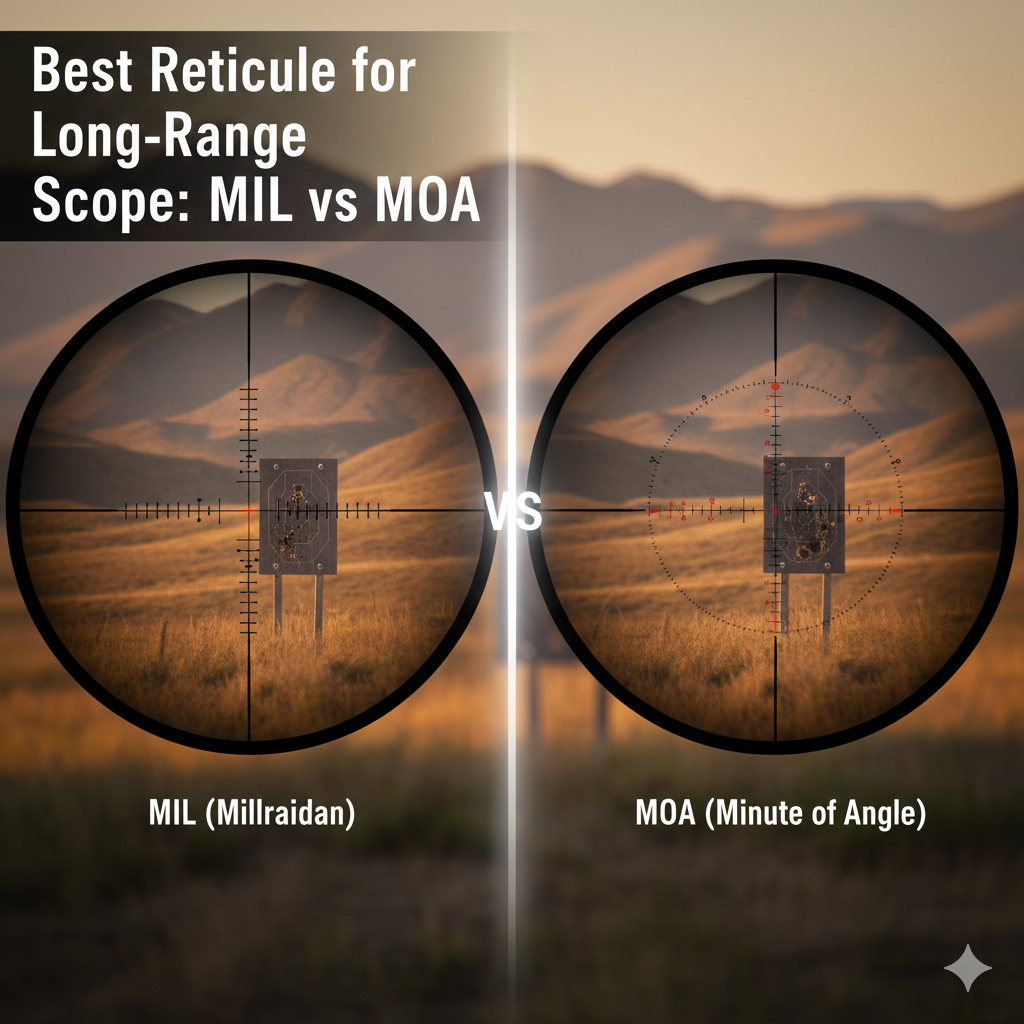
MIL is short for milliradian. A milliradian is an angular measurement, not a fixed inch measurement. MOA means minute of angle, another angular measurement. The minute of arc reference gives the technical background.
In practical shooting language, both systems let you measure miss distance, dial corrections, and hold for wind or elevation. The numbers look different, but the job is the same. MIL users often work in tenths, such as 0.1 MIL clicks. MOA users often work in quarter-minute clicks, such as 0.25 MOA clicks.
Do not choose based on internet arguments. Choose based on what you can learn, what your range partners or instructor use, and what matches the scope you are buying.
Match the Reticle and Turrets
The most important rule is simple: match the reticle and turrets. A MIL reticle with MIL turrets lets you observe a miss in the reticle and dial the same unit. An MOA reticle with MOA turrets does the same. Mixing systems adds unnecessary conversion work at the worst time.
For example, if your shot lands 0.6 MIL low in a MIL reticle, you can dial 0.6 MIL up or hold 0.6 MIL higher. With a mixed system, you have to convert before correcting. That slows learning and increases mistakes. For most buyers, matched reticle/turret units matter more than whether the system is MIL or MOA.
Reticle Style Matters Too
The word reticle simply refers to the aiming pattern you see inside the optic. Long-range reticles can be simple crosshairs, hash-mark reticles, Christmas-tree-style grids, illuminated hunting reticles, or very fine target reticles.
A simple reticle is fast and clean, but it gives fewer hold references. A hash reticle gives elevation and wind holds without dialing every correction. A tree-style reticle gives more references for wind and elevation, but it can look cluttered to hunters or newer shooters. Fine target reticles can be precise on paper but hard to see in low light or brush.
Hunting vs Range Use
For hunting, readability matters. A reticle that disappears at low light, covers too much of the animal, or requires slow calculation may be the wrong choice even if it looks excellent on a range target. Many hunters prefer a clean center, visible posts or illumination, and enough hash marks for modest holds.
For range, competition, or load-development work, more reference marks can be useful. A reticle with clear elevation and wind holds lets you spot impacts and correct quickly. The tradeoff is visual clutter, especially at lower magnification.
First Focal Plane vs Second Focal Plane
Reticle unit choice also connects to focal plane. In a first focal plane scope, the reticle scale stays true at every magnification because the reticle appears to grow and shrink with the image. In a second focal plane scope, the reticle appears the same size and the hold marks are usually true at one specified magnification.
First focal plane is often preferred for variable-magnification long-range work because holds remain consistent. Second focal plane can be easier to see at low power and may suit hunters who mostly dial or shoot at a known magnification. Check the scope manual before relying on hold marks.
Common Mistakes
- Buying a MIL reticle with MOA turrets or the reverse.
- Choosing a cluttered reticle before learning basic holds.
- Assuming more magnification makes the reticle easier to use.
- Ignoring low-light visibility for hunting.
- Using second focal plane hold marks at the wrong magnification.
- Not confirming turret tracking and zero stop behavior at the range.
Buying Checklist
- Pick one unit system: MIL/MIL or MOA/MOA.
- Choose a reticle you can read quickly.
- Match reticle complexity to your use: hunting, range, competition, or mixed use.
- Decide whether first focal plane or second focal plane fits your shooting style.
- Check illumination, center aiming point, hash-mark spacing, and manual clarity.
- Confirm zero stop, turret feel, and adjustment range before buying if possible.
FAQ
Is MIL better than MOA?
No. MIL and MOA are both angular systems that can work well. The better choice is the one you understand, practice with, and match across both reticle and turrets.
Should hunters use a simple reticle?
Many hunters benefit from a cleaner reticle because it is faster to read and easier to see in low light. A few useful hold marks can help, but a very busy grid may slow down field decisions.
Do I need first focal plane for long range?
Not always. First focal plane is useful when you hold at different magnifications. Second focal plane can still work if you understand the magnification where the reticle subtensions are accurate.
What is the safest beginner choice?
For a beginner, choose a matched MIL/MIL or MOA/MOA scope with a clear reticle, readable manual, and enough practice time to learn corrections. Avoid overly complex reticles until the basics are solid.