Hunting Post-Fire Ecosystems: Access, Safety, Wildlife, and Ethics
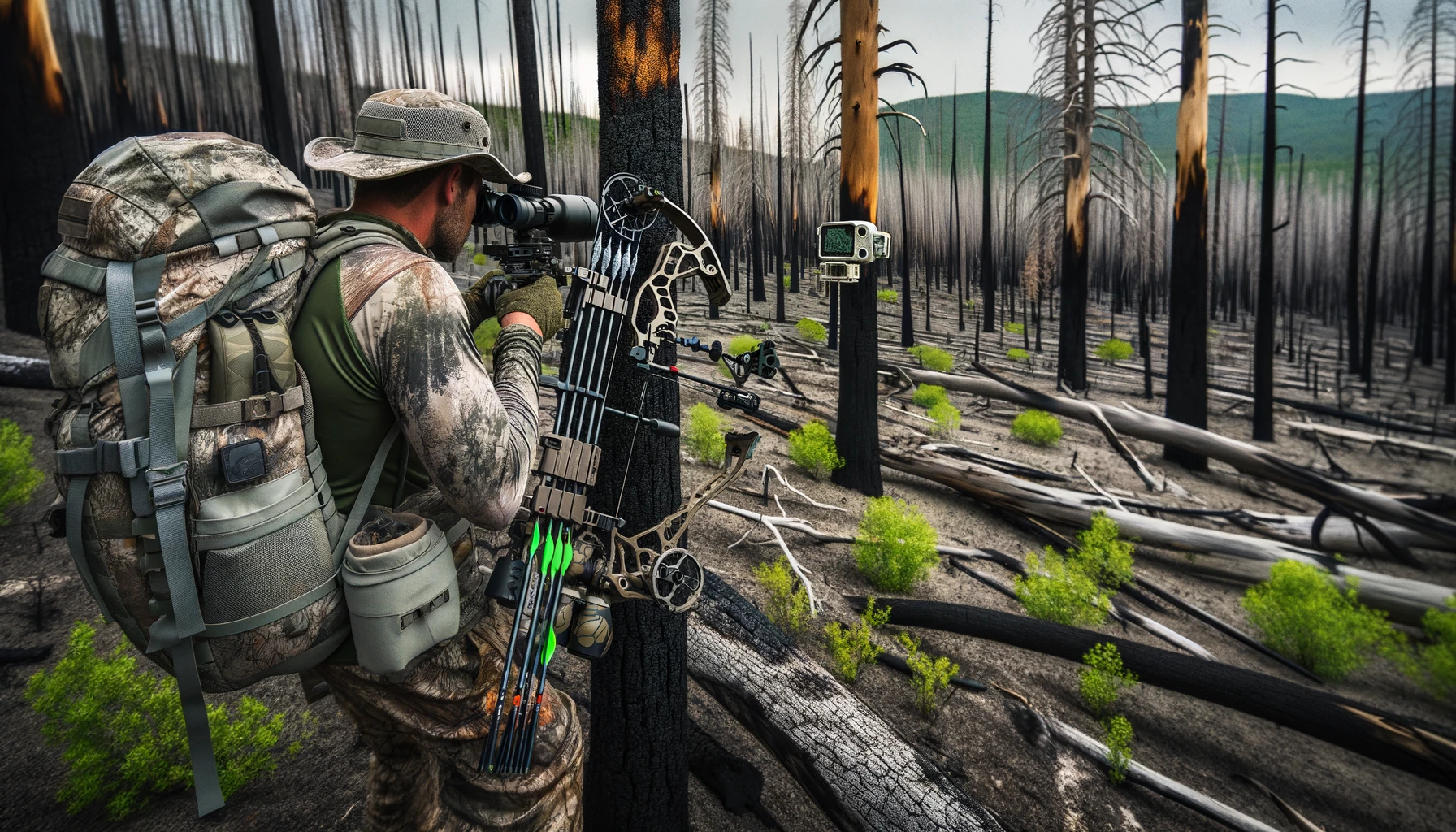
Post-fire hunting can be productive, but only after the area is legally open, physically safe, and far enough into recovery that your presence will not damage soil, seedlings, wildlife cover, or agency restoration work. A burned landscape is not a shortcut to easy game. It is a changed habitat with new food, new travel routes, new hazards, and sometimes temporary closures that matter more than any scouting plan.
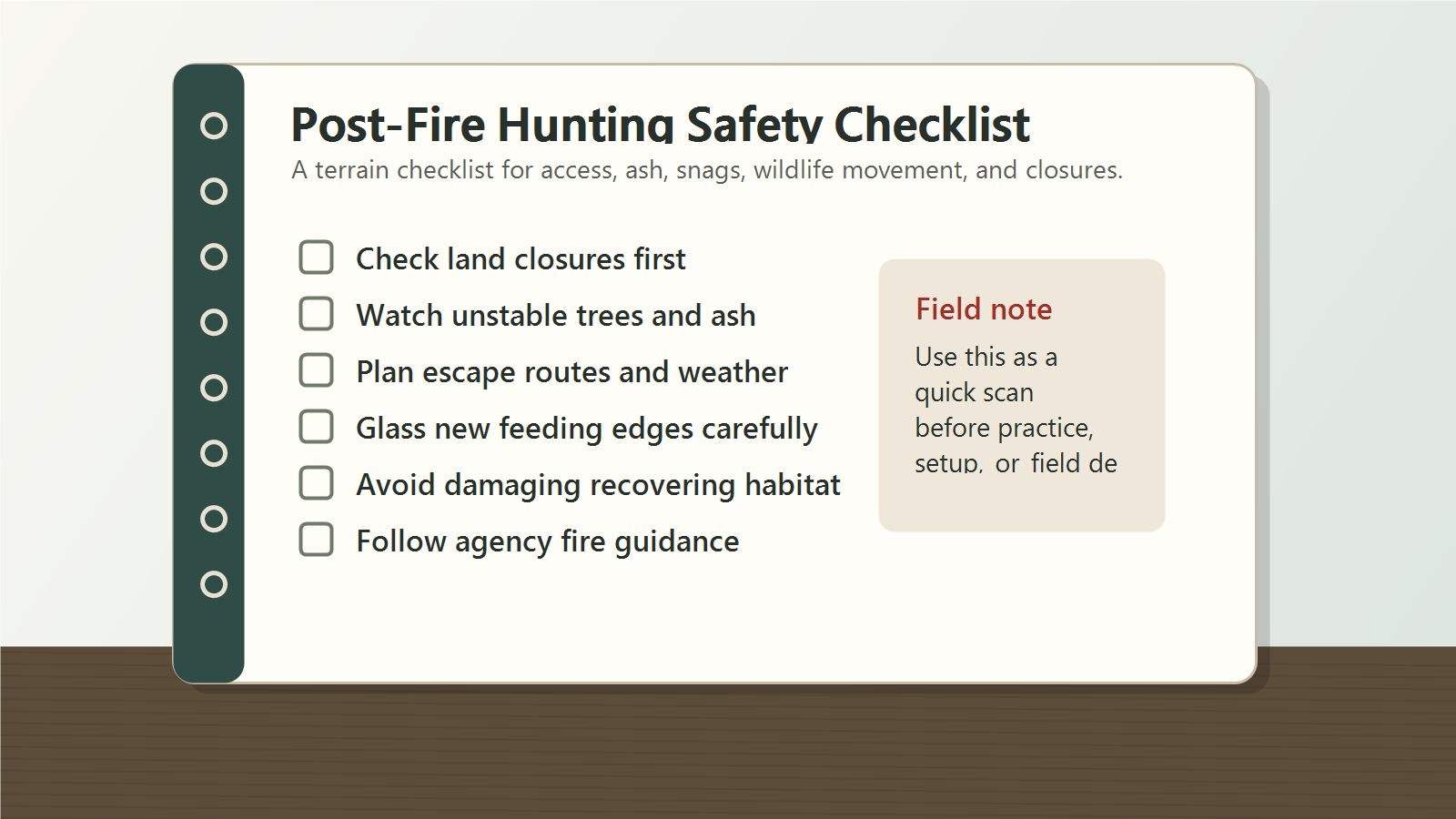
This guide is for hunters who want to read a burn area responsibly before a season. It covers how fire changes habitat, how to verify access, where game may use the new edges and green-up, and when the best choice is to stay out and let the country heal. Check the current rules for your state, unit, forest, wildlife area, refuge, tribal land, or private permission before every trip.
Table of Contents
Start With Access, Closures, and Current Rules
Post-fire access is a legal and safety question before it is a hunting question. A unit may appear open in the general hunting regulations while a specific road, trailhead, canyon, campground, wildlife area, timber sale block, or national forest closure order still keeps you out. Fire closures can also change quickly after storms, debris-flow warnings, road washouts, salvage work, or active suppression repair.
Begin with the agency that manages the ground, not with a mapping app alone. For national forest land, check the local forest alerts page and review the U.S. Forest Service explanation of Burned Area Emergency Response, which describes why some fires create post-fire risks to visitors, water quality, soil, and downstream communities. For state wildlife areas, confirm the current hunting regulations and emergency notices through the state wildlife agency, such as the California Department of Fish and Wildlife hunting resources. For state forests, state parks, BLM land, refuges, tribal land, and private timberlands, check each landowner or managing agency separately.
Do not assume a road is open because the gate was open last year. Do not assume a burned area is legal to enter because other hunters are parked nearby. In some places, walking past a closure sign can create a citation, put rescue crews at risk, and damage agency trust with hunters. If the answer is unclear, call the local ranger district, wildlife office, sheriff’s office, or land manager before you drive.
What should you verify before scouting a burn?
Verify the hunting season, tag rules, weapon restrictions, public access status, fire restrictions, road status, parking rules, motorized travel limits, camping rules, and any temporary area closures. In dry years, a legal hunting season can overlap with campfire bans, target-shooting restrictions, chainsaw limits, vehicle restrictions, or full public-land closures. Those rules are not suggestions. They protect firefighters, wildlife staff, local residents, and the habitat hunters depend on.
Private land boundaries also deserve extra care after a fire. Fence lines may be burned, signs may be gone, and landmarks may look different. Use a current land-ownership map, carry written permission where required, and avoid crossing a property line just because the old marker is no longer visible.
How Fire Changes Habitat for Wildlife
Fire changes habitat by removing some cover, releasing nutrients, opening sunlight to the ground, creating snags and downed wood, and starting a new cycle of grasses, forbs, shrubs, and tree regeneration. The effect is not automatically good or bad. It depends on burn severity, soil type, slope, moisture, plant community, season, invasive species pressure, and how much unburned cover remains nearby.
Low- and mixed-severity fire can create a patchwork of open feeding areas and nearby security cover. High-severity fire across a large block can leave game with little shade, little hiding cover, unstable travel routes, and a longer recovery period. Some animals may use the edge of a burn quickly. Others may avoid the black until forage, water, and cover return.
The first useful hunting feature is usually contrast. Look for the line where burned ground meets unburned timber, brush, riparian cover, north-facing shade, benches, saddles, and water. Those transition zones can let animals feed on new growth while staying close to escape cover. A big, uniform burn with no nearby cover is often less useful than a messy burn with fingers of live vegetation, islands of standing timber, and protected drainages.
When does new growth become attractive?
New growth becomes attractive when plants have enough moisture and time to produce usable forage without being fragile. In some grass and shrub communities, green-up can appear during the first favorable moisture window. In dry forests or severe burns, recovery can be much slower. Heavy hoof traffic, boot traffic, or vehicle use during the early recovery stage can break soil crust, crush seedlings, and widen erosion channels.
Extension fire resources are useful for understanding recovery because they focus on soil, vegetation, and land management rather than hunting pressure. Oregon State University Extension’s wildfire resources for landowners and managers, including Fire FAQs for Landowners and Managers, are a good starting point for thinking about post-fire recovery decisions, erosion, and vegetation response. Local extension offices can also point you toward region-specific advice for your plant community.
How do different game animals use burned areas?
Deer and elk often key on edges, new forbs, shrub sprouts, and travel routes that connect bedding cover to open feeding pockets. Black bears may work burns where berries, ants, carrion, or green vegetation become available, but their use depends heavily on local food cycles. Turkeys may feed through lighter burns and edges where insects and visibility improve, but they still need roost trees and escape cover. Upland birds may benefit from some fire-created structure over time, while a severe burn that removes nesting cover can reduce near-term use.
Predators can follow prey back into a burn, but ethical hunting still requires restraint. Do not pressure animals that are clearly concentrated by displacement, drought, winter stress, or lack of cover. If a burn has turned a drainage into the only practical escape route or water source, hunting it too aggressively may be legal but still poor stewardship.
Post-Fire Scouting Plan for Hunters
A good post-fire scouting plan compares the old landscape to the new one. The goal is to find where food, cover, water, shade, and travel security now overlap, not simply to stand in the black and hope visibility does the work.
Step 1: Compare pre-fire and post-fire maps
Start at home with satellite imagery, fire perimeter maps, slope layers, public access layers, and land-management notices. Mark the burn perimeter, but do not treat the perimeter as the hunting plan. A perimeter tells you where fire reached, not where it burned hot, where animals feed, or where the ground is safe to walk.
Look for unburned islands, creek bottoms, north slopes, benches above drainages, springs, seeps, meadows, old burns, mast-producing trees, and roadless pockets that escaped the worst fire behavior. If your mapping tool has recent imagery, compare it with older imagery to identify new openings, burned-over trails, damaged roads, and likely deadfall zones.
Step 2: Scout from the outside in
Scout from legal, durable routes before walking deep into a burn. Glass from roads, ridges, and open vantage points where access is allowed. Watch early and late feeding periods along the edge. Use tracks, droppings, rubs, beds, browsed tips, and trail-camera data only where cameras are legal and do not create extra disturbance.
Avoid walking straight across fragile slopes just to confirm sign. Burned soil can be powdery, water-repellent, crusted, or loose. One person may not look like much impact, but repeated boot paths can become erosion lines when rain arrives. If a route crosses steep ash, exposed mineral soil, seedling patches, or restoration treatments, back out and choose a more durable approach.
Step 3: Hunt the best remaining cover
In many post-fire areas, the best hunting setup is not in the middle of the most burned ground. It is where animals can step out of cover, feed briefly, and return to safety. Edges of live timber, brush fingers, riparian corridors, shaded draws, and unburned pockets often matter more than the wide-open black.
For deer and elk, watch travel routes that let animals avoid long exposure. For turkeys, confirm roosts before assuming they will use the burn. For bears, focus on food sources and wind discipline, not just visibility. For upland birds, look for a mix of bare ground, grass, shrubs, and escape cover. In every case, use the burn as a clue, then build the plan around the animal’s current needs.
Step 4: Keep pressure light
Post-fire animals may be easier to see because cover is gone. That does not mean they are easier to hunt well. Open country can magnify noise, scent, and skyline movement. It can also make animals more vulnerable near the few remaining cover strips. Limit repeated intrusion into bedding areas, do not crowd water, and avoid pushing game into closed areas, roads, private land, or unsafe terrain.
Safety Cautions in Burned Country
Burned areas can remain hazardous long after flames are out. The most obvious dangers are falling trees, rolling rocks, ash pits, damaged bridges, washed-out roads, unstable slopes, debris flows, and flash flooding. Less obvious problems include poor footing, loose soil, weakened roots, hidden stump holes, burned signs, changed drainage patterns, and dust or ash that can irritate eyes and lungs.
The U.S. Geological Survey tracks and explains post-fire debris-flow hazards, which are most concerning when intense rain falls on steep burned watersheds. A canyon that was safe during dry scouting can become dangerous during or after a storm. If heavy rain is forecast, stay out of steep burn scars, narrow drainages, alluvial fans, and downstream channels until conditions are reassessed by local authorities.
What are the main hazards for hunters after a fire?
Snags are one of the biggest hazards. A dead standing tree can fall without much wind, especially after roots burn or soil erodes. Do not glass, rest, dress game, or camp beneath fire-killed trees. Move through timber with your head up, and leave during high wind.
Ash pits are another serious concern. They can form where roots, stumps, or organic material burn underground, leaving a hidden void covered by ash. Step into one and you can be burned, trapped, or injured. Use a trekking pole in questionable ground, avoid deep ash pockets, and keep dogs away from fresh or unstable burn debris.
Roads and trails can be misleading after a fire. Culverts may plug with sediment, shoulders may collapse, and familiar two-tracks may be closed for repair. A vehicle stuck in a fragile burn area can cause more damage and may require rescue. Park on durable, legal surfaces and walk only where conditions allow.
What should you do if weather changes?
Leave early when weather points toward heavy rain, high wind, lightning, or rapid snowmelt. Post-fire country gives fewer second chances because slopes, drainages, and standing timber are already stressed. Tell someone your route, carry offline maps, bring extra water, and know more than one exit. A legal tag is not worth gambling against a debris-flow warning or wind event.
Ethical Hunting in a Recovering Ecosystem
Ethical post-fire hunting means taking legal opportunity without exploiting wildlife stress or damaging recovery. The standard is higher than “Can I get away with it?” A better question is, “Can I hunt this place today without making the recovery harder?”
Respect closures even when the habitat looks tempting. If a hillside is closed for erosion work, salvage operations, cultural-resource protection, nesting protection, or public safety, stay out. If the area is open but the ground is visibly fragile, choose durable routes, avoid steep ash, and keep your setup near existing trails, rock, gravel, duff, or other stable surfaces.
How do you avoid pressuring displaced wildlife?
Avoid hunting animals that are bunched into the only remaining cover, water, or feed because fire removed everything else. Displacement can be temporary, but repeated pressure can push game into roads, private land, or poor habitat. Give bedding cover extra room, especially during hot weather, winter stress, drought, or immediately after a fire.
Also think about recovery after the shot. In open burned country, a wounded animal may travel into steep debris, deadfall, or closed ground. Take only shots that allow a clean recovery within legal access. If recovery would likely require crossing a closure or entering unsafe terrain, pass the shot.
How should you handle vehicles, dogs, and camp?
Keep vehicles on open roads and legal parking areas. Do not drive around barriers, across ash, over seedling areas, through dozer lines, or onto temporary fire roads unless they are officially open for public travel. Keep dogs under control where allowed, because burned pads, sharp debris, and ash pits can injure them quickly. Camp outside fragile recovery zones when possible, and obey all fire restrictions. In a dry burn scar, even a small careless ignition can restart the problem everyone is trying to recover from.
How Hunters Can Support Post-Fire Recovery
Hunters can support post-fire recovery by staying legal, staying light on the land, reporting hazards, volunteering when agencies ask for help, and sharing accurate information instead of rumors. Conservation after a fire is practical work, not just a slogan.
Report washed-out roads, damaged signs, illegal vehicle use, active erosion problems, injured wildlife, and suspected poaching to the correct agency. If you see restoration materials, straw wattles, erosion-control fabric, seeded areas, temporary fences, or research markers, leave them alone. Those treatments may be protecting water quality, cultural sites, rare plants, road systems, or downstream homes.
Should hunters join restoration projects?
Yes, when the land manager asks for volunteers and the work fits the recovery plan. Useful projects may include trail repair, fence repair, weed pulls, native planting, sign replacement, wildlife surveys, and access cleanup. Do not scatter seed, cut snags, build water features, clear roads, or “improve” habitat on your own. Good intentions can spread invasive plants, disturb soil, damage cultural resources, or conflict with the recovery plan.
Clean your boots, tires, gaiters, pack, and dog gear before and after visiting a burn. Invasive plants often take advantage of disturbed soil, and hunters can move seeds between trailheads without noticing. A stiff brush and a few minutes at the truck can prevent a long-term habitat problem.
How can hunters share information responsibly?
Share access facts, safety notices, and agency links. Be careful about posting exact locations of recovering wildlife concentrations, water sources, or unburned refuges. A single viral waypoint can turn a sensitive pocket into a pressure point. If you want to help other hunters, teach the process: check closures, read the edge, protect soil, and hunt with restraint.
Post-Fire Hunt Planning Checklist
Use this checklist before hunting a burned area. If any answer is uncertain, pause the trip until you can verify it.
| Question | Why it matters |
|---|---|
| Is the exact area legally open today? | Temporary closures can override normal season assumptions. |
| Are roads, trailheads, and parking areas open? | Post-fire road damage and repair closures can change access. |
| Is heavy rain, high wind, or lightning forecast? | Burn scars can produce debris-flow, flood, snag, and rockfall hazards. |
| Can I reach the setup on durable ground? | Fragile ash, bare soil, and seedling zones need protection. |
| Is there enough cover for ethical hunting and recovery? | Animals concentrated by lack of cover deserve extra restraint. |
| Can I recover game without entering closed or unsafe terrain? | A responsible shot includes a realistic recovery plan. |
| Have I cleaned boots, tires, and gear? | Disturbed burn areas are vulnerable to invasive plants. |
Frequently Asked Questions
How soon after a wildfire can you hunt a burned area?
You can hunt only when the land is legally open, the season and tag rules allow it, and conditions are safe enough for access. Some burns may reopen quickly at the edges, while others stay closed because of falling trees, damaged roads, erosion work, active suppression repair, or debris-flow risk. Always check the current land-manager notice before entering.
Do deer and elk come back after a fire?
Deer and elk often return when usable forage, water, and cover are available, but timing varies by burn severity and local habitat. They may use edges and unburned islands before they use the middle of a severe burn. Do not assume every blackened slope is a feeding hotspot.
Are burned areas good places to glass?
Burned areas can improve visibility, but visibility alone does not make a good setup. The best glassing often covers the edge between burn and cover, especially near benches, saddles, drainages, and feeding pockets. Avoid glassing or sitting under dead standing trees.
Is it legal to walk into a fire closure if hunting season is open?
No. A hunting season does not cancel a closure order. If a road, trail, wildlife area, forest, refuge, or private property is closed, stay out until the managing agency reopens it.
Can trail cameras be used in post-fire areas?
Trail cameras can help where they are legal, but rules vary by state, season, species, and land ownership. Place cameras without damaging trees, seedlings, soil, or restoration work, and avoid creating new paths into fragile cover. If camera rules are unclear, ask the wildlife agency before setting one.
What gear matters most in a burn scar?
Foot protection, eye protection, navigation, water, weather awareness, and communication matter more than camouflage patterns. Wear sturdy boots, consider gaiters, protect your eyes from ash and windblown grit, and carry offline maps. If snags, ash pits, or debris-flow risk are present, the smartest gear choice may be choosing a different area.
Should hunters avoid all burned areas?
No, but hunters should avoid closed, unstable, or heavily stressed areas. Fire is part of many ecosystems, and some post-fire habitats can support healthy wildlife use over time. The responsible approach is to verify access, read the recovery stage, hunt lightly, and leave fragile ground alone.
Final Takeaway
The best post-fire hunting strategy is patience with a map in your hand and restraint in your boots. Check the legal status first, scout the edges and surviving cover, stay out of hazardous drainages and snag patches, and avoid adding pressure where wildlife or soil is still recovering. A burn can become good habitat again, but the hunter’s job is to take opportunity only where access, safety, and stewardship line up.