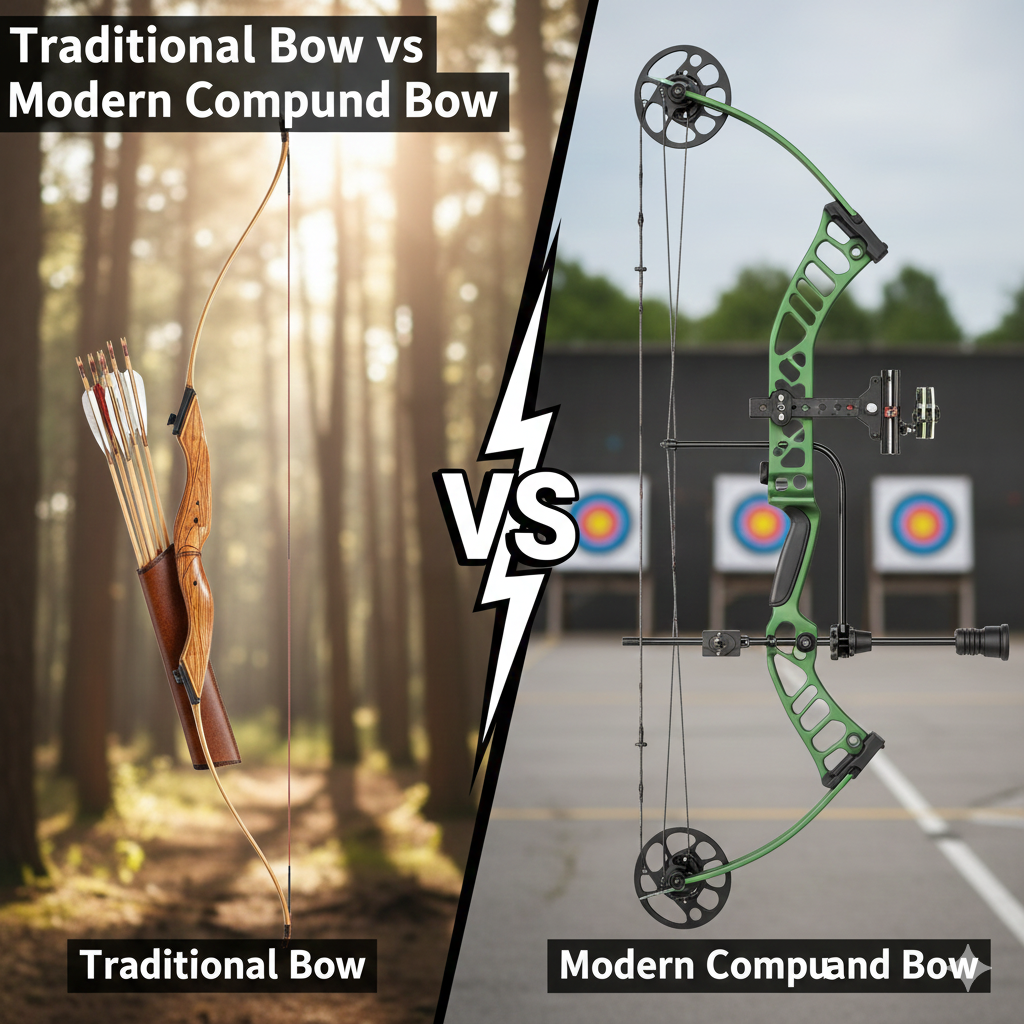
Archery has evolved dramatically over thousands of years, yet one debate continues to spark curiosity among beginners and experienced archers alike: should you shoot a traditional bow or a modern compound bow? Although both tools serve the same purpose propelling an arrow toward a target they are built on entirely different philosophies. One represents centuries of culture, craftsmanship, and instinct, while the other showcases precision engineering and mechanical advantage. Understanding these differences is essential for choosing the best bow for your goals, shooting style, and long-term development as an archer.
Table of Contents
The traditional bow, whether in the form of a longbow or a recurve bow, connects the archer directly to the roots of the sport. Its simplicity is its most defining feature: a single curved piece of wood or laminated material and a bowstring. There are no pulleys, cables, sights, or mechanical systems. Every shot you take depends entirely on your body’s strength, your instinctive aim, and your technique.
Shooting a traditional bow feels organic and pure. When you draw the bowstring, the full weight of the draw remains in your fingers until the moment you release it. There is no let-off, no mechanical ease, no gadgets to stabilize your aim. Because of this, traditional archery demands a high level of discipline. Archers develop muscle memory, fluid form, and a deep sensitivity to the smallest physical movements.
Most traditional shooters appreciate this challenge. They enjoy the process more than the score. The bow becomes an extension of the body, and every successful shot feels earned. Traditional bows also appeal to those who enjoy historical reenactment, bowhunting with minimal gear, or simply the elegance of a quiet, lightweight bow with minimal maintenance.
In contrast, the modern compound bow is engineered for maximum efficiency and accuracy. Developed in the 1960s, compound bows use a system of cams or wheels, cables, and limbs designed to reduce the draw weight at full draw a feature known as let-off. Once the bow is fully drawn, the archer holds only a small percentage of the actual draw weight, making it easier to take steady and precise shots.
The compound bow is built around technology. It often includes sights, stabilizers, peep sights, release aids, and many other accessories that refine accuracy. The design allows for faster arrow speeds, flatter trajectories, and significantly greater consistency shot after shot. Hunters particularly prefer compound bows because they deliver high kinetic energy with minimal effort, giving them better penetration and ethical shot capability.
Another major advantage is adjustability. Draw weight and draw length can be fine-tuned to suit the archer, making compound bows more forgiving for beginners and extremely customizable for advanced users. For competitive archers, a compound bow provides the precision and repeatability needed for tournaments where even a millimeter can determine the winner.
Accuracy is one of the biggest differences between the two bow types. Traditional bows rely on instinctive shooting or gap shooting. Over time, archers learn to feel the trajectory, anchor naturally, and release smoothly. The learning curve is steep, but the satisfaction of mastering instinctive archery is unmatched. Each shot carries a sense of craftsmanship.
On the other hand, compound bows are designed to reduce human error. The mechanical let-off allows the archer to take their time at full draw without fatigue. Stabilizers counterbalance the bow. Sights and peeps align your vision. Release aids ensure a clean, controlled release. Everything works together to enhance accuracy. For beginners who want to hit tight groups quickly, a compound bow offers a clear advantage.
In hunting scenarios, the compound bow’s power and efficiency give it even more of an edge. Faster arrow speeds and deeper penetration provide more ethical kills and higher confidence at longer distances. Traditional bows can still be effective hunters, but they require more patience, closer distances, and refined skill to achieve the same results.
Choosing between these two bows often comes down to the experience you want while shooting. Traditional bows feel light, quiet, and responsive. They require little to maintain no cables to tune, no cams to adjust, no gadgets to depend on. Every session becomes a meditative practice focusing on form, breathing, and flow.
Meanwhile, compound bows offer a more structured shooting experience. You can dial in your sights, measure distances, and adjust settings to perfect your performance. Shooting becomes a blend of technique and fine-tuned equipment. For many archers, this creates confidence and satisfaction because improvements are measurable and repeatable.
Traditional archers often speak of the sport as an art, while compound archers view it as a science. Neither is wrong; they simply highlight different aspects of the same discipline.
Many newcomers assume traditional bows are easier because of their simple design, but the opposite is usually true. A traditional bow requires more skill development to achieve consistent accuracy. Beginners who want early success and visible progress often find the compound bow more motivating. Its mechanical assistance helps them avoid frustration and build confidence.
However, those who are drawn to the heritage of archery, or who want to develop strong foundational habits, may prefer starting with a traditional bow. It teaches discipline and technique from day one and helps shooters feel a deeper connection to the process.
Your personal preference matters most. Are you motivated by technological refinement and precision? Or do you enjoy the challenge of mastering something simple yet demanding?
Traditional bows require minimal upkeep. As long as the limbs are not cracked and the string is waxed regularly, the bow can last for decades. There are no moving parts to tune or replace. This durability makes traditional bows ideal for archers who value simplicity and reliability.
Compound bows, however, need regular tuning and maintenance. Cables stretch, cams must stay aligned, and accessories need periodic adjustments. Although modern compound bows are incredibly durable, they are machines and machines require care. This is not necessarily a disadvantage; many archers love tuning their bows and pushing their equipment to peak performance.
Traditional bows are generally more affordable. A beginner can start shooting with a well-made traditional bow for a reasonable price, and accessories are minimal. Compound bows often cost more due to their engineering complexity and additional gear sights, rests, releases, stabilizers, and tuning tools.
For people on a tight budget, traditional archery is easier to start. But those who see archery as a long-term investment often appreciate the features and benefits that come with a more expensive compound bow setup.
The debate between traditional bows and modern compound bows does not have a universal answer. Instead, it reflects the diversity of archery itself. The traditional bow is perfect for those who want to experience archery in its purest form minimalist, instinctive, and deeply connected to ancient tradition. The compound bow is ideal for those who value accuracy, adjustability, and the advantages of modern engineering.
Think about what inspires you. Do you want each shot to feel like a personal achievement built on instinct and discipline? Or do you want to leverage technology to push your accuracy and consistency to the highest level? Your goals, your style, and even your personality will guide you toward the right choice.
In the end, both bows can provide incredible satisfaction. The true joy of archery comes from the connection between the archer, the bow, and the moment of release whether it is guided by tradition or technology.
Small game hunting is one of the most rewarding yet technically demanding forms of hunting.…
Shooting sports, hunting, and target practice expose your ears to extremely loud sounds. Most firearms…
Handgun accuracy is one of the most important skills in shooting sports and responsible firearm…
Selecting the best scope magnification for shooting at 300 yards is a decision that directly…
Traveling with a firearm whether for hunting, competitive shooting, professional training, or lawful personal protection…
Preparing for a successful day at the shooting range involves much more than simply bringing…
This website uses cookies.

