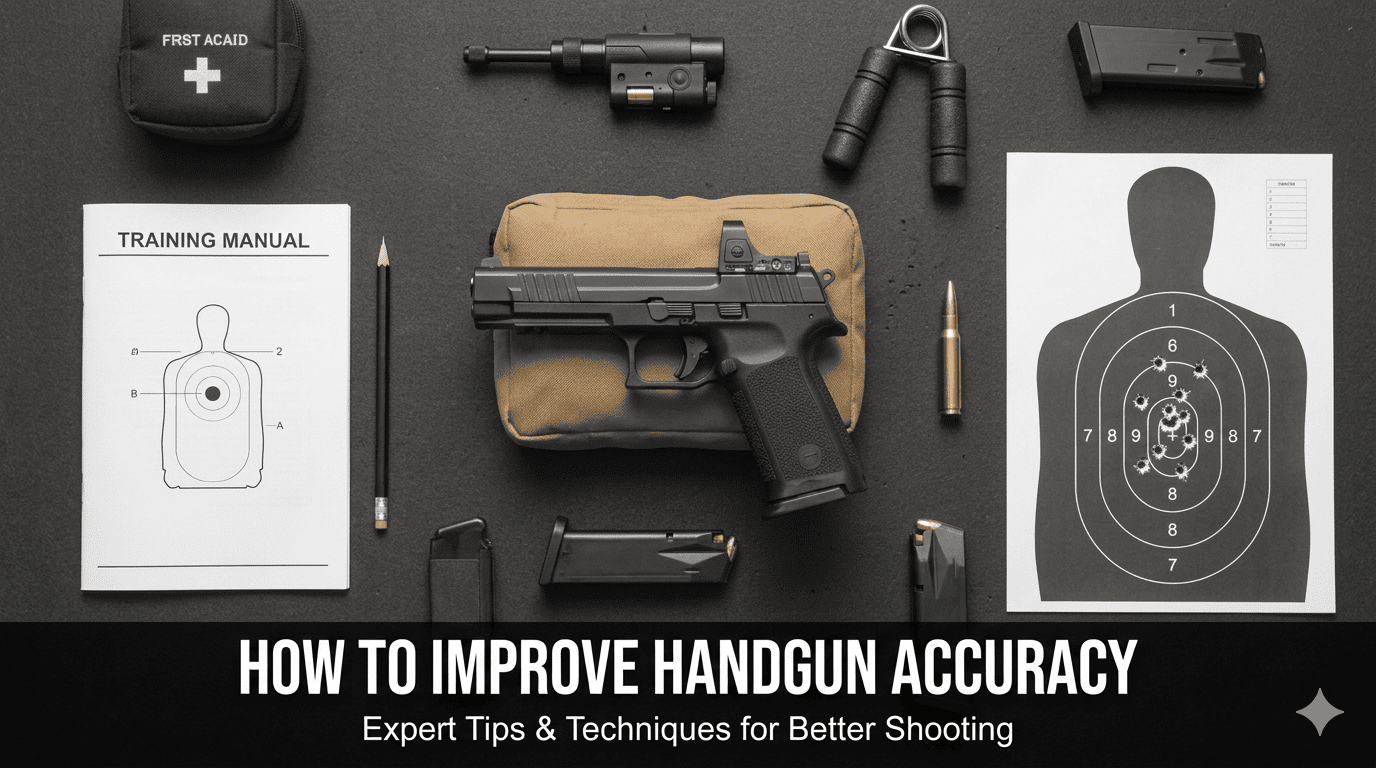
Handgun accuracy is one of the most important skills in shooting sports and responsible firearm handling. Whether you are practicing at the range for recreational shooting, competitive shooting, or improving your overall firearm control, accuracy depends on a combination of technique, consistency, and practice.
Many shooters believe accuracy comes from expensive firearms or accessories. In reality, most improvements come from fundamental shooting skills such as grip, stance, trigger control, and sight alignment.
This detailed guide will explain the key factors that affect handgun accuracy and provide practical techniques to help you consistently hit your target.
Table of Contents
Before focusing on accuracy, every shooter must understand and follow the core firearm safety rules. Safe handling ensures responsible practice and prevents accidents.
The commonly accepted firearm safety rules include:
Practicing safety creates good habits and allows you to focus on improving your technique without risk.
Grip is one of the most important factors in handgun accuracy. A poor grip can cause the gun to move during recoil, which affects shot placement.
High Grip on the Backstrap
Place your dominant hand as high as possible on the handgun’s backstrap. A higher grip helps control recoil and keeps the sights aligned.
Firm but Not Excessive Pressure
Your grip should be firm enough to control the firearm but not so tight that your hands shake.
A good rule many instructors recommend:
Thumb Position
Your thumbs should generally point forward along the frame. This helps maintain stability and alignment.
Support Hand Engagement
Your support hand fills the empty space on the grip and wraps around the dominant hand, adding stability.
A strong, consistent grip helps reduce unnecessary movement and keeps your sights steady.
Your stance acts as the foundation for accuracy. A weak stance can cause balance problems and inconsistent shots.
This is one of the most common stances used by modern shooters.
Characteristics:
This stance provides good recoil management and balance.
Another traditional stance that involves a slightly bladed body position.
Characteristics:
Both stances can be effective. The key is choosing a stance that provides stability and consistency.
Many shooting errors occur because shooters misunderstand how to properly align their sights.
Sight alignment refers to the relationship between the front sight and rear sight.
Correct alignment means:
Sight picture is how the aligned sights are positioned relative to the target.
In most handgun shooting:
Focusing on the front sight helps maintain precise alignment when firing.
Trigger control is one of the biggest factors affecting handgun accuracy.
Poor trigger control often leads to jerking the trigger, which causes the gun to move just before the shot breaks.
Use the Pad of Your Finger
Place the pad of your index finger on the trigger rather than the joint.
Press Straight Back
The trigger should move straight to the rear without disturbing sight alignment.
Smooth and Consistent Pressure
Avoid slapping or jerking the trigger. Apply gradual pressure until the shot breaks.
Many experienced shooters say:
“The shot should surprise you.”
This means the trigger press is smooth enough that the exact moment of firing is not anticipated.
Breathing can influence stability when shooting.
While breathing is less critical for handguns than rifles, controlled breathing can still improve accuracy.
A simple method:
This pause is when your body is most stable.
Many shooters immediately relax after firing, which can affect shot placement.
Follow-through means maintaining your grip, sight alignment, and stance after the shot.
Proper follow-through helps ensure:
Good shooters often describe this as “calling the shot” knowing where the shot landed based on sight position during recoil.
Dry fire practice is one of the most effective ways to improve handgun accuracy without using ammunition.
Dry fire involves practicing your shooting technique with an unloaded firearm.
Simple dry fire drills include:
Even 10–15 minutes of dry fire practice several times per week can significantly improve shooting performance.
Accuracy is largely about repeatability.
Each shot should be performed with the same steps:
Small inconsistencies can cause shots to drift left, right, high, or low.
Keeping your technique consistent helps tighten shot groupings.
Understanding shooting errors helps you correct them quickly.
Often caused by anticipating recoil or pushing the gun downward.
Usually due to improper sight alignment.
Commonly caused by jerking the trigger.
Often caused by too much finger on the trigger.
By analyzing your target patterns, you can identify what adjustments are needed.
Many shooters only practice at a single distance. Training at multiple distances improves skill development.
Suggested practice distances:
As your accuracy improves, gradually increase distance.
Inconsistent ammunition can affect accuracy.
For practice and accuracy testing:
Changing ammunition types frequently may affect your point of impact.
Shooting is not only physical it is also mental.
Distractions, stress, or rushing can cause accuracy problems.
Good shooters maintain a simple mental process:
Staying calm and focused improves consistency.
Tracking your shooting performance helps identify improvement areas.
You can track:
Keeping a shooting log helps you measure progress over time.
Professional instruction can accelerate learning and correct bad habits early.
Certified instructors can help with:
Even experienced shooters benefit from occasional training sessions.
Improving handgun accuracy is a process that requires practice, patience, and attention to fundamentals. While equipment can play a role, most improvements come from mastering core techniques such as grip, stance, sight alignment, and trigger control.
By consistently applying the principles discussed in this guide, shooters can gradually tighten their shot groups and develop more confidence with their handgun.
Selecting the best scope magnification for shooting at 300 yards is a decision that directly…
Traveling with a firearm whether for hunting, competitive shooting, professional training, or lawful personal protection…
Preparing for a successful day at the shooting range involves much more than simply bringing…
Selecting the right tactical scope for hunting is one of the most important decisions a…
Hunting has always been deeply connected to nature, patience, and self-reliance. For generations, success in…
Choosing the right rifle scope is one of the most important decisions a shooter or…
This website uses cookies.
