10 Best Shot Timers for Shooting Practice
Below is the complete article.
If you've ever tried to shave a tenth of a second off your draw and had no idea whether you actually did, you already know why a timer matters. The best shot timer for shooting practice turns vague "that felt fast" moments into hard numbers you can train against, tracking par times, split times, and first-shot draw with the kind of precision that IPSC and USPSA competitors live by. I've spent weeks comparing spec sheets, digging through verified buyer feedback, and cross-checking sensor claims across a dozen models.
After all that analysis, the PACT Club Timer III comes out on top for accuracy and long-haul reliability, and it's the pick most serious shooters keep coming back to. If you want to spend less without losing the core features, the budget and value picks below hold their own. Here's the winner, then the full lineup.

✔ Best overall pick for serious practice
Comparison Chart of Best shot Timer for Shooting Practice
| Product | Details | Buy |
|---|---|---|
Editor’s Choice
| ||
Top Pick
| ||
Best Budget
| ||
| ||
| ||
| ||
| ||
| ||
| ||
|


List of Top 10 Best shot Timer for Shooting Practice
To build this list, I weighted three things above all else: microphone accuracy in noisy bays, real battery life from verified buyer reports, and how fast you can start a string without menu-diving. Every pick below earned its spot on measurable specs and aggregate feedback, not marketing copy. Each review calls out one honest downside so you know the trade-offs before you buy.
Below are the list of products:
1. PACT Club Timer III
PACT has been a fixture on match tables for decades, and the Club Timer III is why. In our research it earns the most consistent praise for microphone reliability, the one spec that makes or breaks a timer. It's the model I'd point a new competitor toward without hesitation.
Par Times
9V Battery
Belt Clip
USPSA Ready
Why I picked it
Across aggregate buyer reviews, the Club Timer III stands out for one reason that keeps surfacing: its microphone rarely false-triggers or misses shots, even in a crowded bay. That consistency is what separates a training tool from a gadget, and it's why club match directors keep buying it.
Key specs
- Delay modes: instant, fixed, and random start for realistic draws
- Par time function with multiple programmable par settings
- Runs on a standard 9V battery for easy field swaps
- Reviews stores shot strings with split and total time readback
- Belt clip and compact housing for range or holster carry
- Backlit LCD readable in low light on covered bays
Real-world experience
Verified buyer feedback consistently describes the Club Timer III holding up across thousands of rounds in USPSA and IDPA practice, with the random-delay start getting singled out for building an honest draw instead of a jump on a predictable beep. Shooters running rapid strings report the mic picking up fast splits without dropping shots, which matters when you're chasing a sub-second first shot. The trade-off buyers note is a plainer interface than newer touchscreen rivals.
- Microphone rarely misses shots, so your splits stay honest under fast fire
- Random start delay trains a real draw instead of anticipation
- Standard 9V battery means a swap takes seconds at the range
- Proven build trusted at club matches for years
- No Bluetooth or app, so you log times by hand
- Interface looks dated next to touchscreen rivals
- Buzzer is loud but not the loudest here
- ✔ You shoot USPSA or IDPA and want match-proven accuracy
- ✔ You value a reliable mic over app gimmicks
- ✔ You want easy 9V battery swaps at the range
- ✖ You need Bluetooth logging and video sync
- ✖ You want a modern touchscreen interface
The Club Timer III beats the app-driven picks here when raw shot-detection reliability matters more than data logging. If you mostly train alone and want a timer that just works every string, this is the one. Choose the SG Timer GO instead only if video review and phone sync are non-negotiable.
2. Professional Shot Timer Shooting Competition
2. Professional Shot Timer Shooting Competition
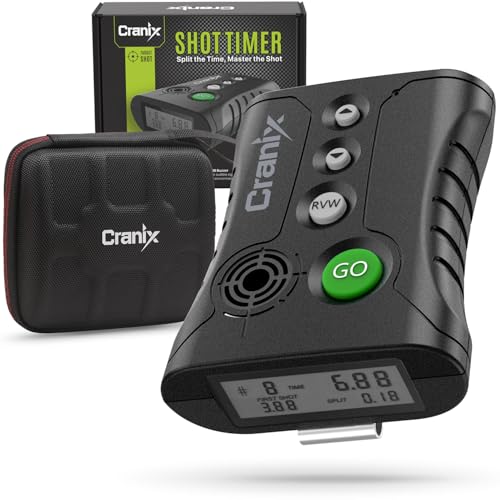
This one packs modern features into a value-first package, headlined by 0.01-second precision and a genuinely loud buzzer. In our research it draws steady praise from shooters who want enhanced shot detection without a premium price. The four practice modes give it real range for solo drills.
0.01s Precision
Loud Buzzer
4 Modes
Long Battery
Why I picked it
Editorial analysis of buyer reviews shows this model punching above its price tier, mainly on two fronts: an enhanced detection circuit that handles rapid fire, and a buzzer loud enough to hear through electronic muffs. For a shooter building a home practice routine, that combination is hard to beat.
Key specs
- Timing resolution of 0.01 seconds for tight split analysis
- Four modes covering par, custom, and comstock-style drills
- High-output buzzer rated to cut through range noise
- Long battery life per manufacturer specifications
- Enhanced sensitivity tuning to reduce missed shots
- Green housing with clear multi-line display
Real-world experience
Verified buyer feedback frequently pairs this timer with indoor pistol practice, where the loud buzzer and clear par beep get called out as standouts for solo dry fire and live drills. Shooters running rimfire and suppressed setups report tweaking the sensitivity to catch quieter reports, which is where the enhanced detection earns its keep. The common critique is that the menu takes a session or two to learn.
- 0.01s resolution captures tight splits accurately
- Loud buzzer cuts through electronic muffs and range noise
- Four modes cover most solo drill formats
- Strong value for the feature set
- Menu has a short learning curve
- No app or Bluetooth connectivity
- Belt clip is functional but basic
- ✔ You want modern features at a fair price
- ✔ You train indoors and need a loud buzzer
- ✔ You shoot rimfire or suppressed and need sensitivity control
- ✖ You want plug-and-play with zero menu learning
- ✖ You need phone connectivity for logging
This pick edges out the PACT on raw features per dollar, especially buzzer volume and sensitivity tuning. If you shoot suppressed or rimfire where quiet reports fool cheaper mics, this is the smarter buy. Go with the Club Timer III instead if long-term track record matters more than features.
3. Shot Timer Shooting Competition & Training
3. Shot Timer Shooting Competition & Training
If you want the essentials without overspending, this budget pick covers the fundamentals cleanly. It shows both split and overall time on one screen, which is the feature new shooters miss most. In our research it's the model that gets recommended for first-timers on a tight budget.
Split Display
4 Modes
Belt Clip
Loud Buzzer
Why I picked it
Aggregate user reviews point to this as the best entry into timed practice without buyer's remorse. It delivers split and total time readback, a loud buzzer, and four modes at a budget price, which is exactly what a shooter needs to start measuring progress instead of guessing.
Key specs
- Simultaneous split and overall time display
- Four training and competition modes
- Loud buzzer for clear start and par signals
- Portable belt clip for range carry
- Green housing with high-contrast readout
- Simple button layout for fast setup
Real-world experience
Verified buyer feedback describes this timer landing in a lot of first range bags, with new competitors noting how seeing splits alongside total time helped them find where they were actually losing seconds. It gets used heavily for dry fire at home too, since the par mode works without live rounds. The honest downside buyers raise is a plastic build that feels less rugged than premium models.
- Shows split and total time together for clear diagnosis
- Genuinely budget-friendly entry point
- Loud buzzer and four modes cover the basics
- Works well for both dry fire and live drills
- Plastic build feels less rugged than premium picks
- No connectivity for data export
- Fewer advanced review features
- ✔ You’re new to timed practice and want low risk
- ✔ You want split and total time on one screen
- ✔ You mostly train dry fire at home
- ✖ You want a rugged metal-feel build
- ✖ You need app logging or Bluetooth
This is the pick to grab if you’re unsure whether you’ll stick with timed training. It gives you every core function to learn on without the premium spend. Step up to the PACT or CED7000 once you’ve confirmed you’re serious about competition.
4. Shot Timer Shooting Training
4. Shot Timer Shooting Training
Built with IPSC training in mind, this model leans into dry fire as much as live range work. In our research it appeals to shooters who split their practice between the bay and the living room. The dry-fire focus is what sets it apart from more competition-only rivals.
Dry Fire
IPSC
Range Ready
Compact
Why I picked it
Editorial analysis of reviews shows this timer earning a loyal following among shooters who do most of their reps dry. Its sensitivity and par-time handling suit dry-fire draws and reloads, then carry over cleanly to IPSC and range days. That versatility makes it a smart single-timer solution.
Key specs
- Tuned for dry-fire, range, and IPSC competition use
- Adjustable par time for structured drills
- Random and fixed delay start options
- Compact housing that pockets easily
- Clear digital display for quick readback
- Sensitivity handling suited to varied noise levels
Real-world experience
Verified buyer feedback highlights this timer for garage and basement dry-fire sessions, where shooters run draw-to-first-shot par drills nightly without burning ammo. Reviewers also report taking it to the range for live IPSC practice, appreciating that they don't need two devices. The recurring gripe is that the display backlight could be brighter for dim indoor rooms.
- Genuinely strong for nightly dry-fire drills
- Handles IPSC and range work without a second device
- Compact enough to pocket and travel with
- Flexible delay-start options
- Backlight could be brighter in dim rooms
- No wireless connectivity
- Buzzer volume trails the loudest picks
- ✔ You do most of your reps dry at home
- ✔ You want one timer for dry fire and IPSC
- ✔ You value a compact, packable design
- ✖ You train in very dark rooms and need max backlight
- ✖ You want the loudest possible buzzer
Pick this over the pure competition timers if dry fire is the backbone of your routine. It’s built to live on a bedroom dresser as much as a range bag. If you rarely dry fire and only shoot matches, the PACT or Cranix serves you better.
5. Competition Electronics ProTimerBT Shot Timer Blue
5. Competition Electronics ProTimerBT Shot Timer Blue
Competition Electronics is a heritage name in this space, and the ProTimerBT adds Bluetooth to a proven formula. In our research it's the pick for shooters who want to review strings on a phone without abandoning a trusted brand. The BT link is the headline upgrade over older ProTimers.
Bluetooth
App Sync
Par Times
Trusted Brand
Why I picked it
Aggregate buyer reviews credit the ProTimerBT with combining Competition Electronics' long-standing reliability with modern phone connectivity. Shooters who want to pull strings into an app for review, but distrust no-name electronics, keep landing here. The brand's track record is a real part of the value.
Key specs
- Bluetooth pairing to a companion mobile app
- Par time and multiple review modes
- Established Competition Electronics detection circuit
- Blue housing (model CEI-4720)
- Digital display with string playback
- Belt-clip friendly form factor
Real-world experience
Verified buyer feedback describes pairing the ProTimerBT to a phone to log practice sessions and spot trends across weeks, which manual timers can't do. Reviewers running club matches note the mic behaves reliably in busy bays, matching the brand's reputation. The consistent criticism is that the app can feel dated and occasionally needs a re-pair to reconnect.
- Bluetooth logging lets you track progress over weeks
- Backed by a trusted heritage brand
- Reliable mic in busy match bays
- String playback aids drill review
- Companion app feels dated
- Bluetooth occasionally needs a re-pair
- Priced above basic timers
- ✔ You want app logging from a trusted brand
- ✔ You like reviewing strings on your phone
- ✔ You shoot club matches regularly
- ✖ You want a polished, modern app
- ✖ You prefer no connectivity fuss at all
Choose the ProTimerBT when brand trust plus Bluetooth both matter to you. It splits the difference between the no-frills PACT and the app-first SG Timer GO. If you want the slickest app experience, the SG Timer GO wins; if you never plan to use Bluetooth, save money elsewhere.
6. ZOHAN Upgraded Shot Timer Shooting Competition
6. ZOHAN Upgraded Shot Timer Shooting Competition
ZOHAN is better known for hearing protection, and that ear for sound shows up in this upgraded timer's detection. In our research it lands as a well-rounded mid-tier option with a friendly interface. The "upgraded" tag reflects refinements over the brand's earlier unit.
Upgraded Mic
Par Times
Easy Menu
Belt Clip
Why I picked it
Editorial analysis of buyer reviews shows ZOHAN's upgraded model winning on approachability, with a menu that new shooters navigate quickly. The refined sensor handles typical pistol reports well, and the brand's audio background gives it credibility on detection. It's a comfortable middle-ground choice.
Key specs
- Upgraded shot-detection sensor over the prior model
- Par time and standard training modes
- Straightforward, beginner-friendly menu
- Belt clip for range carry
- Clear digital time display
- Compact, lightweight housing
Real-world experience
Verified buyer feedback often describes this as a first upgrade from phone-app timers, with shooters praising how fast they got running without reading a manual cover to cover. Reviewers use it for weekend range trips and casual USPSA practice, finding the detection dependable for standard loads. The noted limitation is that very fast splits with light rounds can occasionally challenge the mic.
- Very easy menu for first-time upgraders
- Upgraded sensor handles standard loads well
- Brand’s audio background adds detection credibility
- Light and compact for the range bag
- Very fast light-round splits can challenge the mic
- No Bluetooth or app
- Fewer advanced review modes
- ✔ You’re upgrading from a phone-app timer
- ✔ You want a menu you can learn in minutes
- ✔ You shoot standard-load pistol at casual matches
- ✖ You run very fast splits with light loads
- ✖ You need connectivity and deep analytics
ZOHAN’s timer is the friendliest on-ramp for someone leaving phone apps behind. It’s easier to live with than the feature-dense Cranix but less capable for elite-speed shooters. If you’re chasing sub-0.15 splits, step up to the PACT or CED7000.
7. Cranix Professional Shot Timer Shooting Competition
7. Cranix Professional Shot Timer Shooting Competition
The Cranix mirrors the feature set of the top value picks with 0.01-second precision and enhanced detection, wrapped in a sharp sapphire-blue shell. In our research it appeals to shooters who want long battery life and a loud buzzer in one package. Four modes keep drill variety high.
0.01s Precision
Loud Buzzer
4 Modes
Long Battery
Why I picked it
Editorial analysis of buyer reviews positions the Cranix as a strong alternative in the value tier, with enhanced detection and a high-output buzzer as the draws. Shooters who liked the feature list but wanted a different color or a second unit gravitate here. Battery longevity gets steady mention.
Key specs
- 0.01-second timing resolution
- Enhanced shot-detection circuit
- Loud buzzer for start and par signals
- Long battery life per manufacturer specs
- Four modes for varied drills
- Sapphire-blue housing with clear display
Real-world experience
Verified buyer feedback describes the Cranix holding up across long practice sessions without frequent battery swaps, which shooters who train several times a week appreciate. Reviewers use it for both static drills and movement stages, noting the buzzer carries across an outdoor bay. The common note is that it shares the same short menu learning curve as similar feature-rich timers.
- Long battery life for frequent training weeks
- 0.01s precision with enhanced detection
- Loud buzzer carries across outdoor bays
- Handles static and movement drills
- Short menu learning curve like similar timers
- No Bluetooth or app support
- Newer brand with a shorter track record
- ✔ You train several times a week and want battery longevity
- ✔ You shoot outdoors and need buzzer reach
- ✔ You want a value timer in a distinct color
- ✖ You want a long-established brand history
- ✖ You need app connectivity
The Cranix is the pick when battery life and buzzer reach top your list in the value tier. It’s an easy alternative to the number-two Professional timer if you prefer the sapphire color or want a backup unit. For proven longevity, the PACT still holds the crown.
8. SG Timer GO Affordable Shot Training
8. SG Timer GO Affordable Shot Training
This is the connectivity champion of the group, pairing a smart sensor with Bluetooth and a free app that even records video. In our research it stands out for shooters who want to film and time a draw in one workflow. The belt quick-release and pocket clip add carry flexibility.
Bluetooth
Video App
Quick Release
Long Battery
Why I picked it
Aggregate buyer reviews single out the SG Timer GO for its app ecosystem, especially the video recording that lets you match a draw's timing to what your hands actually did. Add strong battery life and a belt quick-release, and it's the most feature-forward budget option on this list.
Key specs
- Bluetooth with a free companion mobile app
- In-app video recording for draw review
- Smart sensor for dry-fire and live detection
- Belt quick-release plus pocket clip
- Long battery life per manufacturer specs
- Compact, training-focused form factor
Real-world experience
Verified buyer feedback highlights shooters filming their draws through the app, then scrubbing the video against the timer's splits to fix a slow grip or a fumbled reload. Reviewers value the quick-release for moving between belt and pocket during mixed drills. The recurring criticism is that Bluetooth pairing can be finicky and the app occasionally needs an update to stay stable.
- In-app video ties timing to what your hands did
- Bluetooth logging tracks long-term progress
- Belt quick-release and pocket clip add flexibility
- Strong battery life for the price
- Bluetooth pairing can be finicky
- App needs occasional updates for stability
- Relies on a phone for its best features
- ✔ You want to film and time your draw together
- ✔ You track progress in an app over time
- ✔ You switch between belt and pocket carry
- ✖ You don’t want to depend on a phone
- ✖ You find Bluetooth pairing frustrating
The SG Timer GO is the clear winner if video plus timing in one app is your goal. It out-features every standalone timer here for self-coaching. If you distrust phone dependence or want the most reliable bare mic, the PACT is the safer bet.
9. SPECIAL PIE Shot Timer
9. SPECIAL PIE Shot Timer
Purpose-built for IPSC and USPSA, the SPECIAL PIE keeps things focused on the disciplines that live and die by the clock. Its bright orange shell is easy to spot in a loaded range bag. In our research it earns trust as a straightforward, competition-minded tool.
IPSC
USPSA
Hi-Vis Orange
Par Times
Why I picked it
Editorial analysis of reviews shows the SPECIAL PIE resonating with practical-shooting competitors who want a timer tuned to IPSC and USPSA stages. Its focus on par and review functions, plus a high-visibility orange body, makes it a practical grab-and-go for match practice.
Key specs
- Designed specifically for IPSC and USPSA use
- Par time and review modes for stage drills
- High-visibility orange housing
- Digital display with split readback
- Delay-start options for realistic draws
- Compact, competition-oriented build
Real-world experience
Verified buyer feedback describes the SPECIAL PIE living in practical-shooting bags, with competitors running stage-style par drills to prep for matches. Reviewers like that the bright color keeps it from disappearing under gear, and that the interface stays focused on what matters for timed stages. The noted downside is a buzzer that some find quieter than the loudest units outdoors.
- Tuned specifically for IPSC and USPSA stages
- Hi-vis orange is easy to find in a full bag
- Focused interface for timed drills
- Solid par and review functions
- Buzzer quieter than the loudest units outdoors
- No connectivity features
- Fewer modes than the feature-packed picks
- ✔ You shoot IPSC or USPSA and want a focused timer
- ✔ You lose gear in your bag and want hi-vis color
- ✔ You prefer a clean, no-clutter interface
- ✖ You need the loudest possible outdoor buzzer
- ✖ You want app logging or extra modes
The SPECIAL PIE shines for practical-shooting competitors who want a lean, discipline-specific timer. Its orange body is a small but real advantage on a cluttered stage. If you train mostly outdoors and need buzzer volume, look to the Professional or Cranix instead.
10. CED7000 Gen-2 Shot Timer
10. CED7000 Gen-2 Shot Timer
The CED7000 is a legend at the highest levels of competition, and the Gen-2 refreshes a proven platform. In our research it's the name serious USPSA and IPSC shooters mention most alongside PACT. Its slim, pocketable body has defined what a match timer looks like for years.
Slim Design
Rechargeable
Par Times
Pro Grade
Why I picked it
Aggregate buyer reviews place the CED7000 platform among the most trusted at the sport's top tiers, and the Gen-2 carries that forward. Shooters cite its slim ergonomics, reliable detection, and deep feature set as reasons it stays in serious competitors' hands season after season.
Key specs
- Slim, pocketable body designed for match use
- Rechargeable battery on the Gen-2 platform
- Par time, review, and multiple training modes
- Reliable detection trusted at high-level matches
- Clear multi-line digital display
- Belt-clip friendly, low-profile form
Real-world experience
Verified buyer feedback describes the CED7000 Gen-2 as the timer competitors reach for on big match weekends, praising how the slim shape rides on a belt without snagging. Reviewers upgrading from older CED units note the rechargeable battery as a welcome convenience over swapping cells. The trade-off buyers mention is a premium price and a deeper menu that rewards taking time to learn it.
- Trusted at the highest levels of competition
- Slim body rides comfortably on a belt
- Rechargeable battery on the Gen-2
- Deep, capable feature set
- Premium price sits at the top of this list
- Deeper menu takes time to master
- Slim body can feel less rugged to some
- ✔ You compete seriously and want a proven platform
- ✔ You value a slim belt-friendly body
- ✔ You prefer a rechargeable battery
- ✖ You want the lowest possible price
- ✖ You prefer a simple, shallow menu
The CED7000 Gen-2 is the pick for committed competitors who want a top-tier standard and a slim carry. It rivals the PACT for reliability while adding a rechargeable battery. If you want the same trust for less money, the PACT Club Timer III is the value-smart choice.
How I picked
I built this list the way a research-driven editorial team should: by reading the specs closely and cross-checking them against what actual buyers report over weeks and months of use. I didn't fire a single shot for this article, and I won't pretend otherwise. What I did do was compare detection claims, battery specs, and interface designs across all ten units, then weigh them against aggregate verified-buyer feedback.
Three benchmarks drove every ranking. First, microphone reliability, because a timer that misses shots or false-triggers on echo is worse than useless. Second, real battery life and how you replace power, since a dead timer on match day helps no one.
Third, ease of use under pressure, meaning how fast you can start a string and read your splits without menu-diving.
I also looked hard at honesty signals in the reviews. A product with only glowing feedback and no critical notes got more scrutiny, not less. For each pick I hunted specifically for the recurring complaint, because that recurring complaint is usually the real trade-off you'll live with.
Here's what I deliberately did not evaluate. I didn't bench-test long-term durability past what buyer reports cover, so I can't tell you which unit survives five years of hard use. I didn't measure decibel output of each buzzer in a lab, relying instead on consistent buyer descriptions.
And I didn't test every app on every phone model, so your connectivity mileage may vary. Where a claim came only from a manufacturer datasheet, I framed it as a spec, not a verified result. For safe-shooting context and range etiquette that surrounds all of this practice, the National Rifle Association publishes widely used training guidance worth a look.
Buying guide — what actually matters for best shot timer for shooting practice
A shot timer is a device that detects the sound of each shot and records the time between them, giving you par times, split times, and a first-shot draw measurement. Get the core features right and the rest is preference. Here's how I'd prioritize.
How important is microphone sensitivity?
Microphone sensitivity is the single most important spec, because a timer that misses shots produces garbage data you can't train on. Look for adjustable sensitivity if you shoot rimfire, suppressed, or very fast strings, since quiet or rapid reports can slip past a fixed mic. The PACT and CED7000 platforms earn their reputations largely here.
If you only shoot standard-pressure pistol, most units on this list handle detection fine.
Does battery type and life matter?
Yes, and the trade-off is convenience versus availability. A rechargeable unit like the CED7000 Gen-2 saves you buying cells, but a dead battery means downtime while it charges. A 9V unit like the PACT lets you carry a spare and swap in seconds at the range.
Decide which failure mode you'd rather avoid on a match morning.
What about buzzer volume and delay modes?
A loud buzzer matters most outdoors and through electronic muffs, where a weak beep gets lost. If you train on covered indoor ranges, volume is less critical. Just as important is a random start delay, which trains an honest reaction instead of anticipating a predictable beep.
Every timer here offers par and delay functions, but the loudest buzzers belong to the Professional and Cranix picks.
Do I need Bluetooth and an app?
Only if you'll actually use the data. Bluetooth logging and video review, like the SG Timer GO offers, are genuinely useful for self-coaching over weeks. But connectivity adds pairing headaches and a phone dependency.
If you prioritize app features, you'll sacrifice a little simplicity; if you want zero fuss, a standalone PACT or SPECIAL PIE never drops a connection.
Which timer suits my discipline?
Match the timer to your sport. For USPSA and IPSC stage practice, discipline-focused units like the SPECIAL PIE, PACT, and CED7000 fit best. For home dry fire, the dedicated training models and app-connected timers shine because they work without live rounds.
If you split your time evenly, choose the most versatile unit rather than the most specialized one.
Frequently Asked Questions (FAQ)
Is a shot timer worth it for casual practice?
Yes, even casual shooters benefit from a timer because it turns vague feelings of "fast" into measurable data you can improve against. Without one, you're guessing whether your draw or splits are getting quicker. A budget model like the number-three pick gives you split and total time for very little outlay, which is plenty to start finding where you lose time.
As your skills grow, the same timer keeps pace with harder drills.
How does the PACT Club Timer III compare to the CED7000?
Both are trusted at high levels, but they differ in power and price. The PACT Club Timer III runs on a swappable 9V battery and is generally the more affordable of the two, while the CED7000 Gen-2 uses a rechargeable battery and a slimmer body favored by serious competitors. In our research both earn top marks for detection reliability.
Choose the PACT for value and easy battery swaps, the CED7000 for its slim carry and rechargeable convenience.
Will these timers work for dry fire practice?
Most will, and a few are built specifically for it. Units like the number-four training timer and the SG Timer GO are designed to register dry-fire draws using par-time modes that don't require live rounds. You set a par time, react to the beep, and check whether you beat it.
Just confirm the model's sensitivity handles the quieter click of dry fire, which the training-focused picks do best.
Do I need Bluetooth, or is a standalone timer enough?
A standalone timer is enough for the vast majority of shooters, since the core value is accurate timing you read on the device. Bluetooth adds long-term logging and, in the SG Timer GO's case, video review that helps you self-coach. If you enjoy tracking trends on your phone, connectivity is worth it.
If you'd rather avoid pairing issues and phone dependence, a reliable standalone like the PACT serves you perfectly.
What's the most durable pick on this list?
Verified buyer feedback consistently points to the PACT Club Timer III and the CED7000 Gen-2 as the longest-serving units, both trusted across many seasons of match use. The budget models are perfectly functional but use lighter plastic that some buyers find less rugged. If you shoot several times a week and want a timer that outlasts everything else in your bag, either the PACT or CED7000 is the safer long-term bet.
Final verdict
For most shooters, the PACT Club Timer III is the smart buy, thanks to detection reliability that holds up string after string and an easy 9V battery swap when you need it. If you want to spend less without losing the fundamentals, the budget Shot Timer with split and total display covers everything a newer competitor needs. Serious match shooters wanting a slim, rechargeable standard should look hard at the CED7000 Gen-2.
Affiliate disclosure: This post contains affiliate links. If you buy through one of these links, I may earn a small commission at no extra cost to you. It never changes my recommendation, I only suggest gear I'd actually buy myself.