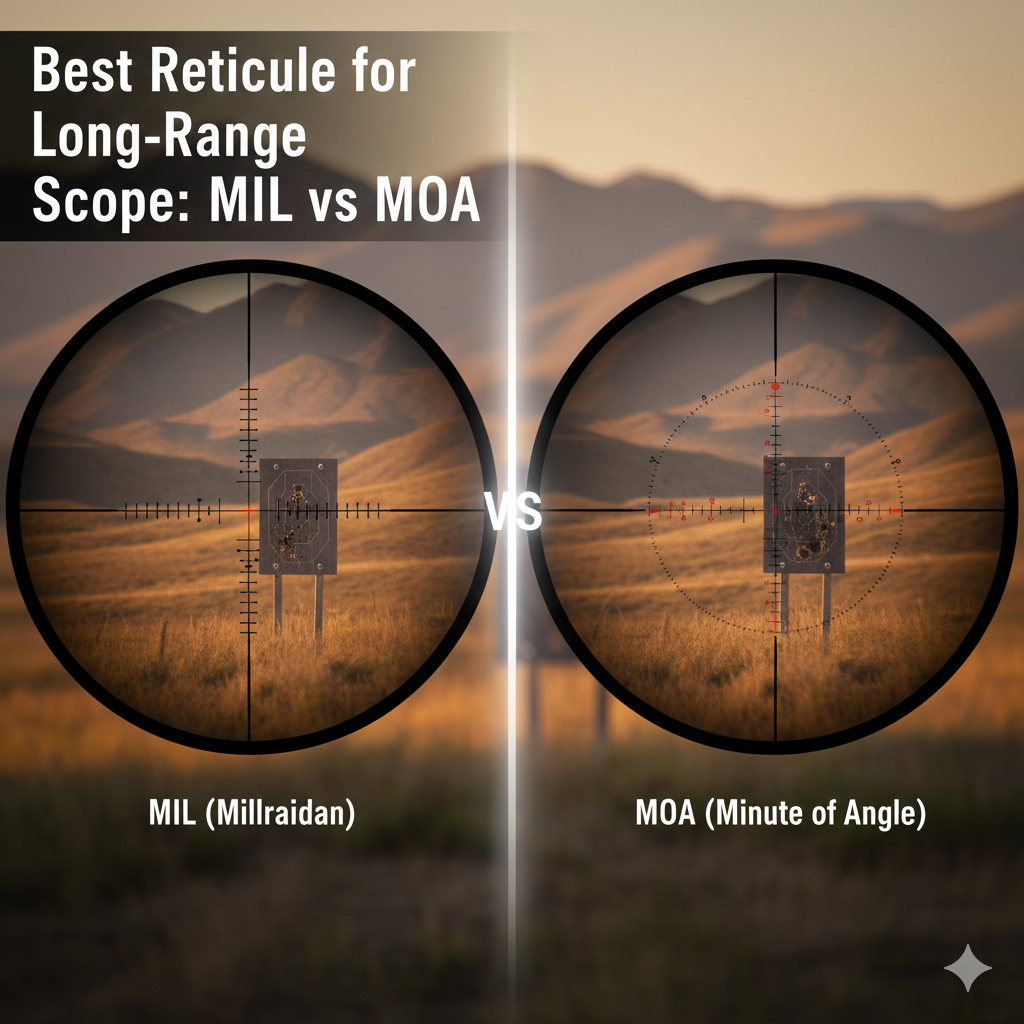
When you’re setting up a long-range rifle scope, one of the most important decisions you’ll make is choosing the reticle specifically whether to go with a MIL-based (or mil/radian) reticle or a MOA-based reticle. Both have pros and cons, and the “right” choice depends heavily on how you shoot (hunting, tactical, competition), what units you’re comfortable with (metric vs imperial), and what level of precision and speed you need.
In this post, we break down the differences between MIL and MOA how they work, when each shines, and which kind of shooter or scenario is likely to benefit more from each.
Table of Contents
Here’s how MIL and MOA compare across important aspects for long-range shooting:
| Feature / Consideration | MOA | MIL (mrad) |
|---|---|---|
| Unit System | Angular — traditional imperial; good for yards/inches. | Angular — metric-rooted (radians), decimal-based; great for meters/centimeters. |
| Adjustment Granularity | Fine increments (e.g. ¼ MOA), useful for very precise, small corrections. | Adjustments often in 0.1 mil steps; somewhat larger per click compared to MOA, but easier to do quick math. |
| Math & Ease of Use | Familiar if you think in yards/inches — straightforward for short-range or medium-range shooting. | Base-10 math: easier for range estimation, wind-hold, and ballistic calculations, especially over long ranges or when using metric distances. |
| Reticle Clarity / Complexity | Hash marks/dots can get dense; reticle may appear “busy,” especially with fine spacing at long range. | Usually cleaner or more intuitive spacing for range-finding and holdovers; less cluttered at high magnification. |
| Speed of Use / Field Shooting | Slightly slower when making bigger adjustments (many clicks needed). | Faster to adjust for big corrections — useful for dynamic environments, long-range moves, or tactical shooting. |
| Precision Potential | High precision for small corrections, especially in controlled bench or precision shooting settings. | Slightly coarser per unit, but still very accurate — especially effective for long-range precision with less mental math. |
Depending on what you’re doing, here’s when one system might be better than the other:
In the debate between MIL and MOA reticles, there’s no single system that universally outperforms the other the best choice ultimately depends on your shooting style, preferred units, and long-range needs. MOA excels in fine, precise adjustments and feels more natural for shooters who think in yards and inches, making it a strong option for hunters and precision bench-rest shooters. MIL, on the other hand, has become the preferred standard for most long-range and tactical shooters thanks to its simple decimal system, faster corrections, cleaner reticles, and compatibility with modern ballistic tools. Whether you choose MIL or MOA, consistency is key: understand your system, train with it, and stick to it. Mastery matters far more than the measurement system itself a well-practiced shooter will achieve excellent results with either reticle.
Shooting sports, hunting, and target practice expose your ears to extremely loud sounds. Most firearms…
Handgun accuracy is one of the most important skills in shooting sports and responsible firearm…
Selecting the best scope magnification for shooting at 300 yards is a decision that directly…
Traveling with a firearm whether for hunting, competitive shooting, professional training, or lawful personal protection…
Preparing for a successful day at the shooting range involves much more than simply bringing…
Selecting the right tactical scope for hunting is one of the most important decisions a…
This website uses cookies.
