Surviving a Bear Attack: 10 Safety Checks for Bear Country
If you are searching for how to survive a bear attack, start with the safer goal: avoid forcing the encounter into an attack at all. In bear country, your best protection is early awareness, clean food storage, calm movement, and bear spray that you can reach quickly and use correctly.
There is no single response that fits every bear. The National Park Service bear safety guidance says each encounter is different, so this guide focuses on decisions that reduce panic and help you choose the safest next step.
Table of contents
Quick Answer: What Should You Do Around a Bear?
If you see a bear, stay calm, do not run, speak in a low steady voice, give the bear room, and back away slowly if you can do so safely. If the bear has not noticed you, leave quietly without drawing attention.
If the bear moves closer, make yourself look larger, keep your group together, and get bear spray ready if you have it. If contact happens, the safest response depends on the species, the bear’s behavior, and whether the encounter looks defensive or predatory. When local park or wildlife-agency guidance differs, follow the local guidance first.
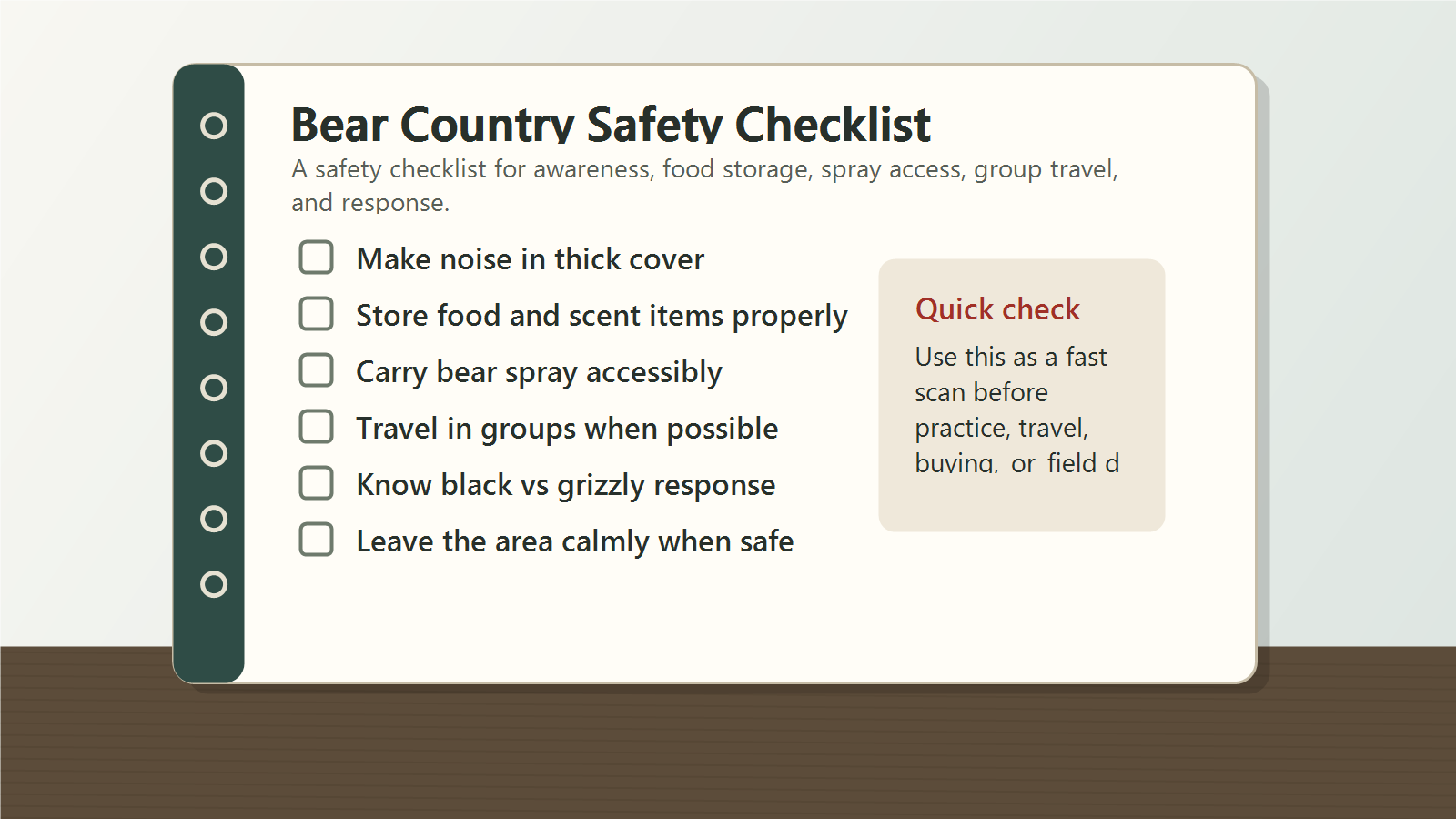
Bear Country Checklist
Before You Leave the Trailhead
- Check current bear activity notices at the visitor center, land manager office, or state wildlife agency.
- Carry bear spray where it is legal, keep it reachable, and know how the safety clip works.
- Hike in a group when possible, especially in dense cover, near streams, or in low visibility.
- Keep food, trash, scented items, and game meat secured from the start, not only after a bear appears.
- Plan a calm retreat route instead of assuming you can push through thick cover or surprise an animal.
If You Notice Fresh Bear Sign
Fresh tracks, scat, digging, overturned logs, carcass odor, or heavy berry feeding activity should change your pace and noise level. Slow down, talk with your group, scan ahead, and avoid moving between a bear and a food source, cubs, or escape cover.
Prevention First: Avoid the Close Encounter
Most bear safety starts before you see a bear. Surprise is one of the biggest problems because a bear that suddenly discovers a person at close range has less time to choose avoidance.
Make Human Noise in the Right Places
Talk, call out, or clap before blind corners, thick brush, noisy streams, and berry patches. A steady human voice is usually more useful than silent hiking. Bear bells alone should not be your full plan.
Give Bears Room
Do not approach a bear for a photo. If you are watching wildlife, use binoculars or a long lens from a distance and leave the animal an open path to move away. A bear that feels crowded may react defensively.
Secure Food and Scented Items
Food-conditioned bears are dangerous for people and usually bad news for the bear. The BearWise safety program emphasizes removing attractants around people, camps, homes, and travel routes. Treat food, wrappers, toothpaste, deodorant, pet food, fish, and game meat as bear attractants.
Read Bear Behavior Without Guessing Too Much
Bear behavior can change quickly. You should not bet your safety on one body-language clue, but you can use the bear’s movement, distance, attention, and setting to slow down your response.
A Bear That Has Not Noticed You
If the bear is feeding, traveling, or resting and has not noticed you, do not call out just to get its attention. Leave quietly, keep watching its position, and avoid stepping into cover where you may meet it at closer range.
A Defensive Bear
A defensive bear may be protecting cubs, food, or personal space. Signs can include huffing, jaw popping, swaying, pawing, bluff charges, or ears laid back. The goal is to reduce the pressure and show you are not a threat.
A Bear Showing Predatory Interest
Predatory encounters are less common but more serious. A bear that follows, circles, tests your retreat, or approaches silently with fixed attention may require a stronger response. Get bear spray ready, stay with your group, and be prepared to defend yourself if the bear makes contact.
If You See a Bear From a Distance
Stop and Assess
Do not keep walking toward the bear. Stop, gather children or partners close, note the wind and terrain, and choose the lowest-risk way to leave the area. A detour is usually better than forcing the bear to move.
Do Not Run
Running can make the situation worse. Back away slowly while facing generally toward the bear, but avoid a hard stare that looks like a challenge. Keep your voice steady and your movements deliberate.
Change Plans Early
If the bear is near a trail, carcass, river crossing, berry patch, or campsite, turn around or take another route. A few lost minutes are better than moving into a bear’s feeding area or escape path.
If a Bear Approaches You
An approaching bear does not always mean an attack is coming. Some bears are curious, some are testing, and some are trying to make you leave. Your job is to avoid sudden moves and be ready if the bear keeps closing distance.
Make Yourself Identifiable as Human
Speak calmly. Raise your arms or jacket slowly to look larger. If you are with others, stand close together rather than scattering. Pick up small children without bending over for too long.
Move Away Without Turning Your Back
Back away at an angle if the terrain allows. Do not drop your pack as a distraction unless local guidance tells you otherwise; food or scent in a dropped pack can teach a bear that approaching people leads to reward.
Prepare Bear Spray Before the Last Second
Bear spray is not useful if it is buried in a backpack. Move it into your hand if the bear keeps closing. Keep the wind in mind, remove the safety only when needed, and follow the label directions for distance and burst length.
Defensive vs. Predatory Encounters
This is the part people often oversimplify. Advice such as “play dead” or “fight back” can be dangerous when used in the wrong setting. Local agency guidance matters because bear species and behavior patterns vary by region.
When an Encounter Appears Defensive
If a brown bear or grizzly bear makes defensive contact, many agencies advise lying face down, covering your neck, spreading your legs for stability, and staying still until the bear leaves. This is meant for a defensive contact where the bear is trying to neutralize a perceived threat, not a bear that is treating you as prey.
When an Encounter Appears Predatory
If a bear follows, stalks, enters a tent, or attacks in a way that appears predatory, fight back with everything available. Aim at the face and muzzle, stay on your feet if you can, and keep resisting. The Alaska Department of Fish and Game bear country guidance gives region-specific advice that is worth reading before traveling in areas with brown or black bears.
With Black Bears, Do Not Assume Playing Dead Is Right
Black bear guidance often differs from grizzly guidance. If a black bear attacks, many wildlife agencies advise fighting back rather than playing dead. If you are unsure which species you may encounter, learn the local guidance before the trip.
Bear Spray: Carry It Where Legal and Practice the Motion
Bear spray is a deterrent, not a shield. It must be legal where you are traveling, accessible on your body, and used according to the label. The NPS bear safety page includes bear spray as part of bear-country preparation, but it also stresses prevention and calm behavior.
Keep It Accessible
A holster on your belt or pack strap is usually better than storage inside a pack. Everyone in the group should know who has spray, where it is carried, and how to move without crossing into the spray path.
Practice Without Spraying Live Canisters
Practice drawing, removing the safety, aiming low enough to create a cloud, and stepping sideways. Use inert practice canisters when available. Do not test-fire a real canister around camp unless the label and local rules allow it.
Mind Wind and Distance
Wind can push spray back toward you or away from the bear. If you have to deploy it, follow the canister directions, spray when the bear is within the listed range, and be ready to move after the cloud forms.
Camp and Food Safety in Bear Country
Many bad encounters begin with food or scent mistakes. A bear that gets human food may return, push closer to people, and become a long-term problem around trails and camps.
Use Approved Food Storage
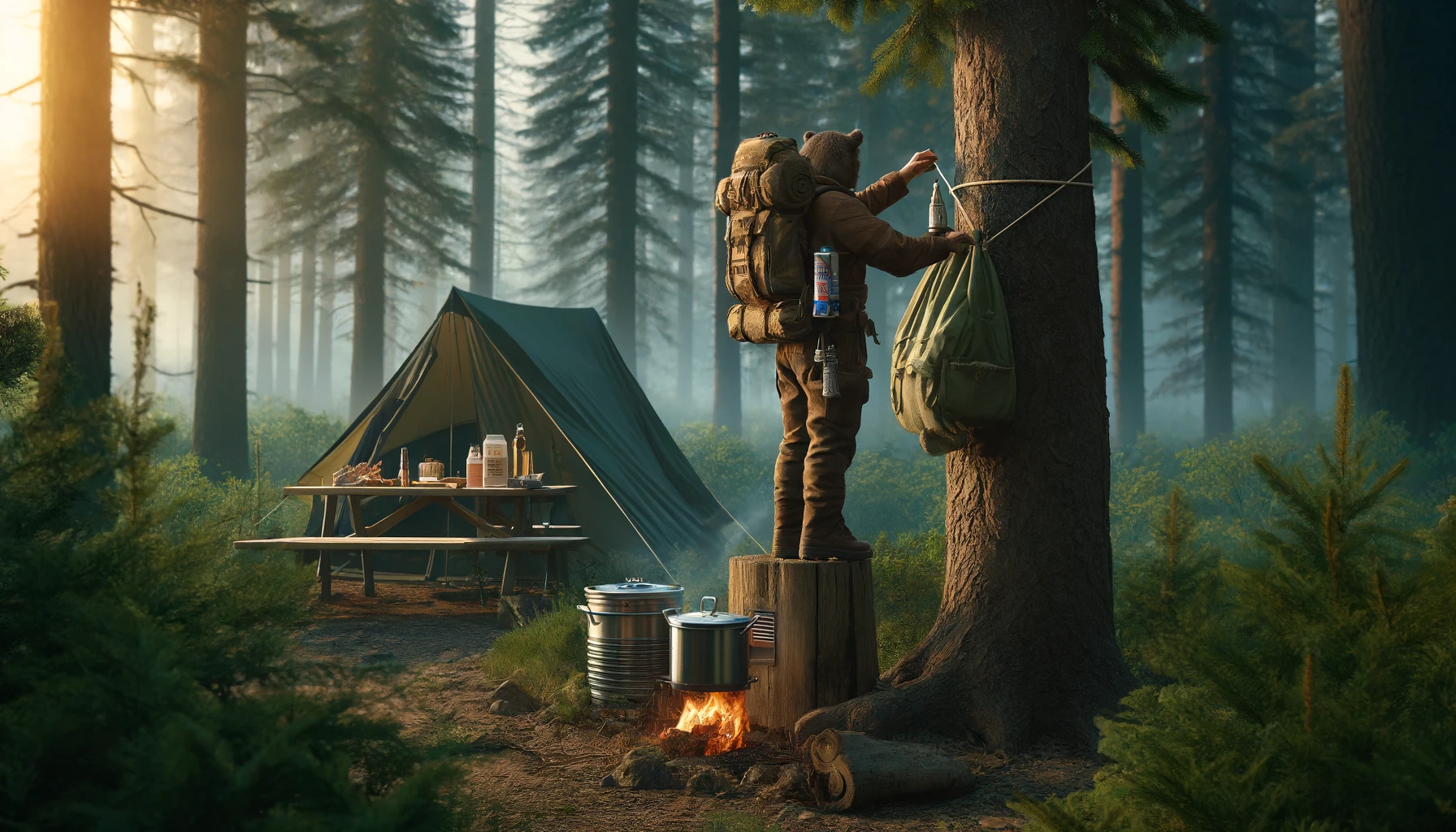
Use bear boxes, bear-resistant canisters, vehicle storage where allowed, or the food-storage method required by the land manager. Hanging food is not accepted everywhere, and poor hangs are easy for bears to defeat.
Separate Cooking and Sleeping Areas
Keep cooking, eating, dishwashing, and food storage away from your sleeping area when camping rules allow. Change clothing if it is heavily scented with fish, meat, or cooking grease.
Handle Game Meat Carefully
Hunters should be especially careful around gut piles, carcasses, and pack-out routes. Make noise when returning to a downed animal, approach from upwind when possible, and leave the area if a bear has claimed the carcass.
After a Bear Encounter
Leave the Area Safely
Once the bear leaves or you create distance, do not linger to take photos or gather gear if doing so brings you back toward the animal. Move to a safer open area, check your group, and reassess the route.
Report Serious Encounters
Report close encounters, bluff charges, food-conditioned behavior, aggressive contact, injured bears, or bear spray deployment to park staff, wildlife officers, or the land manager. Good reports help other visitors and help agencies manage the area.
Get Medical Care for Injuries
Bear contact can cause punctures, crushing injuries, contamination, and shock. Treat wounds as urgent and get medical care as soon as possible, even if the injury looks smaller than expected.
Common Mistakes That Make Bear Encounters Worse
Running From the Bear
Running is one of the worst habits to fall into. Bears are faster than people over short distances, and sudden flight can turn curiosity or defense into a chase.
Getting Between a Sow and Cubs
If you see cubs, assume the adult bear is nearby. Do not move toward the cubs. Back away and give the family a wide path.
Leaving Attractants Around Camp
Coolers, trash, fish scraps, scented wipes, dog food, and dirty cookware can pull bears into camp. A clean camp is not just tidy; it is a safety practice.
Relying on One Rule for Every Bear
Bear safety is not a slogan. Species, local bear behavior, food sources, cubs, terrain, and distance all matter. Read local guidance before you enter bear habitat.
Related Guides
For broader field safety, read our guides on ways to signal for help in the wilderness, bear baiting laws and cleanup checks, and high country hydration planning. If you are hunting, combine those with local game regulations before your trip.
FAQ
Should I play dead if a bear attacks?
Only in the right context. Playing dead is commonly advised for some defensive brown bear or grizzly contacts, but it is not the right rule for every bear or every attack. Learn the local species guidance before traveling.
Should I fight back against a black bear?
If a black bear makes contact or appears predatory, many agencies advise fighting back. Use bear spray first if you can deploy it safely. If contact continues, defend yourself with anything available.
Is bear spray better than a firearm?
This depends on the person, laws, terrain, and training. Bear spray is widely recommended by land managers because it can deter a bear without killing it, but it still requires access and practice. Follow local law and carry only what you can use safely under stress.
Can I climb a tree to escape a bear?
Do not plan on climbing a tree as your safety strategy. Some bears climb well, and looking for a climbable tree can waste the time you need to back away, group up, or prepare bear spray.
What should hunters do if a bear claims game meat?
Leave the area and contact the proper wildlife authority if needed. Do not try to scare the bear off a carcass at close range. A bear defending meat can be much more dangerous than a bear simply passing through.
What is the most important bear safety habit?
Prevent surprise and food rewards. Make yourself known in poor visibility, secure attractants, respect distance, and keep bear spray accessible where it is legal. Those habits prevent more trouble than any last-second reaction.