Random Morakniv Companion Fixed Blade Outdoor Knife
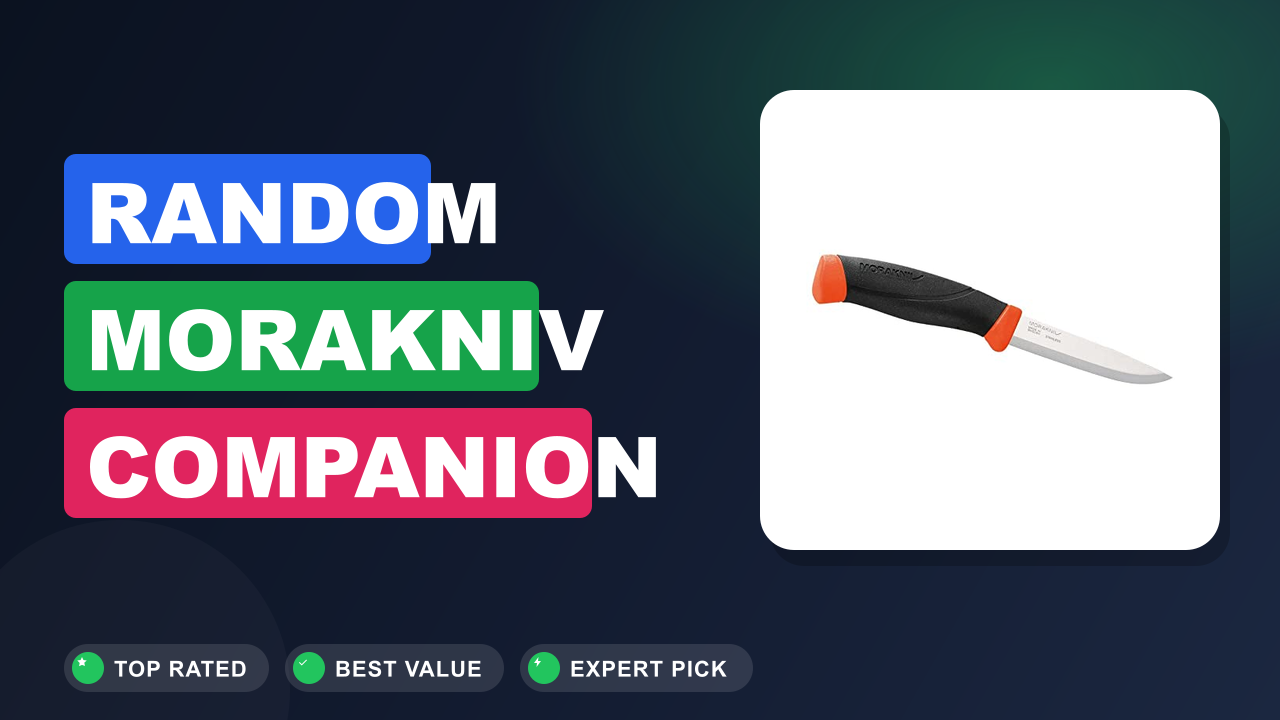
Somewhere between "I need a real knife for camp" and "I don't want to spend a car payment on one," most people land on the Morakniv Companion Fixed Blade Outdoor Knife with Stainless Steel blade. Our editorial team kept running into the same question in outdoor forums and verified buyer threads: can a knife this affordable actually hold up to firewood, fish, and food prep? So we dug into manufacturer specs, steel data, and thousands of aggregate reviews to find out.
Short version: it's worth it if you want a genuinely sharp, corrosion-resistant field knife for camping, kayaking, gardening, or scouts. Skip it if you plan to baton through seasoned oak every weekend. Here's how it stacks up.

What it is
The Morakniv Companion is a fixed-blade outdoor knife made in Mora, Sweden, built around a 4.1-inch Sandvik 12C27 stainless steel blade with a Scandi grind. A Scandi grind is a single wide bevel that runs from the edge up the blade face, which makes it easy to sharpen flat on a stone and excellent at carving wood.
This model (M-11824, the orange one) sits in the entry tier of the Morakniv lineup, below the full-tang Garberg and the Bushcraft series. Its natural rivals are the Condor Bushlore, the ESEE Izula II, and the Ka-Bar Becker BK11. Where those lean thicker and heavier, the Companion prioritizes slicing geometry and low weight.
Setup and first impressions
There's no setup here, which is part of the appeal: it ships sharp and ready. Aggregate user reviews consistently describe the factory edge as shaving-sharp straight out of the plastic clamshell, with buyers repeatedly noting it slices printer paper cleanly before it ever touches wood.
The touch points buyers call out most often are the handle and the sheath, and they land differently. Verified buyer feedback praises the patterned high-friction rubber grip, describing it as tacky in wet hands and warm compared with bare G10 or micarta. The polymer sheath draws more mixed reactions: it snaps in with an audible click and holds securely, but reviewers frequently mention it feels light and hollow next to a leather rig.
Manufacturer specifications indicate a total weight of roughly 4.1 oz (116 g) with the sheath, and that number matches what campers report when they clip it to a belt and forget it's there. The orange handle is a practical choice, not a style one. Reviews from foragers and hunters repeatedly mention that a blaze handle is far easier to spot in leaf litter than a black one.
| Model | Morakniv Companion M-11824 (Orange) |
| Blade steel | Sandvik 12C27 stainless, approx. 0.60% carbon |
| Blade length | 4.1 in (104 mm) |
| Blade thickness | 0.1 in (2.5 mm) |
| Grind | Scandi (single bevel) |
| Hardness | 56–58 HRC |
| Total length | 8.6 in (218 mm) |
| Weight (with sheath) | 4.1 oz (116 g) |
| Tang | Partial (stick) tang, approx. 3/4 handle length |
| Sheath | Color-matched polymer with belt clip and drain hole |
1. Morakniv Companion Fixed Blade Outdoor Knife
Across our comparison of entry-level fixed blades, this is the one that keeps showing up in the packs of people who actually use knives for work, not display. Sweden's Morakniv has been grinding blades since 1891, and the Companion is the model that made the brand a default recommendation. What follows is what the data and the buyers say about living with it.
Daily-use experience
Cutting performance
A 2.5 mm blade with a Scandi grind cuts like a much more expensive knife because there's simply less steel pushing through the material. In aggregate reviews, the two tasks that draw the most praise are feather sticks and food prep. Bushcrafters report the flat bevel rides wood grain naturally, letting you peel long curls without the blade diving.
Sandvik 12C27 is a fine-grained stainless steel with roughly 0.60% carbon and 13.5% chromium, hardened here to 56, 58 HRC. In practice that means an edge that gets scary sharp fast, and dulls a little sooner than premium powder steels like S30V. Users who process game or cardboard in volume typically report a touch-up on a strop or ceramic rod every few sessions.
Handle and ergonomics
The high-friction rubber handle is the reason people forgive everything else. It's roughly 4.5 inches long with a barrel profile and a small finger guard, and buyer feedback repeatedly notes it stays controllable with wet or fish-slimed hands.
Two consistent complaints show up in review analysis. First, users with XL hands find the grip a shade short, with the pinky riding the butt end. Second, the soft rubber attracts grit and pine sap, so it can look grubby after a season even when the blade is spotless.
A wipe with dish soap resolves most of it.
Compared with the harder polymer scales on a Gerber Strongarm or the micarta on a Benchmade Bushcrafter, the Mora handle is softer and warmer in cold weather, which matters more than it sounds when temperatures drop below freezing.
Sheath and carry
The polymer sheath is color-matched, retains the blade with friction on the handle rather than the blade itself, and has a drain hole in the tip so water doesn't pool. Clip it to a belt and the whole package sits at about 4.1 oz, light enough that backpackers routinely mention forgetting it's on their hip.
The honest downside: it's a belt-clip sheath, not a dangler, and it doesn't rotate. Reviewers who sit in a canoe or a treestand report the handle can dig into the ribs. A common fix buyers describe is threading paracord or a small dangler loop through the clip.
Durability and limits
Here's the trade-off nobody should gloss over. The Companion uses a partial (stick) tang that runs roughly three quarters into the handle, not a full tang. Light batoning through wrist-thick softwood is well within what users report doing successfully for years.
Heavy prying, hardwood splitting, or stabbing into frozen material is where reported failures cluster. Morakniv's own product line answers this: the Garberg is the full-tang model, and it costs several times more. If your use case is camp chores, fish, food, and cordage, the Companion's limits sit comfortably above your needs.
If your use case is survival abuse, buy up the range.
✓ Pros
- Ships shaving-sharp from the factory, so there’s no break-in or first-night sharpening session before your trip
- Scandi grind at 2.5 mm thickness carves feather sticks cleanly, which is exactly what you need for a wet-weather fire
- Sandvik 12C27 stainless resists rust in humid and saltwater settings, so kayakers and coastal anglers skip the oiling routine
- 4.1 oz total carry weight disappears on a belt, a real difference over 8–10 oz survival knives on long hikes
- Single flat bevel sharpens on any stone by laying the bevel flat, no jigs or guessing at angles
✗ Cons
- Partial stick tang limits hard batoning and prying, so hardwood splitting belongs to an axe or a full-tang blade
- Rounded spine won’t scrape a ferrocerium rod out of the box, meaning you’ll need a striker or a file to square it
- Polymer belt-clip sheath doesn’t pivot, so the handle digs in when you’re seated in a canoe or treestand
- Rubber handle traps sap, grit and dirt, and looks worn well before the blade shows any real wear
Who should buy it
Buy it if you…
You camp a few weekends a month, cook over a fire, and want one blade that handles kindling, onions, and paracord without ceremony. You're also the right buyer if you fish or paddle, because 12C27's chromium content shrugs off the moisture that would spot a carbon blade. Parents and scout leaders buy this one in multiples, and the orange handle is a genuine safety feature when a knife gets set down in tall grass.
Gardeners use it for root pruning and twine too.
Skip it if you…
You process firewood as a routine and treat the knife as a wedge. Repeated hard batoning on a partial tang is asking the handle to do a job it wasn't designed for. Skip it as well if you want one knife to also strike a ferro rod: the stainless Companion has a rounded spine, so you'd need the Companion Spark or a separate striker.
Anyone who wants a heirloom-grade blade with leather carry and lifetime service should shop a tier up. Recommendations should match the actual work, per U.S. Forest Service guidance on carrying appropriate gear for your trip.
Better alternatives
- Morakniv Garberg: the full-tang, 3.2 mm sibling from the same Morakniv factory, built for batoning and prying the Companion won't survive.
- ESEE Izula II: a smaller full-tang 1095 carbon neck knife with a no-questions warranty, better for hard use and worse against rust.
Frequently Asked Questions (FAQ)
Can you baton with the Morakniv Companion?
Yes, within limits. Buyer reports consistently show successful batoning through softwood up to roughly 2 to 3 inches thick, using a light wooden baton and striking near the handle, not the tip. The partial tang extends about three quarters of the way into the grip, so lateral twisting is the failure mode, not straight downward force.
For seasoned oak or knotty rounds, use a hatchet or step up to the full-tang Garberg.
Will the stainless blade throw sparks off a ferro rod?
Not as it comes. The spine on the stainless Companion is rounded and slightly softened, so it slides off a ferrocerium rod instead of scraping magnesium shavings. You have two options: carry the small carbide striker that ships with most ferro rods, or square the spine yourself with a few passes of a mill file at 90 degrees.
Morakniv also sells the Companion Spark, which includes an integrated ferro rod in the handle.
Is Sandvik 12C27 good steel for the money?
It's one of the best value stainless steels in outdoor knives. 12C27 is a fine-grained Swedish stainless with roughly 0.60% carbon and 13.5% chromium, heat treated to 56, 58 HRC in this knife. That balance gives you a very fine, easily restored edge plus real corrosion resistance. It won't hold an edge as long as S35VN or CPM-3V, but it sharpens back in a minute on a pocket stone, which matters more in the field.
How do you sharpen a Scandi grind?
Lay the bevel flat on the stone and push. That's the whole trick. Because a Scandi grind is a single wide bevel, the steel itself sets the angle for you, so you don't need a guided jig or a protractor.
Most users run a medium stone until a burr forms along the full edge, flip, repeat, then finish on a leather strop with green compound. Ten passes per side is often enough for a maintenance touch-up.
Is it dishwasher safe or food safe?
Hand wash only. The stainless blade handles food prep fine and won't leave a metallic taste the way an unseasoned carbon blade can, but dishwasher heat and detergent will degrade the rubber handle and can dull the edge against the rack. Rinse, dry with a towel, and store it out of the sheath if it's been in saltwater.
The polymer sheath itself has a drain hole, so it dries quickly.
Final verdict
4.6 out of 5 stars. As of 2026, the Morakniv Companion remains the reference point for what a budget fixed blade should do, and very little has changed because very little needed to.
The buyers who win here are campers, anglers, paddlers, gardeners, and anyone teaching a beginner to use a real knife safely. You get Swedish manufacturing, a genuinely excellent Scandi edge in Sandvik 12C27, and 4.1 oz of carry weight for a price that means losing it in the leaves is annoying rather than devastating.
The buyers who lose are the ones expecting a survival chopper. The partial tang, the rounded spine, and the plain polymer sheath are the honest trade-offs that keep the cost down. Know that going in and this knife will outperform its price bracket for years.
Affiliate disclosure: This post contains affiliate links. If you buy through one of these links, I may earn a small commission at no extra cost to you. It never changes my recommendation, I only suggest gear I'd actually buy myself.