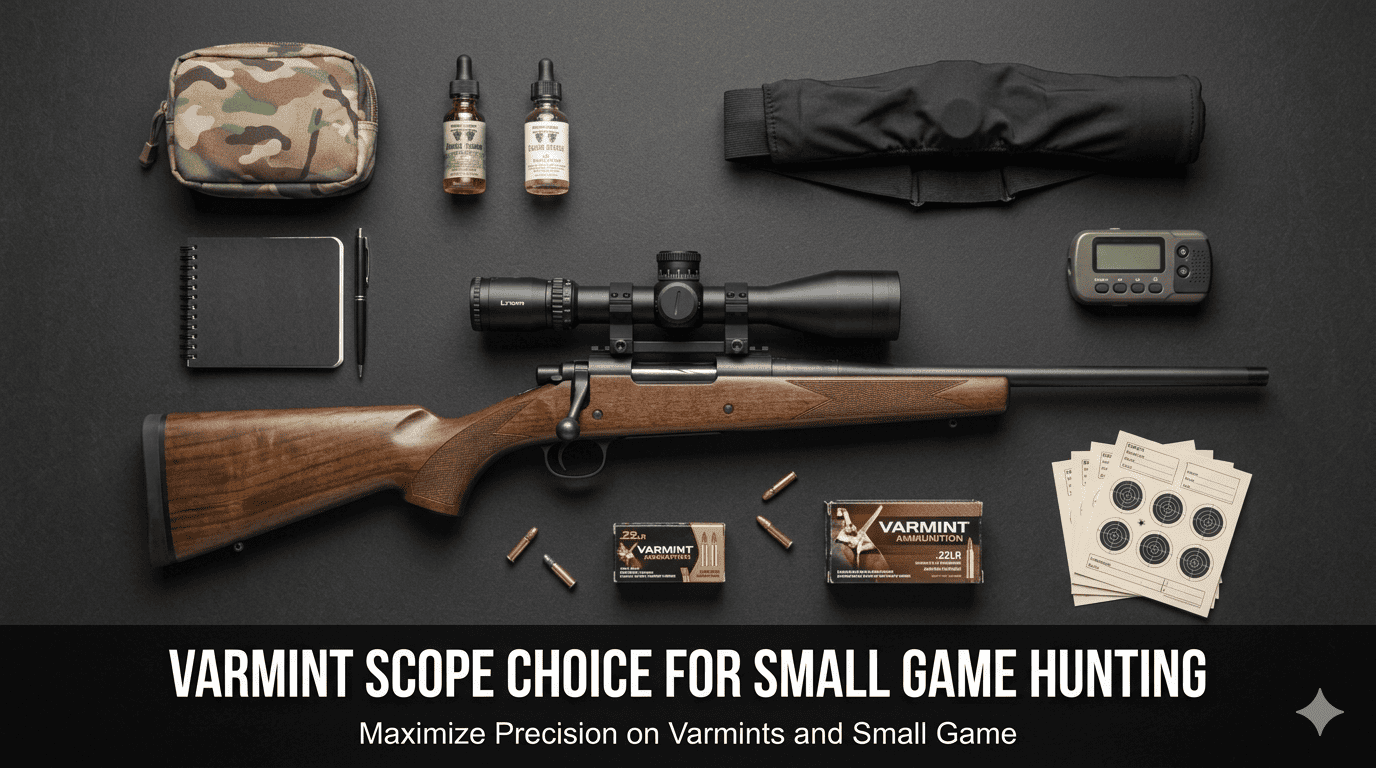
Small game hunting is one of the most rewarding yet technically demanding forms of hunting. Unlike large game, where targets are bigger and more forgiving, small animals such as rabbits, squirrels, and prairie dogs require exceptional precision. That precision does not come only from your rifle or your shooting skillsit comes heavily from your scope. Choosing the right varmint scope is not just about buying an optic; it is about matching your equipment to the behavior of your target, the environment you hunt in, and the distances you shoot.
Table of Contents
When hunting small game, you are often dealing with animals that are quick, alert, and small in size. A squirrel’s vital zone, for example, is tiny compared to that of a deer. This means even slight inaccuracies can result in a miss or, worse, an unethical shot. A good scope helps you see clearly, aim precisely, and react quickly.
In dense forests, your target may appear suddenly and disappear just as fast. In open fields, you may be taking longer shots where bullet drop becomes a factor. A well-chosen scope bridges these different scenarios by giving you clarity, flexibility, and confidence. Without it, even a high-quality rifle cannot perform to its full potential.
Magnification is often the first thing hunters focus on, but it is also one of the most misunderstood aspects of a scope. Many beginners assume that higher magnification automatically means better performance. In reality, magnification is about balance.
At lower magnification levels, such as 3x or 4x, your field of view is much wider. This makes it easier to locate and track moving animals, especially in wooded areas. It also allows for faster target acquisition, which is critical when hunting animals that rarely stay still.
As you increase magnification, you gain the ability to see fine details at longer distances. This is particularly useful in open terrain where targets may be 100 yards or more away. However, higher magnification narrows your field of view and can make it harder to find your target quickly. It can also amplify small movements, making your sight picture less stable.
For most small game hunters, a variable scope in the range of 3-9x or 4-12x provides the best versatility. It allows you to stay at low magnification when scanning for targets and then zoom in when you are ready to take a precise shot.
The objective lens, located at the front of the scope, plays a crucial role in how much light enters your optic. This directly affects how bright and clear your image appears, especially during low-light conditions such as early morning or late evening hunts.
A larger objective lens, such as 50mm, allows more light to enter, resulting in a brighter image. This can be beneficial when hunting at dawn or dusk. However, larger lenses also add weight and can make your rifle feel less balanced. They may also require higher mounting, which can affect your shooting comfort.
On the other hand, a 40mm objective lens strikes an excellent balance between brightness and practicality. It provides sufficient light for most hunting conditions while keeping your setup lightweight and easy to handle. For the majority of small game hunters, this size is more than adequate.
The reticle is your point of reference inside the scope, and its design can significantly influence your shooting experience. A simple duplex reticle, with its thicker outer lines and fine center crosshair, is often the preferred choice for beginners. It is easy to use and allows for quick target acquisition without unnecessary complexity.
More advanced reticles, such as mil-dot or BDC (bullet drop compensation), provide additional information that can be used for range estimation and holdover adjustments. These reticles become particularly useful when shooting at varying distances, as they help you compensate for bullet drop without adjusting your turrets.
While advanced reticles offer more functionality, they also require practice and understanding. For small game hunting, where shots are often taken within moderate distances, many hunters find that a simple reticle is more than sufficient. However, if you frequently hunt in open areas and take longer shots, a BDC reticle can be a valuable tool.
Parallax is a phenomenon where the reticle appears to shift relative to the target when you move your eye behind the scope. This can lead to inaccuracies, especially when shooting at small targets.
Many basic scopes come with a fixed parallax setting, often set at 100 yards. While this may work reasonably well for general hunting, it is not ideal for small game, where shots may be taken at much shorter distances. In such cases, parallax error can become more noticeable and affect your accuracy.
Scopes with adjustable parallax, either through an adjustable objective (AO) or a side focus knob, allow you to fine-tune the focus for different distances. This not only improves clarity but also ensures that your reticle remains aligned with the target. For varmint hunting, where precision is critical, having parallax adjustment can make a significant difference.
One of the most overlooked aspects of a scope is the quality of its glass. Two scopes may have the same magnification and lens size, but the difference in clarity can be dramatic.
High-quality glass with fully multi-coated lenses provides better light transmission, sharper images, and reduced glare. This is especially important when trying to identify small targets against complex backgrounds. Poor-quality optics can result in a blurry or dim image, making it difficult to distinguish your target clearly.
Investing in good glass does not necessarily mean buying the most expensive scope on the market. Many mid-range scopes offer excellent optical performance and represent great value for money. The key is to prioritize clarity and reliability over unnecessary features.
When you are out in the field for hours, every ounce matters. A heavy scope can make your rifle cumbersome and tiring to carry, especially if you are moving frequently. Lightweight scopes are easier to handle and contribute to better overall balance.
Durability is equally important. Hunting conditions can be unpredictable, and your scope needs to withstand recoil, weather, and rough handling. Features such as waterproofing, fog-proofing, and shock resistance ensure that your optic performs reliably in all conditions.
A well-built scope not only lasts longer but also maintains its zero, which is essential for consistent accuracy.
Small game hunting is not a one-size-fits-all activity. The environment you hunt in plays a major role in determining the type of scope you need.
In dense forests, where shots are typically short and targets appear quickly, a lower magnification scope with a wide field of view is ideal. It allows you to acquire targets بسرعة and track movement بسهولة.
In open fields, where distances are greater, higher magnification becomes more useful. Here, the ability to zoom in and make precise adjustments can significantly improve your success rate.
For hunters who frequently switch between environments, a versatile variable scope provides the flexibility needed to adapt to different situations.
Choosing the right varmint scope for small game hunting is about understanding your needs and finding the right balance between performance and practicality. While it may be tempting to focus on specifications such as magnification and lens size, the true value of a scope lies in how well it performs in real hunting conditions.
A reliable scope with clear optics, appropriate magnification, and practical features will enhance your accuracy and overall hunting experience. It will allow you to take cleaner shots, reduce missed opportunities, and ultimately become a more effective hunter.
In the end, the best scope is not necessarily the most expensive one, but the one that fits your style, your environment, and your goals in the field.
Shooting sports, hunting, and target practice expose your ears to extremely loud sounds. Most firearms…
Handgun accuracy is one of the most important skills in shooting sports and responsible firearm…
Selecting the best scope magnification for shooting at 300 yards is a decision that directly…
Traveling with a firearm whether for hunting, competitive shooting, professional training, or lawful personal protection…
Preparing for a successful day at the shooting range involves much more than simply bringing…
Selecting the right tactical scope for hunting is one of the most important decisions a…
This website uses cookies.


