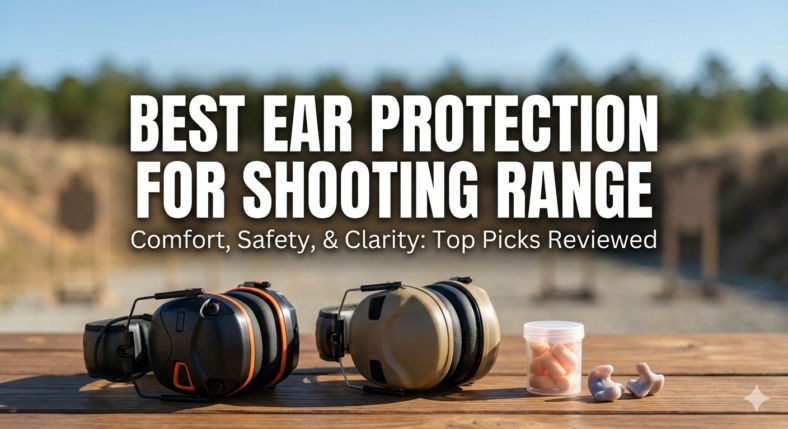
Best Ear Protection for Shooting Range: Complete Buyer’s Guide

Spending time at a shooting range without proper ear protection can permanently damage your hearing. Firearms produce impulse noise that often exceeds 140–170 decibels, far above the safe hearing threshold. Even a single unprotected gunshot can cause irreversible hearing loss or tinnitus. That’s why choosing the best ear protection for shooting range use is not optional it’s essential.

In this in-depth guide, we’ll explore how shooting noise affects your ears, the different types of hearing protection available, what features matter most, and how to choose the right option based on your shooting style and environment.

Why Ear Protection Is Critical at a Shooting Range

Gunshots are classified as impulse noise, which is more damaging than continuous noise because it delivers a sudden, extremely loud sound wave. Indoor ranges are especially dangerous since sound reflects off walls and ceilings, amplifying exposure. Repeated exposure without adequate protection can lead to:

  • Permanent noise-induced hearing loss
  • Ringing in the ears (tinnitus)
  • Reduced ability to hear conversations or range commands
  • Increased sensitivity to everyday sounds

Quality ear protection reduces sound levels to safe ranges while still allowing situational awareness.

Understanding Noise Reduction Rating (NRR)

The Noise Reduction Rating (NRR) is one of the most important metrics when selecting ear protection for shooting. It indicates how many decibels of noise the device can reduce.

For shooting ranges:

  • Minimum recommended NRR: 22 dB
  • Ideal NRR for indoor ranges: 26–33 dB

Higher-caliber firearms and indoor environments require higher NRR values. Many experienced shooters even double up by wearing earplugs under earmuffs for maximum protection.

Types of Ear Protection for Shooting Ranges

Foam Earplugs

Foam earplugs are one of the most affordable and effective solutions when used correctly. They expand inside the ear canal to create a tight seal that blocks noise.

They are lightweight, disposable, and offer high NRR ratings often up to 33 dB. However, they must be inserted properly to be effective, and they don’t allow you to hear conversations or range commands clearly.

Foam earplugs are best suited for shooters who prioritize maximum noise reduction and don’t mind limited communication.

Reusable Earplugs

Reusable earplugs are typically made from silicone or rubber and are designed for long-term use. They are easier to insert than foam plugs and more environmentally friendly.

While their NRR is usually slightly lower than foam plugs, they are comfortable for extended sessions and ideal for shooters who visit the range frequently.

Some models include acoustic filters that reduce harmful noise while letting lower-level sounds pass through.

Passive Earmuffs

Passive earmuffs cover the entire ear and block noise through sound-dampening materials. They are easy to put on and take off, making them popular among beginners.

Most passive earmuffs offer NRR ratings between 22 and 30 dB. They work well at outdoor ranges but can interfere with cheek weld when using rifles or shotguns.

They are a solid choice for casual shooters and guests at the range.

Electronic Earmuffs (Best Overall Choice)

Electronic earmuffs are widely considered the best ear protection for shooting range use, especially for regular shooters. These muffs use built-in microphones to amplify low-level sounds like speech while instantly cutting off harmful gunshot noise.

This allows you to:

  • Hear range commands clearly
  • Communicate with other shooters
  • Maintain situational awareness

High-quality electronic earmuffs typically offer NRR ratings around 22–26 dB and are ideal for both indoor and outdoor shooting.

Custom Molded Ear Protection

Custom molded earplugs are created from impressions of your ears, providing a perfect fit and superior comfort. They offer consistent protection and are excellent for long shooting sessions.

Although more expensive, they are popular among competitive shooters, instructors, and professionals who spend hours at the range.

Some advanced versions include electronic sound enhancement similar to electronic earmuffs.

Best Ear Protection Based on Shooting Environment

Indoor Shooting Ranges

Indoor ranges are louder due to sound reflection. For these environments, the best option is double hearing protection foam earplugs combined with electronic or passive earmuffs.

This setup can provide a combined protection level suitable for high-caliber firearms and prolonged sessions.

Outdoor Shooting Ranges

Outdoor ranges disperse sound more effectively. High-quality electronic earmuffs or high-NRR earplugs are usually sufficient, depending on firearm caliber.

Electronic earmuffs are especially beneficial outdoors, where communication and awareness are important.

Key Features to Look for in Shooting Ear Protection

Comfort is critical, especially during long sessions. Look for padded ear cups, adjustable headbands, and lightweight designs.

Durability matters as well. Shooting ear protection should withstand frequent use, temperature changes, and minor impacts.

Low-profile ear cups are important for rifle shooters to avoid interference with stock positioning.

Battery life is another factor for electronic earmuffs. Models with automatic shutoff features help conserve power.

How to Properly Wear Ear Protection

Even the best ear protection won’t work if worn incorrectly. Foam earplugs should be rolled tightly, inserted deeply, and allowed to expand fully. Earmuffs must create a tight seal around the ears without gaps caused by glasses or hats.

For maximum safety, especially indoors, combining earplugs with earmuffs provides the highest level of hearing protection.

Final Thoughts

The best ear protection for shooting range activities depends on your shooting frequency, environment, and firearm type. For most shooters, electronic earmuffs paired with high-NRR earplugs offer the best balance of safety, comfort, and awareness.

Protecting your hearing is a lifelong investment. Unlike other gear, hearing loss cannot be repaired only prevented. Choosing the right ear protection ensures you can enjoy shooting sports safely for years to come.
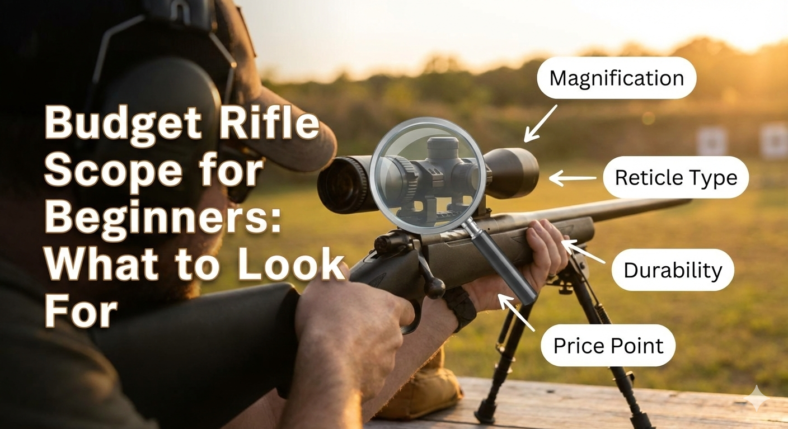
Budget Rifle Scope for Beginners: What to Look For

Choosing your first rifle scope can feel overwhelming, especially when you are on a budget. The optics market is flooded with options that promise crystal-clear glass, extreme durability, and long-range precision often at prices that seem too good to be true. For beginners, the challenge is not finding a scope, but finding the right scope that balances performance, durability, and cost without sacrificing reliability.

A budget rifle scope does not mean a low-quality rifle scope. It means understanding which features truly matter for your shooting needs and which are simply marketing extras. This guide will walk you through everything a beginner needs to know before buying a budget rifle scope, helping you spend your money wisely and avoid common mistakes.

Understanding Your Purpose First

Before you even look at magnification numbers or reticle styles, you must be clear about how you plan to use the rifle scope. A scope suitable for casual range shooting may not perform well for hunting or tactical training. Beginners often make the mistake of buying the most powerful scope they can afford without considering whether it suits their actual use.

If you primarily shoot at the range within 50 to 200 yards, a simple low-to-mid magnification scope will be more than enough. For hunting, clarity in low-light conditions becomes more important than extreme zoom. For long-range target shooting, precision adjustments and reticle accuracy matter most. Identifying your primary purpose will immediately narrow down your options and prevent unnecessary spending.

Magnification: Why More Is Not Always Better

Magnification is one of the most misunderstood aspects of rifle scopes among beginners. Many new shooters assume that higher magnification automatically leads to better accuracy, but this is not true. Excessive magnification can actually make shooting more difficult by exaggerating movement and reducing field of view.

For beginners on a budget, variable scopes in the 2-7x, 3-9x, or 4-12x range offer the best balance of versatility and usability. A 3-9x scope, for example, is widely considered one of the most beginner-friendly options because it works well for both range shooting and hunting at moderate distances. Fixed-power scopes can be cheaper and more durable, but they lack flexibility, which most beginners benefit from.

Objective Lens Size and Light Transmission

The objective lens is the large lens at the front of the scope, and its size plays a key role in light transmission. Larger objective lenses allow more light to enter, resulting in a brighter image, especially in low-light conditions such as dawn or dusk.

However, larger lenses also make the scope heavier and require higher mounting, which can affect cheek weld and shooting comfort. For beginners, an objective lens size between 32mm and 40mm is usually ideal. This range provides sufficient brightness without adding unnecessary bulk or cost. Ultra-large objective lenses may sound appealing, but they rarely provide real benefits for beginner-level shooting.

Glass Quality Over Brand Names

When shopping for a budget rifle scope, glass quality matters far more than the brand logo. High-end scopes use premium glass and advanced coatings, but many budget-friendly scopes still offer surprisingly good clarity if they use proper multi-coated lenses.

Look for scopes labeled as fully multi-coated rather than simply coated. This improves light transmission, reduces glare, and enhances image contrast. While you may not get edge-to-edge clarity comparable to premium optics, a good budget scope should still provide a clear and usable sight picture under normal conditions. Avoid scopes that show heavy distortion, excessive blurriness at higher magnifications, or poor color accuracy.

Reticle Types: Keep It Simple

Reticles come in many designs, from simple crosshairs to complex tactical grids. For beginners, simplicity is key. A basic duplex or simple BDC (Bullet Drop Compensating) reticle is usually the best choice.

Complex reticles with excessive markings can be distracting and difficult to understand, especially for new shooters who are still learning fundamentals. A simple reticle allows you to focus on proper sight alignment, trigger control, and follow-through. As your skills improve, you can always upgrade to a more advanced reticle if needed.

Turret Quality and Adjustments

Turrets control elevation and windage adjustments, and their quality directly affects accuracy. In the budget category, you should not expect ultra-precise tracking, but the turrets should still be consistent and repeatable.

For beginners, capped turrets are often preferable because they protect against accidental adjustments during transport or field use. If you plan to dial frequently for distance, exposed turrets can be useful, but only if they are well-built. Cheap turrets that do not return to zero accurately can cause frustration and missed shots.

It is also important that turret clicks are tactile and audible. Soft or mushy clicks make it difficult to know whether your adjustment has registered correctly.

Durability and Build Quality

A rifle scope must withstand recoil, environmental exposure, and regular handling. Even budget scopes should be shockproof, waterproof, and fog-resistant. These features are not luxuries; they are essentials.

Most reliable budget scopes are made from aircraft-grade aluminum and sealed with O-rings to prevent moisture ingress. Nitrogen or argon purging helps prevent internal fogging. While a beginner may not subject their scope to extreme abuse, a poorly built scope can lose zero or fail internally after minimal use.

Eye Relief and Comfort

Eye relief refers to the distance between your eye and the scope where the image is clear. Insufficient eye relief can result in discomfort or even injury from recoil, especially on higher-caliber rifles.

Beginners should look for scopes offering at least 3.5 inches of eye relief. Consistent eye relief across magnification levels is also important. A comfortable shooting experience encourages proper technique and reduces fatigue during longer shooting sessions.

Weight and Balance Considerations

Budget scopes vary widely in weight, and beginners often overlook this factor. A heavy scope can throw off rifle balance, making it harder to hold steady and track targets.

For most beginners, a lightweight scope improves handling and overall shooting comfort. While heavier scopes may feel more robust, they are not always necessary for entry-level shooting. Balance is especially important for hunters and offhand shooters.

Warranty and Customer Support Matter

One of the best indicators of a trustworthy budget rifle scope is a solid warranty. Many reputable optics brands offer lifetime warranties even on their entry-level products. This provides peace of mind and protects your investment if something goes wrong.

A strong warranty often reflects the manufacturer’s confidence in their product. Beginners should avoid unknown brands with no clear warranty or customer support presence, as replacing or repairing a defective scope can be difficult or impossible.

Common Beginner Mistakes to Avoid

Many beginners overspend on magnification while ignoring glass quality. Others choose scopes designed for long-range shooting when their actual needs are basic. Another common mistake is buying the cheapest scope available without researching reviews or specifications.

A budget rifle scope should still meet fundamental performance standards. Saving money is important, but reliability and usability should never be compromised.

Final Thoughts

Buying your first rifle scope is an important step in your shooting journey. A well-chosen budget scope can provide years of reliable performance and help you develop solid shooting fundamentals. By focusing on practical magnification, decent glass quality, simple reticles, and proven durability, beginners can avoid costly mistakes and unnecessary upgrades.

Remember, accuracy comes from skill first and equipment second. A modest, reliable scope in capable hands will always outperform an expensive optic used incorrectly. Start with the right basics, and upgrade only when your experience truly demands it.

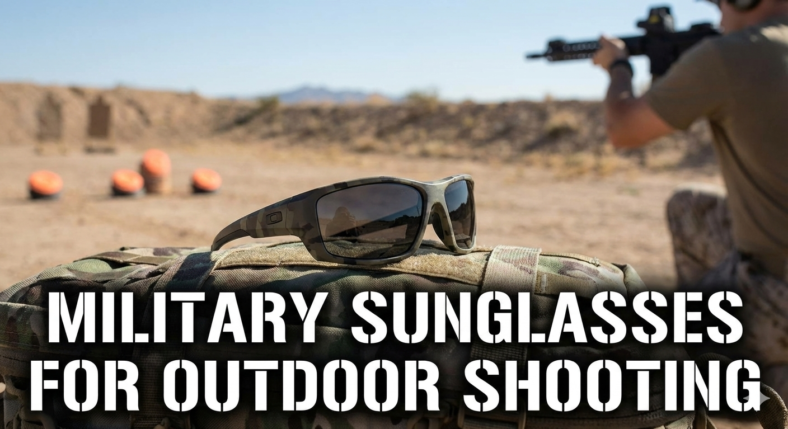
Military Sunglasses for Outdoor Shooting: Precision, Protection, and Performance

Outdoor shooting demands more than just skill and the right firearm it requires clear vision, eye protection, and comfort under changing light and weather conditions. This is where military sunglasses for outdoor shooting play a critical role. Designed to meet the rigorous standards of military and tactical professionals, these sunglasses provide unmatched durability, ballistic protection, and visual clarity that standard eyewear simply cannot offer.

In this in-depth guide, we’ll explore what makes military sunglasses essential for outdoor shooting, key features to look for, lens technologies, and how they enhance shooting performance in real-world environments.

Why Military Sunglasses Matter in Outdoor Shooting

Outdoor shooting environments are unpredictable. Dust, debris, wind, glare, and sudden light changes can all affect vision and safety. Military sunglasses are engineered specifically to handle these challenges.

Unlike regular sunglasses, military-grade shooting eyewear is designed to:

  • Protect against high-velocity debris and shell casings
  • Reduce glare without distorting targets
  • Enhance contrast for faster target acquisition
  • Maintain clarity during long shooting sessions

For both recreational shooters and professionals, the right eyewear can significantly improve accuracy and reduce eye fatigue.

Ballistic Protection: Safety Comes First

One of the most important features of military sunglasses is ballistic-rated eye protection. These glasses are tested against strict military standards such as ANSI Z87.1 and MIL-PRF-32432, ensuring they can withstand high-impact threats.

How Ballistic Protection Helps Shooters

  • Shields eyes from ricochets and fragments
  • Protects against ejected shell casings
  • Prevents dust and debris from entering the eyes
  • Reduces risk of serious eye injuries

For outdoor shooting ranges, tactical drills, or hunting in rugged terrain, ballistic protection is non-negotiable.

Advanced Lens Technology for Shooting Accuracy

Military sunglasses are equipped with specialized lenses that enhance vision rather than simply darken it.

Polarized vs Non-Polarized Lenses

  • Polarized lenses reduce glare from reflective surfaces like sand, water, or metal, making them ideal for bright outdoor environments.
  • Non-polarized lenses are often preferred for tactical shooting as they preserve depth perception and visibility of digital optics.

Lens Color Options and Their Benefits

  • Smoke/Grey lenses: Maintain natural color balance in bright sunlight
  • Brown/Bronze lenses: Enhance contrast and depth perception
  • Yellow/Amber lenses: Improve visibility in low-light or overcast conditions
  • Clear lenses: Perfect for dusk, dawn, or indoor-outdoor transitions

Many military sunglasses feature interchangeable lenses, allowing shooters to adapt quickly to changing light conditions.

Anti-Fog and Scratch-Resistant Coatings

Outdoor shooting often involves temperature changes, sweat, and humidity. Fogged lenses can compromise safety and performance.

Military-grade shooting sunglasses typically include:

  • Anti-fog coatings to maintain clear vision
  • Scratch-resistant surfaces for long-term durability
  • Hydrophobic coatings that repel water, sweat, and oil

These features ensure uninterrupted focus during extended shooting sessions.

Frame Design Built for Tactical Use

Military sunglasses are designed for comfort and stability, even during intense movement.

Key Frame Features

  • Lightweight materials like TR90 or ballistic polycarbonate
  • Wraparound design for full peripheral coverage
  • Rubberized nose pads and temple grips for slip resistance
  • Helmet and ear-protection compatibility

These design elements ensure the sunglasses stay securely in place without causing pressure points, even when worn for hours.

UV Protection for Long-Term Eye Health

Extended exposure to sunlight can cause eye strain and long-term damage. Military sunglasses offer 100% UVA and UVB protection, safeguarding your eyes during prolonged outdoor shooting activities.

This is especially important for shooters who train or hunt in open environments such as deserts, plains, or mountainous regions.

Military Sunglasses vs Regular Shooting Glasses

While standard shooting glasses may offer basic protection, military sunglasses provide a higher level of performance.

FeatureMilitary SunglassesRegular Sunglasses
Ballistic Impact ProtectionYesNo
Interchangeable LensesOftenRare
Tactical FitYesNo
Anti-Fog TechnologyAdvancedLimited
DurabilityExtremeModerate

For serious shooters, military sunglasses are a long-term investment in safety and performance.

Ideal Use Cases for Military Shooting Sunglasses

Military sunglasses are suitable for a wide range of outdoor shooting activities, including:

  • Tactical and defensive shooting
  • Military and law enforcement training
  • Competitive shooting sports
  • Hunting in bright or harsh environments
  • Range training with high round counts

Their versatility makes them a favorite among professionals and enthusiasts alike.

How to Choose the Right Military Sunglasses for Shooting

When selecting the best military sunglasses for outdoor shooting, consider the following:

  • Ballistic safety certifications
  • Lens interchangeability
  • Comfort and fit with hearing protection
  • Light conditions you shoot in most often
  • Durability and warranty

Choosing the right pair ensures optimal performance and eye protection in every scenario.

Final Thoughts

Military sunglasses for outdoor shooting are more than just protective eyewear they are precision tools designed to enhance vision, safety, and shooting performance. With ballistic protection, advanced lens technology, and tactical comfort, they offer a level of reliability that standard sunglasses cannot match.

Whether you’re a professional operator, competitive shooter, or outdoor enthusiast, investing in high-quality military sunglasses can significantly elevate your shooting experience while keeping your eyes protected in the most demanding environments.

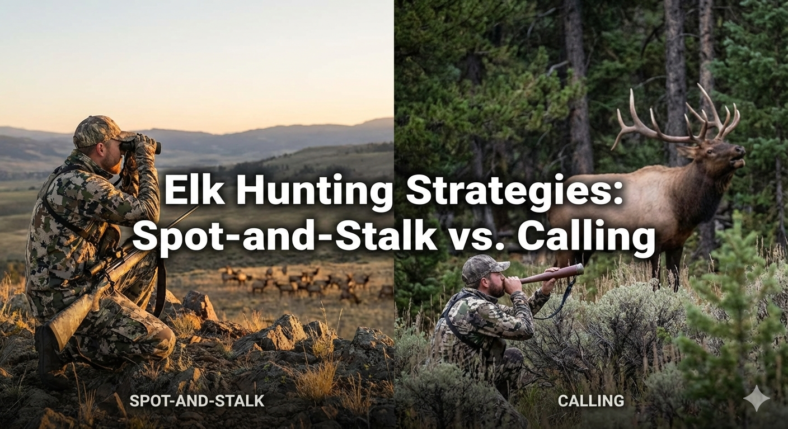
Elk Hunting Strategies: Spot-and-Stalk vs Calling

Spot-and-stalk and calling are both effective elk hunting strategies, but they solve different problems. Spot-and-stalk works best when you can glass, read wind, and move quietly into range. Calling works best when elk are vocal, responsive, and the hunter understands how much calling is enough. The better strategy depends on season timing, hunting pressure, terrain, wind, elk behavior, and your ability to make a safe, ethical shot.

Table of Contents
  1. Quick Answer
  2. Spot-and-Stalk Basics
  3. Calling Basics
  4. Wind and Thermals
  5. Season Timing
  6. Hunting Pressure
  7. Terrain and Visibility
  8. When To Combine Both
  9. Rules and Safety
  10. Strategy Checklist
  11. FAQ

Quick Answer

Choose spot-and-stalk when elk are visible, the wind is readable, and you can close distance without forcing a response. Choose calling when elk are vocal or when terrain makes it hard to see them before they are close. Many successful hunters use both: glass first, move carefully, then call only when calling solves a specific problem.

Best for Beginners

Beginners often learn more from spot-and-stalk because it teaches glassing, wind, terrain, and patience. Calling can work, but overcalling is a common mistake.

Best During the Rut

Calling becomes more useful during the rut when bulls are vocal and social behavior creates openings. Even then, calling should match what the elk are doing, not what the hunter wants them to do.

Spot-and-Stalk Basics

Spot-and-stalk hunting starts with observation. You find elk from a distance, study their movement, and plan a route that keeps the wind and terrain in your favor. It rewards patience and punishes shortcuts.

Why It Works

Elk are large animals, but they can disappear quickly in timber, folds, and shadows. Glassing from a distance lets you understand where they feed, bed, and travel before you enter their space.

Where It Fails

Spot-and-stalk fails when hunters rush, treat wind as an afterthought, skyline themselves, or move without a plan. Once elk smell or see you, the opportunity usually ends.

Calling Basics

Calling uses bugles, cow calls, or contact calls to communicate with elk. It can locate animals, stop an elk briefly, or bring a responsive bull into range. It can also educate elk when used carelessly.

Bugles

Bugles can help locate bulls and challenge responsive animals during the rut. They are less useful when bulls are quiet, pressured, or moving away from hunter noise.

Cow Calls

Cow calls can be useful for soft contact, calming an elk, or stopping an animal for a moment. Too much cow calling can sound unnatural, especially in heavily hunted areas.

Wind and Thermals

Wind is the heart of elk hunting. Elk trust their nose. Morning thermals often rise as air warms, and evening thermals often fall as temperatures drop, but terrain can create swirls and surprises. For general wind awareness, the National Weather Service wind safety resources are a useful reminder that conditions can change quickly outdoors.

Spot-and-Stalk Wind Rule

Do not start a stalk unless you have a wind plan. A longer route with steady wind is usually better than a short route that blows scent into the elk.

Calling Wind Rule

When calling, assume elk may circle downwind. Set up where you can see or cover the downwind side if legal and safe.

Season Timing

Season timing affects which strategy shines. Early, pre-rut, peak rut, post-rut, and late-season elk can behave very differently. Always confirm season dates, legal method, and unit rules with your state wildlife agency before planning gear or strategy.

Early Season

Spot-and-stalk can be strong early when elk patterns are more feed-and-bed oriented. Soft calling may help, but aggressive calling can be out of place if elk are not behaving that way.

Rut and Post-Rut

During the rut, calling can create opportunities. After heavy pressure or after the rut, elk may become quieter and more security-focused, making glassing, travel corridors, and bedding cover more important.

Hunting Pressure

Pressure changes elk behavior. In pressured units, elk may move before daylight, avoid open areas, respond poorly to calling, or shift into thicker cover. A strategy that works on quiet private land may fail on busy public land.

Pressure and Calling

If many hunters are calling, less can be more. Use calling to locate or finish a setup, not to broadcast constantly from every ridge.

Pressure and Stalking

In pressured areas, quiet movement and patience can beat noise. Watch escape routes, shade, water, and cover edges instead of only obvious feeding openings.

Terrain and Visibility

Open country favors glassing and planned stalks. Thick timber can favor calling or still-hunting because you may hear elk before you see them. Broken terrain may require both approaches.

Open Country

Use optics, shade lines, benches, basins, and feeding areas. Move only when terrain hides you or when elk are bedded and the wind allows a safe approach.

Timber and Cover

In timber, slow down. Listen more. Calling may help locate elk, but setup matters. If you call from a poor position, you may bring elk close without ever seeing them clearly.

When To Combine Both

The best strategy is often hybrid. Glass first to find elk or fresh sign. Move with wind and terrain. Call only when you need to locate, stop, or influence elk at the right moment.

A Simple Hybrid Plan

  • Glass or listen from a distance.
  • Confirm wind and thermals before moving.
  • Use terrain to close distance quietly.
  • Call only if elk behavior suggests it may help.
  • Set up with shooting lanes and a safe backstop in mind.

Rules and Safety

Elk strategy still starts with legal access and safe handling. Confirm your tag, unit, season dates, weapon rules, and harvest reporting with the current state wildlife agency source before the hunt. General hunter education resources such as Hunter-Ed and the International Hunter Education Association can help reinforce safety and ethics, but they do not replace current state regulations.

Before You Move In

Before starting a stalk or calling setup, confirm shooting lanes, backdrop, wind, and where other hunters may be. Calling can pull elk, but it can also pull attention from nearby hunters. Wear required visibility clothing, know the property boundaries, and avoid taking marginal shots when excitement is high.

Strategy Checklist

  • Check current elk season, unit, tag, and method rules with the state wildlife agency.
  • Start with wind, not with calling.
  • Glass before entering likely bedding or feeding areas.
  • Call less in pressured areas unless elk are clearly responsive.
  • Use terrain to hide movement and avoid skylining.
  • Pass shots that are rushed, unsafe, or beyond your practiced limit.

FAQ

Is spot-and-stalk better than calling for elk?

Neither is always better. Spot-and-stalk is stronger when elk are visible and wind allows a planned approach. Calling is stronger when elk are vocal or hidden in cover and responsive.

Do elk calls work on pressured public land?

They can, but pressured elk may ignore or avoid unnatural calling. Use calls sparingly and focus on setup, wind, and realistic elk behavior.

What is the biggest mistake in elk stalking?

The biggest mistake is treating wind as secondary. A perfect route can fail instantly if your scent reaches the elk before you do.

Should beginners call elk?

Beginners can learn basic calls, but they should not rely on calling alone. Glassing, wind, movement, and safe shot judgment matter more.

Final Takeaway

Spot-and-stalk and calling both work when they match the elk, terrain, wind, and season. Start by reading the country and the wind, then choose the strategy that creates a safe, ethical opportunity instead of forcing a response.

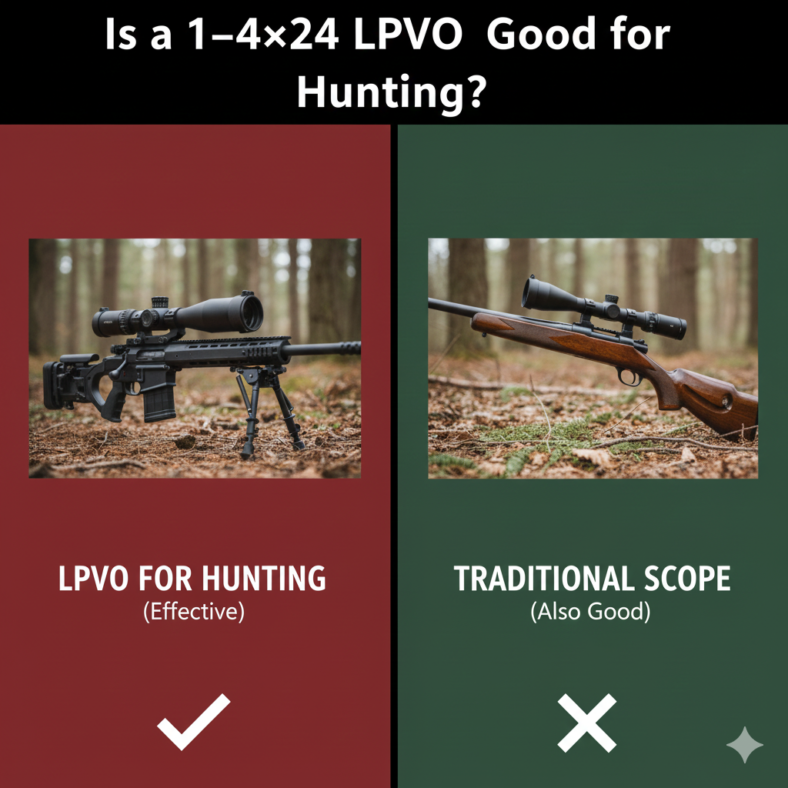
Is a 1-4×24 LPVO Good for Hunting?

A 1-4×24 LPVO can be good for hunting when most shots are close to moderate range, the cover is thick, and you value fast target acquisition more than high magnification. It is not the best choice for long open-country shots, tiny targets, or hunters who need strong low-light detail at higher magnification.

The short answer: use a 1-4×24 LPVO for woods hunting, driven hunts, hogs, coyotes at closer ranges, and general rifles where speed matters. Choose a higher-magnification scope if your hunting regularly stretches beyond the range where 4x gives you enough target detail for an ethical shot.

Table of Contents

Quick Verdict

A 1-4×24 LPVO is best when your hunting is built around quick shots, brush, timber, food plots, stands, or short lanes. At 1x, it can feel much faster than a traditional high-power scope. At 4x, it gives enough precision for many realistic short-to-mid-range hunting shots. The limitation is simple: it gives up magnification and some low-light performance compared with larger scopes.

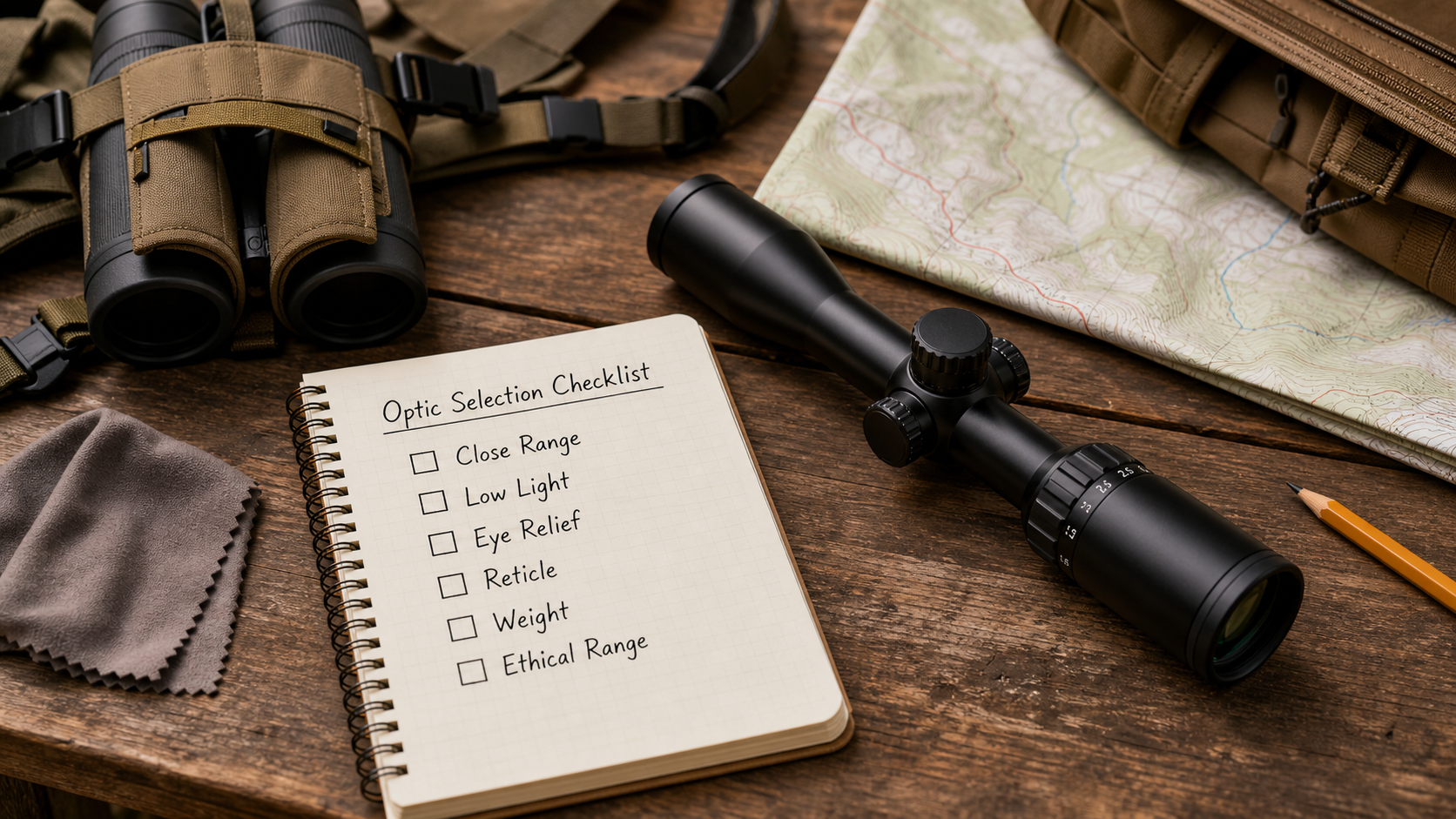
A 1-4×24 LPVO makes the most sense when close range, eye relief, reticle visibility, weight, and ethical shot distance all match your hunt.

LPVO Hunting Selection Checklist

Before choosing a 1-4×24 LPVO, answer these questions. If most answers fit your hunting style, the optic makes sense. If several answers point toward longer distances or low-light identification, consider a 2-10x, 3-9x, 3-12x, or similar hunting scope instead.

  • Range: Are most shots close enough that 4x gives clear target detail?
  • Cover: Are you hunting timber, brush, stands, hog blinds, or short shooting lanes?
  • Speed: Do you need fast target acquisition more than high magnification?
  • Light: Do you hunt mostly legal daylight with enough visibility to identify the animal clearly?
  • Reticle: Can you see the aiming point quickly at 1x and precisely enough at 4x?
  • Ethical range: Can you pass shots when the target is too small or unclear at 4x?

What 1-4×24 Means

The “1-4x” part means the optic can adjust from roughly 1x to 4x magnification. The “24” refers to a 24 mm objective lens. In plain terms, it is a low-power variable optic designed for speed at the low end and modest precision at the high end. For background on how telescopic sights work, the telescopic sight overview is a useful general reference.

Why 1x Matters

At or near 1x, the optic can be faster for close targets because the image appears less zoomed-in. This can help when an animal steps out quickly at close range or when you are tracking movement through brush. It still requires safe firearm handling and target identification; speed is only useful after you know exactly what you are aiming at.

Why 4x Can Be Limiting

Four-power magnification is enough for many close and moderate shots, but it does not show the same detail as a higher-power hunting scope. If you need to judge small antler points, pick a precise spot at longer distance, or see through dim timber at the edge of legal light, 4x may feel limiting.

Where a 1-4×24 LPVO Works Well

This optic class works best when the hunting environment rewards quick handling. Thick woods, hog hunting, short food-plot lanes, and compact rifles are all natural fits. It can also make sense for hunters who keep shots conservative and want one optic that feels fast up close while still offering more precision than a red dot at distance.

Close-Range Deer and Hog Hunting

For close-range deer or hog hunting, a 1-4×24 LPVO can be comfortable because you can leave it low while scanning a lane, then turn up magnification if the animal stops and the shot is still inside your confident range. It is especially useful when targets may appear quickly and high magnification would make it harder to find the animal in the scope.

Compact Rifles and Field Carry

Many 1-4x optics are relatively compact compared with larger hunting scopes. That can help rifle balance, especially on carbines or lightweight field rifles. Balance still depends on the mount, rings, rifle, and optic weight, so check the full setup rather than judging by magnification alone.

Where It Falls Short

A 1-4×24 LPVO is not ideal for every hunt. If you hunt large fields, mountain country, crop edges with long shots, or small varmints, the top-end magnification may be too low. It also may not be the best choice if your biggest need is late-evening brightness and target detail.

The ethical answer is to match the optic to the shot you can clearly identify and place. Hunter education resources emphasize planning and preparation before the hunt; the same idea applies to optics. Use resources such as Hunter Ed for broader hunting safety and planning context, then match your scope to your real conditions.

Low-Light Reality

A 24 mm objective is not automatically bad in low light, but it has limits. Glass quality, coatings, reticle visibility, exit pupil, eye position, and magnification all matter. At lower magnification, the image may still look usable. At 4x, you may notice the difference compared with a larger-objective hunting scope in dim conditions.

Do not use magnification to compensate for poor target identification. If you cannot identify the animal and what is beyond it, do not shoot. The NSSF firearm safety rules are a good reminder that every hunting optics decision still sits under basic safety rules.

Reticle and Eye Relief

The reticle can make or break a 1-4x hunting optic. A center aiming point that is easy to find at low power is helpful for close shots, while enough detail at 4x helps with more deliberate shots. Illumination can help in some light, but it should not be your only way to see the reticle.

Eye Box and Mounting

Eye relief and eye box matter because hunting shots are not always taken from a perfect bench position. The optic should come up naturally when you shoulder the rifle. If you have to crawl the stock or shift your head to see a full image, the scope may be mounted poorly or may not fit your setup.

Who Should Use One

Choose a 1-4×24 LPVO if you hunt close cover, value quick sight acquisition, keep shots inside a conservative range, and want a compact optic with some magnification flexibility. Skip it if your hunts require frequent long shots, detailed antler judging at distance, or stronger low-light performance than a small objective can provide.

A good rule is this: if you would be comfortable with a red dot but want a little magnification, a 1-4x LPVO may be a smart upgrade. If you often wish for more detail than 4x can provide, choose a higher magnification hunting scope instead.

FAQ

Is a 1-4×24 LPVO good for deer hunting?

Yes, for close-range deer hunting in woods, brush, or short lanes. It is less ideal for long fields or situations where you need more magnification for detail.

How far is a 1-4x LPVO good for hunting?

There is no universal distance. It depends on the animal, light, reticle, rifle, shooter skill, and whether you can identify the target clearly. Use 4x only inside your confident ethical range.

Is a 1-4×24 LPVO good in low light?

It can be usable in reasonable light, especially at low magnification, but a larger hunting scope may show more detail in dim conditions. Never shoot if the target is not clearly identified.

Is an LPVO better than a 3-9x scope?

It depends on the hunt. A 1-4x LPVO is faster up close. A 3-9x scope is usually better when you need more magnification and target detail at distance.

Final Takeaway

A 1-4×24 LPVO is a strong hunting choice for close cover, fast shots, and compact rifle setups. It is not a do-everything optic. Buy it when your real hunting distances fit the 1-4x range, and pass on it when low-light detail or longer-range precision matters more.

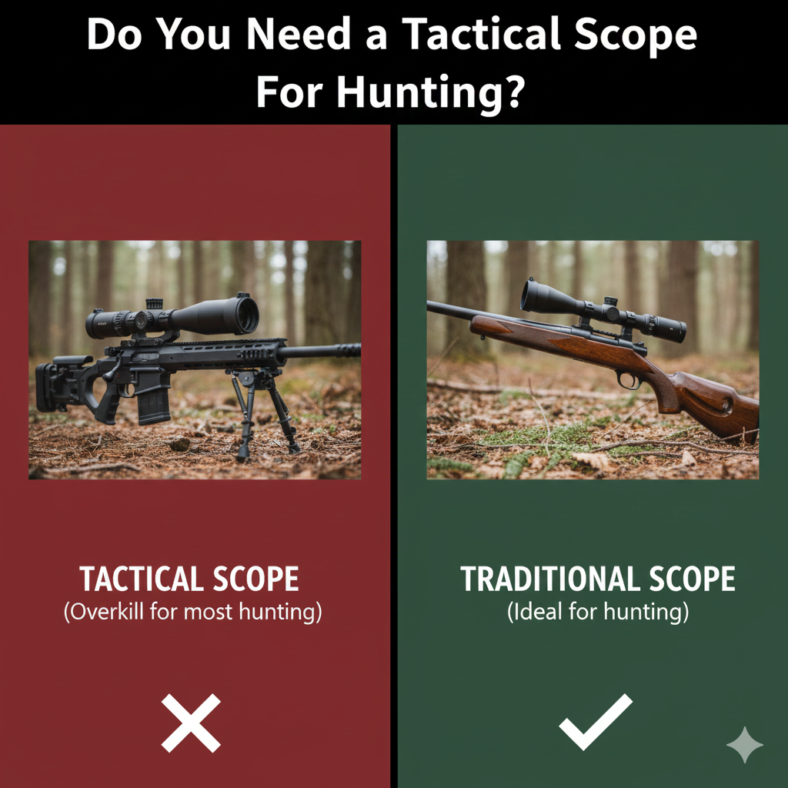
Do You Need a Tactical-Style Scope for Hunting? Features Compared


Most hunters do not need a tactical-style scope, but some scope features marketed under that label, such as exposed dialing turrets and detailed holdover reticles, can genuinely help a hunter who shoots at varied or longer known distances. The label matters less than the features. This guide reframes the question toward lawful hunting and walks through which heavier, more adjustable scope features earn their place in the field, which ones add weight and complexity you may never use, and how to match a scope to how you actually hunt.

Table of contents

What Tactical-Style Scope Features Actually Are

The phrase tactical-style scope usually describes a set of features rather than a single product type: exposed adjustment turrets you can dial by hand, a detailed reticle with holdover and ranging marks, a larger main tube, a wider elevation adjustment range, and rugged construction. None of these features is exclusive to any one use. They are simply tools, and each one has a clear tradeoff for a hunter who carries a rifle long distances and needs to make an ethical, well-placed shot.

Before comparing features, it helps to be clear about the goal in hunting: a clean, accurate, humane shot within your skill and equipment limits. The features below should be judged against that goal, not against marketing language. For broader firearm safety context, the NSSF firearm safety rules are a solid reference, and a hunter education course covers shot selection and field judgment.

Exposed Turrets vs Capped Turrets for Hunting

Exposed turrets let you dial elevation and windage adjustments by hand without removing a cap, which is useful if you regularly correct for distance by turning the turret to a known setting. Capped turrets cover the adjustments and protect them from accidental movement, which is why many traditional hunting scopes use them. The right choice depends on whether you dial or hold over.

The accidental-movement tradeoff

The main risk with exposed turrets in the field is bumping a turret while moving through brush or stowing the rifle, which can shift your zero without you noticing. Some exposed turrets include a locking feature or a zero stop that reduces this risk. If you choose an exposed-turret scope for hunting, look for a locking turret or develop a habit of checking your setting before a shot. That one habit can prevent a bumped turret from turning a good opportunity into a bad hit.

Reticles, Holdovers, and Dialing

A detailed reticle with holdover marks lets you aim above the center point for longer shots without touching a turret, which is fast and keeps both hands on the rifle. Dialing, by contrast, means turning the elevation turret to a calculated value so you can hold center. Both methods can work for hunting, and many hunters use a simple duplex reticle and a single zero for the ranges they actually shoot.

The key honest point is that more reticle detail and more adjustment options only help if you have practiced with them and know your rifle and load. A cluttered reticle you do not understand is slower than a simple one you do. No scope feature can promise accuracy on its own; placement comes from practice, a confirmed zero, and honest range estimation.

Weight, Tube Size, and Durability

Tactical-style scopes often use a larger 30mm or 34mm tube and heavier construction to support a wider adjustment range and rugged use. That durability is real, but so is the weight. A heavier scope on a rifle you carry for miles adds up, and for many hunters a lighter, simpler scope is the better all-day choice. Decide how much you value the wider adjustment range and toughness against the weight you will carry.

When Tactical-Style Features Help a Hunter

  • You hunt open country where shots happen at varied, sometimes longer, known distances.
  • You have practiced dialing or holding over and confirmed your come-ups at the range.
  • You want a locking exposed turret and zero stop to dial confidently and return to zero.
  • You value a wider elevation range for a flatter setup across distances.

When They Hurt More Than They Help

  • You hunt thick cover or timber where shots are close and fast, where a simple reticle is quicker.
  • You carry your rifle long distances and the extra weight is a burden.
  • You have not practiced with turrets or a busy reticle, so the added complexity slows you down.
  • Exposed turrets risk being bumped during your style of hunting and you have no locking feature.

Matching a Scope to Your Hunt

Start with your typical shot distance and terrain, then pick the simplest scope that covers it well. A hunter taking close shots in timber is well served by a low magnification scope with capped turrets and a simple reticle. A hunter making longer shots in open country may benefit from a holdover reticle or a locking dialing turret, provided they have practiced. Magnification matters too; for a primer, see our guide on rifle scope magnification for beginners. Whatever you choose, confirm your zero and practice before the season. If you cannot use the reticle or turrets calmly at the range, they do not belong in your hunting decision under pressure.

Frequently Asked Questions

Do you need a tactical scope for hunting?

Most hunters do not. A simple scope with a clear reticle and a confirmed zero covers typical hunting distances. Tactical-style features like exposed turrets or holdover reticles help only if you hunt varied or longer distances and have practiced with them.

Are exposed turrets a problem for hunting?

They can be, because a turret bumped in the field can shift your zero unnoticed. Choosing a scope with a locking turret or a zero stop, and checking your setting before a shot, reduces that risk.

Is dialing or holding over better for hunting?

Neither is universally better. Holding over keeps both hands on the rifle and is fast, while dialing lets you hold center at known distances. Use whichever you have practiced and trust, and confirm your data at the range first. Write down your zero, common distances, and any turret or holdover references so you are not trying to remember them when an animal is in front of you.

Does a heavier tactical-style scope improve accuracy?

No scope guarantees accuracy. A rugged scope holds zero well and offers more adjustment, but shot placement comes from practice, a confirmed zero, and honest range estimation. The extra weight is a real tradeoff for hunters who carry far.

Final Takeaway

You do not need a tactical-style scope to hunt well. Judge the individual features, exposed turrets, detailed reticles, larger tubes, against your terrain, your typical shot distance, and the practice you have actually put in. Many hunters are best served by a lighter, simpler scope with a confirmed zero, while open-country hunters who have trained with dialing or holdovers may benefit from those features. Confirm any equipment rules with your state wildlife agency and take a hunter education course to sharpen shot selection.

Why Choose a First Focal Plane Scope for Long-Range Shooting?


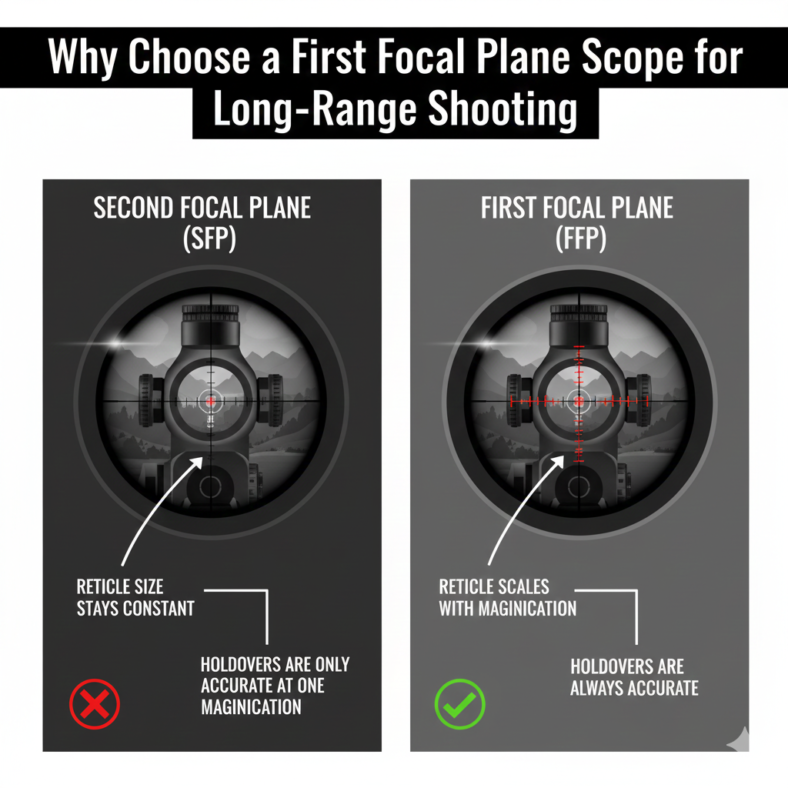
A first focal plane scope is popular for long-range shooting because its reticle scales with magnification, which keeps the reticle’s measurement marks true at any power setting. That means your holdover and ranging marks represent the same value whether you are zoomed in or out, so you can use the reticle to estimate and hold without changing the magnification. The tradeoff is that the reticle looks tiny at low power and large at high power, and a good second focal plane scope can still be the better choice for some hunters. The right pick depends on how you shoot and whether you rely on reticle measurements.

Table of contents

Quick answer

Choose a first focal plane scope if you want the reticle’s holdover and ranging marks to stay accurate at every magnification, which is useful when you hold off rather than dial and when you change power often. Choose a second focal plane scope if you mostly shoot at a set magnification, want a crisp, constant reticle at all powers, or prefer a simpler view for hunting. Neither is universally better, and many capable shooters use both for different rifles.

The core appeal of FFP

The main reason long-range shooters like FFP is that the reticle subtensions stay correct at any zoom. You do not have to remember that your marks only work at one specific magnification, which removes a common source of error when you use the reticle to measure or hold.

What first focal plane means

First focal plane refers to where the reticle sits inside the scope relative to the magnifying lenses. In an FFP scope the reticle is positioned so that it grows and shrinks along with the target image as you change magnification. Because the reticle and the image scale together, the relationship between the reticle marks and the target stays constant across the magnification range.

Subtension stays constant

Subtension is how much of the target a reticle mark covers at a given distance. In an FFP scope the subtension of each mark stays true at every magnification, so a mark that represents a certain value still represents that value whether you are at low or high power. The exact subtension values for your reticle are listed in the optic’s manual, so defer to that document for the specific numbers.

First vs second focal plane

The difference between first and second focal plane is where the reticle lives and how it behaves with magnification. In a second focal plane scope the reticle stays the same visual size no matter the magnification, while the target image changes size around it. That means the reticle’s measurement marks are only true at one specified magnification, usually the highest power.

First focal plane behavior

An FFP reticle appears small at low magnification and large at high magnification because it scales with the image. The benefit is that its marks are usable for holds and ranging at any power, which is valuable when you cannot or do not want to zoom to a fixed setting before a shot.

Second focal plane behavior

An SFP reticle stays the same size at every magnification, which keeps it crisp, clean, and easy to see, including in low light. The cost is that any reticle-based holds or measurements are only correct at the one magnification the maker specifies, so using the marks at other powers introduces error. A good SFP scope is simple and effective if you shoot at a known, set magnification.

Why FFP suits long-range use

Long-range shooting often involves using the reticle to hold for distance or to estimate size and range, and it frequently means changing magnification as conditions and targets change. FFP fits this because the reticle works the same way regardless of the power you are on, which reduces mental math and the chance of an error at the moment of the shot.

Consistent holds at any power

If you prefer to hold off with the reticle rather than dial the turrets, FFP lets you do that at any magnification with the same reference values. You do not have to first zoom to a specific power to make your holds valid, which can save time and reduce mistakes.

Ranging and measuring

Because the subtensions stay true, reticle-based ranging and measuring remain consistent across the magnification range. This is part of why precision and competition shooters often favor FFP, though the specific technique should follow your optic manual and proper training, not a shortcut.

The tradeoffs of FFP

FFP is not free of downsides, and those tradeoffs are exactly why SFP scopes remain popular. Knowing them helps you decide honestly rather than buying FFP just because it is associated with long-range shooting.

Reticle size at the extremes

At low magnification an FFP reticle can be very thin and hard to see, and at high magnification it can grow thick enough to cover small targets or fine detail. This changing appearance takes some getting used to and can be a real drawback in certain conditions.

Low-light visibility

Because the reticle shrinks at low power, a non-illuminated FFP reticle can be difficult to see in dim light at the bottom of the magnification range. Many FFP scopes add illumination to address this, which adds cost and another control to manage.

Cost and complexity

FFP scopes are often more expensive than comparable SFP scopes, and the detailed reticles common on FFP optics can look busy to a shooter who does not use the marks. If you do not plan to hold or range with the reticle, you may be paying for capability you will not use.

FFP for hunting

For hunting, FFP can be helpful if you take longer, well-supported shots and use the reticle to hold, but it is not automatically the better hunting optic. Many hunters do well with a simple SFP scope set at a known magnification, especially at moderate distances and in low light where a clean reticle is easy to see.

When FFP helps a hunter

FFP can suit open-country hunters who practice with their reticle, change magnification often, and take longer shots from solid rests. In that case the consistent subtensions are a genuine advantage, provided the shooter trains and confirms data at the range.

When SFP is the simpler choice

For timber, brush, stand hunting, and moderate-range shots, an SFP scope with a clean reticle is often faster and easier in low light. Simplicity under pressure is valuable, and a reticle you can always see clearly may serve you better than scaling subtensions you rarely use.

How to decide

Decide based on how you aim and how often you change magnification. If you hold and range with the reticle and shift power frequently, FFP fits. If you dial your turrets or shoot at a fixed magnification, SFP is simpler and often cheaper.

  • Choose FFP if you hold off with the reticle and use measurements at varied magnifications.
  • Choose SFP if you dial corrections or shoot mostly at one set magnification.
  • Consider illumination if you pick FFP and hunt or shoot in low light.
  • Match the reticle complexity to what you will actually use, not to what looks advanced.

Try the view first

If possible, look through both styles across their magnification range before buying. Seeing how an FFP reticle changes size, and how an SFP reticle stays constant, makes the tradeoff concrete and helps you choose what you will actually be comfortable using.

Safe and honest use

Whichever focal plane you choose, the optic does not replace skill, a confirmed zero, or sound judgment. Reticle holds and ranging require practice and confirmation at the range, and the specific subtension values belong to your optic’s manual, so follow it rather than any general rule of thumb. Review the firearm safety fundamentals from the NSSF, and always be sure of your target and what lies beyond it.

Stay within your tested range

A capable reticle can make a far target look manageable, but your real limit is the distance where you can place repeatable hits from realistic positions in the conditions present. For hunting, keep shots inside the range where you can make a clean, ethical hit, and confirm any equipment rules with your current state wildlife agency.

Frequently asked questions

What is the main advantage of a first focal plane scope?

The reticle scales with magnification, so its holdover and ranging marks stay true at any power. You can hold and measure with the reticle without first zooming to a specific magnification.

Is FFP always better for long range?

No. FFP suits shooters who hold and range with the reticle and change power often. If you dial your turrets or shoot at a fixed magnification, a quality SFP scope can work just as well and often costs less.

Why does the FFP reticle change size?

The reticle sits where it scales with the target image, so it appears small at low power and large at high power. That scaling is what keeps its subtensions accurate at every magnification.

Is FFP good for hunting?

It can be, for longer supported shots where you use the reticle to hold. For brush, timber, and low light, a simple SFP reticle is often easier to see and faster, so it depends on how you hunt.

Final takeaway

A first focal plane scope earns its place in long-range shooting because the reticle’s marks stay true at any magnification, which helps shooters who hold and range with the reticle and change power often. The tradeoffs are reticle visibility at the extremes, possible cost, and added complexity, which keep second focal plane scopes a strong choice for many hunters. Match the focal plane to how you actually aim, confirm subtensions in your optic’s manual, practice at the range, and keep every shot inside your honest, tested limit.

How to Improve Shooting Accuracy Safely

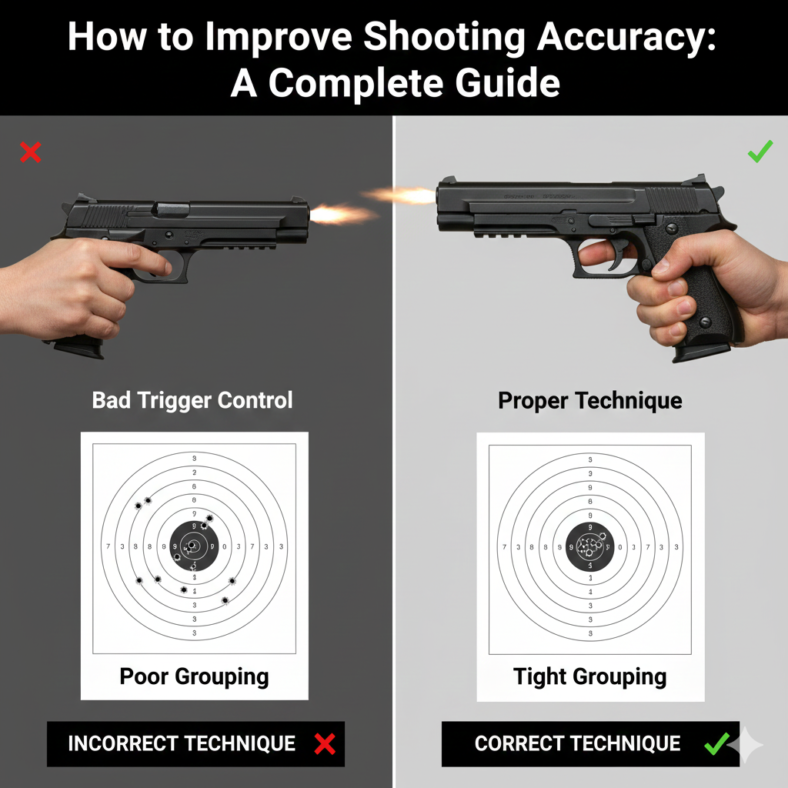
Improving shooting accuracy starts with safe handling and repeatable fundamentals: a stable position, correct sight alignment and sight picture, smooth trigger control, steady breathing, follow-through, and accountable practice. No technique promises a specific result, because accuracy depends on the shooter, firearm, ammunition, conditions, and practice quality.

This guide is for sport and recreational range shooting. It stays at the fundamentals level and does not cover advanced field methods. Always follow your range rules, firearm manual, and qualified instructor guidance first.

Safety Comes Before Accuracy

Safe gun handling is the foundation of every accuracy session. Treat every firearm as if it is loaded, keep your finger off the trigger until your sights are on target and you intend to fire, keep the muzzle in a safe direction, and be sure of your target and what is beyond it. The NSSF firearm safety rules are a useful public reference for these fundamentals.

Accuracy practice also requires the correct ammunition for your firearm, eye and ear protection, clear range procedures, and awareness of the backstop. If you are unsure about loading, unloading, clearing, or checking your firearm, stop and ask qualified help before continuing.

Core Accuracy Fundamentals

A small set of fundamentals drives accuracy across most firearm disciplines. They work together, so consistency across the whole process matters more than chasing one trick.

FundamentalBeginner FocusWhy It Matters
Position or stanceStable, repeatable body supportReduces unnecessary movement
Sight alignmentConsistent relationship between sights and targetHelps aim stay repeatable
Trigger controlSmooth press without disturbing sightsReduces pulled shots
BreathingCalm, natural rhythmReduces body tension
Follow-throughMaintain position after the shotPrevents relaxing too early

Position or stance

A stable position gives every other fundamental something to build on. For standing range work, many shooters start with a balanced stance, feet about shoulder-width apart, weight slightly forward, and a relaxed but firm hold. Our shooting stance for beginners guide covers that foundation in more detail.

Sight alignment and sight picture

Sight alignment is the relationship between the sights, and sight picture is that alignment placed on the target. A consistent sight picture makes shot placement easier to evaluate over time.

Trigger control

Trigger control means pressing smoothly without disturbing the sights. Jerking, slapping, or anticipating recoil can move the firearm before the shot breaks. For more detail, read our guide on the importance of trigger control for shooting accuracy.

Follow-through

Follow-through means holding your position, grip, and focus for a moment after the shot rather than relaxing immediately. It helps make each shot part of the same repeatable process.

Rifle, Handgun, and Shotgun Differences

Accuracy fundamentals overlap, but rifle, handgun, and shotgun shooting differ enough that general advice should stay cautious. Treat these notes as orientation, not discipline-specific instruction.

  • Rifles: Stability, support, cheek placement, and consistent shoulder position matter.
  • Handguns: Grip consistency, stance, trigger control, and sight management carry extra weight.
  • Shotguns: Smooth mount, target focus, movement, and follow-through are common themes.

The NSSF shooting resources are a helpful starting point for understanding organized shooting activities and safety context.

Practice Plans and Training Classes

Accountable practice usually helps more than equipment changes for newer shooters. Work slowly, record what you are doing, and compare targets over several sessions instead of judging from one group. Add distance, speed, or complexity only when the basics are consistent.

A qualified instructor can spot habits that are hard to feel on your own, such as flinch, uneven grip pressure, or inconsistent trigger movement. If practice at home ever becomes part of your routine, review secure storage and safe handling resources such as Project ChildSafe, and follow your firearm manual.

Common Accuracy Mistakes

  • Trying to shoot faster than the fundamentals allow.
  • Changing equipment before checking technique.
  • Using an inconsistent stance, grip, or support position.
  • Anticipating recoil and disturbing the firearm before the shot breaks.
  • Relaxing before follow-through is complete.
  • Ignoring range safety while focusing too hard on the target.

Before each range session, review our shooting range safety rules guide so safety remains the first habit, not an afterthought.

Frequently Asked Questions

What improves shooting accuracy the most?

No single factor improves accuracy by itself. For many newer shooters, consistent position and smooth trigger control are common areas where careful practice can help.

Are accuracy fundamentals the same for rifle, handgun, and shotgun?

The core ideas overlap, but each firearm type has different emphasis. Rifles reward stability, handguns reward grip and trigger consistency, and shotguns reward mount and movement.

Will better equipment make me more accurate?

Equipment can matter, but technique is usually the larger variable for newer shooters. Work on fundamentals with qualified guidance before assuming a firearm or accessory is the limiting factor.

How long does it take to improve shooting accuracy?

It varies by shooter, firearm, ammunition, and practice quality. Consistent, safe, accountable sessions are more useful than occasional unfocused practice.

Final Range Takeaway

Better accuracy starts with safety, repeatability, and honest practice. Keep the muzzle in a safe direction, follow range commands, use the correct ammunition and protective gear, and build fundamentals slowly with qualified help when needed.

What Is Gun Caliber? A Simple Beginner Explanation

Gun caliber usually describes bullet or bore diameter, but cartridge names are not always simple measurements. That is why beginners can see names like 9mm, .22 LR, .308 Winchester, or 7.62x39mm and feel like the system is harder than it should be. The most important rule is simple: the ammunition must match the firearm markings, the ammunition packaging, and the owner’s manual.

This guide explains caliber in plain language. It is not a recommendation guide, not a technical ammunition-building guide, and not a substitute for firearm markings, manufacturer instructions, range rules, or qualified instruction.

Quick Beginner Summary

  • Caliber usually refers to bullet or bore diameter.
  • A cartridge is the complete round of ammunition, not just the diameter.
  • Cartridge names mix measurement, history, and naming conventions.
  • Similar names are not automatically interchangeable.
  • Always verify ammunition against the firearm markings, packaging, and manual.

Caliber vs Cartridge

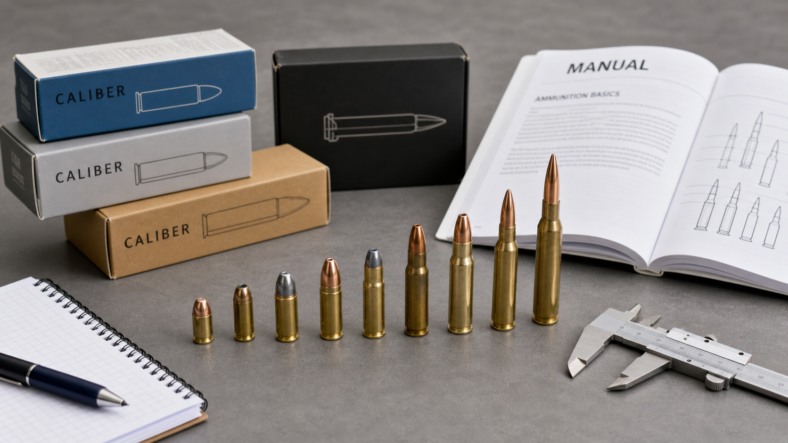
People often use caliber and cartridge as if they mean the same thing, but they are different ideas. Caliber generally refers to diameter. A cartridge is the complete round of ammunition, including the case, primer, propellant, and bullet. A cartridge name may include a caliber figure, but the full name matters because it identifies the specific ammunition type.

For terminology, the SAAMI glossary is a useful authority because SAAMI publishes firearm and ammunition industry standards and definitions. For a beginner, the practical point is this: caliber gives part of the story, but cartridge designation tells you much more.

TermPlain MeaningBeginner Takeaway
CaliberA diameter measurement or naming conventionHelpful, but not enough by itself
CartridgeThe complete round of ammunitionThe full cartridge designation must match the firearm
Firearm markingThe designation marked on the firearmUse it with the manual and ammunition box before loading

Why Caliber Names Can Confuse Beginners

Caliber names developed over a long time. Some names come from bullet diameter, some from case design, some from older conventions, and some from manufacturer or military naming history. That is why the number in a name is not always a simple literal measurement.

This is also why similar-looking names can be risky for beginners. A name that looks close on a shelf is not proof that the ammunition is correct for your firearm. Compatibility is a manual-and-marking question, not a guess from memory.

Metric vs Inch-Based Names

You will see cartridge names in metric measurements and inch-based measurements. Metric names often use millimeters, such as 9mm or 7.62mm. Some metric names include another number for case length. Inch-based names use decimals such as .22, .30, .357, or .45.

The measurement system is only part of the label. Do not assume that two cartridges are the same because their numbers seem close, and do not assume that one naming system translates neatly into the other. The correct source is still the firearm marking, owner’s manual, and ammunition packaging.

Why Matching Ammunition Matters

A firearm is designed around a specific cartridge or a clearly stated set of compatible cartridges. Using the wrong ammunition can damage equipment and injure people. A cartridge that appears similar, or even one that seems to fit, is not automatically safe.

Safety organizations make this point directly. The NSSF rules of safe gun handling include using only the correct ammunition for your firearm. SAAMI also publishes firearm safety rules that reinforce the same manual-first mindset.

For more on this specific safety check, read our guide to choosing the right ammunition for your firearm.

Common Beginner Mistakes

  • Relying on memory: A remembered caliber name is not enough. Check the marking and box.
  • Assuming close names match: Similar numbers or similar words do not prove compatibility.
  • Using fit as a test: A cartridge appearing to fit is not proof that it is safe.
  • Ignoring the manual: The owner’s manual and manufacturer guidance are part of the safety check.
  • Mixing loose ammunition: Keep ammunition organized and clearly identified.

How to Check the Right Ammunition Safely

Start with the cartridge designation marked on the firearm. Depending on the firearm, that marking may be on the barrel, slide, frame, or receiver. Then compare that exact designation with the owner’s manual and the ammunition box. If the markings and packaging do not clearly match, do not use that ammunition.

If anything is unclear, stop and ask a qualified range officer, instructor, gunsmith, or the firearm manufacturer. This is not a place to guess. A few minutes of verification is much better than trying to solve a compatibility question at the firing line.

Where Caliber Fits in Safe Shooting

Caliber knowledge helps you understand ammunition labels, compare terminology, and ask better questions. It does not replace the rest of firearm safety. You still need safe handling, safe storage, range commands, eye and ear protection, and clear ammunition organization.

If you are new to shooting, pair this article with our shooting range safety rules overview before live-fire practice.

Frequently Asked Questions

What does caliber mean in simple terms?

Caliber usually refers to bullet or bore diameter, expressed in inches or millimeters. It is part of how ammunition is described, but it is not always the complete cartridge designation.

Is caliber the same as cartridge?

No. Caliber is a diameter-related term. A cartridge is the complete round of ammunition, including the case, primer, propellant, and bullet.

Why are caliber names confusing?

Names come from different measurement systems, historical conventions, case designs, and manufacturer naming habits. That is why a cartridge name is not always a literal measurement.

Are similar cartridge names interchangeable?

Not unless your firearm markings or manual clearly state that they are compatible. Similar names, close numbers, or physical fit do not prove safety.

How do I know which ammunition my firearm uses?

Read the cartridge designation marked on the firearm, confirm it in the owner’s manual, and match it to the ammunition box and headstamp. If you are unsure, ask a qualified professional before loading or firing.

Final Safety Reminder

Caliber is a useful term, but it is not enough by itself. Cartridge names can be historical and confusing, so the safest habit is to verify the exact ammunition designation every time. Match the firearm marking, manual, ammunition packaging, and headstamp, and ask for qualified help whenever something is unclear.

How a Semi-Automatic Pistol Works

A semi-automatic pistol is one of the most widely used firearms in the modern world, yet its internal operation remains a mystery to many people. Whether used for self-defense, law enforcement, military service, or recreational shooting, this type of handgun relies on a carefully engineered mechanical cycle that allows it to fire a single round with each trigger pull while automatically loading the next cartridge. Understanding how a semi-automatic pistol works is essential for safety, responsible handling, and a deeper appreciation of firearm engineering.

Unlike revolvers or manual-action firearms, a semi-automatic pistol uses the energy created by firing a round to reset itself. This process happens extremely fast, often in milliseconds, but it involves multiple mechanical steps occurring in perfect sequence. From the moment the trigger is pulled to the instant a new round is chambered, the pistol performs a complex series of actions designed to be reliable, repeatable, and safe.

What Is a Semi-Automatic Pistol?

A semi-automatic pistol is a handgun that automatically cycles the firing mechanism, extracts and ejects the spent cartridge case, and chambers a fresh round from the magazine after each shot. The term “semi-automatic” means the firearm fires only one bullet per trigger pull, even though the reloading process happens automatically. This is a crucial distinction that separates semi-automatic pistols from fully automatic firearms, which continue firing as long as the trigger is held down.

Most modern pistols fall into this category because they offer a balance between control, efficiency, and capacity. The shooter remains in full command of each shot while benefiting from rapid follow-up fire without manual reloading between rounds.

Main Components of a Semi-Automatic Pistol

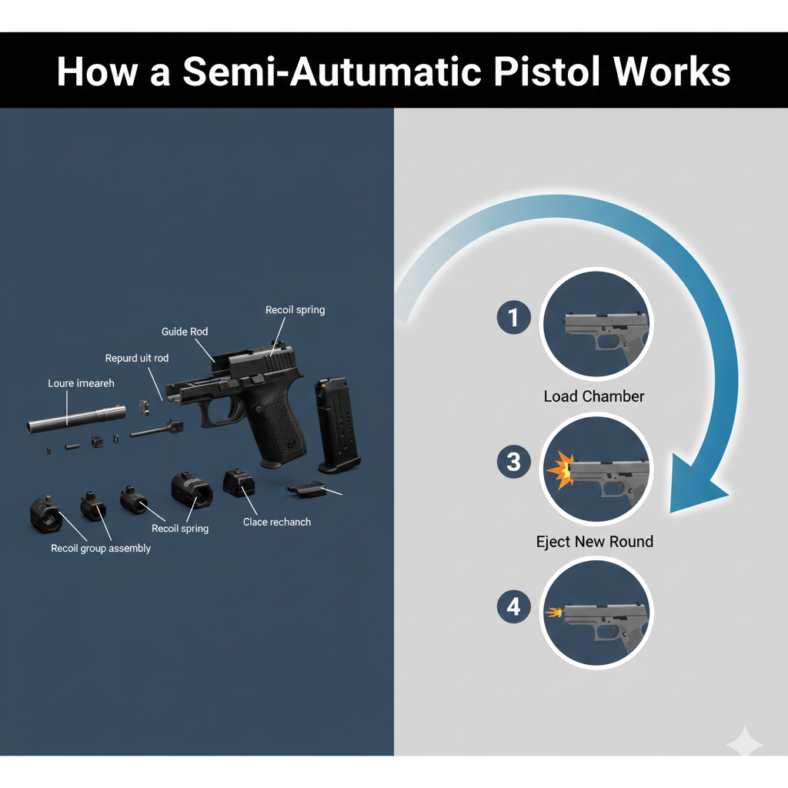
To understand how the pistol operates, it is necessary to understand its primary components and the roles they play in the firing cycle. The frame forms the foundation of the firearm and houses the trigger assembly, grip, and magazine well. The slide is the upper portion that moves back and forth during firing and contains the firing pin or striker, extractor, and ejection port. The barrel is the tube through which the bullet travels, and it contains rifling that stabilizes the projectile.

Inside the pistol is the recoil spring, which absorbs energy when the slide moves backward and then pushes the slide forward again. The magazine, typically located inside the grip, stores ammunition and feeds cartridges upward into the path of the slide. Each of these components must function precisely for the pistol to operate correctly.

How Ammunition Is Loaded and Chambered

The operation of a semi-automatic pistol begins before the first shot is fired. Ammunition is loaded into the magazine, and the magazine is inserted into the grip of the pistol until it locks into place. When the shooter pulls the slide backward and releases it, the recoil spring pushes the slide forward with force. As it moves forward, the slide strips the top cartridge from the magazine and guides it into the chamber of the barrel.

Once the cartridge is fully seated in the chamber, the barrel and slide lock together in most designs. At this point, the pistol is considered loaded and ready to fire, provided the trigger is pulled and all safety systems allow the firing mechanism to function.

Trigger Pull and Firing Mechanism

Pulling the trigger initiates the firing process. Depending on the pistol’s design, the trigger either releases a striker or drops a hammer. In striker-fired pistols, which are extremely common today, the trigger releases a spring-loaded firing pin assembly. In hammer-fired pistols, the trigger allows the hammer to strike the firing pin.

When the firing pin hits the primer at the rear of the cartridge, it ignites a small explosive compound. This ignition sets off the main gunpowder charge inside the cartridge casing. The burning powder rapidly expands into gas, creating extremely high pressure inside the sealed chamber.

Bullet Travel and Barrel Dynamics

The expanding gas generated by the ignited gunpowder forces the bullet forward out of the cartridge and into the barrel. As the bullet travels down the barrel, it engages the rifling, which consists of spiral grooves cut into the interior surface. These grooves cause the bullet to spin as it moves forward, stabilizing it during flight and improving accuracy.

Once the bullet exits the muzzle, the projectile continues toward the target, while the remaining energy inside the firearm begins the next phase of operation: recoil-driven cycling.

Recoil Energy and Slide Movement

At the moment the bullet is driven forward, an equal amount of force pushes backward against the pistol. This is the recoil force. In a semi-automatic pistol, this recoil energy is harnessed to move the slide rearward. In most designs, the barrel and slide are locked together briefly during the initial phase of recoil to ensure that chamber pressure drops to a safe level before the action opens.

After traveling a short distance together, the barrel unlocks, often tilting slightly downward, while the slide continues moving rearward on its own. This rearward motion compresses the recoil spring and sets the stage for extraction and ejection.

Extraction and Ejection of the Spent Cartridge

As the slide moves backward, the extractor, a small hooked component on the slide, grips the rim of the spent cartridge case and pulls it from the chamber. When the casing reaches the ejection port, it strikes the ejector, which causes the casing to pivot and be expelled out of the pistol. This ejection happens rapidly and clears the chamber so that a new round can be loaded.

Simultaneously, the rearward slide movement re-cocks the firing mechanism, resetting it so the pistol can fire again when the trigger is pulled the next time.

Feeding and Chambering the Next Round

Once the slide reaches its rearward limit, the recoil spring pushes it forward again. As the slide moves forward, it strips the next cartridge from the top of the magazine. The cartridge is guided up the feed ramp and into the chamber. The barrel and slide then lock together once more, sealing the chamber and preparing the pistol for the next shot.

This entire cycle—firing, extraction, ejection, reloading, and resetting takes place in fractions of a second and repeats every time the trigger is pulled, as long as there is ammunition in the magazine.

Trigger Reset and Controlled Fire

After a shot is fired, the trigger must be released forward slightly before it can be pulled again. This process is known as trigger reset. Trigger reset ensures controlled fire by preventing the pistol from discharging more than one round per trigger pull. Once the trigger resets, the shooter can fire the next shot, continuing the semi-automatic cycle.

Built-In Safety Mechanisms in Semi-Automatic Pistols

Modern semi-automatic pistols are designed with multiple internal safety features to prevent accidental discharge. These safeties often include firing pin blocks that prevent the firing pin from moving forward unless the trigger is pulled, drop safeties that stop the gun from firing if it is dropped, and trigger safeties that require deliberate finger pressure. Some models also include manual safeties, magazine disconnects, and loaded chamber indicators for added protection.

Why Semi-Automatic Pistols Are So Popular

The widespread adoption of semi-automatic pistols is driven by their efficiency, reliability, and capacity. Compared to revolvers, they typically hold more ammunition, reload faster, and offer slimmer profiles for easier carry. Advances in materials and engineering have made modern pistols highly durable and capable of functioning reliably under harsh conditions.

Conclusion

A semi-automatic pistol is a finely tuned mechanical system that transforms explosive force into controlled motion. Every trigger pull initiates a precise sequence of events that allows the firearm to fire, eject, reload, and reset automatically. Understanding how a semi-automatic pistol works improves safety awareness, handling confidence, and appreciation for the engineering behind modern firearms.

Exit mobile version