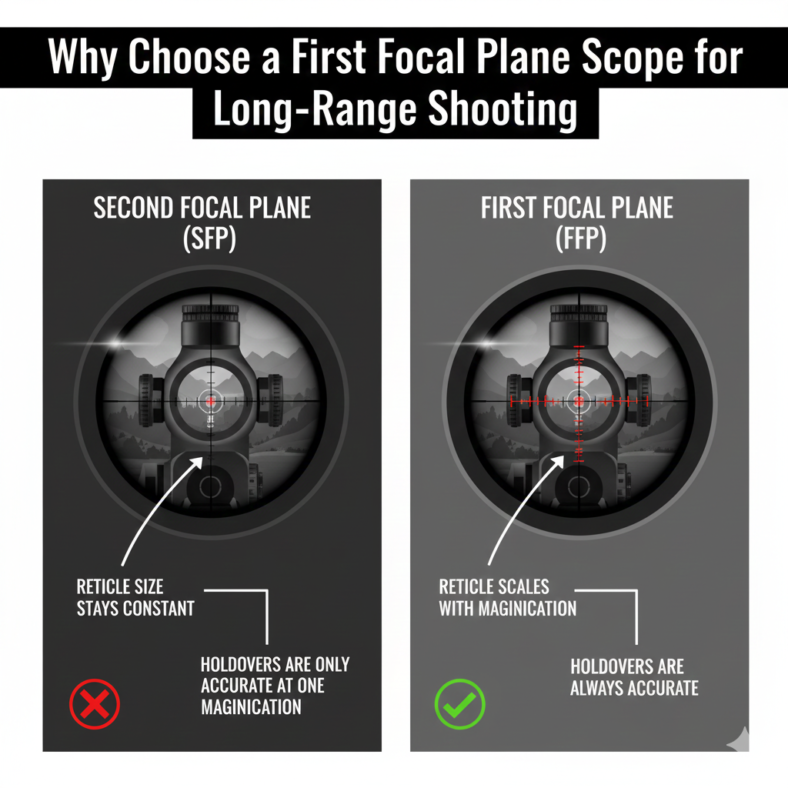
A first focal plane scope is popular for long-range shooting because its reticle scales with magnification, which keeps the reticle’s measurement marks true at any power setting. That means your holdover and ranging marks represent the same value whether you are zoomed in or out, so you can use the reticle to estimate and hold without changing the magnification. The tradeoff is that the reticle looks tiny at low power and large at high power, and a good second focal plane scope can still be the better choice for some hunters. The right pick depends on how you shoot and whether you rely on reticle measurements.
Table of contents
Quick answer
Choose a first focal plane scope if you want the reticle’s holdover and ranging marks to stay accurate at every magnification, which is useful when you hold off rather than dial and when you change power often. Choose a second focal plane scope if you mostly shoot at a set magnification, want a crisp, constant reticle at all powers, or prefer a simpler view for hunting. Neither is universally better, and many capable shooters use both for different rifles.
The core appeal of FFP
The main reason long-range shooters like FFP is that the reticle subtensions stay correct at any zoom. You do not have to remember that your marks only work at one specific magnification, which removes a common source of error when you use the reticle to measure or hold.
What first focal plane means
First focal plane refers to where the reticle sits inside the scope relative to the magnifying lenses. In an FFP scope the reticle is positioned so that it grows and shrinks along with the target image as you change magnification. Because the reticle and the image scale together, the relationship between the reticle marks and the target stays constant across the magnification range.
Subtension stays constant
Subtension is how much of the target a reticle mark covers at a given distance. In an FFP scope the subtension of each mark stays true at every magnification, so a mark that represents a certain value still represents that value whether you are at low or high power. The exact subtension values for your reticle are listed in the optic’s manual, so defer to that document for the specific numbers.
First vs second focal plane
The difference between first and second focal plane is where the reticle lives and how it behaves with magnification. In a second focal plane scope the reticle stays the same visual size no matter the magnification, while the target image changes size around it. That means the reticle’s measurement marks are only true at one specified magnification, usually the highest power.
First focal plane behavior
An FFP reticle appears small at low magnification and large at high magnification because it scales with the image. The benefit is that its marks are usable for holds and ranging at any power, which is valuable when you cannot or do not want to zoom to a fixed setting before a shot.
Second focal plane behavior
An SFP reticle stays the same size at every magnification, which keeps it crisp, clean, and easy to see, including in low light. The cost is that any reticle-based holds or measurements are only correct at the one magnification the maker specifies, so using the marks at other powers introduces error. A good SFP scope is simple and effective if you shoot at a known, set magnification.
Why FFP suits long-range use
Long-range shooting often involves using the reticle to hold for distance or to estimate size and range, and it frequently means changing magnification as conditions and targets change. FFP fits this because the reticle works the same way regardless of the power you are on, which reduces mental math and the chance of an error at the moment of the shot.
Consistent holds at any power
If you prefer to hold off with the reticle rather than dial the turrets, FFP lets you do that at any magnification with the same reference values. You do not have to first zoom to a specific power to make your holds valid, which can save time and reduce mistakes.
Ranging and measuring
Because the subtensions stay true, reticle-based ranging and measuring remain consistent across the magnification range. This is part of why precision and competition shooters often favor FFP, though the specific technique should follow your optic manual and proper training, not a shortcut.
The tradeoffs of FFP
FFP is not free of downsides, and those tradeoffs are exactly why SFP scopes remain popular. Knowing them helps you decide honestly rather than buying FFP just because it is associated with long-range shooting.
Reticle size at the extremes
At low magnification an FFP reticle can be very thin and hard to see, and at high magnification it can grow thick enough to cover small targets or fine detail. This changing appearance takes some getting used to and can be a real drawback in certain conditions.
Low-light visibility
Because the reticle shrinks at low power, a non-illuminated FFP reticle can be difficult to see in dim light at the bottom of the magnification range. Many FFP scopes add illumination to address this, which adds cost and another control to manage.
Cost and complexity
FFP scopes are often more expensive than comparable SFP scopes, and the detailed reticles common on FFP optics can look busy to a shooter who does not use the marks. If you do not plan to hold or range with the reticle, you may be paying for capability you will not use.
FFP for hunting
For hunting, FFP can be helpful if you take longer, well-supported shots and use the reticle to hold, but it is not automatically the better hunting optic. Many hunters do well with a simple SFP scope set at a known magnification, especially at moderate distances and in low light where a clean reticle is easy to see.
When FFP helps a hunter
FFP can suit open-country hunters who practice with their reticle, change magnification often, and take longer shots from solid rests. In that case the consistent subtensions are a genuine advantage, provided the shooter trains and confirms data at the range.
When SFP is the simpler choice
For timber, brush, stand hunting, and moderate-range shots, an SFP scope with a clean reticle is often faster and easier in low light. Simplicity under pressure is valuable, and a reticle you can always see clearly may serve you better than scaling subtensions you rarely use.
How to decide
Decide based on how you aim and how often you change magnification. If you hold and range with the reticle and shift power frequently, FFP fits. If you dial your turrets or shoot at a fixed magnification, SFP is simpler and often cheaper.
- Choose FFP if you hold off with the reticle and use measurements at varied magnifications.
- Choose SFP if you dial corrections or shoot mostly at one set magnification.
- Consider illumination if you pick FFP and hunt or shoot in low light.
- Match the reticle complexity to what you will actually use, not to what looks advanced.
Try the view first
If possible, look through both styles across their magnification range before buying. Seeing how an FFP reticle changes size, and how an SFP reticle stays constant, makes the tradeoff concrete and helps you choose what you will actually be comfortable using.
Safe and honest use
Whichever focal plane you choose, the optic does not replace skill, a confirmed zero, or sound judgment. Reticle holds and ranging require practice and confirmation at the range, and the specific subtension values belong to your optic’s manual, so follow it rather than any general rule of thumb. Review the firearm safety fundamentals from the NSSF, and always be sure of your target and what lies beyond it.
Stay within your tested range
A capable reticle can make a far target look manageable, but your real limit is the distance where you can place repeatable hits from realistic positions in the conditions present. For hunting, keep shots inside the range where you can make a clean, ethical hit, and confirm any equipment rules with your current state wildlife agency.
Frequently asked questions
What is the main advantage of a first focal plane scope?
The reticle scales with magnification, so its holdover and ranging marks stay true at any power. You can hold and measure with the reticle without first zooming to a specific magnification.
Is FFP always better for long range?
No. FFP suits shooters who hold and range with the reticle and change power often. If you dial your turrets or shoot at a fixed magnification, a quality SFP scope can work just as well and often costs less.
Why does the FFP reticle change size?
The reticle sits where it scales with the target image, so it appears small at low power and large at high power. That scaling is what keeps its subtensions accurate at every magnification.
Is FFP good for hunting?
It can be, for longer supported shots where you use the reticle to hold. For brush, timber, and low light, a simple SFP reticle is often easier to see and faster, so it depends on how you hunt.
Final takeaway
A first focal plane scope earns its place in long-range shooting because the reticle’s marks stay true at any magnification, which helps shooters who hold and range with the reticle and change power often. The tradeoffs are reticle visibility at the extremes, possible cost, and added complexity, which keep second focal plane scopes a strong choice for many hunters. Match the focal plane to how you actually aim, confirm subtensions in your optic’s manual, practice at the range, and keep every shot inside your honest, tested limit.