Tactical Scope vs Hunting Scope: A Complete In-Depth Comparison

Choosing the right rifle scope is one of the most important decisions a shooter or hunter can make. A scope is not just an accessory; it directly affects accuracy, confidence, and overall performance. Among the most commonly compared options are tactical scopes and hunting scopes. While they may look similar at first glance, they are designed for very different purposes, shooting environments, and user expectations. Understanding these differences in detail is essential before investing in the right optic.

The debate around tactical scope vs hunting scope is not about which one is superior overall, but about which one is better suited to a specific application. Each scope type has been engineered with a clear use case in mind, and using the wrong one can make shooting unnecessarily difficult or uncomfortable.

Purpose and Intended Use

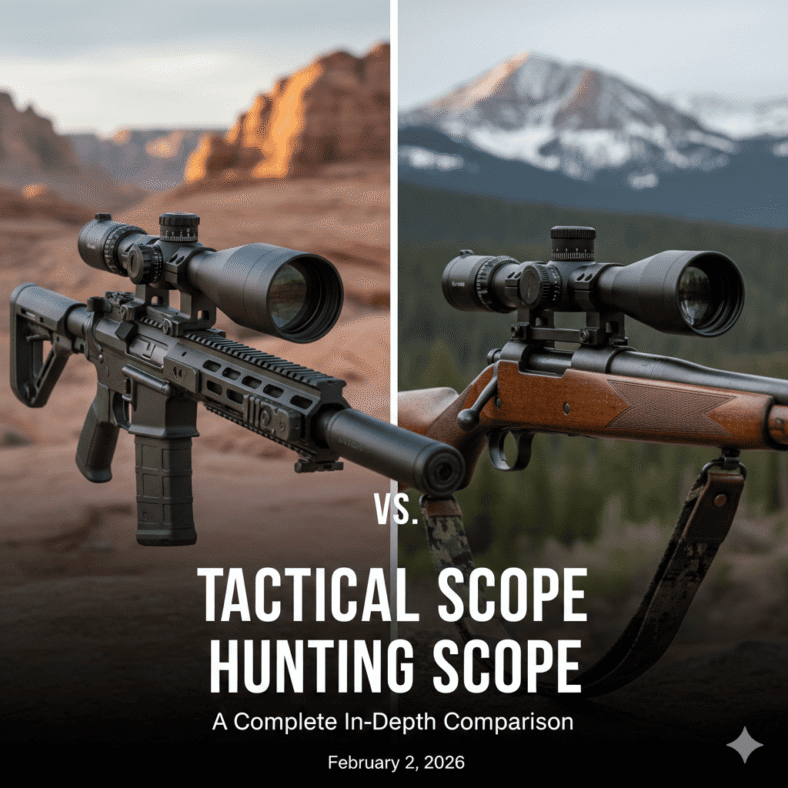
A tactical scope is primarily designed for precision shooting where accuracy at long distances is critical. These scopes are commonly used in tactical training, military or law enforcement contexts, long-range target shooting, and precision rifle competitions. In these situations, shooters often need to engage targets at varying distances and must make precise adjustments to account for bullet drop, wind drift, and elevation changes. Tactical scopes are built to support constant adjustments and detailed ballistic calculations.

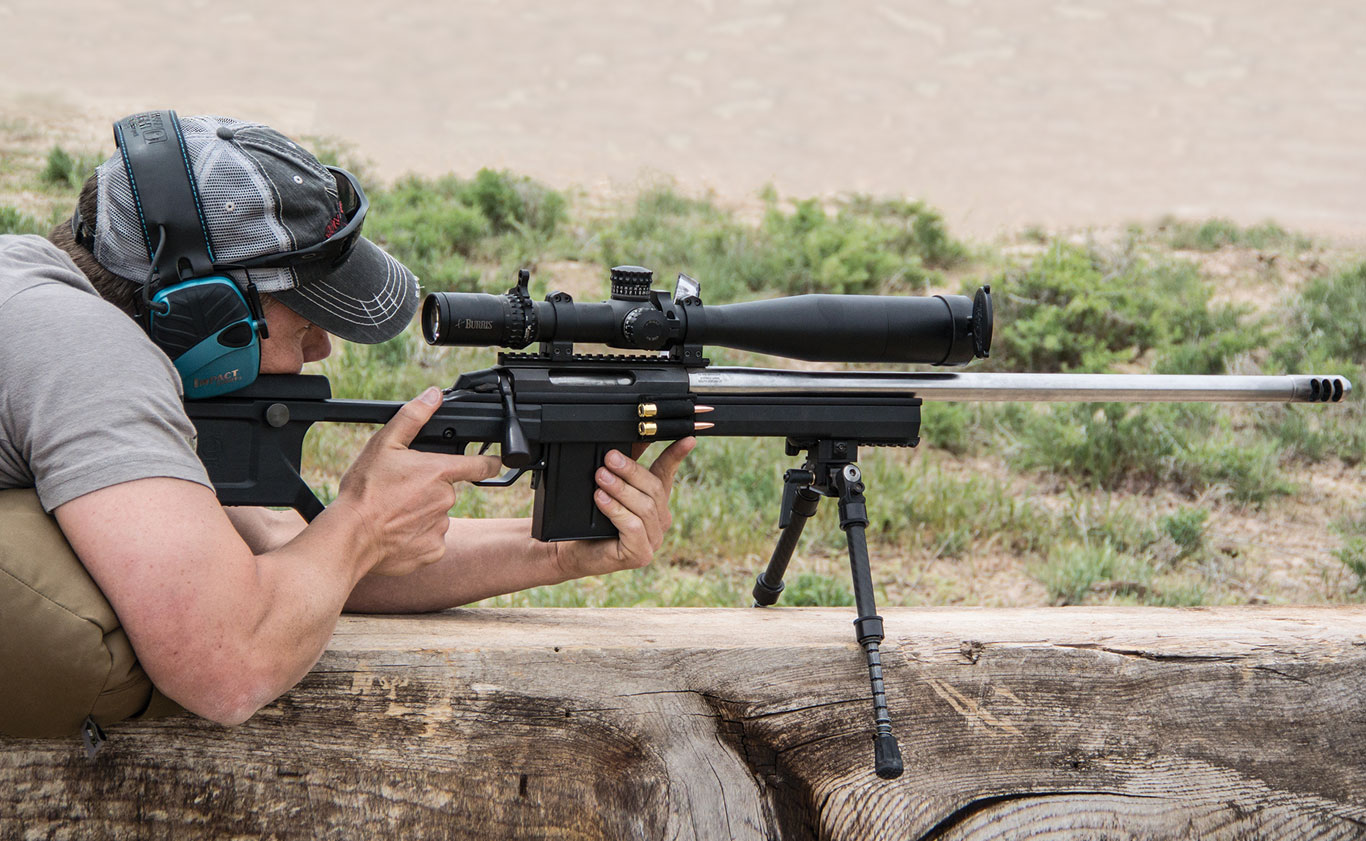
A hunting scope, on the other hand, is built for real-world field conditions where speed, simplicity, and reliability matter more than constant precision adjustments. Hunters usually take one carefully placed shot, often under time pressure, in changing weather conditions and uneven terrain. Hunting scopes are designed to be intuitive, lightweight, and dependable, allowing the hunter to focus on the animal rather than on adjusting complex controls.

Reticle Design and Practical Use

One of the most noticeable differences between tactical and hunting scopes is the reticle. Tactical scopes typically use complex reticles that include measurement markings such as mil-dots or grid-style patterns. These markings allow the shooter to estimate range, hold for wind, and compensate for bullet drop without dialing the turrets every time. In many tactical scopes, the reticle is placed in the first focal plane, meaning it changes size as magnification changes, keeping measurements accurate at all zoom levels.

Hunting scopes generally use simpler reticles, often a traditional duplex or basic crosshair. The goal here is quick target acquisition rather than measurement. The reticle remains easy to see in low light and does not clutter the sight picture. Most hunting scopes use a second focal plane reticle, meaning the reticle stays the same size regardless of magnification. This makes aiming more intuitive, especially for hunters who do not want to think about reticle scaling while lining up a shot.

Turrets and Adjustment Philosophy

Tactical scopes are built around the idea of frequent and precise adjustments. Their turrets are usually exposed, oversized, and clearly marked, allowing shooters to dial elevation and windage quickly and accurately. These turrets are designed to track perfectly, meaning that every click corresponds exactly to the expected point-of-impact change. Many tactical scopes also include zero-stop systems, which allow the shooter to return instantly to their zeroed position without looking.

In contrast, hunting scopes are designed to be adjusted once and then left alone. After zeroing the rifle, most hunters rarely touch the turrets again. To support this style of use, hunting scopes usually feature capped turrets that protect against accidental movement while walking through brush or climbing terrain. This design reduces complexity and ensures the rifle stays zeroed throughout the hunt.

Magnification and Field of View

Magnification range is another major difference between tactical and hunting scopes. Tactical scopes often offer high magnification ranges to support long-distance shooting. High magnification helps shooters clearly identify distant targets and make precise shots at extended ranges. However, higher magnification also narrows the field of view, which is acceptable in controlled shooting environments where targets are stationary.

Hunting scopes usually prioritize a wider field of view over extreme magnification. Lower magnification allows hunters to quickly locate animals, track movement, and maintain situational awareness. In many hunting scenarios, shots are taken at relatively short to medium distances, making extremely high magnification unnecessary and even counterproductive.

Weight, Size, and Handling

Tactical scopes are typically larger and heavier due to their robust construction and advanced internal mechanisms. The additional weight comes from thicker housings, larger lenses, and reinforced components designed to handle repeated recoil and harsh use. While this added weight improves durability and stability, it can make the rifle less comfortable to carry for long periods.

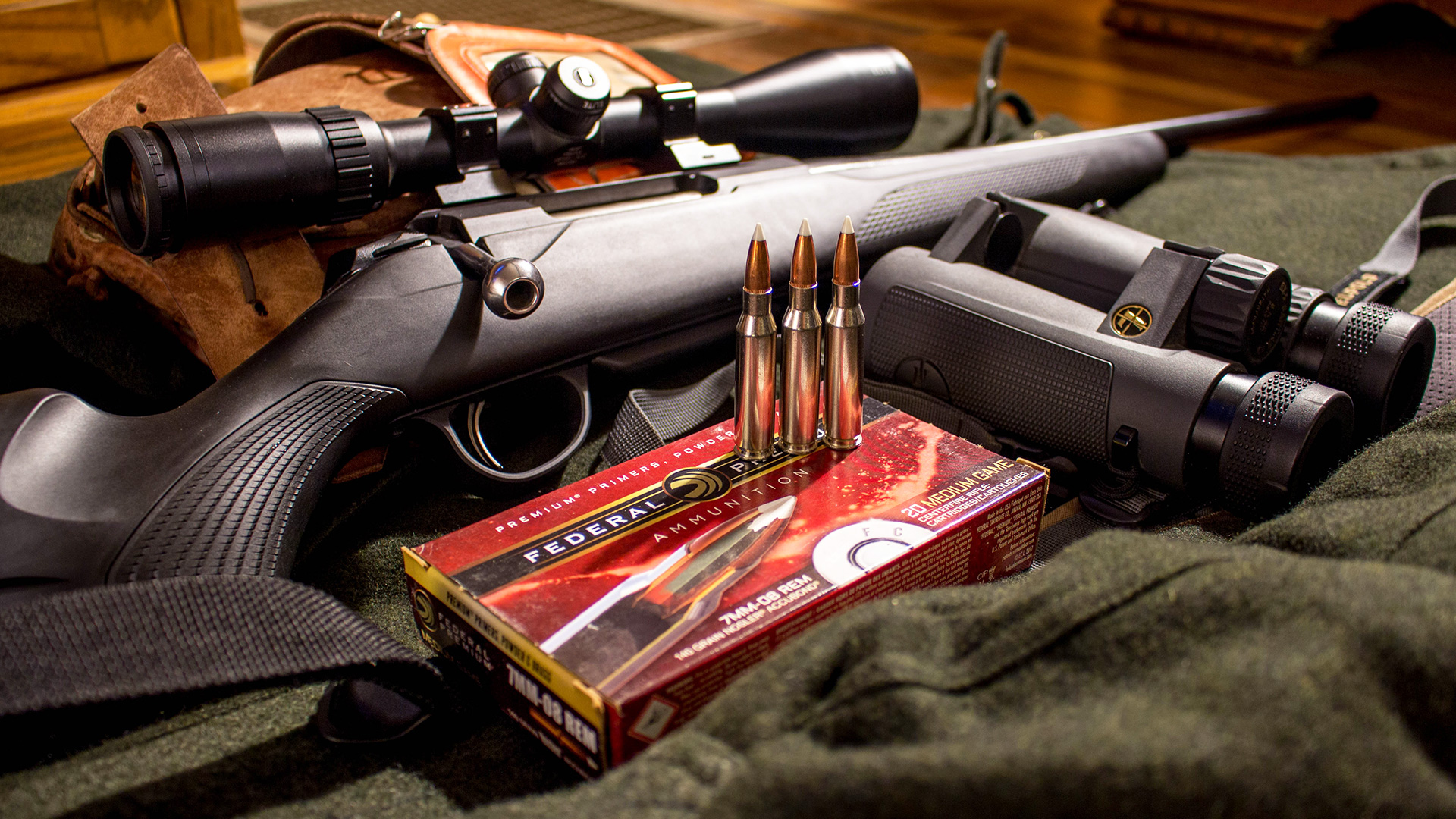
Hunting scopes are engineered with portability in mind. They are lighter and more compact, making them easier to carry during long hikes and extended hunts. A lighter scope also improves rifle balance, which is especially important for off-hand shooting or quick target acquisition in the field.

Durability and Environmental Performance

Tactical scopes are built to survive extreme conditions. They are designed to withstand hard impacts, heavy recoil, temperature changes, and constant use. This level of durability is essential in tactical and competitive environments where equipment failure is not an option.

Hunting scopes are also built to be weather-resistant and reliable, but they focus more on practical durability rather than extreme ruggedness. They are typically waterproof, fog-proof, and shock-resistant, but without the excessive reinforcement found in tactical optics. This balance keeps them reliable without adding unnecessary weight.

Cost and Value Considerations

Because of their advanced features and precision engineering, tactical scopes are generally more expensive. The cost reflects the complexity of the reticle, turret system, optical clarity, and mechanical accuracy. These scopes are often paired with high-end rifles and are considered long-term investments for serious shooters.

Hunting scopes offer a wider range of price options, from budget-friendly models to premium optics. Many hunters can find excellent performance without spending excessively, especially if their shooting distances and conditions are relatively consistent.

Final Thoughts

The choice between a tactical scope and a hunting scope ultimately comes down to how and where the rifle will be used. Tactical scopes excel in situations that demand precision, repeatability, and constant adjustment. They are ideal for shooters who enjoy long-range accuracy and detailed ballistic control. Hunting scopes, on the other hand, are built for simplicity, speed, and comfort in real-world environments where a single accurate shot matters most.

Understanding these differences ensures that you select a scope that complements your shooting style rather than working against it. When matched correctly, the right scope enhances confidence, accuracy, and overall shooting enjoyment.

Rifle Scope Mounting Mistakes Beginners Make (And How to Avoid Them)

For many new shooters, mounting a rifle scope seems like a simple, almost mechanical job. The scope goes into the rings, the screws are tightened, and the rifle is ready for the range. Because the process looks straightforward, beginners often underestimate how much precision is actually involved. In reality, scope mounting is one of the most critical steps in setting up a rifle, and small errors made at this stage can lead to major problems later. Inconsistent accuracy, shifting zero, uncomfortable shooting positions, eye strain, and even damage to expensive optics are all commonly traced back to poor mounting practices rather than to the rifle or ammunition.

A rifle scope is an optical instrument that must be perfectly aligned with the rifle’s bore and securely held in place to perform as intended. Unlike iron sights, which are fixed to the barrel, a scope relies entirely on its mounting system for alignment and stability. Any misalignment, uneven pressure, or improper positioning can affect how the reticle tracks, how the shooter’s eye lines up with the image, and how the rifle behaves under recoil. For beginners, these issues often show up as unexplained misses, difficulty maintaining zero, or discomfort when trying to get a clear sight picture.

Understanding the common mistakes made during scope mounting helps new shooters avoid frustration and build a solid foundation for accurate, confident shooting. By learning why these errors occur and how to prevent them, beginners can ensure their rifle and optic work together as a single, properly tuned system rather than as mismatched parts fighting against each other.

1. Choosing the Wrong Mounts and Rings

For many beginners, the first mistake happens before the scope is even placed on the rifle. Selecting mounts or rings that do not match the scope tube diameter or the rifle’s rail system can create alignment issues and mechanical stress. Even when the diameter is correct, ring height is often chosen poorly. Very high rings are commonly selected to “play it safe,” but this forces the shooter’s head into an unnatural position, ruins cheek weld, and makes consistent shooting difficult. The scope should sit as low as possible while still clearing the barrel and bolt, allowing the shooter’s eye to align naturally with the optic.

2. Incorrect Eye Relief Setup

Eye relief determines how comfortably and safely you can look through the scope. Beginners often mount the scope too far forward or too far back and then adjust their head position to compensate. This leads to neck strain, a reduced field of view, and in heavy-recoiling rifles, the risk of the scope striking the shooter’s face. Proper eye relief is set by shouldering the rifle naturally, closing the eyes, settling into a comfortable cheek weld, and then opening the eyes to adjust the scope position until a full, clear image appears without moving the head.

3. Failing to Level the Reticle

A scope that is not level may seem fine at close range, but at longer distances it causes serious accuracy problems. When the reticle is canted, dialing elevation makes the bullet travel diagonally rather than straight up and down relative to the target. This introduces unexplained windage errors and inconsistent hits. Leveling the scope requires first leveling the rifle itself and then carefully rotating the scope until the vertical crosshair is perfectly aligned with gravity, using proper leveling tools rather than visual estimation.

4. Over-Tightening Ring Screws

Many beginners believe that tighter screws mean a more secure scope. In reality, over-tightening can crush the scope tube, damage internal components, and cause tracking problems. Modern scopes are precision instruments with thin walls, and excessive torque can permanently affect their performance. The correct approach is to use a torque wrench and follow the manufacturer’s specifications, tightening the screws gradually and evenly to avoid distorting the tube.

5. Under-Tightening and Loose Mounting

The opposite problem also occurs when shooters are too cautious and leave screws insufficiently tight. Under recoil, even slight looseness allows the scope to shift, resulting in a wandering zero and inconsistent accuracy. Proper torque settings, combined with a small amount of blue thread locker on base screws, help ensure that the mount remains secure during firing.

6. Uneven Ring Pressure

Tightening one side of the ring completely before the other creates uneven pressure on the scope tube. This can bend the tube slightly, misalign the optical system, and tilt the reticle. Rings should be tightened in a crisscross pattern, applying small, equal increments of torque to each screw while maintaining even gaps on both sides of the ring halves.

7. Mounting the Scope Too High

Excessive scope height above the bore leads to poor shooting ergonomics and complicates ballistic calculations. A high-mounted scope forces the shooter to lift their head off the stock, reducing stability and consistency. It also increases the offset between the line of sight and the bore, making close-range zeroing and holdovers more complex. Whenever possible, the scope should be mounted low enough to allow a solid cheek weld and natural alignment.

8. Skipping Bore Sighting

Many beginners go straight to the range and attempt to zero without bore sighting. This often results in shots missing the target paper entirely, wasting ammunition and time. Bore sighting aligns the scope roughly with the bore so that initial shots land close to the point of aim, making the zeroing process faster and more efficient.

9. Ignoring Parallax Adjustment

Parallax occurs when the reticle appears to move relative to the target as the shooter’s eye position changes. If not properly adjusted for the shooting distance, this effect can cause subtle but significant point-of-impact shifts. Beginners frequently overlook this setting, not realizing how much it can influence precision, especially at medium and long ranges.

10. Using Low-Quality Mounts

Even the best scope cannot perform well if it is held by poorly made mounts. Cheap rings may be out of round, misaligned, or made from soft materials that deform under recoil. This leads to shifting zero and long-term damage to the scope. High-quality, properly machined mounts provide a stable foundation and preserve the integrity of the optic.

11. Failing to Recheck After Shooting

Once the scope is mounted and zeroed, many beginners assume the job is done permanently. In reality, recoil and vibration can cause screws to settle or loosen slightly over time. Without periodic inspection and re-torquing, a previously accurate setup can slowly lose zero. Regular checks, especially after the first range session, ensure long-term reliability.

Conclusion

Rifle scope mounting is a precision task that demands careful attention to detail. Mistakes in mount selection, eye relief, leveling, torque, ring alignment, and maintenance can all undermine accuracy and comfort. When these factors are handled correctly, the shooter gains a stable zero, a natural shooting position, and the confidence that the rifle and scope are working together as a single, precise system.

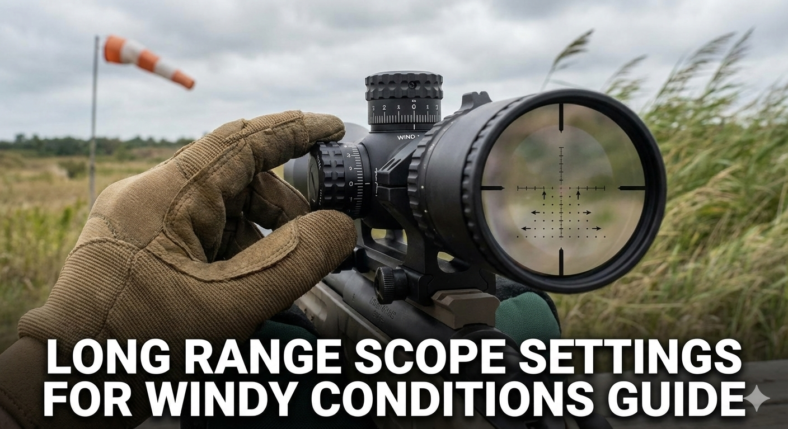
Long Range Scope Settings for Windy Conditions Guide

Long-range shooting in calm weather already demands precision, but when wind enters the equation, accuracy becomes far more complex. Wind is invisible, constantly shifting, and rarely uniform from the shooter to the target. Unlike elevation, which can be dialed once and trusted, wind must be continuously read, interpreted, and corrected. Proper scope setup and intelligent use of reticles and turrets allow the shooter to manage this unpredictable force and achieve consistent hits at extended distances.

How Wind Influences Bullet Flight at Long Range

A bullet traveling hundreds or thousands of yards is exposed to airflow for a significant amount of time. Even a light crosswind can push it several inches off target, while stronger winds can cause feet of horizontal drift. The effect grows with distance and depends on bullet speed, weight, ballistic coefficient, and air density. Wind also changes along the bullet’s path, meaning the air near the shooter may not be the same as the air halfway to the target or near the impact point. This is why wind correction is never a single fixed number but a continuously refined estimate.

Importance of Proper Scope Mounting and Zero

Before any wind correction can be trusted, the scope must be perfectly mounted and zeroed. A level scope is critical because even slight cant can create horizontal error when elevation is dialed, making wind corrections appear incorrect. A true mechanical zero, accurate turret tracking, and properly set parallax ensure that every adjustment you make is real and repeatable. Without this foundation, it becomes impossible to distinguish between wind error and equipment error.

Choosing the Right Reticle for Wind Holds

The reticle is the shooter’s primary tool for managing wind in real time. First focal plane reticles are especially valuable because their subtensions remain accurate at all magnifications. Reticles with multiple horizontal reference marks or full “Christmas tree” designs allow precise wind holds while also compensating for elevation. This makes it possible to hold into the wind rather than constantly dialing the turret, which is faster and more adaptable in changing conditions.

Dialing Windage Versus Holding in the Reticle

Wind can be corrected either by dialing the windage turret or by holding using the reticle. Dialing is precise and clean when the wind is steady and consistent across the entire range, but it becomes slow and risky when the wind is switching or gusting. Holding with the reticle allows instant adjustment shot to shot, making it the preferred method for most long-range shooters in real-world conditions. By shifting the aiming point left or right along the reticle’s scale, the shooter can respond immediately to changes in wind speed or direction.

Using Ballistic Data to Set Initial Wind Values

Accurate wind correction starts with ballistic calculations. By inputting distance, muzzle velocity, ballistic coefficient, and estimated wind speed into a ballistic solver, the shooter obtains an initial wind drift value in mils or MOA. This value is then applied either by dialing or holding. It serves as a starting point rather than a final answer, as real-world conditions often differ slightly from calculated models. Observing bullet impact and trace allows the shooter to refine this value for maximum precision.

Reading Wind Through Mirage and Visual Cues

The scope itself becomes a wind-reading instrument when observing mirage. When mirage rises straight up, wind is minimal. When it flows at an angle, wind is present, and the flatter the angle, the stronger the wind. By focusing the scope at different distances, the shooter can identify changes in wind speed and direction along the bullet’s path. This helps determine whether stronger wind exists mid-range or near the target, where its influence may be greater than at the firing position.

Managing Variable Winds with Bracketing and Averaging

In unstable conditions, it is often impossible to assign a single exact wind value. Instead, the shooter estimates a low and high wind speed and chooses a hold between them. This bracketing approach increases first-round hit probability and allows quick correction after observing the impact. Reticles with fine horizontal markings make this method especially effective, as small adjustments can be made without touching the turrets.

Role of Turret Precision and Click Values

Fine turret resolution is essential for precise wind correction. Click values such as 0.1 mil or 0.25 MOA allow small, accurate adjustments after spotting impacts. Coarse adjustments can lead to overcorrection and wasted shots. Smooth, repeatable turret tracking ensures that any dialed correction matches the reticle’s subtensions and ballistic data exactly.

Understanding Wind Zones Along the Bullet Path

Wind rarely behaves the same from muzzle to target. Terrain, vegetation, and temperature differences create multiple wind layers or zones. A bullet may pass through calm air, then strong crosswind, and finally a different direction near the target. By observing mirage and environmental indicators in each zone, the shooter can mentally average the conditions and apply a more realistic overall wind hold.

Final Thoughts

Long-range scope settings for windy conditions are not about a single perfect adjustment but about creating a reliable system. A level and accurately zeroed scope, a reticle designed for precise wind holds, dependable ballistic data, and skilled wind reading all work together. Wind will always be the most unpredictable variable in long-range shooting, but with proper scope setup and disciplined technique, it becomes a controllable factor rather than a mystery. Mastery comes from continuous observation, correction, and confidence in both equipment and method.

Why Choose a First Focal Plane Scope for Long-Range Shooting

Long-range shooting demands a high level of precision, consistency, and confidence in your equipment. As distances increase, even minor miscalculations in elevation, wind, or ranging can lead to complete misses. This is why choosing the right optic is critical. Among experienced shooters, competitors, and professionals, the first focal plane scope for long range shooting has become the preferred choice. Its design directly supports accuracy, speed, and reliability at extended distances.

This guide explains what a first focal plane scope is, how it works, and why it is widely considered the best option for long-range and precision shooting.

What Is a First Focal Plane (FFP) Scope?

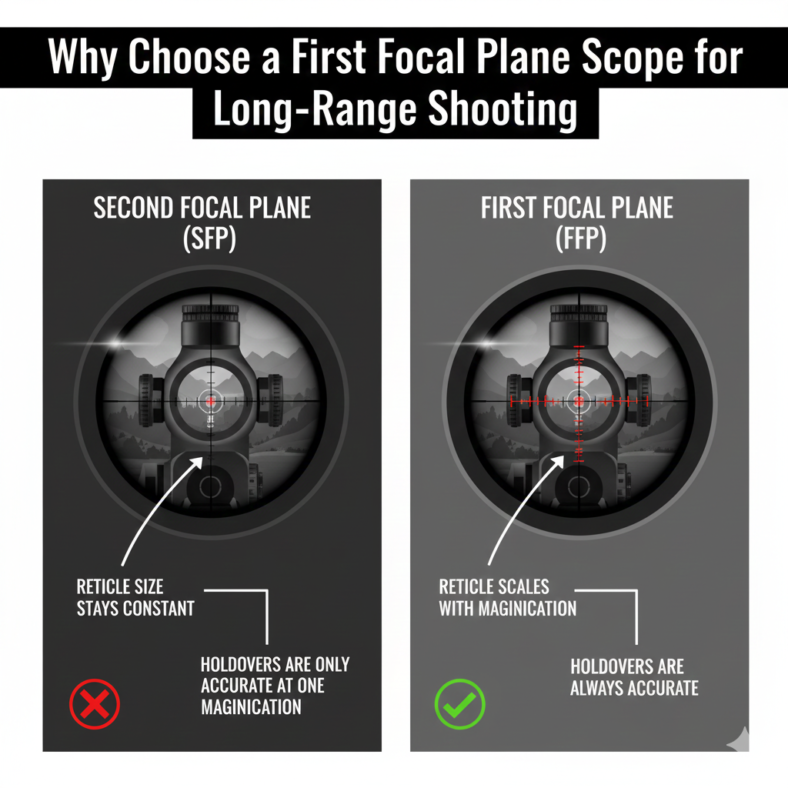
A first focal plane (FFP) scope is designed so that the reticle is placed in front of the magnification system. As magnification increases or decreases, the reticle scales proportionally with the image. This means the reticle appears smaller at low magnification and larger at high magnification, while its measurement values remain constant.

This design ensures that reticle subtensions—whether measured in MIL or MOA—are always accurate, regardless of zoom level. In contrast, a second focal plane scope keeps the reticle the same size at all magnifications, making reticle measurements accurate only at a single preset magnification.

Why Reticle Accuracy Matters for Long-Range Shooting

Long-range shooters rely heavily on their reticle for elevation holdovers, wind corrections, and ranging. At distances beyond a few hundred yards, bullet drop becomes significant, and dialing turrets for every shot is not always practical or efficient.

With a first focal plane scope, reticle measurements remain true at all magnifications. This eliminates guesswork and prevents costly errors caused by using the wrong zoom level. For long-range shooting, where precision is everything, this consistency is a major advantage.

First Focal Plane Scope for Long Range Accuracy

Accuracy at long distance is not only about the rifle and ammunition; it is also about how reliably the shooter can apply corrections. A first focal plane scope allows shooters to hold accurately for elevation and wind without worrying about magnification settings.

Whether shooting at 10x or 20x, one MIL in the reticle always equals one MIL on the target. This makes FFP scopes ideal for shooters who frequently adjust magnification based on target size, distance, or field of view while maintaining absolute confidence in their holds.

Faster Target Engagement with First Focal Plane Scopes

Speed plays a critical role in practical long-range shooting, especially in competitions like PRS and NRL. Targets may appear at different distances within the same stage, requiring rapid adjustments.

First focal plane scopes allow shooters to engage targets quickly because reticle accuracy is never affected by zoom changes. Shooters can adjust magnification for clarity or field of view and immediately apply correct holds without rechecking settings. This efficiency reduces mental workload and improves hit probability under time pressure.

Accurate Ranging at Any Magnification

Ranging is a key skill in long-range shooting, particularly when engaging unknown-distance targets. Many shooters estimate distance by measuring a target’s known size using reticle markings.

Because a first focal plane reticle is always dimensionally accurate, ranging can be performed at any magnification. This flexibility is especially valuable in hunting or tactical scenarios where time is limited and adjusting magnification to a specific setting may not be possible.

Advanced Reticles Perform Best in FFP Scopes

Modern long-range rifle scopes often feature advanced reticles, such as Christmas tree or grid-style designs. These reticles allow shooters to hold for both elevation and wind simultaneously, enabling fast follow-up shots and efficient corrections.

These complex reticles are designed to function correctly only in first focal plane scopes. Since the reticle scales with magnification, all hold points remain accurate at every zoom level. This makes FFP scopes the preferred choice for shooters who rely heavily on reticle-based shooting techniques.

Improved Wind Holds and Shot Corrections

Wind is the most challenging variable in long-range shooting. Conditions can change rapidly between the shooter and the target, requiring constant adjustment.

First focal plane scopes simplify wind corrections by allowing precise wind holds at any magnification. Shooters can observe impacts, measure the miss using the reticle, and correct immediately without dialing turrets. This faster correction process improves consistency and increases hit rates at long distances.

First Focal Plane vs Second Focal Plane for Long Range

When comparing first focal plane vs second focal plane scopes for long range shooting, the differences become clear. FFP scopes offer consistent reticle accuracy at all magnifications, faster engagement, and superior ranging capabilities. SFP scopes, while often less expensive and easier to see at low magnification, limit reticle accuracy to a single zoom setting.

For shooters who regularly shoot beyond mid-range distances, use holdovers, or compete in precision disciplines, the advantages of a first focal plane scope far outweigh its drawbacks.

Why Professionals Prefer First Focal Plane Scopes

Military snipers, law enforcement precision shooters, and elite competitors overwhelmingly choose first focal plane optics. These professionals operate in environments where mistakes are costly and equipment reliability is essential.

The consistent performance of FFP scopes reduces cognitive load, allowing shooters to focus on fundamentals rather than equipment limitations. This professional-level trust further confirms why FFP scopes dominate the long-range shooting world.

When a First Focal Plane Scope May Not Be Ideal

Although first focal plane scopes excel at long range, they are not perfect for every shooter. At low magnification, the reticle can appear thinner, which may be less desirable for close-range or low-light use. Additionally, FFP scopes typically cost more due to their complex design.

For shooters who primarily operate under 300 yards, rarely change magnification, or prefer a bold, constant reticle, a second focal plane scope may be sufficient. However, these limitations become less relevant as shooting distance increases.

Who Should Choose a First Focal Plane Scope?

A first focal plane scope is best suited for long-range target shooters, precision rifle competitors, tactical users, and hunters who regularly engage targets at extended distances. Anyone who relies on reticle holdovers, ranging, and fast corrections will benefit significantly from an FFP optic.

Final Verdict: Is a First Focal Plane Scope Worth It for Long Range?

For serious long-range shooting, a first focal plane scope is more than just a premium feature—it is a performance advantage. Its ability to maintain reticle accuracy at all magnifications, support advanced reticle designs, and improve speed and consistency makes it the gold standard for precision shooting.

While first focal plane scopes require a higher investment and a short learning curve, they deliver unmatched reliability and confidence at distance. For shooters who demand accuracy where it matters most, choosing a first focal plane scope for long range shooting is a smart and proven decision.

Exit mobile version